Kirjailija
Jean-Francois Lyotard
Kirjat ja teokset yhdessä paikassa: 47 kirjaa, julkaisuja vuosilta 1984–2027, suosituimpiin kuuluu Der Widerstreit. Vertaile teosten hintoja ja tarkista saatavuus suomalaisista kirjakaupoista.
Nimi esiintyy myös muodoissa: Jean-François Lyotard
47 kirjaa
Kirjojen julkaisuvuodet: 1984–2027.
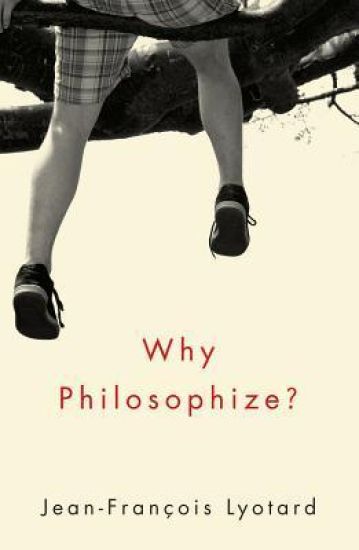
Why Philosophize? is a series of lectures given by Jean-François Lyotard to students at the Sorbonne embarking on their university studies. The circumstances obliged him to be both clear and concise: at the same time, his lectures offer a profound and far-reaching meditation on how essential it is to philosophize in a world where philosophy often seems irrelevant, outdated, or inconclusive. Lyotard begins by drawing on Plato, Proust and Lacan to show that philosophy is a never-ending desire - for wisdom, for the ‘other’. In the second lecture he draws on Heraclitus and Hegel to explore the close relation between philosophy and history: the same restlessness, the same longing for a precarious unity, drives both. In his third lecture, Lyotard examines how philosophy is a form of utterance, both communicative and indirect. Finally, he turns to Marx, exploring the extent to which philosophy can be a transformative action within the world. These wonderfully accessible lectures by one of the most influential philosophers of the last 50 years will attract a wide readership, since, as Lyotard says, ‘How can one not philosophize?’ They are also an excellent introduction to Lyotard’s mature thought, with its emphasis on the need for philosophy to bear witness, however obliquely, to a recalcitrant reality.
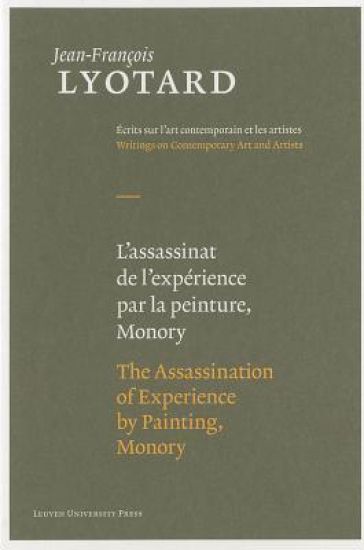
The Assassination of Experience by Painting, Monory
Jean-François Lyotard; Sarah Wilson
Leuven University Press
2013
sidottu
Final volume in the series 'Jean-François Lyotard: Ecrits sur l'art contemporain et les artistes / Writings on Contemporary Art and Artists'! Lyotard met Jacques Monory in 1972, and the text on him published at that time was the first that Lyotard dedicated to contemporary art since Discourse, Figure. Lyotard's interest in the plastic arts thus fits fully within the setting of his political preoccupations. The artist-protagonist stages the recurring motifs that fascinate Lyotard: the scene of the crime, the revolver, the woman, the victim, glaciers, deserts, stars. The atmosphere of the essays on Monory is "Californian". Monory's imaginary repertoire goes well beyond the masters of modernity and is in line rather with a "modern contemporary surrealism". Both Lyotard and Monory live the "dilemma of Americanisation", the America represented by cinema, fashion, novels, music. It is in this atmosphere that Lyotard and Monory will finally evoke their supreme experience of difference: desire and fear, exultation and a profound malaise. The plastic universe of Monory and the aesthetic meditations of Lyotard are in perfect symbiosis. Sarah Wilson's epilogue thoroughly outlines both the history of a friendship, and at the same time the intellectual and artistic climate of the nineteen-seventies. This publication is GPRC-labeled (Guaranteed Peer-Reviewed Content).
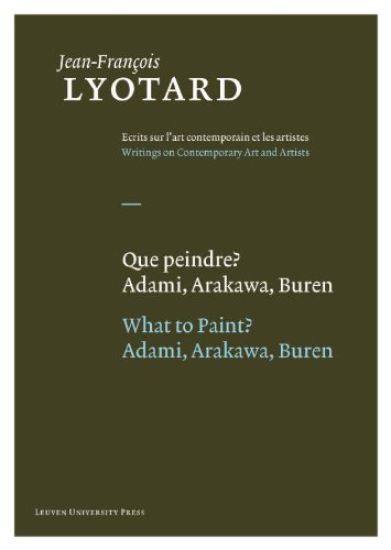
The most important writings of Lyotard on contemporary art in English for the first timeSeven writings assembled in the context of the philosophy of art that Jean-François Lyotard developed in the nineteen-eighties, at the time of the Differend(1983) and of the ‘Kantian turn' leading to the Lessons on the Analytic of the Sublime (1992), are here published for the first time in English translation. The texts focus on three artists with widely divergent aesthetic orientations: the colourist-draughtsman Valerio Adami, the conceptual metaphysician Shusaku Arakawa, and Daniel Buren, the ‘pragmatist of the invisible'. These three protagonists share the notion that the interest in art does not lie in the simple denotation of a frame of reference, but in the connotations of material nuances, in flavours, in tones-in one word, the visual that is barely revealed in the anamnesis that guides the visible and provokes the essential inquietude of the aesthetic experience. What to Paint? Not reality or a ‘world', nor a rich subjectivity, nor even the phantasms of dreams or ideals of being-together, but the act of painting itself, and, beyond the performance of the painter, the presence of matters, a presence that in Arakawa's word is quite obviously blank, elusive. This publication is GPRC-labeled (Guaranteed Peer-Reviewed Content)
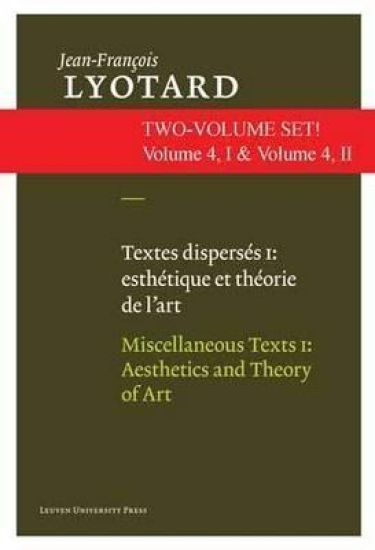
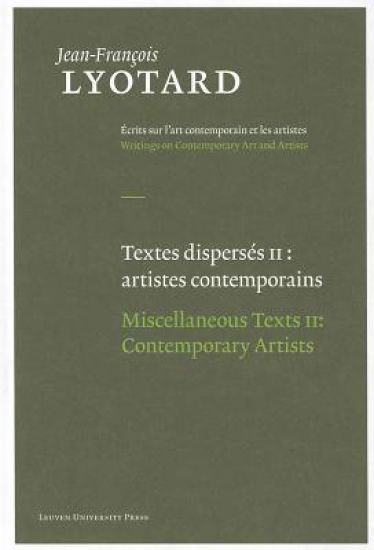
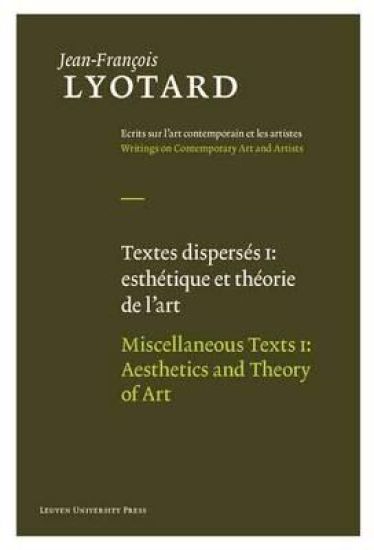
OFFRE DE PRIX! Achetez les deux volumes 4, I & 4, II ensemble et recevez € 20 de réduction. Vous ne payez que € 109 au lieu de 129 €! TWO-VOLUME SET! Buy volumes 4, I & 4, II together and receive € 20 discount. You only pay € 109 instead of € 129! Volume 4 est l'ouvrage le plus ambitieux de la série Jean-François Lyotard. Écrits sur l'art contemporain et les artistes. Il est composé de deux volumes: Textes dispersés I: esthétiques et théorie de l'art et Textes dispersés II: artistes contemporains. Volume 4 is the most comprehensive and ambitious work in the series Jean-François Lyotard: Writings on Contemporary Art and Artists. It is comprised of two volumes: Miscellaneous Texts I: Aesthetics on Contemporary Art and Artists and Miscellaneous Texts II: Contemporary Artists. Volume 4, I - Textes dispersés I : esthétiques et théorie de l'art/Miscellaneous Texts I: Aesthetics and Theory of Art >Ce quatrième volume dans la collection dédiée aux écrits de Jean-François Lyotard sur l'art contemporain et les artistes contient neuf essais sur l'esthétique générale et la théorie de l'art. This fourth volume in the series devoted to Jean-François Lyotard's writings on contemporary art and artists presents nine essays on general aesthetics and the theory of art. Volume 4, II - Textes dispersés II : artistes contemporains/Miscellaneous Texts II: Contemporary Artists >Ce second tome du quatrième volume rassemble trente-neuf textes de Lyotard qui concernent vingt-six artistes contemporains importants et novateurs. This second book of the fourth volume in the series brings together thirty-nine essays by Lyotard that deal with twenty-seven influential and innovative contemporary artists. This publication is GPRC-labeled (Guaranteed Peer-Reviewed Content).
TWO-VOLUME SET! Buy volume 4, I & 4, II together and receive € 20 discount. You only pay €109 instead of € 129! >Ce second tome du quatrième volume rassemble trente-neuf textes de Lyotard qui concernent vingt-six artistes contemporains importants et novateurs : Luciano Berio, Richard Lindner, René Guiffrey, Gianfranco Baruchello, Henri Maccheroni, Riwan Tromeur, Albert Ayme, Manuel Casimiro, Ruth Francken, Barnett Newman, Jean-Luc Parant, François Lapouge, Sam Francis, André Dubreuil, Joseph Kosuth, Sarah Flohr, Lino Centi, Gigliola Fazzini, Bracha Lichtenberg Ettinger, Henri Martin, Michel Bouvet, Corinne Filippi, Stig Brøgger, François Rouan, Pierre Skira et Béatrice Casadesus. Plusieurs de ces textes sont des contributions à des catalogues dont certains sont inaccessibles ou introuvables. Ce volume est illustré par plus de soixante images, pour la plupart en couleur, d'oeuvres d'art commentées par Lyotard dans ces textes. On comprend que Lyotard, au titre d'une esthétique de la présence matérielle, favorise la peinture. L'art de peindre, pour qu'il y ait présence, doit se rendre à ce rien qui vibre entre le vide et le plein, un air, un clinamen, un neutre, une nuance, un timbre. This second book of the fourth volume in the series brings together thirty-nine essays by Lyotard that deal with twenty-seven influential and innovative contemporary artists: Luciano Berio, Richard Lindner, René Guiffrey, Gianfranco Baruchello, Henri Maccheroni, Riwan Tromeur, Albert Ayme, Manuel Casimiro, Ruth Francken, Barnett Newman, Jean-Luc Parant, François Lapouge, Sam Francis, André Dubreuil, Joseph Kosuth, Sarah Flohr, Lino Centi, Gigliola Fazzini, Bracha Lichtenberg Ettinger, Henri Martin, Michel Bouvet, Corinne Filippi, Stig Brøgger, François Rouan, Pierre Skira, and Béatrice Casadesus. Some of these texts were originally written as contributions to catalogues; others were published in now-inaccessible journals. This volume is illustrated with more than sixty images, mainly in colour, of works of art discussed by Lyotard in these writings. This publication is GPRC-labeled (Guaranteed Peer-Reviewed Content).
TWO-VOLUME SET! Buy volume 4, I & 4, II together and receive € 20 discount. You only pay €109 instead of € 129! > Ce quatrième volume dans la collection dédiée aux écrits de Jean-François Lyotard sur l'art contemporain et les artistes contient neuf essais sur l'esthétique générale et la théorie de l'art. Ces essais sont publiés en français, la langue originale, avec les traductions en anglais. La plupart de ces textes, préservés à la Bibliothèque Littéraire Jacques Doucet à Paris, sont publiés en ce lieu pour la première fois. Ils ne manifestent pas un « autre » Lyotard que celui que nous connaissons de ses écrits majeurs. Mais ils couvrent l'entière période de sa production, de 1969 à 1997, et rendent le développement de sa philosophie de l'art plus explicite. Après la conception « libidinale » dans ses premiers écrits sur l'art, on constate chez Lyotard vers 1980 le « tournant kantien » qui place sa philosophie de l'art sous l'égide du sublime. Ces essais suggèrent ce que signifient, pour Jean-François Lyotard, la main du peintre tout comme le regard de l'amoureux de la résonance des couleurs. This fourth volume in the series devoted to Jean-François Lyotard's writings on contemporary art and artists presents nine essays on general aesthetics and the theory of art. They are published in the original French along with English translations on facing pages. Most of these texts, preserved in the Lyotard archives of the Bibliothèque Littéraire Jacques Doucet in Paris, are published here for the first time. They do not reveal ‘another Lyotard' than the one whom we know through his major writings. Nevertheless, they cover the whole period of his production, from 1969 to 1997; and they make the development of his philosophy of art explicit. After the ‘libidinal' conception of art in his early writings, the ‘Kantian twist' of around 1980 places his view on art under the aegis of the sublime. These essays specify what, for Jean-François Lyotard, the hand of the painter means, as well as the gaze of the viewer, enamoured with resonant colours. This publication is GPRC-labeled (Guaranteed Peer-Reviewed Content).
Les Transformateurs Duchamp/Duchamp's TRANS/formers
Jean-François Lyotard
Leuven University Press
2010
sidottu
The second volume in the series Jean-Franois Lyotard--Writings on Contemporary Art and Artists introduces forty-two poetical reflections and comments on the work of the well-known Californian painter Sam Francis (1923-1994). This new edition reprints the English text, which is no longer available, with the previously unpublished French original on facing pages. In Lyotard's opinion Sam Francis's work "pays homage to the visible marvel and bears witness to the visual enigma." Color evokes conflicting feelings in the artist: ." . . color says to me: 'Come, I am your consolation, I cure your melancholy, love me, ' and it says to me: 'Go, I am your deception, traverse me, lose yourself and enough of absent truth.'" Lyotard is the first to see through the subtle variety of meanings in Sam Francis's use of color. This edition also reproduces in full color all forty-two paintings discussed by Lyotard.
Karel Appel, A Gesture of Colour
Jean-François Lyotard; Christine Buci-Glucksmann
Leuven University Press
2009
sidottu
Epilogue by Christine Buci-GlucksmannKarel Appel. A Gesture of Colour is the first of a series of six volumes, bringing together the most important writings of Jean-François Lyotard (1924 - 1998) on contemporary art and artists. The book he devoted to the art of Karel Appel (1921 - 2006) is doubtlessly one of the most complete and inspired texts of all the writings included in the series. Neither the original French manuscript nor the English translation have ever been published, and their presentation face to face should constitute a considerable plus. In this book, Lyotard presents Karel Appel's "matterism" as an offer of presence, presence deferred - it is the visual where every predicate is suspended, the visual touched, "gesture" of colour more than property of colour, appearance at the edge of the abyss. Christine Buci-Glucksmann's epilogue indicates the position of Karel Appel. A Gesture of Colour within the whole of Lyotard's writings on art, considering equally the philosopher's subsequent work. Winner of the Plantin Moretus Prize 2010 for the best designed book in the category textbooks and academic publications Photo Credits: Van Looveren & Princen
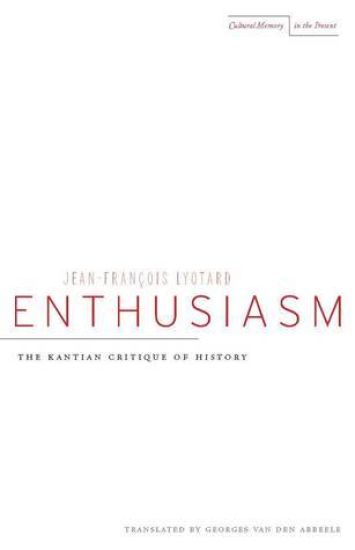
Enthusiasm studies what Kant calls a "strong" sense of the sublime, not as an aesthetic feeling but as a form of political judgment rendered not by the active participants in historical events but those who witness them from afar. Lyotard's analysis, preparatory to his work in The Differend and subsequent publications, is a radical rereading of the Kantian "faculties," traditionally understood as functions of the mind, in terms of a philosophy of phrases derived from Lyotard's prior encounters with Wittgenstein's theory of language games. The result is a kind of "fourth" critique based in Kant's later political and historical writings, with an emphasis on understanding the place of those sudden and unscripted events that have the power to reshape the political/historical landscape (such as the French Revolution, May 1968, and others).
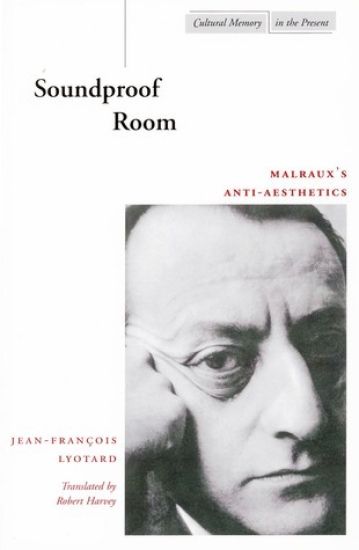
In this, one of the last published books planned by one of the major cultural philosophers of our time, Lyotard addresses, in his powerful and allusive critical voice, Malraux's reflections on art and literature. The result, more than a sequel to Lyotard's acclaimed biography Signé Malraux, tells us as much about Lyotard and his critical concerns as it does about Malraux. It gives us Lyotard's final thoughts on his long study of the critical, disruptive possibilities of art and of the relation between aesthetics and politics. At first glance, Lyotard's sympathetic and generous analysis of Malraux might be surprising to some, for Malraux's metaphysics of art seems far removed from, if not diametrically opposed to, Lyotard's postmodern, experimental approach. But this is perhaps the book's greatest achievement, for Lyotard succeeds both in giving a compelling critical reading of Malraux (and through him of an entire era of art criticism) and in presenting, complicating, and developing his own position on art and aesthetics. In order to present Lyotard's exquisitely compact style in the best possible way, the original French text appears on facing pages with the English translation.
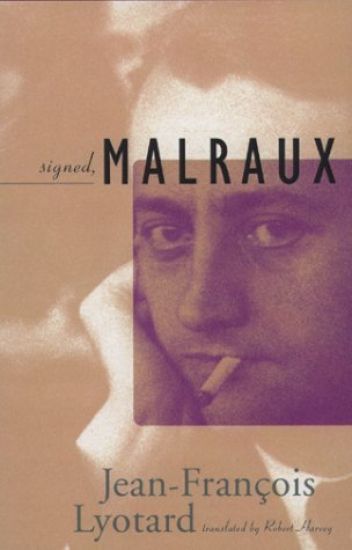
Traces the life and career of the French novelist, describing his participation in the Spanish Civil War, command of a World War II resistance brigade, and his position as a government minister
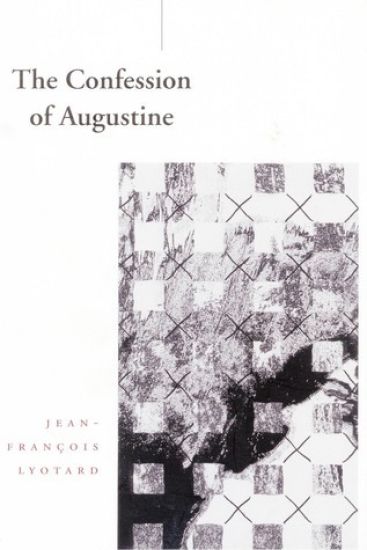
The Confession of Augustine
Jean-François Lyotard
Stanford University Press
2000
pokkari
Halvin toimitettuna 32,50 €
This remarkable posthumous work by one of the leading philosophers of the twentieth century engages Augustine's Confessions, one of the major canonical works of world literature and the very paradigm of autobiography as a definable genre of writing. Lyotard approaches his subject by returning to his earliest phenomenological training, rearticulating Augustine's sensory universe from a vantage point imaginarily inside the confessant's world, a vantage point that reveals the intense point of conjuncture between the sensual and the spiritual, the erotic world and the mystical, being and appearance, sin and salvation. Lyotard reveals the very origins of phenomenology in Augustine's narrative, and in so doing also shows the origins of semiotics to lie there (in the explication of the Augustinian heavens as skin, as veil, as vellum). Lyotard's explication of Augustine is also a final survey of the entirety of the philosophical enterprise, a philosopher's profound reflections on the very basis of philosophy. He sees the Confessions as a major source of the Western—and decidedly modern—determination of the self and of its normativity, the point of departure for all reflection and the condition of possibility of all experience. Lyotard suggests that Augustine's "I," Descartes's "cogito," and Husserl's "transcendental ego" in essence or structurally say the same thing. Lyotard aims at no simple ascription of Augustine's position. Instead, his text centers on what he takes to be Augustine's central confession: the repeated avowal of an essential uncertainty concerning the status of the faith confessed, of being in a sense already too late, of a difficulty in being no longer of this world while being in it all the same. Far from offering the foundation of all subsequent journeys to selfhood, Lyotard sees the Confessions as many evocations of a certain loss of self, of a temporality that is not given or recuperated all at once—or once and for all—but that time and again is lost or forgotten.
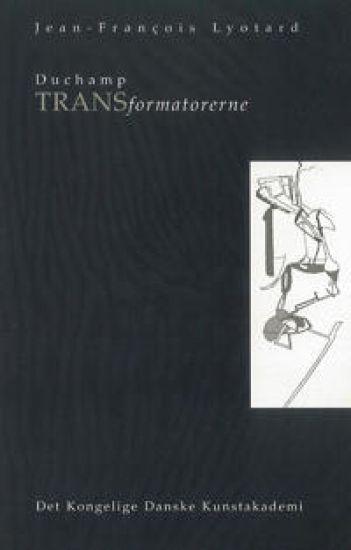
Ud fra en psykologisk og perceptionsorienteret vinkel ser forfatteren på den visuelle kompleksitet i Marcel Duchamps (1887-1968) arbejde
This is a collection of fifteen 'fables' that ask, in the words of Jean-Francois Lyotard, "how to live, and why?" Here, Lyotard provides a mixture of anarchistic, irreverence and sober philosophical reflection on a wide range of topics with attention to issues of justice and ethics, aesthetics and judgement.
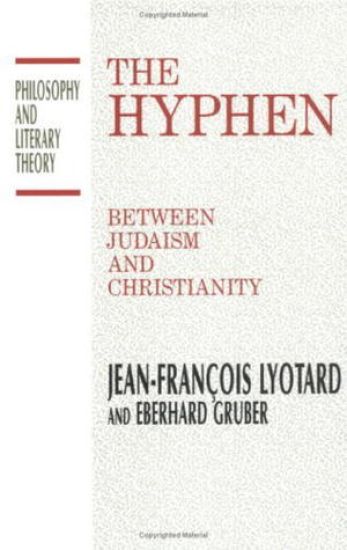
The Hyphien
Jean-Francois Lyotard; Eberhard Gruber; Pascale-Anne (TRN) Brault
Prometheus Books
1999
sidottu
This brilliant and engaging critical encounter between Jean-Franiois Lyotard and Eberhard Gruber has as its focus a single punctuation mark-the hyphen connecting 'Jew' and 'Christian' in the expression 'Judeo-Christian'. While focusing on the nature, meaning, and function of this hyphen, the authors are able to analyse many of the essential differences between Judaism and Christianity, as well as the most significant historical and political consequences of these differences from the Roman Empire to the Shoah. Beginning with a reading of the Letters of Paul, they contrast the Jewish and Christian positions on a variety of issues ranging from emancipation, history, sacrifice, incarnation, faith, law, and sexual difference to the value that is accorded reading, writing, and interpretation within these two traditions.
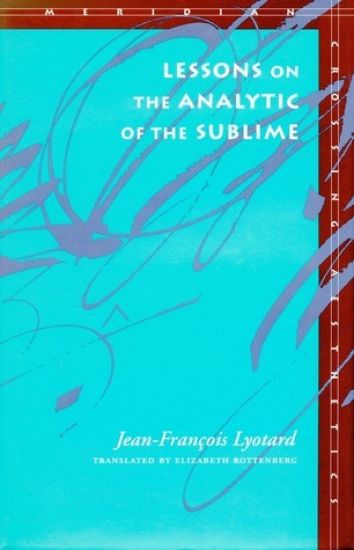
Philosophical aesthetics has seen an amazing revival over the past decade, as a radical questioning of the very grounds of Western epistemology has revealed that some antinomies of aesthetic experience—and in particular of the limits of the aesthetical—can be viewed as a general, yet necessarily open model for human understanding. In this revival, no text in the classical corpus of Western philosophy has been more frequently discussed than the complex paragraphs modestly inserted into Kant's Critique of Judgment as sections 23-29: the Analytic of the Sublime. This book is a rigorous explication de texte, a close reading of these sections. First, Lyotard reconstitutes, following the letter of Kant's analysis, the philosophical context of his critical writings and of the European Enlightenment. Second, because the analytic of the sublime reveals the inability of aesthetic experience to bridge the separate realms of theoretical and practical reason, Lyotard can connect his reconstitution of Kant's critical project with today's debates about the very conditions—and limits—of presentation in general. Lyotard enables us to see the sublime as a model for reflexive thinking generally via his concept of the "differend," which emphasizes the inevitability of conflicts and incompatibilities between different notions and "phrases." The Analytic of the Sublime, he points out, tries to argue that human thought is always constituted through a similar incompatibility between different intellectual and affective faculties. These lessons thus highlight the analysis of a "differend of feeling" in Kant's text, which is also the analysis of a "feeling of differend," and connect this feeling with the transport that leads all thought (critical thought included) to its limits.