
Kirjailija
Jean-Paul Sartre
Kirjat ja teokset yhdessä paikassa: 225 kirjaa, julkaisuja vuosilta 1952–2026, suosituimpiin kuuluu Réussir son Bac de français 2025 : Analyse de la pièce Les Mains sales de Jean-Paul Sartre. Vertaile teosten hintoja ja tarkista saatavuus suomalaisista kirjakaupoista.
Nimi esiintyy myös muodoissa: Jean Paul Sartre, Jean–paul Sartre
225 kirjaa
Kirjojen julkaisuvuodet: 1952–2026.
The Psychology of the Imagination was originally published in France in 1940 under the title of L'Imaginaire. It was specifically designed as an essay in phenomenology and it constitutes the first attempts to introduce Husserl's work into French culture,and from there to the English speaking world. Published three years before Being and Nothingness , it reveals Sartre's first extended examination of such concepts as nothingness and freedom, both here derived from the consciousness's ability to imagine objects not only as they are but as they are not, and to imagine objects not in existence. According to Sartre, an object can be given to us in three ways: by perceiving it, by having an idea of it, and by imagining it (having an image of it). Although we may try to respond to the image in the same way as we would to the object itself, the fact remains that an image, however vivid, presents its object as not being. It was in The Psychology of Imagination that Sartre first brought together his new enthusiasm for phenomenology with the analysis of the preconditions for human freedom which was to figure so prominently in his later philosophical works.
Sartre's study of Baudelaire is one of the more brilliant achievements of modern criticism. We may often disagree with his interpretations of the poet's personality, but we cannot fail to wonder at the mastery with which he presents his case. It is the case, quite patently, of an Existentialist who wishes to psychoanalyze a paramount literary figure in terms of his own beliefs. Perhaps Sartre's greatest contribution to Existentialism has been his own personality. He made it a living philosophy, giving it his exotic imagination, his penchant for controversy, and above all his daring. He turned abstractions like Existence and Being, Freedom and Nature, into a theory of psychoanalysis, grounded in man's creativity and opposed to Freudian determinism. Then he put the theory into practice in this book on Baudelaire. Baudelaire, man of shadows, opium-addict, dandy, frigid disciple of volupté; and then the greatest lyric poet of the age. Sartre lays bare the "lunar landscape of this distressed soul." We see Baudelaire, with anguished intelligence, selecting and arranging his own evil destiny, juggling the values of a world at the turning point of modern times.
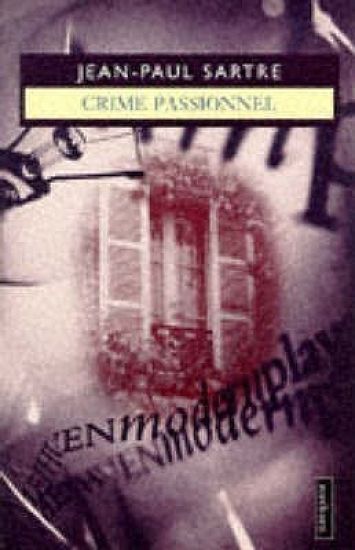
"A highly entertaining political political thriller...the play shows where that peculiarly Gallic combinations of sex, politics and suspense has its origins" (Michael Billington, Guardian) Crime Passionnel reflects Sartre's fascination with the mentality and morality of Communism in its story of a young Party member assigned to shoot a "deviationist". It was first staged in 1948.