
Kirjailija
Jean Racine
Kirjat ja teokset yhdessä paikassa: 560 kirjaa, julkaisuja vuosilta 1973–2026, suosituimpiin kuuluu Oeuvres de Jean Racine. Notice Sur La Vie Et Les Ouvrages de J. Racine (Éd.1825). Vertaile teosten hintoja ja tarkista saatavuus suomalaisista kirjakaupoista.
560 kirjaa
Kirjojen julkaisuvuodet: 1973–2026.


Phèdre, Tragédie En Cinq Actes Et En Vers, de Racine (Éd.1827)
Jean Racine
Hachette Livre - BNF
2012
pokkari
Oeuvres de Racine. Les Plaideurs, Britannicus, Bérénice (Éd.1822)
Jean Racine
Hachette Livre - BNF
2012
pokkari
Esther, Tragédie Tirée de l'Écriture Sainte, (Éd.1843)
Jean Racine
Hachette Livre - BNF
2012
pokkari
Théâtre de Jean Racine. Mémoires Sur Racine. La Thébaïde, Alexandre, Andromaque (Éd.1823)
Jean Racine
Hachette Livre - BNF
2012
pokkari
Théâtre de Jean Racine. Britannicus, Bérénice, Bajazet, Mithridate (Éd.1823)
Jean Racine
Hachette Livre - BNF
2012
pokkari

As Voltaire famously opined, Athaliah, Racine's last play, is "perhaps the greatest masterwork of the human spirit." Its formidable antagonists, Athaliah, queen of Judah, and Jehoiada, high priest of the temple of Jerusalem, are engaged in a deadly struggle for dominion: she, fiercely determined to maintain her throne and exterminate the detested race of David; he, no less fiercely determined to overthrow this heathen queen and enthrone the orphan Joash, the scion of the house of David, whom Athaliah believes she slew as an infant ten years earlier. This boy represents the sole hope for the survival of the royal race from which is to spring the Christ. But in this play, even God is more about hate and retribution than about love and mercy. This is the fourth volume of a projected translation into English of all twelve of Jean Racine's plays-only the third time such a project has been undertaken. For this new translation, Geoffrey Alan Argent has rendered these plays in the verse form that Racine might well have used had he been English: namely, the "heroic" couplet. Argent has exploited the couplet's compressed power and flexibility to produce a work of English literature, a verse drama as gripping in English as Racine's is in French. Complementing the translation are the illuminating Discussion, intended as much to provoke discussion as to provide it, and the extensive Notes and Commentary, which offer their own fresh and thought-provoking insights.

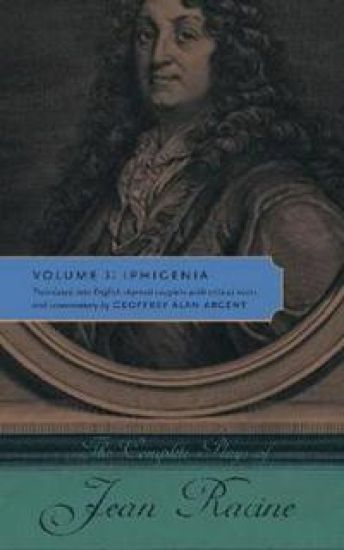
This is the third volume of a projected translation into English of all twelve of Jean Racine’s plays—only the third time such a project has been undertaken. For this new translation, Geoffrey Alan Argent has rendered these plays in the verse form that Racine might well have used had he been English: namely, the “heroic” couplet. Argent has exploited the couplet’s compressed power and flexibility to produce a work of English literature, a verse drama as gripping in English as Racine’s is in French. Complementing the translation are the illuminating Discussion, intended as much to provoke discussion as to provide it, and the extensive Notes and Commentary, which offer their own fresh and thought-provoking insights. In Iphigenia, his ninth play, Racine returns to Greek myth for the first time since Andromache. To Euripides’s version of the tale he adds a love interest between Iphigenia and Achilles. And dissatisfied with the earlier resolutions of the Iphigenia myth (her actual death or her eleventh-hour rescue by a dea ex machina), Racine creates a wholly original character, Eriphyle, who, in addition to providing an intriguing new denouement, serves the dual dramatic purpose of triangulating the love interest and galvanizing the wholesome “family values” of this play by a jolt of supercharged passion.
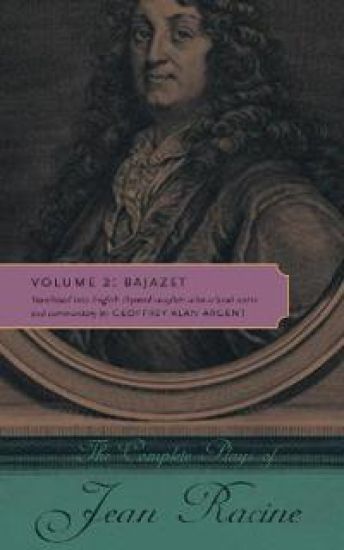
This is the second volume of a projected translation into English of all twelve of Jean Racine’s plays—only the third time such a project has been undertaken in the three hundred years since Racine’s death. For this new translation, Geoffrey Alan Argent has taken a fresh approach: he has rendered these plays in rhymed “heroic” couplets. While Argent’s translation is faithful to Racine’s text and tone, his overriding intent has been to translate a work of French literature into a work of English literature, substituting for Racine’s rhymed alexandrines (hexameters) the English mode of rhymed iambic pentameters, a verse form particularly well suited to the highly charged urgency of Racine’s drama and the coiled strength of his verse. Complementing the translation are the illuminating Discussion, intended as much to provoke discussion as to provide it, and the extensive Notes and Commentary, which clarify obscure references, explicate the occasional gnarled conceit, and offer their own fresh and thought-provoking insights. Bajazet, Racine’s seventh play, first given in 1672, is based on events that had taken place in the Sultan’s palace in Istanbul a mere thirty years earlier. But the twilit, twisting passageways of the Seraglio merely serve as a counterpart to the dim and errant moral sense of the play’s four protagonists: Bajazet, the Sultan’s brother; Atalide, Bajazet’s secret lover; Roxane, the Sultaness, who is madly in love with Bajazet and dangles over his head the death sentence the Sultan has ordered her to implement in his absence; and Akhmet, the wily, well-intentioned Vizier, who involves them all in an imbroglio in the Seraglio, with disastrous consequences. Unique among Racine’s plays, Bajazet provides no moral framework for either protagonists or audience. We watch as these benighted characters, cut adrift from any moral moorings, with no upright character at hand to serve as an ethical anchor and no religious or societal guidelines to serve as a lifeline, flail, flounder, and finally drag one another down. Here, Racine has presented us with his four most mercilessly observed, most subtly delineated, and most ambiguously fascinating characters. Indeed, Bajazet is certainly Racine’s most undeservedly neglected tragedy.