Kirjojen hintavertailu – 12 859 829 kirjaa ja 27 kauppaa

Kirjailija

Jianwei Zhang

Kirjat ja teokset yhdessä paikassa: 6 kirjaa, julkaisuja vuosilta 2008–2024, suosituimpiin kuuluu Active Sensor Planning for Multiview Vision Tasks. Vertaile teosten hintoja ja tarkista saatavuus suomalaisista kirjakaupoista.

6 kirjaa

Kirjojen julkaisuvuodet: 2008–2024.

Bio-Inspired Locomotion Control of Limbless Robots

Bio-Inspired Locomotion Control of Limbless Robots

Guoyuan Li; Houxiang Zhang; Jianwei Zhang

SPRINGER VERLAG, SINGAPORE
2024
nidottu
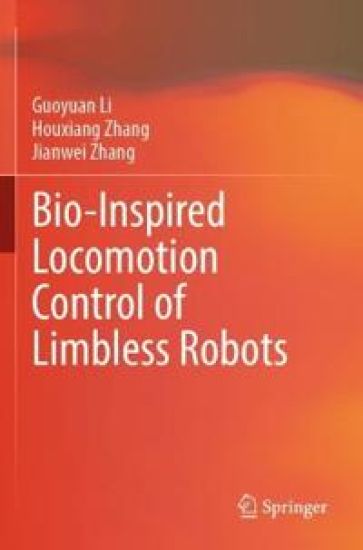
This book presents a bio-inspired hierarchical control scheme step by step toward developing limbless robots capable of 3D locomotion, fast reflex response, as well as sophisticated reaction to environmental stimuli. This interdisciplinary book introduces how to combine biological concept with locomotion control of limbless robots. The special features of the book include limbless locomotion classification and control, design of biological locomotor and the integration of sensory information into the locomotor using artificial intelligence methods, and on-site demonstrations of limbless locomotion in different scenarios. The book is suitable for readers with engineering background, especially for researchers focused on bio-inspired robots.
Robot Learning Human Skills and Intelligent Control Design

Robot Learning Human Skills and Intelligent Control Design

Chenguang Yang; Chao Zeng; Jianwei Zhang

TAYLOR FRANCIS LTD
2023
nidottu
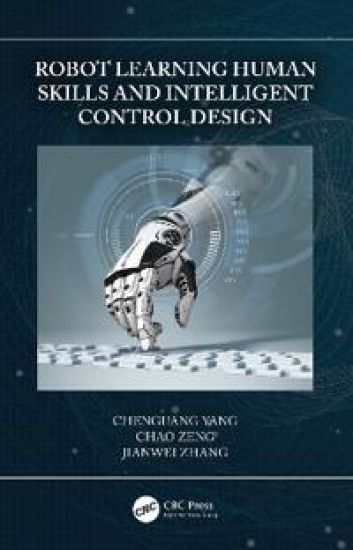
In the last decades robots are expected to be of increasing intelligence to deal with a large range of tasks. Especially, robots are supposed to be able to learn manipulation skills from humans. To this end, a number of learning algorithms and techniques have been developed and successfully implemented for various robotic tasks. Among these methods, learning from demonstrations (LfD) enables robots to effectively and efficiently acquire skills by learning from human demonstrators, such that a robot can be quickly programmed to perform a new task. This book introduces recent results on the development of advanced LfD-based learning and control approaches to improve the robot dexterous manipulation. First, there's an introduction to the simulation tools and robot platforms used in the authors' research. In order to enable a robot learning of human-like adaptive skills, the book explains how to transfer a human user’s arm variable stiffness to the robot, based on the online estimation from the muscle electromyography (EMG). Next, the motion and impedance profiles can be both modelled by dynamical movement primitives such that both of them can be planned and generalized for new tasks. Furthermore, the book introduces how to learn the correlation between signals collected from demonstration, i.e., motion trajectory, stiffness profile estimated from EMG and interaction force, using statistical models such as hidden semi-Markov model and Gaussian Mixture Regression. Several widely used human-robot interaction interfaces (such as motion capture-based teleoperation) are presented, which allow a human user to interact with a robot and transfer movements to it in both simulation and real-word environments. Finally, improved performance of robot manipulation resulted from neural network enhanced control strategies is presented. A large number of examples of simulation and experiments of daily life tasks are included in this book to facilitate better understanding of the readers.
Bio-Inspired Locomotion Control of Limbless Robots

Bio-Inspired Locomotion Control of Limbless Robots

Guoyuan Li; Houxiang Zhang; Jianwei Zhang

SPRINGER VERLAG, SINGAPORE
2023
sidottu
This book presents a bio-inspired hierarchical control scheme step by step toward developing limbless robots capable of 3D locomotion, fast reflex response, as well as sophisticated reaction to environmental stimuli. This interdisciplinary book introduces how to combine biological concept with locomotion control of limbless robots. The special features of the book include limbless locomotion classification and control, design of biological locomotor and the integration of sensory information into the locomotor using artificial intelligence methods, and on-site demonstrations of limbless locomotion in different scenarios. The book is suitable for readers with engineering background, especially for researchers focused on bio-inspired robots.
Robot Learning Human Skills and Intelligent Control Design

Robot Learning Human Skills and Intelligent Control Design

Chenguang Yang; Chao Zeng; Jianwei Zhang

CRC Press
2021
sidottu
In the last decades robots are expected to be of increasing intelligence to deal with a large range of tasks. Especially, robots are supposed to be able to learn manipulation skills from humans. To this end, a number of learning algorithms and techniques have been developed and successfully implemented for various robotic tasks. Among these methods, learning from demonstrations (LfD) enables robots to effectively and efficiently acquire skills by learning from human demonstrators, such that a robot can be quickly programmed to perform a new task. This book introduces recent results on the development of advanced LfD-based learning and control approaches to improve the robot dexterous manipulation. First, there's an introduction to the simulation tools and robot platforms used in the authors' research. In order to enable a robot learning of human-like adaptive skills, the book explains how to transfer a human user’s arm variable stiffness to the robot, based on the online estimation from the muscle electromyography (EMG). Next, the motion and impedance profiles can be both modelled by dynamical movement primitives such that both of them can be planned and generalized for new tasks. Furthermore, the book introduces how to learn the correlation between signals collected from demonstration, i.e., motion trajectory, stiffness profile estimated from EMG and interaction force, using statistical models such as hidden semi-Markov model and Gaussian Mixture Regression. Several widely used human-robot interaction interfaces (such as motion capture-based teleoperation) are presented, which allow a human user to interact with a robot and transfer movements to it in both simulation and real-word environments. Finally, improved performance of robot manipulation resulted from neural network enhanced control strategies is presented. A large number of examples of simulation and experiments of daily life tasks are included in this book to facilitate better understanding of the readers.
Active Sensor Planning for Multiview Vision Tasks

Active Sensor Planning for Multiview Vision Tasks

Shengyong Chen; Y. F. Li; Jianwei Zhang; Wanliang Wang

Springer-Verlag Berlin and Heidelberg GmbH Co. K
2014
nidottu
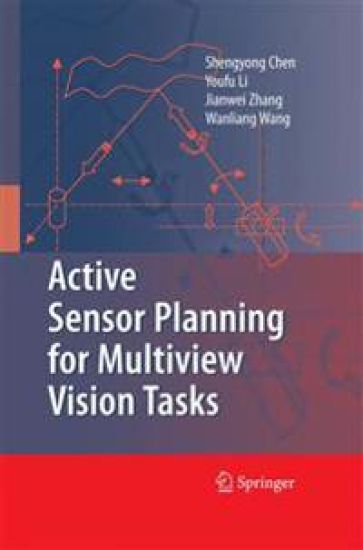
An active robot system can change its visual parameters in an intentional manner and perform its sensing actions purposefully. A general vision task thus can be performed in an efficient way by means of strategic control of the perception process. The controllable processes include 3D active sensing, sensor configuration and recalibration, automatic sensor placement, and 3D sensing. This book explores these important issues in studying for active visual perception. Vision sensors have limited fields of views and can only "see" a portion of a scene from a single viewpoint. To make the entire object visible, the sensor has to be moved from one place to another around the object to observe all features of interest. The sensor planning presented in this book describes an effective strategy to generate a sequence of viewing poses and sensor settings for optimally completing a perception task. Several methods are proposed to solve the problems in both model-based and nonmodel-based vision tasks. For model-based applications, the method involves determination of the optimal sensor placements and a shortest path through these viewpoints for automatic generation of a perception plan. A topology of viewpoints is achieved by a genetic algorithm in which a min-max criterion is used for evaluation. A shortest path is also determined by graph algorithms. For nonmodel-based applications, the method involves determination of the best next view and sensor settings. The trend surface is proposed as the cue to predict the unknown portion of an object or environment. The 11 chapters in Active Vision Planning draw on recent work in robot vision over ten years, particularly in the use of new concepts of active sensing, reconfiguration, recalibration, sensor model, sensing constraints, sensing evaluation, viewpoint decision, sensor placement graph, model based planning, path planning, planning for robot in unknown environment, dynamic 3D construction,surface prediction, etc. Implementation examples are also provided with theoretical methods for testing in a real robot system. With these optimal sensor planning strategies, this book will give the robot vision system the adaptability needed in many practical applications.
Active Sensor Planning for Multiview Vision Tasks

Active Sensor Planning for Multiview Vision Tasks

Shengyong Chen; Y. F. Li; Jianwei Zhang; Wanliang Wang

Springer-Verlag Berlin and Heidelberg GmbH Co. K
2008
sidottu
An active robot system can change its visual parameters in an intentional manner and perform its sensing actions purposefully. A general vision task thus can be performed in an efficient way by means of strategic control of the perception process. The controllable processes include 3D active sensing, sensor configuration and recalibration, automatic sensor placement, and 3D sensing. This book explores these important issues in studying for active visual perception. Vision sensors have limited fields of views and can only "see" a portion of a scene from a single viewpoint. To make the entire object visible, the sensor has to be moved from one place to another around the object to observe all features of interest. The sensor planning presented in this book describes an effective strategy to generate a sequence of viewing poses and sensor settings for optimally completing a perception task. Several methods are proposed to solve the problems in both model-based and nonmodel-based vision tasks. For model-based applications, the method involves determination of the optimal sensor placements and a shortest path through these viewpoints for automatic generation of a perception plan. A topology of viewpoints is achieved by a genetic algorithm in which a min-max criterion is used for evaluation. A shortest path is also determined by graph algorithms. For nonmodel-based applications, the method involves determination of the best next view and sensor settings. The trend surface is proposed as the cue to predict the unknown portion of an object or environment. The 11 chapters in Active Vision Planning draw on recent work in robot vision over ten years, particularly in the use of new concepts of active sensing, reconfiguration, recalibration, sensor model, sensing constraints, sensing evaluation, viewpoint decision, sensor placement graph, model based planning, path planning, planning for robot in unknown environment, dynamic 3D construction,surface prediction, etc. Implementation examples are also provided with theoretical methods for testing in a real robot system. With these optimal sensor planning strategies, this book will give the robot vision system the adaptability needed in many practical applications.