Kirjojen hintavertailu – 12 859 819 kirjaa ja 27 kauppaa
Kirjailija
John Henry Cardinal Newman
Kirjat ja teokset yhdessä paikassa: 128 kirjaa, julkaisuja vuosilta 1838–2026, suosituimpiin kuuluu The Ecclesiastical History Of M. L'Abbe Fleury From A.D. 400-429 A.D.. Vertaile teosten hintoja ja tarkista saatavuus suomalaisista kirjakaupoista.
Nimi esiintyy myös muodoissa: John Henry (cardinal) Newman
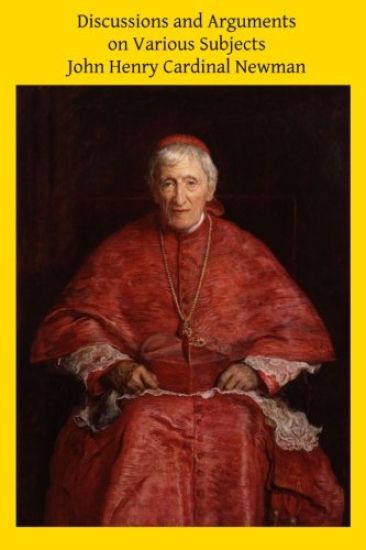
THIS Volume is a fresh contribution, on the part of the Author, towards a uniform Edition of his publications. Of the six portions, of which it consists, the first appeared in the British Magazine in the spring of 1836, under the title of "Home Thoughts Abroad: ' As that title was intended for a series of papers which were never written, and is unsuitable to a single instalment of them, another heading has been selected for it, answering more exactly to the particular subject of which it treats. The second and third are the 83rd and 85th numbers of the "Tracts for the Times," and were published in the 5th volume, in the year 1838. The fourth, "The Tamworth Reading Room," was written for the Times newspaper, and appeared in its columns in February 1841, being afterwards published as a pamphlet. The letters, of which it consists, were written off as they were successively called for by the parties who paid the author the compliment of employing him, and are necessarily immethodical as compositions. The same may with still more reason be said of the Letters which follow, entitled, "Who's to blame?" written in the spring of 1855, for an intimate friend. At that time the editor of the newspaper in which they appeared. The Review, which closes the Volume, was published in the Month Magazine of June 1866
For the first time, the majority of John Henry Cardinal Newman's contributions to the ground-breaking series Tracts for the Times have been collected in one volume, with an introduction and notes supplied by James Tolhurst. The Tracts for the Times will always be connected with the Oxford Movement. John Henry Newman and other leaders of the movement sought a renewal of "catholic," or Roman Catholic, thought and practice within the Church of England. They published their ideas on the theological, pastoral, and devotional problems that they perceived within the church in ninety "Tracts for the Times" (1833-1841). Newman, who edited the series, either wrote or compiled a third of the tracts. Increasingly, the tracts were expanded into treatises—especially after Tract 36—and were often composed of quotations from patristic writers and the English Divines. Tracts 83 and 85 are included in Discussions and Arguments on Various Subjects, volume VII of the Birmingham Oratory Millennium Edition of his works. Tracts 74, 76, and 88 have been omitted here. In Tract 75, the introductory explanation of the breviary has been included.
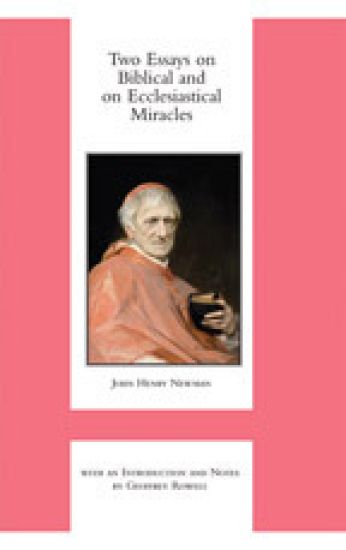
The essays in this volume were written when John Henry Newman was a Fellow of Oriel College, Oxford. He wrote the first, on biblical miracles "The Miracles of Scripture," in 1825-26, as a relatively young man; the other, "The Miracles of Early Ecclesiastical History," was written in 1842-43. A comparison of the two essays displays a shift in Newman's theological stances. In the earlier essay, Newman argues in accordance with the theology of evidence of his time, maintaining that the age of miracles was limited to those recorded in the Old Testament scriptures and in the Gospels and Acts. He asserts that biblical miracles served to demonstrate the divine inspiration of biblical revelation and to attest to the divinity of Christ. However, with the end of the apostolic age, the age of miracles came to an end; miracles reported from the early ages of the Church Newman dismissed as suspicious and possibly fraudulent. With this view, Newman entered into an ongoing debate between the skepticism of Hume and Paine and its continuation in the utilitarianism of Bentham, on the one hand, and the views of Christian apologists rebutting Hume's arguments, on the other. In "The Miracles of Early Ecclesiastical History," Newman can be seen as coming closer to accepting the doctrines of the Catholic Church. He rejects the stance he took in "The Miracles of Scripture," now arguing for a continuity of sacred history between the biblical and ecclesiastical periods. He had clearly abandoned the position of "evidence theologians" that miracles ended after the time of the Apostles. Newman's movement between the writing of the two essays is essentially a growing into a deeper awareness of the Church as a divine society in whose life miracles and supernatural gifts were to be expected.
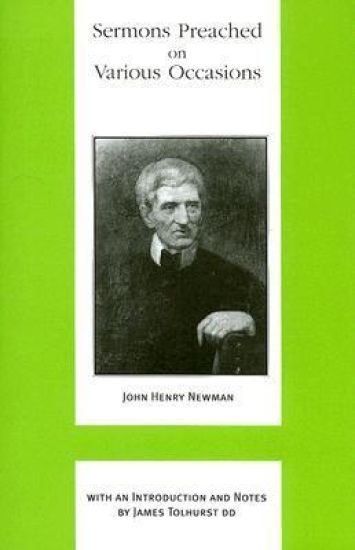
In November 1851, John Henry Newman was appointed President of the new Catholic University of Ireland, with a vague brief as to structure and personnel. He commented, "I mean to be Chancellor, Rector, Provost, Professor, Tutor all at once, and no one else anything." He had to wait until June 1854 for the bishops to approve the university's statutes before he was installed as Rector. The first eight sermons collected in this volume were preached during Mass in the University Church on St Stephen's Green between May 4, 1856, and February 22, 1857. By the time the first edition of Sermons Preached on Various Occasions was published, Newman had already written to the Irish bishops that he intended to resign in November 1857—he was finally convinced that his seven-year commitment to Ireland was sufficient. He was to leave behind not only the nascent new Catholic University, but also the University Church, designed by his friend John Hungerford Pollen, and which he had paid for himself. The remaining sermons were written for the restoration of the Catholic hierarchy in England and Wales, the Risorgimento in Italy and its repercussions on the papacy, and the death of two friends, Dr. Weedall and James Hope Scott. The sermons on the situation of the church in England and Wales, and then of the papacy itself in Italy, reflect a redefinition of the role of Catholicism in the development of the modern world.