Kirjojen hintavertailu – 12 903 725 kirjaa ja 27 kauppaa

Kirjailija

John Roberts

Kirjat ja teokset yhdessä paikassa: 90 kirjaa, julkaisuja vuosilta 1983–2026, suosituimpiin kuuluu Roberts On Billiards. Ed. By H. Buck. Vertaile teosten hintoja ja tarkista saatavuus suomalaisista kirjakaupoista.

90 kirjaa

Kirjojen julkaisuvuodet: 1983–2026.

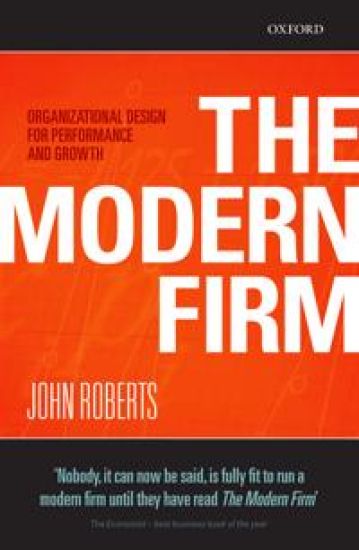
The Modern Firm

The Modern Firm

John Roberts

Oxford University Press
2007
nidottu
Business firms around the world are experimenting with new organizational designs, changing their formal architectures, their routines and processes, and their corporate cultures as they seek to improve their current performance and their growth prospects. In the process they are changing the scope of their business operations, redrawing their organization charts, redefining the allocation of decision-making authority and responsibility, revamping the mechanisms for motivating and rewarding people, reconsidering which activities to conduct in-house and which to out-source, redesigning their information systems, and seeking to alter the shared beliefs, values and norms that their people hold. In this book, John Roberts argues that there are predictable, necessary relationships among these changes that will improve performance and growth. The organizations that are successful will establish patterns of fit among the elements of their organizational designs, their competitive strategies and the external environment in which they operate and will go about this in a holistic manner. The Modern Firm develops powerful conceptual frameworks for analyzing the interrelations between organizational design features, competitive strategy and the business environment. Written in a non-technical language, the book is nevertheless based on rigorous modeling and draws on numerous examples from eighteenth century fur trading companies to such modern firms such as BP and Nokia. Finally the book explores why these developments are happening now, pointing to the increase in global competition and changes in technology. Written by one of the world's leading economists and experts on business strategy and organization, The Modern Firm provides new insights into the changes going on in business today and will be of interest to academics, students and managers alike.
Philosophizing the Everyday

Philosophizing the Everyday

John Roberts

Pluto Press
2006
sidottu
After modernism and postmodernism, it is argued, the everyday supposedly is where a democracy of taste is brought into being - the place where art goes to recover its customary and collective pleasures, and where the shared pleasures of popular culture are indulged, from celebrity magazines to shopping malls. John Roberts argues that this understanding of the everyday downgrades its revolutionary meaning and philosophical implications. Bringing radical political theory back to the centre of the discussion, he shows how notions of cultural democratization have been oversimplified. Asserting that the everyday should not be narrowly identified with the popular, Roberts critiques the way in which the concept is now overly associated with consumption and 'ordinariness'. Engaging with the work of key thinkers including, Lukács, Arvatov, Benjamin, Lefebvre, Gramsci, Barthes, Vaneigem, and de Certeau, Roberts shows how the concept of the everyday continues to be central to debates on ideology, revolution and praxis. He offers a lucid account of different approaches that developed over the course of the twentieth century, making this an ideal book for anyone looking for a politicised approach to cultural theory.
The Modern Firm

The Modern Firm

John Roberts

Oxford University Press
2004
sidottu
Business firms around the world are experimenting with new organizational designs, changing their formal architectures, their routines and processes, and their corporate cultures as they seek to improve their current performance and their growth prospects. In the process they are changing the scope of their business operations, redrawing their organization charts, redefining the allocation of decision-making authority and responsibility, revamping the mechanisms for motivating and rewarding people, reconsidering which activities to conduct in-house and which to out-source, redesigning their information systems, and seeking to alter the shared beliefs, values and norms that their people hold. In this book, John Roberts argues that there are predictable, necessary relationships among these changes that will improve performance and growth. The organizations that are successful will establish patterns of fit among the elements of their organizational designs, their competitive strategies and the external environment in which they operate and will go about this in a holistic manner. The Modern Firm develops powerful conceptual frameworks for analyzing the interrelations between organizational design features, competitive strategy and the business environment. Written in a non-technical language, the book is nevertheless based on rigorous modeling and draws on numerous examples from eighteenth century fur trading companies to such modern firms such as BP and Nokia. Finally the book explores why these developments are happening now, pointing to the increase in global competition and changes in technology. Written by one of the world's leading economists and experts on business strategy and organization, The Modern Firm provides new insights into the changes going on in business today and will be of interest to academics, students and managers alike. The Modern Firm was the Economist Best Business Book of the Year 2004.

The Philistine Controversy

The Philistine Controversy

Dave Beech; John Roberts

Verso Books
2002
nidottu
In this fascinating study, Dave Beech and John Roberts develop what they call a 'counter-intuitive' notion of the philistine, claiming that what the philistine tells us about cultural division and exclusion is more persuasive than the theories of the popular and the 'otherly-cultured' in cultural studies and postmodernism. The 'counter-intuitive' philistine, they contest, returns the cultural debate to the problems of the persistence of power, privilege and symbolic violence. Asserting that the relations between power and art have been untheorized in recent studies, Beech and Roberts find their critical resources in the least likely place: not in the 'best of things', but in that which has 'no proper place'. The book also includes several in-depth responses to the Beech and Roberts thesis by leading scholars in the field of cultural theory, together with the authors' replies to their critics.
World Citizenship and Mundialism

World Citizenship and Mundialism

John Roberts

Praeger Publishers Inc
1999
sidottu
Roberts seeks to show how and why world citizenship and mundialism—the building of global institutions—are essential for the human race to solve the growing problems of the environment, international violence, and other major world challenges. World citizenship is described from its origins, and its importance to solving current problems is made clear. Its necessary connection to federalism and democracy is stressed, while the inevitable consequent requirement of mundialism is discussed and emphasized. Mundialism describes the creation of structures needed by the emerging world community; it means, as Roberts points out, working for a new political organization of humankind involving the transfer of certain parts of national sovereignty to a World Federal Authority. This is an important synthetic and original work that will be of concern to those interested in world citizenship and peace issues.
Why Didn't  I Think of That?

Why Didn't I Think of That?

John Roberts; Susan Roberts

International Marine Publishing Co
1997
nidottu
Cruising on a small boat is a continuous learning experience. Sometimes you discover answers on your own, but more often the best lessons come from casual conversations with other cruisers. Why Didn't I Think of That? brings together the lessons learned, the tested advice, and the ingenious solutions of more than 200 sailors from around the world. Here you'll find nearly 1,200 tips on everything from anchors to bilge pumps, refrigeration to communication, food preparation to handy gadgets, finding just the right tool to weathering the weather, and cruising with children to making your boat a secure and comfortable home. Whether you're new to cruising or a full-time liveaboard, this book belongs on board.