Kirjojen hintavertailu – 12 903 725 kirjaa ja 27 kauppaa

Kirjailija

John Sallis

Kirjat ja teokset yhdessä paikassa: 50 kirjaa, julkaisuja vuosilta 1970–2024, suosituimpiin kuuluu Sojourns. Vertaile teosten hintoja ja tarkista saatavuus suomalaisista kirjakaupoista.

50 kirjaa

Kirjojen julkaisuvuodet: 1970–2024.

Platonic Legacies

Platonic Legacies

John Sallis

State University of New York Press
2004
sidottu
Demonstrates how archaic Platonism has a profound significance for contemporary thought. In Platonic Legacies John Sallis addresses certain archaic or exorbitant moments in Platonism. His concern is to expose such moments as those expressed in the Platonic phrase "beyond being" and in the enigmatic word chora. Thus he ventures to renew chorology and to bring it to bear, most directly, on Platonic political discourse and Plotinian hyperontology. More broadly, he shows what profound significance these most archaic moments of Platonism, which remained largely unheeded in the history of philosophy, have for contemporary discussions of spacings, of utopian politics, of the nature of nature, and of the relation between philosophy and tragedy. Thus addressing Platonism in its bearing on contemporary philosophy, Platonic Legacies engages, in turn, a series of philosophers ranging from Nietzsche, Heidegger, and Arendt to certain contemporary American Continental philosophers. These engagements focus on the way in which these recent and contemporary philosophers take up the Platonic legacies in their own thought and on the way in which the exposure of an archaic Platonism can redirect or supplement what they have accomplished.
On Translation

On Translation

John Sallis

Indiana University Press
2002
pokkari
"Everyone complains about what is lost in translations. This is the first account I have seen of the potentially positive impact of translation, that it represents . . . a genuinely new contribution." —Drew A. Hyland In his original philosophical exploration of translation, John Sallis shows that translating is much more than a matter of transposing one language into another. At the very heart of language, translation is operative throughout human thought and experience. Sallis approaches translation from four directions: from the dream of nontranslation, or universal translatability; through a scene of translation staged by Shakespeare, in which the entire range of senses of translation is played out; through the question of the force of words; and from the representation of untranslatability in painting and music. Drawing on Jakobson, Gadamer, Benjamin, and Derrida, Sallis shows how the classical concept of translation has undergone mutation and deconstruction.
Force of Imagination

Force of Imagination

John Sallis

Indiana University Press
2000
pokkari
Force of ImaginationThe Sense of the ElementalJohn Sallis A bold and original investigation into how imagination shapes thought and feeling. "This is a bold new direction for the author, one that he takes in an arresting and convincing manner. . . . a powerful, original approach to what others call 'ecology' but what Sallis shows to be a question of the status of the earth in philosophical thinking at this historical moment." —Edward S. Casey In this major original work, John Sallis probes the very nature of imagination and reveals how the force of imagination extends into all spheres of human life. While drawing critically on the entire history of philosophy, Sallis's work takes up a vantage point determined by the contemporary deconstruction of the classical opposition between sensible and intelligible. Thus, in reinterrogating the nature of imagination, Force of Imagination carries out a radical turn to the sensible and to the elemental in nature. Liberated from subjectivity, imagination is shown to play a decisive role both in drawing together the moments of our experience of sensible things and in opening experience to the encompassing light, atmosphere, earth, and sky. Set within this elemental expanse, the human sense of time, of self, and of the other proves to be inextricably linked to imagination and to nature. By showing how imagination is formative for the very opening upon things and elements, this work points to the revealing power of poetic imagination and casts a new light on the nature of art. John Sallis is Liberal Arts Professor of Philosophy at Pennsylvania State University. His previous books include Being and Logos: Reading the Platonic Dialogues; Shades—Of Painting at the Limit; Stone; Chorology: On Beginning in Plato's Timaeus (all published by Indiana University Press), Crossings: Nietzsche and the Space of Tragedy and Double Truth. Studies in Continental Thought—John Sallis, editor ContentsProlusionsOn (Not Simply) BeginningRemembranceDuplicity of the ImageSpacing the ImageTractive ImaginationThe ElementalTemporalitiesProprietiesPoetic Imagination
Stone

Stone

John Sallis

Indiana University Press
1994
pokkari
"Stunning insights into Renaissance aesthetic theory. . . a rigorous and critical assessment of key moments in the Western aesthetic tradition, speaks beyond the audience of philosophers and literary critics . . ." —Renaissance Quarterly "Stone challenges the simple opposition of philosophy and art . . . in a style that has the directness of sculpture." —John Llewelyn In an elegant and provocative text enhanced by photographs, John Sallis offers an important new theory of philosophy and art. He takes up the various guises and settings in which stone appears and what philosophers have said about the beauty of stone.
Crossings

Crossings

John Sallis

University of Chicago Press
1991
sidottu
Boldly contesting recent scholarship, Sallis argues that The Birth of Tragedy is a rethinking of art at the limit of metaphysics. His close reading focuses on the complexity of the Apollinian/Dionysian dyad and on the crossing of these basic art impulses in tragedy. "Sallis effectively calls into question some commonly accepted and simplistic ideas about Nietzsche's early thinking and its debt to Schopenhauer, and proposes alternatives that are worth considering."--Richard Schacht, Times Literary Supplement
Crossings

Crossings

John Sallis

University of Chicago Press
1991
nidottu
Boldly contesting recent scholarship, Sallis argues that The Birth of Tragedy is a rethinking of art at the limit of metaphysics. His close reading focuses on the complexity of the Apollinian/Dionysian dyad and on the crossing of these basic art impulses in tragedy. "Sallis effectively calls into question some commonly accepted and simplistic ideas about Nietzsche's early thinking and its debt to Schopenhauer, and proposes alternatives that are worth considering."—Richard Schacht, Times Literary Supplement
Echoes

Echoes

John Sallis

Indiana University Press
1990
sidottu
In Echoes, John Sallis mobilizes the figure of echo, used by Heidegger to characterize originary thinking, as the motif around which to organize a radical reading of Heidegger's most important texts.
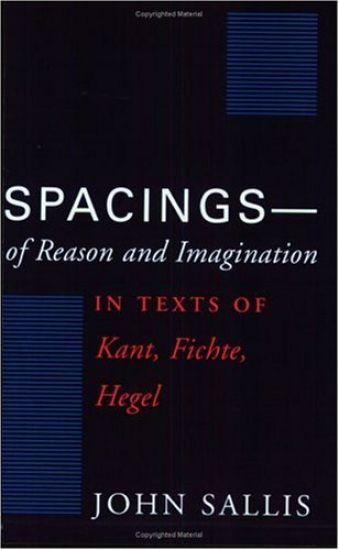
Spacings--of Reason and Imagination

Spacings--of Reason and Imagination

John Sallis

University of Chicago Press
1987
nidottu
By applying the tools of deconstruction to crucial texts of German Idealism, John Sallis reveals the suppressed but essential role of imagination in even the most ambitious attempts to represent pure reason. Sallis focuses on certain operations of "spacing" in metaphysics—textual lapses and leaps in which reason is displaced or suspended or abridged. In the project of establishing priority of reason, such operations can appear only in disguise, and Sallis reveals the play of imagination and metaphor that masks them. Concentrating on what has been called the closure of metaphysics, he examines texts in which the suppression of spacing would be carried out most rigorously, texts in which even metaphysics itself is seen as only an errant roaming, a spacing that must still be secured, to be replaced by a pure space of truth. And yet, in these very texts Sallis identifies outbreaks of spacing that would disrupt the tranquil space of reason. Rather than closure, he finds an opening of reason to imagination. Sallis's reading of a metaphorical system in the Critique of Pure Reason reveals a fissuring and historicizing of what would otherwise be called pure reason. Next he traces in Fichte's major work as well as in several lesser-known texts a decentering from reason to imagination, which he characterizes as a power of hovering between opposites and beyond being. Sallis then returns to the Critique of Pure Reason to expose, in relation to the famous question of the common root of reason and sensibility, a certain eccentricity of reason. Proceeding to the Critique of Judgment, he traces a divergence of sublime nature away from that supersensible space of reason to which Kant would otherwise assimilate it—a withdrawal toward an abyss. Finally, Sallis turns to Hegel's Encyclopedia, supplementing his reading with previously unknown notes from Hegel's lectures on those sections dealing with imagination; his reading of those sections serves to expose, within the most rigorous reduction of spacing in the history of metaphysics, an irrepressible and disseminative play of imagination.