

Kirjailija
John Stuart Mill
Kirjat ja teokset yhdessä paikassa: 889 kirjaa, julkaisuja vuosilta 1850–2027, suosituimpiin kuuluu Sosialismin hyödyt ja haitat. Vertaile teosten hintoja ja tarkista saatavuus suomalaisista kirjakaupoista.
889 kirjaa
Kirjojen julkaisuvuodet: 1850–2027.


The Right and Wrong of State Interference With Corporation and Church Property
John Stuart Mill
Kessinger Pub
2005
pokkari


Professor Sedgwick's Discourse on the Studies of the University of Cambridge
John Stuart Mill
Kessinger Pub
2005
pokkari


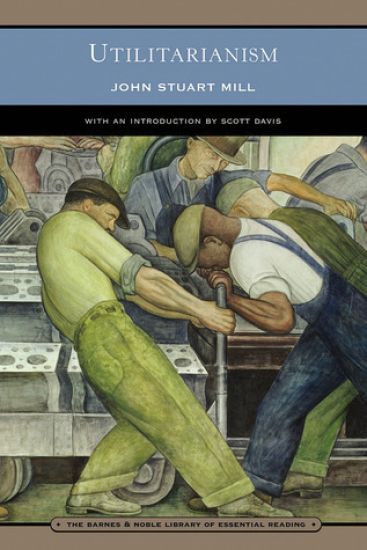
Utilitarianism (Barnes & Noble Library of Essential Reading)
John Stuart Mill
Barnes Noble Inc
2005
pokkari
John Stuart Mill's "Utilitarianism", which first appeared in three installments of "Fraser's Magazine" in 1861, was intended as a defense of the notorious doctrine identified with the liberal reformer Jeremy Bentham (1748-1832) and with the author's father, James Mill (1773-1836). The defense was successful. While 'the principle of utility, or as Bentham has latterly called it, the greatest happiness principle', may have scandalised Victorian England, Mill's "Utilitarianism" became one of the defining documents of modern British and American liberalism. It is impossible to appreciate contemporary social and political life without coming to grips with utilitarianism.

Essays On Some Unsettled Questions Of Political Economy
John Stuart Mill
KESSINGER PUBLISHING CO
2004
pokkari
The standard economics textbook for more than a generation, John Stuart Mill's Principles of Political Economy (1848) was really as much a synthesis of his predecessors' ideas as it was an original economic treatise. Heavily influenced by the work of David Ricardo, and also taking ideas from Adam Smith and Thomas Malthus, Mill systematically demonstrated how important economic concepts could be applied to real-world situations. In his emphasis on realism, Mill thus took economics out of the realm of the abstract and placed it squarely within the context of society. For instance, he made a convincing case that wages, rent, and profit are not necessarily the expression of immutable laws that are independent of society. Rather, they are in actuality the results of social institutions and as such can be changed if the members of a society move to break traditional institutional habits. Reflecting his utilitarian social philosophy, Mill suggested that social improvements are always possible. He thus proposed modifying a purely laissez faire system, advocating trade protectionism and regulation of employees' work hours for the benefit of domestic industries and workers' well-being. In such features he displayed a leaning toward socialism. In summing up his objective for this massive work, Mill said later in his Autobiography (1873) that he wished "to unite the greatest individual liberty of action, with a common ownership in the raw material of the globe, and an equal participation of all in the benefits of combined labour." For anyone with an interest in the history of economics or the history of ideas, this landmark work of classical economics makes for stimulating and in many respects still very relevant reading.
Principles of Political Economy with Some of Their Applications to Social Philosophy Part One
John Stuart Mill
KESSINGER PUBLISHING, LLC
2004
sidottu
Principles of Political Economy with Some of Their Applications to Social Philosophy Part Two
John Stuart Mill
KESSINGER PUBLISHING, LLC
2004
sidottu
Principles of Political Economy: With Some of Their Applications to Social Philosophy
John Stuart Mill
Hackett Publishing Co, Inc
2004
pokkari
Stephen Nathanson's clear-sighted abridgement of Principles of Political Economy, Mill's first major work in moral and political philosophy, provides a challenging, sometimes surprising account of Mill's views on many important topics: socialism, population, the status of women, the cultural bases of economic productivity, the.
Principles of Political Economy: With Some of Their Applications to Social Philosophy
John Stuart Mill
Hackett Publishing Co, Inc
2004
sidottu
Stephen Nathanson's clear-sighted abridgment of Principles of Political Economy , Mill's first major work in moral and political philosophy, provides a challenging, sometimes surprising account of Mill's views on many important topics: socialism, population, the status of women, the cultural bases of economic productivity, the causes and possible cures of poverty, the nature of property rights, taxation, and the legitimate functions of government. Nathanson cuts through the dated and less relevant sections of this large work and includes significant material omitted in other editions, making it possible to see the connections between the views Mill expressed in Principles of Political Economy and the ideas he defended in his later works, particularly On Liberty . Indeed, studying Principles of Political Economy , Nathanson argues in his general Introduction, can help to resolve the apparent contradiction between Mill's views in On Liberty and those in Utilitarianism , making it a key text for understanding Mill's philosophy as a whole.