Kirjojen hintavertailu – 12 903 724 kirjaa ja 27 kauppaa

Kirjailija

John Tulloch

Kirjat ja teokset yhdessä paikassa: 86 kirjaa, julkaisuja vuosilta 1990–2026, suosituimpiin kuuluu Rational Theology and Christian Philosophy in England in the Seventeenth Century. Vertaile teosten hintoja ja tarkista saatavuus suomalaisista kirjakaupoista.

86 kirjaa

Kirjojen julkaisuvuodet: 1990–2026.

Rational Theology and Christian Philosophy in England in the Seventeenth Century
Rational Theology and Christian Philosophy in England in the Seventeenth Century - Second Edition, Vol. 2 is an unchanged, high-quality reprint of the original edition of 1874. Hansebooks is editor of the literature on different topic areas such as research and science, travel and expeditions, cooking and nutrition, medicine, and other genres. As a publisher we focus on the preservation of historical literature. Many works of historical writers and scientists are available today as antiques only. Hansebooks newly publishes these books and contributes to the preservation of literature which has become rare and historical knowledge for the future.
Risk and Hyperconnectivity

Risk and Hyperconnectivity

Andrew Hoskins; John Tulloch

Oxford University Press Inc
2016
nidottu
Risk and Hyperconnectivity brings together for the first time three paradigms: new risk theory, neoliberalization theory, and connectivity theory, to illuminate how the kaleidoscope of risk events in the opening years of the new century has recharged a neoliberal battlespace of media, economy, and security. Hoskins and Tulloch argue that hyperconnectivity is both a conduit of risk and a form of risk in itself, and that it alters the ways in which we experience events and remember them. Through interdisciplinary dialogue and case study analysis they offer original perspectives on the key questions of risk of our age, including: What is the path to a 'balance' between individual privacy and state (or corporate) security? Is hyperconnectivity itself a new risk condition of our time? How do remembering and forgetting shape citizen insecurity and cultures of risk, and legitimize neoliberal governance? How do journalists operate as 'public intellectuals' of risk? Through probing a series of risk events that have already scarred the twenty-first century, Hoskins and Tulloch show how both established and emergent media are central in shaping past, present and future horizons of neoliberalism, while also propelling wide pressure for its alternatives on those ranging from economics students worldwide to potential political leaders cultivated by austerity policies.
Risk and Hyperconnectivity

Risk and Hyperconnectivity

Andrew Hoskins; John Tulloch

Oxford University Press Inc
2016
sidottu
Risk and Hyperconnectivity brings together for the first time three paradigms: new risk theory, neoliberalization theory, and connectivity theory, to illuminate how the kaleidoscope of risk events in the opening years of the new century has recharged a neoliberal battlespace of media, economy, and security. Hoskins and Tulloch argue that hyperconnectivity is both a conduit of risk and a form of risk in itself, and that it alters the ways in which we experience events and remember them. Through interdisciplinary dialogue and case study analysis they offer original perspectives on the key questions of risk of our age, including: What is the path to a balance between individual privacy and state (or corporate) security? Is hyperconnectivity itself a new risk condition of our time? How do remembering and forgetting shape citizen insecurity and cultures of risk, and legitimize neoliberal governance? How do journalists operate as public intellectuals of risk? Through probing a series of risk events that have already scarred the twenty-first century, Hoskins and Tulloch show how both established and emergent media are central in shaping past, present and future horizons of neoliberalism, while also propelling wide pressure for its alternatives on those ranging from economics students worldwide to potential political leaders cultivated by austerity policies.
Icons of War and Terror

Icons of War and Terror

John Tulloch; R. Warwick Blood

Routledge
2012
sidottu
This book explores the ideas of key thinkers and media practitioners who have examined images and icons of war and terror. Icons of War and Terror explores theories of iconic images of war and terror, not as received pieties but as challenging uncertainties; in doing so, it engages with both critical discourse and conventional image-making. The authors draw on these theories to re-investigate the media/global context of some of the most iconic representations of war and terror in the international ‘risk society’. Among these photojournalistic images are: Nick Ut’s Pulitzer Prize winning photograph of a naked girl, Kim Phuc, running burned from a napalm attack in Vietnam in June 1972; a quintessential ‘ethnic cleansing’ image of massacred Kosovar Albanian villagers at Racak on January 15, 1999, which finally propelled a hesitant Western alliance into the first of the ‘new humanitarian wars’; Luis Simco’s photograph of marine James Blake Miller, ‘the Marlboro Man’, at Fallujah, Iraq, 2004; the iconic toppling of the World Trade Centre towers in New York by planes on September 11, 2001; and the ‘Falling Man’ icon – one of the most controversial images of 9/11; the image of one of the authors of this book, as close-up victim of the 7/7 terrorist attack on London, which the media quickly labelled iconic. This book will be of great interest to students of media and war, sociology, communications studies, cultural studies, terrorism studies and security studies in general.
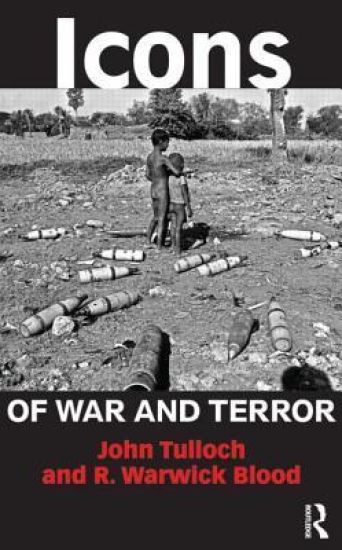
Icons of War and Terror

Icons of War and Terror

John Tulloch; R. Warwick Blood

Routledge
2012
nidottu
This book explores the ideas of key thinkers and media practitioners who have examined images and icons of war and terror. Icons of War and Terror explores theories of iconic images of war and terror, not as received pieties but as challenging uncertainties; in doing so, it engages with both critical discourse and conventional image-making. The authors draw on these theories to re-investigate the media/global context of some of the most iconic representations of war and terror in the international ‘risk society’. Among these photojournalistic images are: Nick Ut’s Pulitzer Prize winning photograph of a naked girl, Kim Phuc, running burned from a napalm attack in Vietnam in June 1972; a quintessential ‘ethnic cleansing’ image of massacred Kosovar Albanian villagers at Racak on January 15, 1999, which finally propelled a hesitant Western alliance into the first of the ‘new humanitarian wars’; Luis Simco’s photograph of marine James Blake Miller, ‘the Marlboro Man’, at Fallujah, Iraq, 2004; the iconic toppling of the World Trade Centre towers in New York by planes on September 11, 2001; and the ‘Falling Man’ icon – one of the most controversial images of 9/11; the image of one of the authors of this book, as close-up victim of the 7/7 terrorist attack on London, which the media quickly labelled iconic. This book will be of great interest to students of media and war, sociology, communications studies, cultural studies, terrorism studies and security studies in general.
Trevor Griffiths

Trevor Griffiths

John Tulloch

Manchester University Press
2011
nidottu
Trevor Griffiths has been a critical force in British television writing for over three decades. His successes have included the series Bill Brand (1976), his adaptations of Sons and Lovers and The Cherry Orchard (1981) and his television plays, The Comedians (1979), Hope in the Year Two (1994) and Food for Ravens (1997). During his creative life he has negotiated the issues of genre, politics, identity, class, history, memory and televisual form with a sustained creativity and integrity second to none. And he has parallelled this career with one as equally as eminent in the theatre, as well as the slightly more problematic forays into film-writing for Warren Beatty's Reds and Ken Loach's Fatherland. John Tulloch's incisive and wide-ranging volume is a perfect entry point not only for students of Griffiths' oeuvre, but also for anyone entering the discourses of television, media and cultural studies.