Kirjojen hintavertailu – 12 903 725 kirjaa ja 27 kauppaa

Kirjailija

John van der Hoek

Kirjat ja teokset yhdessä paikassa: 3 kirjaa, julkaisuja vuosilta 2005–2018, suosituimpiin kuuluu Binomial Models in Finance. Vertaile teosten hintoja ja tarkista saatavuus suomalaisista kirjakaupoista.

3 kirjaa

Kirjojen julkaisuvuodet: 2005–2018.

Introduction to Hidden Semi-Markov Models

Introduction to Hidden Semi-Markov Models

John van der Hoek; Robert J. Elliott

Cambridge University Press
2018
pokkari
Markov chains and hidden Markov chains have applications in many areas of engineering and genomics. This book provides a basic introduction to the subject by first developing the theory of Markov processes in an elementary discrete time, finite state framework suitable for senior undergraduates and graduates. The authors then introduce semi-Markov chains and hidden semi-Markov chains, before developing related estimation and filtering results. Genomics applications are modelled by discrete observations of these hidden semi-Markov chains. This book contains new results and previously unpublished material not available elsewhere. The approach is rigorous and focused on applications.
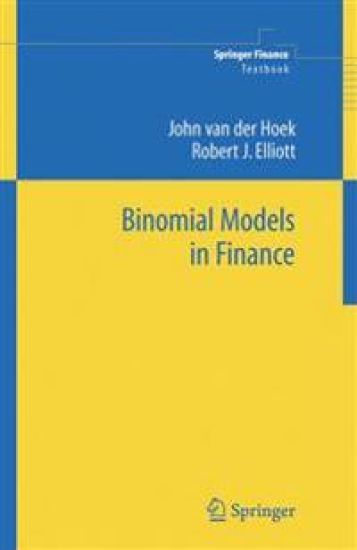
Binomial Models in Finance

Binomial Models in Finance

John van der Hoek; Robert J Elliott

Springer-Verlag New York Inc.
2010
nidottu
This book describes the modelling of prices of ?nancial assets in a simple d- crete time, discrete state, binomial framework. By avoiding the mathematical technicalitiesofcontinuoustime?nancewehopewehavemadethematerial accessible to a wide audience. Some of the developments and formulae appear here for the ?rst time in book form. We hope our book will appeal to various audiences. These include MBA s- dents,upperlevelundergraduatestudents,beginningdoctoralstudents,qu- titative analysts at a basic level and senior executives who seek material on new developments in ?nance at an accessible level. The basic building block in our book is the one-step binomial model where a known price today can take one of two possible values at a future time, which might, for example, be tomorrow, or next month, or next year. In this simple situation “risk neutral pricing” can be de?ned and the model can be applied to price forward contracts, exchange rate contracts and interest rate derivatives. In a few places we discuss multinomial models to explain the notions of incomplete markets and how pricing can be viewed in such a context, where unique prices are no longer available. The simple one-period framework can then be extended to multi-period m- els. TheCox-Ross-RubinsteinapproximationtotheBlackScholesoptionpr- ing formula is an immediate consequence. American, barrier and exotic - tions can all be discussed and priced using binomial models. More precise modelling issues such as implied volatility trees and implied binomial trees are treated, as well as interest rate models like those due to Ho and Lee; and Black, Derman and Toy.
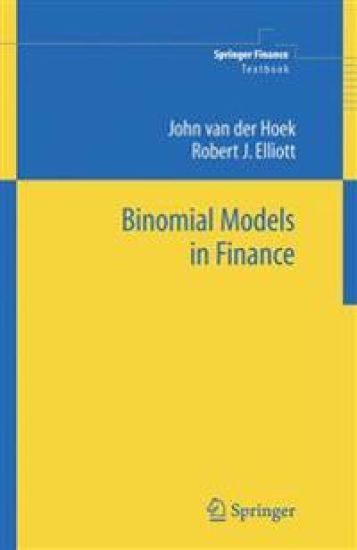
Binomial Models in Finance

Binomial Models in Finance

John van der Hoek; Robert J Elliott

Springer-Verlag New York Inc.
2005
sidottu
This book describes the modelling of prices of ?nancial assets in a simple d- crete time, discrete state, binomial framework. By avoiding the mathematical technicalitiesofcontinuoustime?nancewehopewehavemadethematerial accessible to a wide audience. Some of the developments and formulae appear here for the ?rst time in book form. We hope our book will appeal to various audiences. These include MBA s- dents,upperlevelundergraduatestudents,beginningdoctoralstudents,qu- titative analysts at a basic level and senior executives who seek material on new developments in ?nance at an accessible level. The basic building block in our book is the one-step binomial model where a known price today can take one of two possible values at a future time, which might, for example, be tomorrow, or next month, or next year. In this simple situation “risk neutral pricing” can be de?ned and the model can be applied to price forward contracts, exchange rate contracts and interest rate derivatives. In a few places we discuss multinomial models to explain the notions of incomplete markets and how pricing can be viewed in such a context, where unique prices are no longer available. The simple one-period framework can then be extended to multi-period m- els. TheCox-Ross-RubinsteinapproximationtotheBlackScholesoptionpr- ing formula is an immediate consequence. American, barrier and exotic - tions can all be discussed and priced using binomial models. More precise modelling issues such as implied volatility trees and implied binomial trees are treated, as well as interest rate models like those due to Ho and Lee; and Black, Derman and Toy.