Kirjojen hintavertailu – 12 859 828 kirjaa ja 27 kauppaa

Kirjailija

Jon Stewart

Kirjat ja teokset yhdessä paikassa: 63 kirjaa, julkaisuja vuosilta 1996–2026, suosituimpiin kuuluu The Daily Show with Jon Stewart Presents America (the Book): A Citizen's Guide to Democracy Inaction. Vertaile teosten hintoja ja tarkista saatavuus suomalaisista kirjakaupoista.

63 kirjaa

Kirjojen julkaisuvuodet: 1996–2026.

Volume 15, Tome V: Kierkegaard's Concepts

Volume 15, Tome V: Kierkegaard's Concepts

Steven M. Emmanuel; William McDonald; Jon Stewart

Routledge
2015
sidottu
Kierkegaard’s Concepts is a comprehensive, multi-volume survey of the key concepts and categories that inform Kierkegaard’s writings. Each article is a substantial, original piece of scholarship, which discusses the etymology and lexical meaning of the relevant Danish term, traces the development of the concept over the course of the authorship, and explains how it functions in the wider context of Kierkegaard’s thought. Concepts have been selected on the basis of their importance for Kierkegaard’s contributions to philosophy, theology, the social sciences, literature and aesthetics, thereby making this volume an ideal reference work for students and scholars in a wide range of disciplines.

Volume 16, Tome II: Kierkegaard's Literary Figures and Motifs
While Kierkegaard is perhaps known best as a religious thinker and philosopher, there is an unmistakable literary element in his writings. He often explains complex concepts and ideas by using literary figures and motifs that he could assume his readers would have some familiarity with. This dimension of his thought has served to make his writings far more popular than those of other philosophers and theologians, but at the same time it has made their interpretation more complex. Kierkegaard readers are generally aware of his interest in figures such as Faust or the Wandering Jew, but they rarely have a full appreciation of the vast extent of his use of characters from different literary periods and traditions. The present volume is dedicated to the treatment of the variety of literary figures and motifs used by Kierkegaard. The volume is arranged alphabetically by name, with Tome II covering figures and motifs from Gulliver to Zerlina.
Volume 15, Tome IV: Kierkegaard's Concepts

Volume 15, Tome IV: Kierkegaard's Concepts

Steven M. Emmanuel; William McDonald; Jon Stewart

Routledge
2014
sidottu
Kierkegaard’s Concepts is a comprehensive, multi-volume survey of the key concepts and categories that inform Kierkegaard’s writings. Each article is a substantial, original piece of scholarship, which discusses the etymology and lexical meaning of the relevant Danish term, traces the development of the concept over the course of the authorship, and explains how it functions in the wider context of Kierkegaard’s thought. Concepts have been selected on the basis of their importance for Kierkegaard’s contributions to philosophy, theology, the social sciences, literature and aesthetics, thereby making this volume an ideal reference work for students and scholars in a wide range of disciplines.

Volume 16, Tome I: Kierkegaard's Literary Figures and Motifs
While Kierkegaard is perhaps known best as a religious thinker and philosopher, there is an unmistakable literary element in his writings. He often explains complex concepts and ideas by using literary figures and motifs that he could assume his readers would have some familiarity with. This dimension of his thought has served to make his writings far more popular than those of other philosophers and theologians, but at the same time it has made their interpretation more complex. Kierkegaard readers are generally aware of his interest in figures such as Faust or the Wandering Jew, but they rarely have a full appreciation of the vast extent of his use of characters from different literary periods and traditions. The present volume is dedicated to the treatment of the variety of literary figures and motifs used by Kierkegaard. The volume is arranged alphabetically by name, with Tome I covering figures and motifs from Agamemnon to Guadalquivir.
Volume 12, Tome II: Kierkegaard's Influence on Literature, Criticism and Art
While Kierkegaard is primarily known as a philosopher or religious thinker, his writings have also been used extensively by literary writers, critics and artists worldwide who have been attracted to his creative mixing of genres, his complex use of pseudonyms, his rhetoric and literary style, and his rich images, parables, and allegories. The goal of the present volume is to document this influence in different language groups and traditions. Tome II is dedicated to the use of Kierkegaard by later Danish writers. Almost from the beginning Kierkegaard’s works were standard reading for these authors. Danish novelists and critics from the Modern Breakthrough movement in the 1870s were among the first to make extensive use of his writings. These included the theoretical leader of the movement, the critic Georg Brandes, who wrote an entire book on Kierkegaard, and the novelists Jens Peter Jacobsen and Henrik Pontoppidan. The next generation of writers from the turn of the century and through the First World War also saw in Kierkegaard important points of inspiration. These included Ernesto Dalgas and Harald Kidde, who used elements of Kierkegaard’s thought in their novels. Modern Danish writers such as Karen Blixen, Martin A. Hansen, and Villy Sørensen have continued to incorporate Kierkegaard into their works. There can be no doubt that Kierkegaard has indelibly stamped his name on Danish literature.
The Unity of Content and Form in Philosophical Writing
In The Unity of Content and Form in Philosophical Writing, Jon Stewart argues that there is a close relation between content and form in philosophical writing. While this might seem obvious at first glance, it is overlooked in the current climate of Anglophone academic philosophy, which, Stewart contends, accepts only a single genre as proper for philosophical expression. Stewart demonstrates the uniformity of today's philosophical writing by contrasting it with that of the past. Taking specific texts from the history of philosophy and literature as case studies, Stewart shows how the use of genres like dialogues, plays and short stories were an entirely suitable and effective means of presenting and arguing for philosophical positions given the concrete historical and cultural contexts in which they appeared. Now, Stewart argues, the prevailing intolerance means that the same texts are dismissed as unphilosophical merely due to their form, although their content is, in fact, profoundly philosophical. The book’s challenge to current conventions of philosophical is provocative and timely, and will be of great interest to students and scholars of philosophy, literature and history.
Volume 12, Tome III: Kierkegaard's Influence on Literature, Criticism and Art
While Kierkegaard is primarily known as a philosopher or religious thinker, his writings have also been used extensively by literary writers, critics and artists. This use can be traced in the work of major cultural figures not just in Denmark and Scandinavia but also in the wider world. They have been attracted to his creative mixing of genres, his complex use of pseudonyms, his rhetoric and literary style, and his rich images, parables and allegories. The present volume documents this influence in the different language groups and traditions. Tome III investigates the works of Swedish and Norwegian writers and artists inspired by Kierkegaard. In Sweden the novelist Victoria Benedictsson made use of Kierkegaard during the period of the so-called Modern Breakthrough, as did the playwright August Strindberg. Later Swedish writers have continued to draw on his thought, such as Selma Lagerlof, Lars Ahlin, Lars Gyllensten, and Carl-Henning Wijkmark. The Norwegian reception of Kierkegaard also began remarkably early and was shaped by the leading names in Norwegian cultural life. Despite his coy responses to questions about his relation to Kierkegaard, Henrik Ibsen clearly seems to have been inspired by the Dane in works such as Brand. Norwegian writer and poet Bjornstjerne Bjornson, who was influenced by the Modern Breakthrough movement, was also deeply inspired by Kierkegaard. Finally, the celebrated Norwegian artist Edvard Munch (1863-1944) closely studied key Kierkegaardian concepts such as anxiety, and his influence is notable in his iconic paintings such as The Scream.
Volume 12, Tome V: Kierkegaard's Influence on Literature, Criticism and Art
While Kierkegaard is primarily known as a philosopher or religious thinker, his writings have also been used extensively by literary writers, critics and artists. This use can be traced in the work of major cultural figures not just in Denmark and Scandinavia but also in the wider world. They have been attracted to his creative mixing of genres, his complex use of pseudonyms, his rhetoric and literary style, and his rich images, parables, and allegories. The present volume documents this influence in the different language groups and traditions. Tome V treats the work of a heterogeneous group of writers from the Romance languages and from Central and Eastern Europe. Kierkegaard has been particularly important for Spanish literature: the Argentine writers Jorge Luis Borges, Leonardo Castellani, and Ernesto Sábato, the Mexican writer Carlos Fuentes, and the Spanish essayist and philosopher María Zambrano were all inspired to varying degrees by him. The Dane also appears in the work of Romanian writer Max Blecher, while the Portuguese author Fernando Pessoa was almost certainly inspired by Kierkegaard’s use of pseudonyms. Kierkegaard has also influenced diverse literary figures from Central and Eastern Europe. His influence appears in the novels of the contemporary Hungarian authors Péter Nadas and Péter Esterházy, the work of the Russian writer and literary critic, Mikhail Bakhtin, the Polish writer Witold Gombrowicz and the Czech novelist Ivan Klíma. Tome V also examines how Kierkegaard’s treatment of the story of Abraham and Isaac in Fear and Trembling interested the Polish-born Israeli novelist Pinhas Sadeh.
Volume 12, Tome IV: Kierkegaard's Influence on Literature, Criticism and Art
While Kierkegaard is primarily known as a philosopher or religious thinker, his writings have also been used extensively by literary writers, critics and artists. This use can be traced in the work of major cultural figures not just in Denmark and Scandinavia but also in the wider world. They have been attracted to his creative mixing of genres, his complex use of pseudonyms, his rhetoric and literary style, and his rich images, parables, and allegories. The present volume documents this influence in the different language groups and traditions. Tome IV examines Kierkegaard’s surprisingly extensive influence in the Anglophone world of literature and art, particularly in the United States. His thought appears in the work of the novelists Walker Percy, James Baldwin, Flannery O’Connor, William Styron, Don Delillo, and Louise Erdrich. He has also been used by the famous American literary critics, George Steiner and Harold Bloom. The American composer Samuel Barber made use of Kierkegaard in his musical works. Kierkegaard has also exercised an influence on British and Irish letters. W. H. Auden sought in Kierkegaard ideas for his poetic works, and the contemporary English novelist David Lodge has written a novel Therapy, in which Kierkegaard plays an important role. Cryptic traces of Kierkegaard can also be found in the work of the famous Irish writer James Joyce.
Volume 12, Tome I: Kierkegaard's Influence on Literature, Criticism and Art
While Kierkegaard is primarily known as a philosopher or religious thinker, his writings have also been used extensively by literary writers, critics and artists worldwide who have been attracted to his creative mixing of genres, his complex use of pseudonyms, his rhetoric and literary style, and his rich images, parables, and allegories. The goal of the present volume is to document this influence in different language groups and traditions. Tome I explores Kierkegaard’s influence on literature and art in the Germanophone world. He was an important source of inspiration for German writers such as Theodor Fontane, Thomas Mann, Rainer Maria Rilke, Alfred Andersch, and Martin Walser. Kierkegaard’s influence was particularly strong in Austria during the generation of modernist authors such as Rudolf Kassner, Karl Kraus, Robert Musil, and Hermann Broch. Due presumably in part to the German translations of Kierkegaard in the Austrian cultural journal Der Brenner, Kierkegaard continued to be used by later figures such as the novelist and playwright, Thomas Bernhard. His thought was also appropriated in Switzerland through the works of Max Frisch and Friedrich Dürrenmatt. The famous Czech author Franz Kafka identified personally with Kierkegaard’s love story with Regine Olsen and made use of his reflections on this and other topics.
Idealism and Existentialism

Idealism and Existentialism

Jon Stewart

Continuum Publishing Corporation
2012
nidottu
The history of Continental philosophy is often conceived as being represented by two major schools: German idealism and phenomenology/existentialism. These two schools are frequently juxtaposed so as to highlight their purported radical differences. There is a commonly held view that an abrupt break occurred in the nineteenth century, resulting in a disdainful rejection of idealism in all its forms. This break is often located in the transition from Hegel to Kierkegaard. The history of philosophy in the first half of the nineteenth century has thus been read as a grand confrontation between the overambitious rationalistic system of Hegel and the devastating criticisms of it by Kierkegaard's philosophy of existence. This work aims to undermine this popular view of the radical break between idealism and existentialism by means of a series of detailed studies in specific episodes of European thought. As a whole, this book represents an important attempt to demonstrate the long shadow cast by Kant and Hegel over the subsequent history of European philosophy.
Volume 13: Kierkegaard's Influence on the Social Sciences
Kierkegaard has long been known as a philosopher and theologian, but his contributions to psychology, anthropology and sociology have also made an important impact on these fields. In many of the works of his complex authorship, Kierkegaard presents his intriguing and unique vision of the nature and mental life of human beings individually and collectively. The articles featured in the present volume explore the reception of Kierkegaard's thought in the social sciences. Of these fields Kierkegaard is perhaps best known in psychology, where The Concept of Anxiety and The Sickness unto Death have been the two most influential texts. With regard to the field of sociology, social criticism, or social theory, Kierkegaard's Literary Review of Two Ages has also been regarded as offering valuable insights about some important dynamics of modern society..
Earth: The Book: A Visitor's Guide to the Human Race

Earth: The Book: A Visitor's Guide to the Human Race

Jon Stewart

Grand Central Publishing
2011
nidottu
The eagerly awaited new book from the Emmy-winning, Oscar-hosting, Daily Show-anchoring Jon Stewart--the man behind the megaseller America (The Book). Where do we come from? Who created us? Why are we here? These questions have puzzled us since the dawn of time, but when it became apparent to Jon Stewart and the writers of The Daily Show that the world was about to end, they embarked on a massive mission to write a book that summed up the human race: What we looked like; what we accomplished; our achievements in society, government, religion, science and culture -- all in a tome of approximately 256 pages with lots of color photos, graphs and charts. After two weeks of hard work, they had their book. Earth (The Book) is the definitive guide to our species. With their trademark wit, irreverence, and intelligence, Stewart and his team will posthumously answer all of life's most hard-hitting questions, completely unburdened by objectivity, journalistic integrity, or even accuracy.
The Unity of Hegel's ""Phenomenology of Spirit

The Unity of Hegel's ""Phenomenology of Spirit

Jon Stewart

Northwestern University Press
2011
nidottu
Hegel's Phenomenology is considered by many to be the most difficult book in the philosophical canon. While some authors have published excellent essays on various chapters and aspects of the book, few authors have successfully tackled the whole. In The Unity of Hegel's Phenomenology of Spirit, Jon Stewart interprets Hegel's work as a dialectical transformation of Kantian transcendental philosophy, providing from this unified standpoint a case for Hegel's own conception of philosophy as a system. In restoring them to their larger systematic contexts, Stewart clarifies Hegel's individual analyses, as well as indicating the meaning and significance of the transitions and illustrating the parallelisms between the respective analyses. Many of Hegel's main themes-universal-particular, mediacy-immediacy-are traced through the text, demonstrating Hegel's formal continuity. By examining at the microlevel the particulars of the dialectical movement, and by analyzing at the macrolevel the role of the argument in question in the context of the work as a whole, Stewart provides a detailed analysis of the Phenomenology and a significant scholarly demonstration of Hegel's own conception of the Phenomenology as a part of a systematic philosophy.
Idealism and Existentialism

Idealism and Existentialism

Jon Stewart

CONTINUUM PUBLISHING CORPORATION
2010
sidottu
The history of Continental philosophy is often conceived as being represented by two major schools: German idealism and phenomenology/existentialism. These two schools are frequently juxtaposed so as to highlight their purported radical differences. There is a commonly held view that an abrupt break occurred in the nineteenth century, resulting in a disdainful rejection of idealism in all its forms. This break is often located in the transition from Hegel to Kierkegaard. The history of philosophy in the first half of the nineteenth century has thus been read as a grand confrontation between the overambitious rationalistic system of Hegel and the devastating criticisms of it by Kierkegaard's philosophy of existence. This work aims to undermine this popular view of the radical break between idealism and existentialism by means of a series of detailed studies in specific episodes of European thought. As a whole, this book represents an important attempt to demonstrate the long shadow cast by Kant and Hegel over the subsequent history of European philosophy.
Volume 1, Tome I: Kierkegaard and the Bible - The Old Testament
Exploring Kierkegaard's complex use of the Bible, the essays in this volume use source-critical research and tools ranging from literary criticism to theology and biblical studies, to situate Kierkegaard's appropriation of the biblical material in his cultural and intellectual context. The contributors seek to identify the possible sources that may have influenced Kierkegaard's understanding and employment of Scripture, and to describe the debates about the Bible that may have shaped, perhaps indirectly, his attitudes toward Scripture. They also pay close attention to Kierkegaard's actual hermeneutic practice, analyzing the implicit interpretive moves that he makes as well as his more explicit statements about the significance of various biblical passages. This close reading of Kierkegaard's texts elucidates the unique and sometimes odd features of his frequent appeals to Scripture. This volume in the series devotes one tome to the Old Testament and a second tome to the New Testament. Tome I considers the canonically disputed literature of the Apocrypha. Although Kierkegaard certainly cited the Old Testament much less frequently than he did the New, passages and themes from the Old Testament do occupy a position of startling importance in his writings. Old Testament characters such as Abraham and Job often play crucial and even decisive roles in his texts. Snatches of Old Testament wisdom figure prominently in his edifying literature. The vocabulary and cadences of the Psalms saturate his expression of the range of human passions from joy to despair. The essays in this first tome seek to elucidate the crucial rhetorical uses to which he put key passages from the Old Testament, the sources that influenced him to do this, and his reasons for doing so.
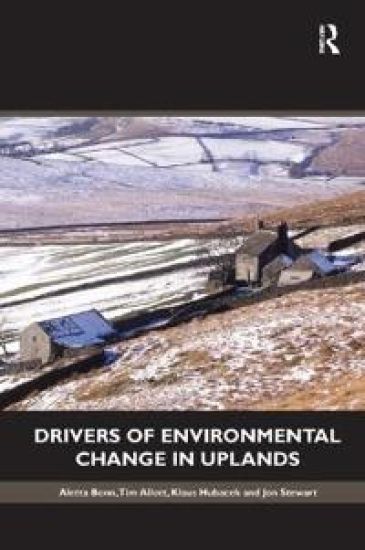
Drivers of Environmental Change in Uplands

Drivers of Environmental Change in Uplands

Aletta Bonn; Tim Allott; Klaus Hubacek; Jon Stewart

Routledge
2009
nidottu
The uplands are a crucial source of ecosystem services, such as water provision, carbon retention, maintenance of biodiversity, provision of recreation value and cultural heritage. This puts them in the focus of both environmental and social scientists as well as practitioners and land managers.. This volume brings together a wealth of knowledge of the British uplands from diverse but interrelated fields of study, clearly demonstrating their importance in 21st Century Britain, and indicating how we may through interdisciplinary approaches meet the challenges provided by past and future drivers of environmental change. The upland environments are subject to change. They face imminent threats as well as opportunities from pressures such as climate change, changes in land management and related changes in fire risk, increases in erosion and water colour, degradation of habitats, altered wildlife and recreational value, as well as significant changes in the economy of these marginal areas. This book presents up-to-date scientific background information, addresses policy related issues and lays out pressing land management questions. A number of world-class experts provide a review of cutting-edge naturaland social science and an assessment of past, current and potential future management strategies, policies and other drivers of change. After appraisal of key concepts and principles, chapters provide specific examples and applications by focussing on UK upland areas and specifically the Peak District National Park as a key example for other highly valuable upland regions.
Drivers of Environmental Change in Uplands

Drivers of Environmental Change in Uplands

Aletta Bonn; Tim Allott; Klaus Hubacek; Jon Stewart

Routledge
2008
sidottu
The uplands are a crucial source of ecosystem services, such as water provision, carbon retention, maintenance of biodiversity, provision of recreation value and cultural heritage. This puts them in the focus of both environmental and social scientists as well as practitioners and land managers.. This volume brings together a wealth of knowledge of the British uplands from diverse but interrelated fields of study, clearly demonstrating their importance in 21st Century Britain, and indicating how we may through interdisciplinary approaches meet the challenges provided by past and future drivers of environmental change. The upland environments are subject to change. They face imminent threats as well as opportunities from pressures such as climate change, changes in land management and related changes in fire risk, increases in erosion and water colour, degradation of habitats, altered wildlife and recreational value, as well as significant changes in the economy of these marginal areas. This book presents up-to-date scientific background information, addresses policy related issues and lays out pressing land management questions. A number of world-class experts provide a review of cutting-edge naturaland social science and an assessment of past, current and potential future management strategies, policies and other drivers of change. After appraisal of key concepts and principles, chapters provide specific examples and applications by focussing on UK upland areas and specifically the Peak District National Park as a key example for other highly valuable upland regions.
Kierkegaard's Relations to Hegel Reconsidered

Kierkegaard's Relations to Hegel Reconsidered

Jon Stewart

Cambridge University Press
2007
pokkari
Jon Stewart's study is a major re-evaluation of the complex relations between the philosophies of Kierkegaard and Hegel. The standard view on the subject is that Kierkegaard defined himself as explicitly anti-Hegelian, indeed that he viewed Hegel's philosophy with disdain. Jon Stewart shows convincingly that Kierkegaard's criticism was not of Hegel but of a number of contemporary Danish Hegelians. Kierkegaard's own view of Hegel was in fact much more positive to the point where he was directly influenced by some of Hegel's work. Any scholar working in the tradition of Continental philosophy will find this an insightful and provocative book with implications for the subsequent history of philosophy in the twentieth century. The book will also appeal to scholars in religious studies and the history of ideas.
Tänkarens mångfald : nutida perspektiv på Søren Kierkegaard

Tänkarens mångfald : nutida perspektiv på Søren Kierkegaard

Jonna Hjertström Lappalainen; Marius G. Mjaaland; Wenche Marit Quist; Jan Holmgaard; Karin Linnell; Lone Koldtoft; Roy Wiklander; K. Brian Söderquist; Jon Stewart

Makadam förlag
2005
sidottu
För 150 år sedan dog Søren Kierkegaard, men hans filosofi och författarskap är fortfarande synnerligen levande. I Sverige har hans allmänkulturella betydelse varit stor genom alla år, men hans fackfilosofiska inflytande har varit begränsat, och diskussionerna kring Kierkegaards teologiska roll tystnade kring mitten av förra seklet. Medan det sedan länge finns en mycket aktiv forskningstradition i ämnet i Danmark, har Kierkegaardstudiet i Sverige, med några få undantag, legat i träda. Denna volym vill markera startskottet för en gemensam skandinavisk diskussion om Kierkegaards arbete. I Tänkarens mångfald erbjuds läsaren en hastig orientering i den samtida skandinaviska Kierkegaardforskningen. Bidragen behandlar Kierkegaards förhållande till döden, hans syn på kommunikation, på synd, på den estetiska upplevelsen och på individen. Kierkegaard och Werder, Kierkegaard och Sokrates, och Kierkegaard som profet är andra teman. Utöver uppsatserna återges en text av Kierkegaard själv, närmare bestämt första delen ur hans allra första Journal, AA från 18351837. Utdraget innehåller de berömda passagerna från Kierkegaards vistelse i Gilleleje, vilka ofta hyllas som vittnesmål om Kierkegaards religiösa omvändelse eller som inledningen till hans existentiella tänkande. Här återfinns också det stycke där Kierkegaard redogör för sin tur över Öresund, närmare bestämt till Krapperups slott vid foten av Kullaberg, en vistelse som ägde rum den 2728 juli 1835. Det får stå som symbol för förhoppningarna om fortsatt forskningssamarbete över gränserna, och om en vital vetenskaplig och intellektuell diskussion på svensk mark kring Kierkegaards tänkande. Ingår i bokserien Centrum för Danmarksstudier.