Kirjojen hintavertailu – 12 903 725 kirjaa ja 27 kauppaa

Kirjailija

Jose Antonio Gutierrez

Kirjat ja teokset yhdessä paikassa: 3 kirjaa, julkaisuja vuosilta 1998–2019, suosituimpiin kuuluu Padron parroquial de Xalostotitlan 1770. Vertaile teosten hintoja ja tarkista saatavuus suomalaisista kirjakaupoista.

3 kirjaa

Kirjojen julkaisuvuodet: 1998–2019.

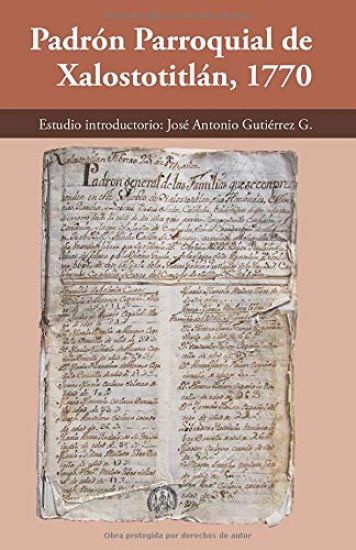
Padron parroquial de Xalostotitlan 1770

Padron parroquial de Xalostotitlan 1770

Jose Antonio Gutierrez

Independently Published
2019
nidottu
La sociedad alte a, para 1770, estaba suficientemente estructurada, aun cuando continuaba conformada de asentamientos escasamente ordenados y poco comunicados. La cr a de ganado y la agricultura la eran la pauta de subsistencia. los giros m s explotados, a lo que los grandes y peque os terratenientes dedicaban sus extensiones de tierra para cubrir la demanda local y de algunos reales de minas circunvecinos. Se hab an conformado algunos latifundios o haciendas, pero el rancho era la instituci n que m s giraba y en l se sustentaba su econom a. Cuando se levant el presente padr n, gobernaba Espa a Carlos III y era virrey de Nueva Espa a Carlos Francisco de Croix, marqu s de Croix, que carg con el destierro de los jesuitas. Gobernaba la Nueva Galicia en general Francisco Galindo y Qui ones, fiel ejecutor de las rdenes reales y que hab a formado los primeros cuerpos de milicias formales con enganches y levas forzosas; pero que descuidaba la observancia de las leyes referentes a los indios. El obispado que se extend a hasta las Californias, Texas y Nuevo M xico, lo ocupaba D. Diego Rodr guez de Rivas y Velasco. El padr n se levanta en el ltimo a o del episcopado de D. Diego Rodr guez de Rivas, cumple el objetivo de poder conocer la poblaci n parroquial. El Concilio de Trento (1545-1563) impuso a los obispos la obligaci n de vivir en sus di cesis y visitarlas al menos una vez; stas involucraban todo el entorno eclesial: culto, decoro de los templos, administraci n de los beneficios, testamentos, capellan as, vida y costumbres del clero y feligres a. Por eso, los padrones se convirtieron en parte esencial para que el obispo pudiera formarse un criterio del estado de las parroquias; por eso las exigencias a los curas y encargados de doctrinas.
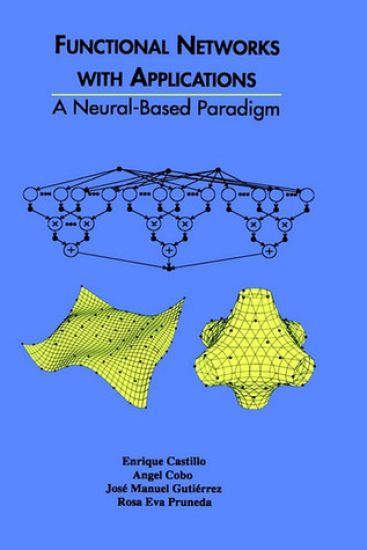
Functional Networks with Applications

Functional Networks with Applications

Enrique Castillo; Angel Cobo; Jose Antonio Gutierrez; Rosa Eva Pruneda

Springer-Verlag New York Inc.
2013
nidottu
Artificial neural networks have been recognized as a powerful tool to learn and reproduce systems in various fields of applications. Neural net­ works are inspired by the brain behavior and consist of one or several layers of neurons, or computing units, connected by links. Each artificial neuron receives an input value from the input layer or the neurons in the previ­ ous layer. Then it computes a scalar output from a linear combination of the received inputs using a given scalar function (the activation function), which is assumed the same for all neurons. One of the main properties of neural networks is their ability to learn from data. There are two types of learning: structural and parametric. Structural learning consists of learning the topology of the network, that is, the number of layers, the number of neurons in each layer, and what neurons are connected. This process is done by trial and error until a good fit to the data is obtained. Parametric learning consists of learning the weight values for a given topology of the network. Since the neural functions are given, this learning process is achieved by estimating the connection weights based on the given information. To this aim, an error function is minimized using several well known learning methods, such as the backpropagation algorithm. Unfortunately, for these methods: (a) The function resulting from the learning process has no physical or engineering interpretation. Thus, neural networks are seen as black boxes.
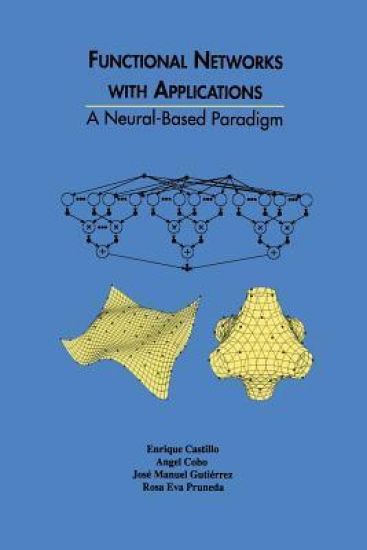
Functional Networks with Applications

Functional Networks with Applications

Enrique Castillo; Angel Cobo; Jose Antonio Gutierrez; Rosa Eva Pruneda

Springer
1998
sidottu
Artificial neural networks have been recognized as a powerful tool to learn and reproduce systems in various fields of applications. Neural net­ works are inspired by the brain behavior and consist of one or several layers of neurons, or computing units, connected by links. Each artificial neuron receives an input value from the input layer or the neurons in the previ­ ous layer. Then it computes a scalar output from a linear combination of the received inputs using a given scalar function (the activation function), which is assumed the same for all neurons. One of the main properties of neural networks is their ability to learn from data. There are two types of learning: structural and parametric. Structural learning consists of learning the topology of the network, that is, the number of layers, the number of neurons in each layer, and what neurons are connected. This process is done by trial and error until a good fit to the data is obtained. Parametric learning consists of learning the weight values for a given topology of the network. Since the neural functions are given, this learning process is achieved by estimating the connection weights based on the given information. To this aim, an error function is minimized using several well known learning methods, such as the backpropagation algorithm. Unfortunately, for these methods: (a) The function resulting from the learning process has no physical or engineering interpretation. Thus, neural networks are seen as black boxes.