Kirjojen hintavertailu – 12 903 725 kirjaa ja 27 kauppaa

Kirjailija

Joseph Priestley

Kirjat ja teokset yhdessä paikassa: 338 kirjaa, julkaisuja vuosilta 1993–2025, suosituimpiin kuuluu Memoirs of Dr. Joseph Priestley, to the Year 1795. Vertaile teosten hintoja ja tarkista saatavuus suomalaisista kirjakaupoista.

338 kirjaa

Kirjojen julkaisuvuodet: 1993–2025.

An Essay on the First Principles of Government

An Essay on the First Principles of Government

Joseph Priestley

Cambridge University Press
2013
pokkari
In this 1768 publication, Joseph Priestley (1733–1804) expounds his political philosophy, revealed in part through his earlier writings on education and theology. While teaching at the dissenting academy at Warrington, he had argued against a scheme of national education in his Essay on a Course of Liberal Education (1765), included and expanded on in his Miscellaneous Observations Relating to Education (1778), which has been reissued in this series. Here, he explains that freedoms of education and religion promote free discourse, which is essential for social progress. Such discourse is only possible when government protects both civil liberty, power over one's own actions, and political liberty, the right to vote and hold office. Although harshly criticised at first for its perceived attack on church and government authority, Priestley's work inspired later liberal political theorists, notably enthusing Jeremy Bentham with its incorporation of a principle of utility.
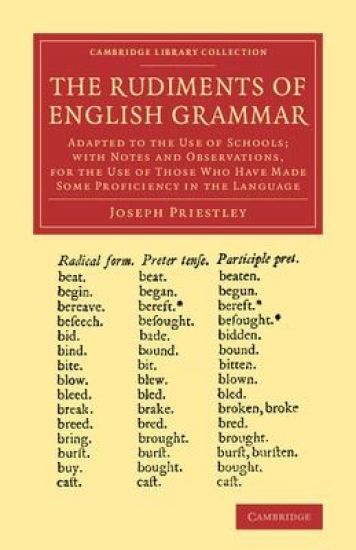
The Rudiments of English Grammar

The Rudiments of English Grammar

Joseph Priestley

Cambridge University Press
2013
pokkari
The English polymath Joseph Priestley (1733–1804) defined grammar as nothing more complicated than a system of rules for the correct use of language. This enlarged second edition of his influential 1761 textbook first appeared in 1769; it had by then established him as one of the major grammarians of his age. With little patience for the confusing and superfluous application of Latin rules to English, Priestley champions a simple style of grammatical explanation here, questioning even such fundamental concepts as an English future tense. The text follows a clear question-and-answer structure designed for students. Priestley's determination to modernise the teaching of English and to promote usage as the crucial linguistic standard remain relevant today. A companion work, A Course of Lectures on the Theory of Language and Universal Grammar (1762), is also reissued in this series, along with other works by Priestley ranging in coverage from oratory to oxygen.
Experiments and Observations on Different Kinds of Air

Experiments and Observations on Different Kinds of Air

Joseph Priestley

Cambridge University Press
2013
pokkari
By the late eighteenth century, scientists had discovered certain types of gas, such as 'fixed air' (carbon dioxide), but their composition was little understood. Relatively few investigations into gases had taken place, and so the polymath Joseph Priestley (1733–1804) was able to make major breakthroughs in the field using a range of experimental techniques. While living near a brewery, he found that it was possible to outline the shape of the gas above fermenting beer with smoke, and that fire would burn with varying strength depending on the composition of the air. This three-volume collection first appeared between 1774 and 1777. Primarily an account of Priestley's early experiments, with details of apparatus including candles and live mice, Volume 1 is reissued here in its corrected 1775 second edition and also incorporates a brief history of the field of inquiry.
Experiments and Observations on Different Kinds of Air

Experiments and Observations on Different Kinds of Air

Joseph Priestley

Cambridge University Press
2013
pokkari
By the late eighteenth century, scientists had discovered certain types of gas, such as 'fixed air' (carbon dioxide), but their composition was little understood. Relatively few investigations into gases had taken place, and so the polymath Joseph Priestley (1733–1804) was able to make major breakthroughs in the field using a range of experimental techniques. While living near a brewery, he found that it was possible to outline the shape of the gas above fermenting beer with smoke, and that fire would burn with varying strength depending on the composition of the air. This three-volume collection first appeared between 1774 and 1777. Following the international interest and new discoveries prompted by the publication of its predecessor, Volume 2 - reissued here in its corrected 1776 second edition - includes accounts of further experiments, Priestley's paper on the conducting power of charcoal, and, most significantly, notes on what he calls 'dephlogisticated air' (oxygen).
Experiments and Observations on Different Kinds of Air

Experiments and Observations on Different Kinds of Air

Joseph Priestley

Cambridge University Press
2013
pokkari
By the late eighteenth century, scientists had discovered certain types of gas, such as 'fixed air' (carbon dioxide), but their composition was little understood. Relatively few investigations into gases had taken place, and so the polymath Joseph Priestley (1733–1804) was able to make major breakthroughs in the field using a range of experimental techniques. While living near a brewery, he found that it was possible to outline the shape of the gas above fermenting beer with smoke, and that fire would burn with varying strength depending on the composition of the air. This three-volume collection first appeared between 1774 and 1777. Priestley acknowledges that Volume 3 (1777) would more greatly interest those with technical training in the physical sciences as compared with general scholars. It also highlights some new and important inferences, notably on the function of blood in respiration.
The History and Present State of Electricity

The History and Present State of Electricity

Joseph Priestley

Cambridge University Press
2013
pokkari
When this work first appeared in 1767, electricity was seen as such a minor aspect of natural philosophy that its investigation was not considered a priority for contemporary scientists. The polymath Joseph Priestley (1733–1804) was one of the few who devoted serious effort to advancing the field. Here he charts the history of electrical study from experiments with amber in ancient Greece to the most recent discoveries. The book comprises explanations of the principal theories of electricity - both historical and contemporary - in addition to a selection of well-known experiments carried out by previous researchers. Priestley also details his own experiments, covering such topics as the colour of electric light, the effects of temperature, and even the musical tone of electrical discharges. One of his most successful works, testifying to the clarity of his explanations, the book remains an important text in the history of science.