Kirjojen hintavertailu – 12 859 818 kirjaa ja 27 kauppaa

Kirjailija

Lawrence Freedman

Kirjat ja teokset yhdessä paikassa: 49 kirjaa, julkaisuja vuosilta 1977–2026, suosituimpiin kuuluu Samhälle i kris : vår förmåga till anpassning och omorientering. Vertaile teosten hintoja ja tarkista saatavuus suomalaisista kirjakaupoista.

49 kirjaa

Kirjojen julkaisuvuodet: 1977–2026.

The Politics of British Defence 1979–98

The Politics of British Defence 1979–98

Lawrence Freedman

Palgrave Macmillan
1999
nidottu
In this collection of essays, a number of which have never been published before, Lawrence Freedman provides an incisive and well-informed analysis of the past two decades of British defence policy, from Conservatives to Labour, and out of the Cold War. He addresses the major issues influencing policy, including the demands of European security, party politics, budgetary pressures and nuclear deterrence.
The Revolution in Strategic Affairs

The Revolution in Strategic Affairs

Lawrence Freedman

Oxford University Press Inc
1998
nidottu
Rapid developments in information technology and precision weaponry are said to herald a 'revolution in military affairs' (RMA), making possible quick and decisive victories with minimal casualties and collateral damage. But has such a revolution taken place? The issues that drive conflict will persist, and many of the technical advances associated with the RMA will not necessarily produce a transformation in the nature of warfare. The end of the Cold War has highlighted another revolution one in political affairs. Major powers appear less likely to go to war with one another than they are to intervene in conflicts involving weak states, with potential opponents including militia groups, drug cartels and terrorists. RMA technology may be less suited to conflicts such as these. If the cumulative effect of these changes has produced a revolution, it is a revolution in strategic, as much as military, affairs. This paper argues that: * the RMA is the practical expression of a 'Western Way of Warfare', the key features of which are: professional armed forces; intolerance of casualties; and intolerance of collateral damage * the key technological and conceptual components of the RMA were in place by the early 1970s. The trend has therefore been evolutionary, rather than revolutionary. The significant difference is in the new political setting of the end of the Cold War, and the revolution in perceptions of Western particularly US conventional military strength brought about by the Gulf War of 1991 * the Gulf conflict could mark the start of a true 'revolution' if future battles offer similar opportunities to exploit the RMA's technology. However, since the US and its allies appear unbeatable when fighting on their own terms, future opponents will fight differently * the West will therefore face opponents who will follow strategies that contradict the Western Way of Warfare. They will avoid pitched battles, will exploit the West's reluctance to inflict civilian suffering, and will target their opponent's domestic political base, as much as its forward troops. The problem for the West is not how to prevail, but how to do so in an acceptable manner. The more warfare becomes entwined with civilian activity, the more difficult it is to respond with the type of decisive and overwhelming military means embodied in the RMA. The RMA does not create a situation in which information is the only commodity at stake, and so does not offer the prospect of a 'virtual war'. The new circumstances and capabilities do not prescribe one strategy, but extend the range of strategies available. The issue underlying the RMA is the ability of Western countries, in particular the US, to follow a line geared to their own interests and capabilities.

The Gulf Conflict 1990-1991

The Gulf Conflict 1990-1991

Lawrence Freedman; Efraim Karsh

Princeton University Press
1995
pokkari
The Gulf Conflict provides the most authoritative and comprehensive account to date of Iraq's occupation of Kuwait, its expulsion by a coalition of Western and Arab forces seven months later, and the aftermath of the war. Blending compelling narrative history with objective analysis, Lawrence Freedman and Efraim Karsh inquire into the fundamental issues underlying the dispute and probe the strategic calculations of all the participants.
Military Power in Europe

Military Power in Europe

Lawrence Freedman

Palgrave Macmillan
1990
nidottu
These essays illuminate different aspects of military power and European security. It deals with the practicalities of planning and command within an alliance structure or the problems connected and with distinguishing between offensive and defensive operations for purposes of arms control.
Nuclear War and Nuclear Peace

Nuclear War and Nuclear Peace

John Baylis; Lawrence Freedman; Edwina Moreton; Gerald Segal

Palgrave Macmillan
1988
sidottu
This study attempts to bring the debate about nuclear weapons and arms control up to date by assessing the reasons for the recent superpower agreement, the decline of the peace movements, the new threats to international stability and the prospects for further detente.
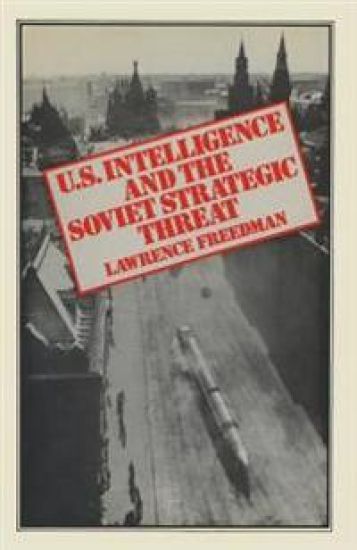
US Intelligence and the Soviet Strategic Threat

US Intelligence and the Soviet Strategic Threat

Lawrence Freedman

Palgrave Macmillan
1977
nidottu
The author examines in detail the organization of the U. S. intelligence community, its attempts to monitor and predict the development of Soviet forces from the early days of the cold war, and how these attempts affected American policy and weapons production. Originally published in 1987. The Princeton Legacy Library uses the latest print-on-demand technology to again make available previously out-of-print books from the distinguished backlist of Princeton University Press. These paperback editions preserve the original texts of these important books while presenting them in durable paperback editions. The goal of the Princeton Legacy Library is to vastly increase access to the rich scholarly heritage found in the thousands of books published by Princeton University Press since its founding in 1905.