Kirjojen hintavertailu – 12 903 724 kirjaa ja 27 kauppaa

Kirjailija

Lawrence M. Friedman

Kirjat ja teokset yhdessä paikassa: 31 kirjaa, julkaisuja vuosilta 1998–2026, suosituimpiin kuuluu Fundamentals of Clinical Trials. Vertaile teosten hintoja ja tarkista saatavuus suomalaisista kirjakaupoista.

Nimi esiintyy myös muodoissa: Lawrence M Friedman

31 kirjaa

Kirjojen julkaisuvuodet: 1998–2026.

Inside the Castle

Inside the Castle

Joanna L. Grossman; Lawrence M. Friedman

Princeton University Press
2014
pokkari
Inside the Castle is a comprehensive social history of twentieth-century family law in the United States. Joanna Grossman and Lawrence Friedman show how vast, oceanic changes in society have reshaped and reconstituted the American family. Women and children have gained rights and powers, and novel forms of family life have emerged. The family has more or less dissolved into a collection of independent individuals with their own wants, desires, and goals. Modern family law, as always, reflects the brute social and cultural facts of family life. The story of family law in the twentieth century is complex. This was the century that said goodbye to common-law marriage and breach-of-promise lawsuits. This was the century, too, of the sexual revolution and women's liberation, of gay rights and cohabitation. Marriage lost its powerful monopoly over legitimate sexual behavior. Couples who lived together without marriage now had certain rights. Gay marriage became legal in a handful of jurisdictions. By the end of the century, no state still prohibited same-sex behavior. Children in many states could legally have two mothers or two fathers. No-fault divorce became cheap and easy. And illegitimacy lost most of its social and legal stigma. These changes were not smooth or linear--all met with resistance and provoked a certain amount of backlash. Families took many forms, some of them new and different, and though buffeted by the winds of change, the family persisted as a central institution in society. Inside the Castle tells the story of that institution, exploring the ways in which law tried to penetrate and control this most mysterious realm of personal life.
The Horizontal Society

The Horizontal Society

Lawrence M. Friedman

Yale University Press
2014
pokkari
Modern technology has radically and irretrievably altered our sense of identity and hence our social, political, and legal life, argues Lawrence M. Friedman in this bold new book. In traditional societies, he explains, relationships and identities were strongly vertical: there was a clear line of authority from top to bottom, and identity was fixed by one’s birth or social position. But in modern society, identity and authority have become much more horizontal: people feel freer to choose who they are and to form relationships on a plane of equality. Friedman examines how modern life centers on human identity seen in terms of race, gender, ethnicity, and religion, and how this new way of defining oneself affects politics, social structure, and the law. Our horizontal society, he says, is the product of the mass media—in particular, television—which break down the isolation of traditional life and allow individuals to connect with like-minded others across barriers of space and time. As horizontal groups blossom, loyalties and allegiances to smaller groups fragment what seemed to be the unity of the larger nation. In addition, the media’s ability to spread a global mass culture causes a breakdown of cultural isolation that leads to more immigration and heavy pressure on the laws and institutions of citizenship and immigration.
Contract Law in America: A Social and Economic Case Study
A classic study of the social and economic realities of trade law, told through case studies and rich historical analysis. Comparing contract cases and legislation over three discrete historical periods, Lawrence Friedman shows that social context matters, that law is more flexible and adaptive than traditional doctrinal studies would suggest, and that the framing of contract law can use a fresh reexamination in light of the historical realities he exposes. A recognized study in law & society, this volume previously hid out as a rare book or was completely unavailable. Now readily accessible worldwide, it also features a new preface by the author as well as a new, analytical foreword by Stewart Macaulay, a senior professor of law at the University of Wisconsin. As Macaulay notes, Friedman's Contract Law in America "still challenges those who research, write and teach in the field of contracts. His findings and arguments still call for a serious response today." Has contracts doctrine become "the law of leftovers"? In any event, Macaulay sums up, "Friedman combines scholarship that takes him into dusty archives with insight into the broader effect of both public culture and legal culture. I am continually and pleasantly surprised when I read him." As with all the quality contributions to Quid Pro's Classics of Law & Society Series, this book features modern formatting, legible tables, and hyperaccurate proofreading from the original text. Moreover, it embeds page numbers from the first edition (in both print and digital formats), for continuity of references. Praise for this anniversary edition of the book abounds: "Contract Law in America is one of the most important works in the entire scholarly literature on American legal history. Friedman took a subject that had been treated by researchers in exclusively doctrinal terms, bringing an entirely new perspective that revealed how contract law has been at the very center of how we need to understand 'law in action' in key periods of American development. In the methodology that Friedman applied, in the brilliance of the analysis, and in the new light his book cast on the full dimensions of governance and law in the United States, this book broke new ground. It remains today, still, required reading for any student of legal history." - Harry N. Scheiber Stefan A. Riesenfeld Professor of Law and History, University of California at Berkeley "The republishing of Contract Law in America is a very welcome event. For years this has been one of the neglected classics of legal literature. Friedman did what the Legal Realists only dreamed of doing-he studied in depth what kinds of contracts cases state courts had decided over time, and found grand patterns in the decisions. As real-world contracts dropped out of common law litigation and into private ordering and specialized regulation, courts abandoned abstract formal rule-making for particularized equitable resolutions. In the present moment, more receptive to social and empirical studies of law than was 1965, Friedman's book should finally find the audience it deserves." - Robert W. Gordon Chancellor Kent Professor of Law and Legal History, Emeritus, Yale University; and Professor of Law, Stanford University "Contract Law in America remains a classic examination of the relationships among legal doctrine, legal culture, and the shifting frameworks of American business enterprise. Amid the current academic re-engagement with questions of political economy, we can only hope that more historians, social scientists, and legal scholars acquaint themselves with Friedman's probing analysis of how law did, and did not, influence American commerce, and how commerce did, and did not, influence American law." - Edward J. Balleisen Associate Professor of History, Duke University

The Massachusetts State Constitution

The Massachusetts State Constitution

Lawrence M. Friedman; Lynnea Thody

Oxford University Press Inc
2011
sidottu
In The Massachusetts State Constitution, Lawrence Friedman and Lynnea Thody present a comprehensive and accessible survey of Massachusetts constitutional history and constitutional law. The Massachusetts Constitution is the oldest state constitution and has remained essentially unchanged since it was drafted in 1780. It served as a model for the United States Constitution and many of the state constitutions that followed. The Massachusetts State Constitution provides an outstanding constitutional and historical account of the state's governing charter. It begins with an overview of Massachusetts's constitutional history, and then provides an in-depth, section-by-section analysis of the entire constitution, detailing important changes that have been made since its drafting. This treatment, which includes a list of cases, index, and bibliography, makes this guide indispensable for students, scholars, and practitioners of the Massachusetts constitution. The Oxford Commentaries on the State Constitutions of the United States is an important new series that reflects a renewed international interest in constitutional history and provides expert insight into each of the 50 state constitutions. Each volume in this innovative series contains a historical overview of the state's constitutional development, a section-by-section analysis of its current constitution, and a comprehensive guide to further research. Under the expert editorship of Professor G. Alan Tarr, Director of the Center on State Constitutional Studies at Rutgers University, this series provides essential reference tools for understanding state constitutional law. Books in the series can be purchased individually or as part of a complete set, giving readers unmatched access to these important political documents.
Dead Hands

Dead Hands

Lawrence M. Friedman

Stanford University Press
2009
pokkari
The law of succession rests on a single brute fact: you can't take it with you. The stock of wealth that turns over as people die is staggeringly large. In the United States alone, some $41 trillion will pass from the dead to the living in the first half of the 21st century. But the social impact of inheritance is more than a matter of money; it is also a matter of what money buys and brings about. Law and custom allow people many ways to pass on their property. As Friedman's enlightening social history reveals, a decline in formal rules, the ascendancy of will substitutes over classic wills, social changes like the rise of the family of affection, changing ideas of acceptable heirs, and the potential disappearance of the estate tax all play a large role in the balance of wealth. Dead Hands uncovers the tremendous social and legal importance of this rite of passage, and how it reflects changing values and priorities in American families and society.
Guarding Life's Dark Secrets

Guarding Life's Dark Secrets

Lawrence M. Friedman

Stanford University Press
2007
sidottu
Guarding Life's Dark Secrets tells the story of an intriguing aspect of the social and legal culture in the United States, the construction and destruction of a network of doctrines designed to protect reputation. The strict and unbending rules of decency and propriety of the nineteenth century, especially concerning sexual behavior, paradoxically provided ways to protect and shield respectable men and women who deviated from the official norms. This "Victorian compromise," which created an important zone of privacy, first came under attack from moralists for its tolerance of sin. During the second half of the twentieth century, the old structure was largely dismantled by an increasingly permissive society. Rich with anecdotes, Friedman's account draws us into the present. The Supreme Court has interpreted the Constitution to include a right of privacy, which has given ordinary people increased freedom, especially in matters of sex, reproduction, and choice of intimate partners. The elite, however, no longer have the freedom they once had to violate decency rules with impunity. Although public figures may have lost some of their privacy rights, ordinary people have gained more privacy, greater leeway, and broader choices. These gains, however, are now under threat as technology transforms the modern world into a world of surveillance.
Law in America

Law in America

Lawrence M. Friedman

Modern Library Inc
2004
pokkari
Throughout America's history, our laws have been a reflection of who we are, of what we value, of who has control. They embody our society's genetic code. In the masterful hands of the subject's greatest living historian, the story of the evolution of our laws serves to lay bare the deciding struggles over power and justice that have shaped this country from its birth pangs to the present. Law in America is a supreme example of the historian's art, its brevity a testament to the great elegance and wit of its composition. From the Hardcover edition.
American Law in the Twentieth Century

American Law in the Twentieth Century

Lawrence M. Friedman

Yale University Press
2004
nidottu
In this long-awaited successor to his landmark work A History of American Law, Lawrence M. Friedman offers a monumental history of American law in the twentieth century. The first general history of its kind, American Law in the Twentieth Century describes the explosion of law over the past century into almost every aspect of American life. Since 1900 the center of legal gravity in the United States has shifted from the state to the federal government, with the creation of agencies and programs ranging from Social Security to the Securities Exchange Commission to the Food and Drug Administration. Major demographic changes have spurred legal developments in such areas as family law and immigration law. Dramatic advances in technology have placed new demands on the legal system in fields ranging from automobile regulation to intellectual property. Throughout the book, Friedman focuses on the social context of American law. He explores the extent to which transformations in the legal order have resulted from the social upheavals of the twentieth century--including two world wars, the Great Depression, the civil rights movement, and the sexual revolution. Friedman also discusses the international context of American law: what has the American legal system drawn from other countries? And in an age of global dominance, what impact has the American legal system had abroad? Written by one of our most eminent legal historians, this engrossing book chronicles a century of revolutionary change within a legal system that has come to affect us all.
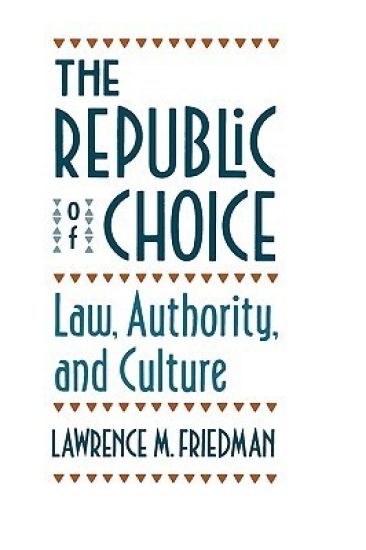
The Republic of Choice

The Republic of Choice

Lawrence M. Friedman

Harvard University Press
1998
nidottu
In this imaginative exploration of modern legal culture, Lawrence Friedman addresses how the contemporary idea of individual rights has altered the legal systems and authority structures of Western societies. Every aspect of law, he argues--from civil rights to personal-injury litigation to divorce law--has been profoundly reshaped, reflecting the power of this concept. The new individualism is quite different from that of the nineteenth century, which stressed self-control, discipline, and traditional group values. Modern individualism focuses on the individual as the starting and ending point of life and assumes a wide zone of choice. Choice is vital, fundamental: the right to develop oneself, to build up a life uniquely suited to oneself through free, open selection among forms, models, and lifestyles. With striking clarity and force, Friedman demonstrates how the new individualism results from changes in the technological and social framework of society. Loose, unconnected, free-floating, mobile: this is the modern individual, at least in comparison with the immediate past. Written for the general reader as well as lawyers and legal scholars, The Republic of Choice offers keen and original observations about legal culture and the public consciousness that informs and expresses it.