Kirjailija
Leo Tolstoy
Kirjat ja teokset yhdessä paikassa: 1 277 kirjaa, julkaisuja vuosilta 1859–2026, suosituimpiin kuuluu Classic Short Story Collection: Charles Dickens, Leo Tolstoy, Fyodor Dostoyevsky, Franz Kafka, Jack London, and Oscar Wilde. Vertaile teosten hintoja ja tarkista saatavuus suomalaisista kirjakaupoista.
1 277 kirjaa
Kirjojen julkaisuvuodet: 1859–2026.
Both critics and admirers of Tolstoy's great novel were shocked by the savage iconoclasm of his What is Art? when it appeared in 1898. How was it that this great artist could condemn the works of Shakespeare, Raphael, Beethoven and even his own Anna Karenina as 'false art'? Today's reader still has to grapple with that paradox. The essay still has power to challenge and provoke, for it was written by a giant who took art seriously while western civilisation toyed with it as a mere pastime. For Tolstoy, art was as natural and as necessary for humankind as speech. In his introduction to this translation, W. Gareth Jones shows how vitally Tolstoy's personality and experience of life were engaged in creating What is Art?, how integral the essay was to his art and teaching, and why it continues to demand a response from us.
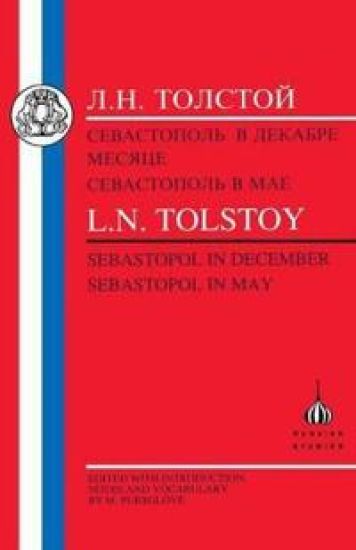
The three 'Sebastopol Stories' were based on Tolstoy's experience as a serving solider in the besieged Crimean city in 1854 and 1855. First published in book form in 1856, they consolidated the reputation the young Tolstoy had established with Childhood (1852). In Sebastopol in December, cast in the form of a guided tour of the city, Tolstoy chronicles both the patient suffering and the undemonstrative heroism of the city's defenders and civilian population. Sebastopol in May focuses on the officer class, particularly the vacillating Mikhailov and the doomed Praskukhin, the description of whose death is one of the most celebrated passages in Russian literature. In these stories Tolstoy's anti-war stance, so important in War and Peace and his later non-fictional works, is already clearly delineated. (The third story, Sebastopol in August, is not included in this edition.)
Tolstoy is most famous for his two major novels, Anna Karenina and War and Peace, but he also produced several minor masterpieces, of which The Death of Ivan Illyichis the most outstanding. In this tale he deals with the subject ofdeath, which for civilised people of our time has become a taboo. Beforeopening this book the reader should be warned: this is strong meat, notto be tasted by the squeamish. Whether the reader finds the hero'sspiritual conversion convincing or not, he/she cannot fail to beimpressed by the sheer power and artistry of Tolstoy's writing.
Childhood (Detstvo) appeared in 1852 and was Lev Tolstoy's first published work. Together with Boyhood (Otrochestvo) and Youth (Iunost') it forms a trilogy which, though fictional, is deeply rooted in Tolstoy's autobiography. As the first-person narrator grows out of childish innocence, he develops a growing awareness of the degree of deception inherent in adult behaviour and the extent to which he himself is increasingly capable of deception. Remarkable in its own right for its clear-sighted portrayal of the child's world, the work also contains in embryo themes which dominate Tolstoy's nature work. These are detailed in the introduction to this edition, which also contains full notes and a vocabulary.
Compiled by the great Russian novelist and once banned by Lenin, this classic daybook features inspirational and moral wisdom from the world's most sacred texts, as well as the works of Cicero, Rousseau, Emerson, Gogol, and other great thinkers. 30,000 first printing.
"Are you acquainted with Tolstoy's The Gospel in Brief? At its time, this book virtually kept me alive. . . . If you are not acquainted with it, then you cannot imagine what an effect it can have upon a person."—Ludwig Wittgenstein, in a letter to Ludwig von Ficker. The Gospel in Brief is Leo Tolstoy's integration of the four biblical Gospels into a single account of the life of Jesus. Inspired in large measure by Tolstoy's meticulous study of the original Greek versions of the Bible, The Gospel in Brief is a highly original fusion of biblical texts and Tolstoy's own influential religious views. Tolstoy explains that his goal is a solution to "the problem of life," not an answer to theological or historical questions. As a result, he sets aside such issues as Jesus' genealogy and divinity, or whether Jesus in fact walked on water. Instead, he focuses on the words and teachings of Jesus, stripped of what Tolstoy regarded as the Church's distortions and focus on dogma and ritual. The result is a work that emphasizes the individual's spiritual condition in a chaotic and indifferent world. Like Tolstoy's celebrated literary achievements, The Gospel in Brief has the distinct bearing of a classic: in its urgency and directness it is remarkably current, as if it were written only yesterday rather than a century ago.
In 1879 the fifty-one-year-old author of War and Peace and Anna Karenina came to believe that he had accomplished nothing and that his life was meaningless. Marking a shift in his career from the aesthetic to the religious, Tolstoy's Confession relates this spiritual crisis, posing the question: Is there any meaning in my life that will not be destroyed by my death? It is a timeless account of an individual's struggle for faith and meaning.
"Backgrounds and Sources" includes the publication history of War and Peace, selections from Tolstoy’s letters and diaries as well as three drafts of his introduction to the novel that elucidate the its evolution, and an 1868 article by Tolstoy in which he reacts to his critics. "Criticism" includes twenty essays, seven of them new, that provide diverse perspectives on the novel by Nikolai Strakhov, V. I. Lenin, Henry James, Isaiah Berlin, D. S. Mirsky, Kathryn Feuer, Lydia Ginzburg, Richard Gustafson, Gary Saul Morson, and Caryl Emerson, among others. A Chronology and Selected Bibliography are also included.
Translated by Louise and Aylmer Maude. Introduction and Notes by E. B. Greenwood, University of Kent. Anna Karenina is one of the most loved and memorable heroines of literature. Her overwhelming charm dominates a novel of unparalleled richness and density. Tolstoy considered this book to be his first real attempt at a novel form, and it addresses the very nature of society at all levels,- of destiny, death, human relationships and the irreconcilable contradictions of existence. It ends tragically, and there is much that evokes despair, yet set beside this is an abounding joy in life's many ephemeral pleasures, and a profusion of comic relief.
During his decades of world fame as a novelist, Tolstoy also wrote prolifically in a series of essays and polemics on issues of morality, social justice and religion. These works culminated in What is Art?, published in 1898. Impassioned and iconoclastic, this powerfully influential work both criticizes the elitist nature of art in nineteenth-century Western society, and rejects the idea that its sole purpose should be the creation of beauty. The works of Dante, Michelangelo, Shakespeare, Beethoven, Baudelaire and Wagner are all vigorously condemned, as Tolstoy explores what he believes to be the spiritual role of the artist - arguing that true art must work with religion and science as a force for the advancement of mankind.
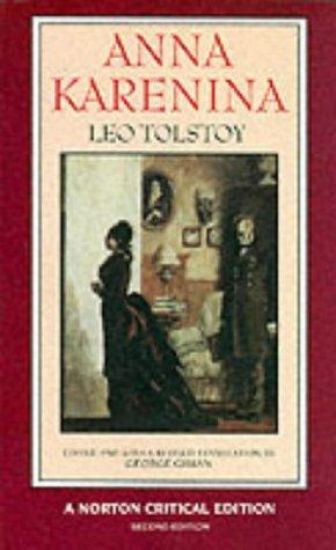
"Backgrounds and Sources" includes central passages from the letters of Tolstoy and his correspondents, S. A. Tolstoy’s diaries, and contemporary accounts translated by George Gibian exclusively for this Norton Critical Edition. Together these materials document Tolstoy’s writing process and chronicle Anna Karenina’s reception upon publication during the period 1875–77. "Criticism" unites Russian and Western interpretations to present the best canonical scholarship on Anna Karenina written between 1877 and 1994. A wide range of perspectives is provided by Fyodor M. Dostoevsky, Nikolai N. Strakhov, Matthew Arnold, M. S. Gromeka, D. S. Merezhkovsky, Boris Eikhenbaum, Henry Gifford and Raymond Williams, George Steiner, Lydia Ginzburg, Eduard Babaev, Gary Saul Morson, Caryl Emerson, Donna Tussing Orwin, and George Gibian. A Chronology of Tolstoy’s life and an updated Selected Bibliography are also included.
War and Peace broadly focuses on Napoleon's invasion of Russia in 1812 and follows three of the most well-known characters in literature: Pierre Bezukhov, the illegitimate son of a count who is fighting for his inheritance and yearning for spiritual fulfillment; Prince Andrei Bolkonsky, who leaves his family behind to fight in the war against Napoleon; and Natasha Rostov, the beautiful young daughter of a nobleman who intrigues both men. As Napoleon's army invades, Tolstoy brilliantly follows characters from diverse backgrounds - peasants and nobility, civilians and soldiers - as they struggle with the problems unique to their era, their history, and their culture. And as the novel progresses, these characters transcend their specificity, becoming some of the most moving - and human - figures in world literature.
A brilliant short novel inspired by Leo Tolstoy's experience as a soldier in the Caucasus, The Cossacks has all the energy and poetry of youth while also foreshadowing the great themes of Tolstoy's later years. His na ve hero, Olenin, is a young nobleman who is disenchanted with his privileged and superficial existence in Moscow and hopes to find a simpler life in a Cossack village. As Olenin foolishly involves himself in their violent clashes with neighboring Chechen tribesmen and falls in love with a local girl, Tolstoy gives us a wider view than Olenin himself ever possesses of the brutal realities of the Cossack way of life and the wild, untamed beauty of the rugged landscape. This novel of love, adventure, and male rivalry on the Russian frontier--completed in 1862, when the author was in his early thirties--has always surprised readers who know Tolstoy best through the vast, panoramic fictions of his middle years. Unlike those works, The Cossacks is lean and supple, economical in design and execution. But Tolstoy could never touch a subject without imbuing it with his magnificent many-sidedness, and so this book bears witness to his brilliant historical imagination, his passionately alive spiritual awareness, and his instinctive feeling for every level of human and natural life. Translated by Louise and Aylmer Maude
A brilliant short novel based on Tolstoy's early life as a soldier in the Caucusus, THE COSSACKS has all the energy and poetry of youth while at the same time foreshadowing the great themes of Tolstoy's later years. A young officer finds himself living among tribesmen on the borders of southern Russia. In depicting his experience, Tolstoy explores the birth and death of love, the transience of life, the love of honour and the pain of war, all portrayed amidst the wild and magnificent landscape of the mountains and described in exquisite detail.
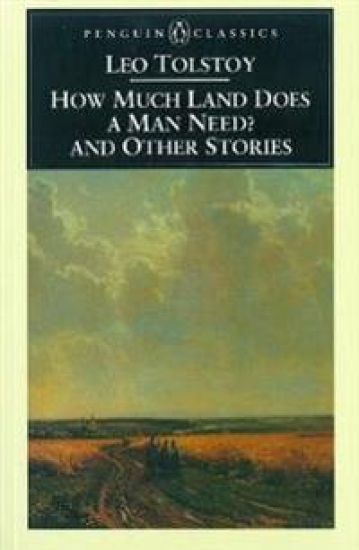
How Much Land Does a Man Need? & Other Stories
Leo Tolstoy
Penguin Classics
1993
pokkari
Halvin toimitettuna 17,00 €
These short works, ranging from Tolstoy's earliest tales to the brilliant title story, are rich in the insights and passion that characterize all of his explorations in love, war, courage, and civilization.
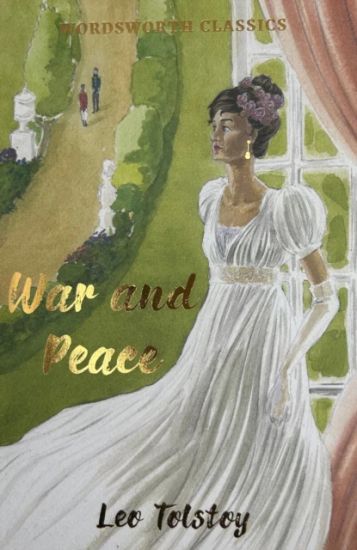
War and Peace is a vast epic centred on Napoleon's war with Russia. While it expresses Tolstoy's view that history is an inexorable process which man cannot influence, he peoples his great novel with a cast of over five hundred characters. Three of these, the artless and delightful Natasha Rostov, the world-weary Prince Andrew Bolkonsky and the idealistic Pierre Bezukhov illustrate Tolstoy's philosophy in this novel of unquestioned mastery. This translation is one which received Tolstoy's approval.
War and Peace: 3-Volume Boxed Set; Introduction by R. F. Christian
Leo Tolstoy
Everyman's Library
1992
nidottu
Halvin toimitettuna 48,10 €
A Stunning Three-Volume Boxed Set of Tolstoy's masterwork--nominated as one of America's best-loved novels by PBS's The Great American Read--War and Peace. War and Peace broadly focuses on Napoleon's invasion of Russia in 1812 and follows three of the most well-known characters in literature: Pierre Bezukhov, the illegitimate son of a count who is fighting for his inheritance and yearning for spiritual fulfillment; Prince Andrei Bolkonsky, who leaves his family behind to fight in the war against Napoleon; and Natasha Rostov, the beautiful young daughter of a nobleman who intrigues both men. As Napoleon's army invades, Tolstoy brilliantly follows characters from diverse backgrounds--peasants and nobility, civilians and soldiers--as they struggle with the problems unique to their era, their history, and their culture. And as the novel progresses, these characters transcend their specificity, becoming some of the most moving--and human--figures in world literature. This collector's boxed set of War and Peace features the classic translation by Louise and Aylmer Maude. Everyman's Library pursues the highest production standards, printing on acid-free cream-colored paper, with full-cloth cases with two-color foil stamping, decorative endpapers, silk ribbon markers, and European-style half-round spines. Everyman's Library Classics include an introduction, a select bibliography, and a chronology of the author's life and times.
This is a three-volume boxed set of Tolstoy's historical chronicle of Russia's struggle with Napoleon. The novel is an affirmation of life itself, focusing on the lives of individuals and the physical reality of human experience and its bewildering complexity.
Anna Karenina is the story of a woman who ab andons her empty existence as a society wife and embarks on a doomed love affair with the passionate but emotionally ban krupt Vronsky. It is widely acknowledged as the greatest nov el in any language '