
Kirjailija
Leon Battista Alberti
Kirjat ja teokset yhdessä paikassa: 55 kirjaa, julkaisuja vuosilta 1991–2025, suosituimpiin kuuluu Intercenales: Editio Minor. Vertaile teosten hintoja ja tarkista saatavuus suomalaisista kirjakaupoista.
55 kirjaa
Kirjojen julkaisuvuodet: 1991–2025.

I Libri della Famgilia
Leon Battista Alberti
Createspace Independent Publishing Platform
2012
nidottu
Momus is the most ambitious literary creation of Leon Battista Alberti, the famous humanist-scientist-artist and "universal man" of the Italian Renaissance. In this dark comedy, written around 1450, Alberti charts the lively fortunes of his anti-hero Momus, the unscrupulous and vitriolic god of criticism. Alberti deploys his singular erudition and wit to satirize subjects from court life and politics to philosophy and intellectuals, from grand architectural designs to human and divine folly. The possible contemporary resonance of Alberti's satire--read variously as a humanist roman-a-clef and as a veiled mockery of the mid-Quattrocento papacy--is among its most intriguing aspects. While his more famous books on architecture, painting, and family life have long been regarded as indispensable to a study of Renaissance culture, Momus has recently attracted increasing attention from scholars as a work anticipating the realism of Machiavelli and the satiric wit of Erasmus. This edition provides a new Latin text, the first to be based on the two earliest manuscripts, both corrected by Alberti himself, and includes the first full translation into English.
L'Architecture Et Art de Bien Bastir, (Éd.1553)
Leon Battista Alberti
Hachette Livre - BNF
2012
pokkari
A Treatise on Painting
Leon Battista Alberti; Leonardo Da Vinci
Dover Publications Inc.
2005
nidottu
Compiled many years after his death from numerous original manuscripts, "A Treatise on Painting is the principal repository of Leonardo da Vinci's practical thoughts on the technique of drawing and painting. It begins with precise instructions on drawing the human body and then moves on to techniques of rendering motion. Other topics covered are perspective, composition, the expression of various emotions, creating effects of light and shadow, and color. With 48 anatomical drawings by the French classicist master Nicholas Poussin and geometrical and architectural designs by the great Renaissance architect Leon Battista Alberti, this famous book remains one of the most useful and valuable art instruction books of all time. Unabridged republication of the John Francis Rigaud translation, as published by George Bell and Sons, London, 1877.
Momus is the most ambitious literary creation of Leon Battista Alberti, the famous humanist-scientist-artist and "universal man" of the Italian Renaissance. In this dark comedy, written around 1450, Alberti charts the lively fortunes of his anti-hero Momus, the unscrupulous and vitriolic god of criticism. Alberti deploys his singular erudition and wit to satirize subjects from court life and politics to philosophy and intellectuals, from grand architectural designs to human and divine folly. The possible contemporary resonance of Alberti's satire—read variously as a humanist roman-à-clef and as a veiled mockery of the mid-Quattrocento papacy—is among its most intriguing aspects. While his more famous books on architecture, painting, and family life have long been regarded as indispensable to a study of Renaissance culture, Momus has recently attracted increasing attention from scholars as a work anticipating the realism of Machiavelli and the satiric wit of Erasmus. This edition provides a new Latin text, the first to be based on the two earliest manuscripts, both corrected by Alberti himself, and includes the first full translation into English.
Grammatichetta. Grammaire de la Langue Toscane: Precede de Ordine Delle Laettere / Ordre Des Lettres
Leon Battista Alberti
Les Belles Lettres
2003
nidottu
De l'oeuvre immense de Leon Battista Alberti (1404-1472) tant par sa masse que par la variete des sujets abordes, il n'existe a ce jour aucune edition complete en Italie ni ailleurs, et encore moins de traduction complete en une langue moderne. Pourtant on s'accorde a le regarder comme la figure la plus importante de l'Humanisme italien du XVe siecle par ses contributions a la philosophie, aux lettres, a l'histoire et aussi par le fait qu'il forme un lien tres important entre le monde de l'ecrit et celui de l'art, peinture et architecture. Enfin par l'equilibre que l'on discerne en lui entre theorie et pratique. Selon l'usage de la Collection, nous donnerons dans cette serie (oeuvres completes de L.-B. Alberti) qui, a terme, comprendra une vingtaine de volumes tous les textes d'Alberti (en latin comme en italien) en edition critique, accompagnee d'une traduction francaise (le plus souvent la premiere), d'introductions, notices et notes dont la longueur sera fonction de la nouveaute et de l'interet des textes. Parmi les premiers volumes publies, nous donnons un texte pratiquement inconnu en dehors de l'Italie: un essai de grammaire et de phonetique de la langue toscane, compose par Alberti vers 1430-1440, a un moment ou l'enseignement traditionnel de la langue latine subit l'assaut des attaques violentes des humanistes (par ex. L. Valla). L'importance du travail de Alberti tient essentiellement a ce qu'il ne regarde pas le vulgaire comme un simple latin degenere, mais comme une veritable langue, susceptible d'etre decrite, avec les outils de la grammaire latine. Notre edition, qui est due au specialiste inconteste de l'histoire de la grammaire italienne, G. Patota, presente une importante introduction generale, ou l'ouvrage d'Alberti est replace dans son contexte historique: la creation des grammaires de langues vivantes au XVe siecle; elle repose sur une collection personnelle de toutes les sources anciennes (manuscrits et editions) et est accompagnee d'un riche ensemble de notes qui estiment, a l'aune de ce que nous savons sur l'Italien du XVe siecle, les observations d'Alberti. Elle est completee d' index nominum et verborum. Serie oeuvres completes d'Alberti, publiees sous la direction de F. Furlan, P. Laurens et A.-Ph. Segonds. Deja paru Rime, qui rassemble l'oeuvre poetique d'Alberti
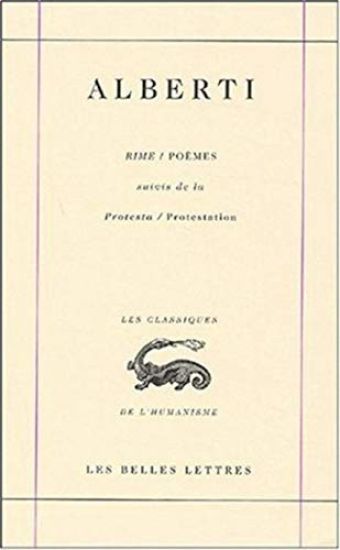
Rime / Poemes: Suivis de la Protesta / Protestation.
Leon Battista Alberti
Les Belles Lettres
2002
nidottu
De l'oeuvre immense d'Alberti tant par sa masse que par la variete des sujets abordes, il n'existe a ce jour aucune edition complete en Italie ni ailleurs, et encore moins de traduction. Il fut pourtant la figure la plus importante de l'Humanisme italien du XVe siecle, tant par ses contributions a la philosophie, aux Lettres et a l'Histoire que par son lien tres important entre le monde de l'ecrit et celui de l'art, peinture et architecture. Enfin, par l'equilibre que l'on discerne en lui entre theorie et pratique. Ce premier volume des OEuvres completes (qui en compteront une vingtaine) reunit toute l'oeuvre poetique (exclusivement italienne): au total dix-neuf pieces. Tous les types de poemes y sont abordes: elegie, eglogue, avec une connaissance remarquable de la poesie italienne precedente et de l'heritage latin. Alberti, qui n'y attachait pas une valeur particuliere, n'a jamais cherche a les rassembler. C'est pourquoi, avec sa multitude de manuscrits disperses dans toute l'Europe, l'edition fut longtemps si difficile a realiser. Desormais rassemblee, on peut enfin porter sur cette oeuvre un jugement d'ensemble, en replacant l'auteur dans les courants poetiques italiens et europeens du XVe siecle. On trouvera dans cette edition non seulement une traduction de textes souvent tres difficiles par leur subtilite, mais aussi un ensemble considerable d'informations sur la langue poetique d'Alberti, ses sources, ses references, etc. Architecte, peintre (auteur des deux premiers traites modernes de ces disciplines), ingenieur, humaniste, moraliste, ecrivain, Alberti (1404-1472) fut, avant Leonard de Vinci, le premier exemple de l'homme universel , genial et inclassable. Dans la collection Le Corps fabuleux , les Belles Lettres ont deja publie: Momus ou le prince, l'un des seuls romans de la Renaissance, les Fables sans morale (1997), couplees aux Propheties facetieuses de Leonard de Vinci, et Le Cheval vivant (1999). Ce volume amorce la publication complete des oeuvres d'Alberti.
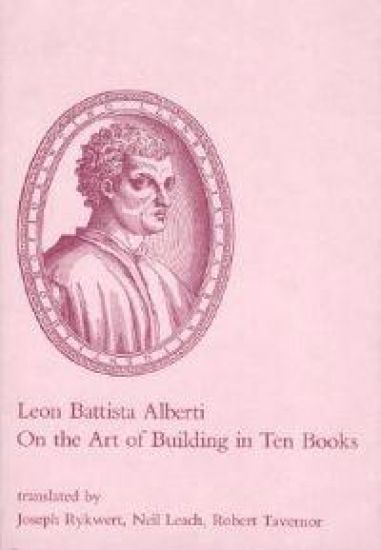
De Re Aedificatoria, by Leon Battista Alberti (1404-1472), was the first modern treatise on the theory and practice of architecture. Its importance for the subsequent history of architecture is incalculable, yet this is the first English translation based on the original, exceptionally eloquent Latin text on which Alberti's reputation as a theorist is founded.