Kirjailija
Marquis De Sade
Kirjat ja teokset yhdessä paikassa: 160 kirjaa, julkaisuja vuosilta 1965–2026, suosituimpiin kuuluu Justine. Vertaile teosten hintoja ja tarkista saatavuus suomalaisista kirjakaupoista.
160 kirjaa
Kirjojen julkaisuvuodet: 1965–2026.
The 120 Days of Sodom is the most extreme book in the history of literature. The Marquis de Sade narrates the escalating sex-crimes of four libertines who barricade themselves in a remote castle with both male and female victims and accomplices for a four-month, precipitous orgy of sodomy, coprophagia and rape leading inexorably towards torture and human decimation. A masterpiece of black humour, pornographic to a point of excess and aberration never reached by any other writer, and required reading for anyone looking for the seminal origins of contemporary culture's fascination with cruelty and violence, The 120 Days of Sodom is the first and ultimate literary outrage. It also stands as the first attempt by an author to collate a systematic psychopathology of human sexual disorder, pre-dating Krafft-Ebing's Psychopathia Sexualis by a century. Until now, Sade's masterwork was only available in tame, outdated translations. This new, uncensored and more complete version of The 120 Days of Sodom brings the work back to incendiary life, returning it to the streamlined status of the revolutionary, raw work Sade had intended. Unbearable, unforgettable, violent, cruel, blasphemous, obscene: The 120 Days of Sodom is a unique and addictive detonation of the senses for the discerning 21st century reader. With a foreword by Georges Bataille, author of The Story of the Eye.

Dialogue Between a Priest and a Dying Man
Marquis de Sade; Maurice Heine
Literary Licensing, LLC
2011
nidottu

Dialogue Between a Priest and a Dying Man
Marquis de Sade; Maurice Heine
Literary Licensing, LLC
2011
sidottu
""Dialogue Between A Priest And A Dying Man"" is a controversial book written by the infamous Marquis de Sade. The book is a philosophical and theological debate between a dying man and a priest. The dying man is a skeptic who questions the existence of God and the validity of religion, while the priest attempts to convince him of the truth of Christianity. Throughout the dialogue, de Sade explores themes such as morality, reason, faith, and the nature of God. The book is known for its explicit and graphic language, as well as its challenging and provocative ideas. Despite its controversial content, ""Dialogue Between A Priest And A Dying Man"" remains an important work in the history of philosophy and literature. This scarce antiquarian book is a facsimile reprint of the old original and may contain some imperfections such as library marks and notations. Because we believe this work is culturally important, we have made it available as part of our commitment for protecting, preserving, and promoting the world's literature in affordable, high quality, modern editions, that are true to their original work.


The 120 Days of Sodom by Marquis de Sade relates the story of four wealthy men who enslave 24 mostly teenaged victims and sexually torture them while listening to stories told by old prostitutes. The book was written while Sade was imprisoned in the Bastille and the manuscript was lost during the storming of the Bastille. Sade wrote that he "wept tears of blood" over the manuscript's loss. Many consider this to be Sade crowing acheivment.

Cupido ergo sum er prinsippet i denne boken, hvor en ung jomfru skoleres i de mest grunnleggende seksuelle perversjoner. Underveis møter leseren det erotiske, det vittige og skrekkelige side om side når forfatteren øser sitt raseri over Gud, kirken, historien, ekteskapet og den borgerlige dobbeltmoral.
'Senneval, you see in me your sister, the girl you seduced at Nancy, the woman who murdered your son, the wife of your own father and the ignoble creature who sent your mother to the gallows...' Who but the Marquis de Sade would write, not of the pain, tragedy, and joy of love but of its crimes? Murder, seduction, and incest are among the cruel rewards for selfless love in his stories; tragedy, despair, and death the inevitable outcome. Sade's villains will stop at nothing to satisfy their depraved passions, and they in turn suffer under the thrall of love. Psychologically astute, and defiantly unconventional, these stories show Sade at his best. A skilled and artful storyteller, he is also an intellectual who asks questions about society, about ourselves, and about life, for which we have yet to find the answers. This new selection includes 'An Essay on Novels', Sade's penetrating survey of the novelist's art. ABOUT THE SERIES: For over 100 years Oxford World's Classics has made available the widest range of literature from around the globe. Each affordable volume reflects Oxford's commitment to scholarship, providing the most accurate text plus a wealth of other valuable features, including expert introductions by leading authorities, helpful notes to clarify the text, up-to-date bibliographies for further study, and much more.
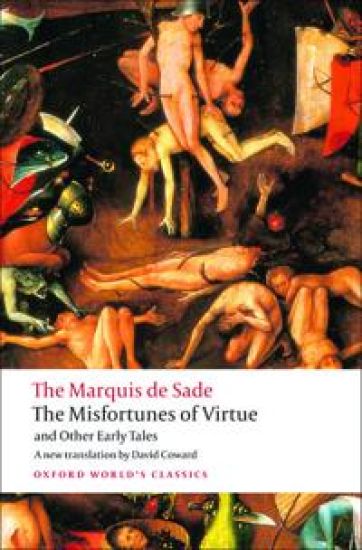
The Misfortunes of Virtue and Other Early Tales
Marquis de Sade
Oxford University Press
2008
nidottu
Halvin toimitettuna 18,90 €
The name of the Marquis de Sade is synonymous with the blackest corners of the human soul, a byword for all that is foulest in human conduct. In his bleak, claustrophobic universe, there is no God, no morality, no human affection, and no hope. Power is given to the strong, and the strong are murderers, torturers, and tyrants. No quarter is given; compassion is the virtue of the weak. Yet Sade was a man of savage intelligence who carried the philosophy of the French Enlightenment to its logical extreme. His writings effectively release the individual from all social and moral constraint: for many, Sade is the Great Libertarian. The Victorians considered him `Divine' and Apollinaire called him `the freest spirit'; the Surrealists recognised him as a founding father, and he is a key figure in the history of modernism and post-modernism. With Freud and Marx, Sade has been one of the crucial shaping influences on this century, and reactions to him continue to be extreme. But he has always been more talked about than read. This selection of his early writings, some making their first appearance in this new translation, reveals the full range of Sade's sobering moods and considerable talents. ABOUT THE SERIES: For over 100 years Oxford World's Classics has made available the widest range of literature from around the globe. Each affordable volume reflects Oxford's commitment to scholarship, providing the most accurate text plus a wealth of other valuable features, including expert introductions by leading authorities, helpful notes to clarify the text, up-to-date bibliographies for further study, and much more.
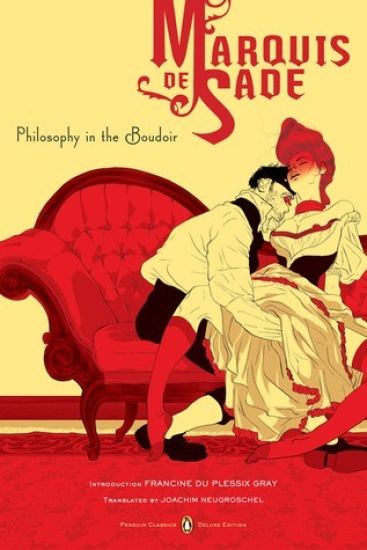
Philosophy in the Bedroom accounts the lascivious education of a privileged young lady at the dawn of womanhood.

Sade is best known for his sensational books Justine, Juliette and Les Cent Vert (The One Hundred Days of Sodom), yet in his lifetime these and other major works appeared in anonymous or clandestine editions or remain unpublished. It was while he was detained in prison and incarcerated in the asylum at Charenton that he decided to follow his 'philosophical' novel Aline et Valcour with writings more accessible to the general public. And he wanted to prove that he was not a mere pornographer but a moralist, like Voltaire and other contemporaries. In The Crimes of Love Sade contends that love can lead to crime and thence to punishment. Uni-like the villains of his major novels, the men and women described in these pages all come to a sticky end. Sade was fascinated by incest but claimed that he did 'not want to make vice liked.' The stories also illustrate his love of history and his frustrated passion for drama, while 'Rodrigo or the Enchanted Tower' is an intriguing example of this complex writer's flight into fantasy - his only means of escape from detention.


Here, in one volume, are three major novels by the Marquis de Sade, including the only authentic and complete British edition of his most famous work JUSTINE: one of his most daring works, PHILOSOPHY IN THE BEDROOM: and the eighteenth-century masterpiece, EUGENIE DE FRANVAL.
A still unsurpassed catalogue of sexual perversions and the first systematic exploration of the psychopathology of sex, it was written during Sade's lengthy imprisonment for sexual deviancy and blasphemy and then lost after the storming of the Bastille during the French Revolution in 1789.