Kirjojen hintavertailu – 12 859 824 kirjaa ja 27 kauppaa

Kirjailija

Martin Gardner

Kirjat ja teokset yhdessä paikassa: 65 kirjaa, julkaisuja vuosilta 1964–2022, suosituimpiin kuuluu Casey at the Bat. Vertaile teosten hintoja ja tarkista saatavuus suomalaisista kirjakaupoista.

65 kirjaa

Kirjojen julkaisuvuodet: 1964–2022.

My Best Mathematical and Logic Puzzles

My Best Mathematical and Logic Puzzles

Martin Gardner

Dover Publications Inc.
2003
nidottu

Halvin toimitettuna 12,80 €

The noted expert and longtime author of Scientific American's Mathematical Games column selects 70 of his favorite "short" puzzles. Enthusiasts can challenge their skills with such mind-bogglers as The Returning Explorer, The Mutilated Chessboard, Scrambled Box Tops, Bronx vs. Brooklyn, and dozens more involving logic and basic math. Complete solutions included.

Did Adam and Eve Have Navels?

Did Adam and Eve Have Navels?

Martin Gardner

WW Norton Co
2001
nidottu

Halvin toimitettuna 31,80 €

Martin Gardner is perhaps the wittiest, most devastating unmasker of scientific fraud and intellectual chicanery of our time. Here he muses on topics as diverse as numerology, New Age anthropology, and the late Senator Claiborne Pell's obsession with UFOs, as he mines Americans' seemingly inexhaustible appetite for bad science. Gardner's funny, brilliantly unsettling exposés of reflexology and urine therapy should be required reading for anyone interested in "alternative" medicine. In a world increasingly tilted toward superstition, Did Adam and Eve Have Navels? will give those of us who prize logic and common sense immense solace and inspiration. "Gardner is a national treasure... I wish [this] could be made compulsory reading in every high school—and in Congress."—Arthur C. Clarke "Nobody alive has done more than Gardner to spread the understanding and appreciation of mathematics, and to dispel superstition."— The New Criterion, John Derbyshire
A Gardner's Workout

A Gardner's Workout

Martin Gardner

A K Peters
2001
sidottu
For many decades, Martin Gardner, the Grand Master of mathematical puzzles, has provided the tools and projects to furnish our all-too-sluggish minds with an athletic workout. Gardner's problems foster an agility of the mind as they entertain. This volume presents a new collection of problems and puzzles not previously published in book form. Martin Gardner has dedicated it to "all the underpaid teachers of mathematics everywhere, who love their subject and are able to communicate that love to their students."
More Mathematical Puzzles of Sam Loyd

More Mathematical Puzzles of Sam Loyd

Martin Gardner

Dover Publications Inc.
2000
nidottu
Sam Loyd (1841-1911) was America's greatest originator of puzzles. For more than 50 years, his ingenious posers, appearing in innumerable newspaper and magazine articles, stumped and delighted an American public running into the millions. (Four or five of his mechanical puzzles became national crazes.) After Loyd's death, his son issued a vast collection of these problems in a book entitled "Cyclopedia of Puzzles" -- probably the most famous and exciting collection of puzzles ever assembled in one volume. Now Martin Gardner, a well-known author of many science and puzzle books and articles, has selected the choicest mathematical puzzles contained in the long out-of-print "Cyclopedia," editing each one for accuracy and clarity, but in such a way as not to sacrifice the unique style and historical flavor of the originals. This is the second volume of Gardner's selection to appear, and contains 166 of Loyd's most brilliant and original creations, together with the 150 line drawings and diagrams with which they were originally illustrated. A distinctive feature of this new selection is the analytical table of contents, which groups the puzzles according to the type of mathematical skill necessary to solve them. Whatever your taste in mathematical puzzles, you will be able to locate easily puzzles based on arithmetic and algebra; speed and distance problems; game theory; operations research; clock problems; plane geometry; geometrical dissection; route tracing and topological problems; counter and sliding block problems; sold geometry; and physics and calculus problems.
Entertaining Mathematical Puzzles

Entertaining Mathematical Puzzles

Martin Gardner; Sean Shesgreen

Dover Publications Inc.
2000
nidottu

Halvin toimitettuna 17,40 €

Only an elementary knowledge of math is needed to enjoy this entertaining compilation of brain-teasers. It includes a mixture of old and new riddles covering a variety of mathematical topics: money, speed, plane and solid geometry, probability, topology, tricky puzzles and more. Carefully explained solutions follow each problem. 65 black-and-white illustrations.
Alice in Wonderland

Alice in Wonderland

Lewis Carroll; Martin Gardner

Dover Publications Inc.
2000
nidottu

Halvin toimitettuna 11,60 €

Beloved classic describes a little girl's adventures in a topsy-turvy land underground and her encounters with such improbable characters as the White Rabbit, March Hare and Mad Hatter, the sleepy Dormouse, grinning Cheshire Cat, Mock Turtle, and the dreadful Queen of Hearts. Includes all 42 of Sir John Tenniel's original illustrations.
Mathematical Puzzle Tales

Mathematical Puzzle Tales

Martin Gardner

American Mathematical Society
2000
nidottu
Martin Gardner is widely known for his writing on recreational mathematics, not least for the myriad problems he has devised over some 25 years for Scientific American. In this book are 36 of his best brainteasers. These are not simply cunning puzzles, but serve to illustrate the art of the mathematician as problem solver, and their solution draws on ideas from topology, probability, number theory, logic and beyond. Fully worked answers are given, which, in turn, lead to additional problems for the reader. For anybody who likes to solve mathematical problems, this book will be both entertaining and a challenge.
Gardner's Whys & Wherefores

Gardner's Whys & Wherefores

Martin Gardner

Prometheus Books
1999
pokkari
Martin Gardner's legacy in mathematics and science is well established, and never is he so at home than when picking apart paranormal claims and pseudoscience. Yet like Isaac Asimov, Gardner's interests encompass a wide range of views and arguments. His wit and encyclopedic knowledge have made him a sought-after contributor to Discover, Nature, Psychology Today, and The New York Review of Books. A delightful collection of his best essays, Gardner's Whys & Wherefores includes articles on the puzzles in James Joyce's Ulysses and on the fantasies of Ray Bradbury, Arthur C. Clarke, Lord Dunsany, Gilbert Chesterton, and H. G. Wells. Gardner expresses strong opinions about the "anthropic principle," computer games capable of discovering scientific laws, the philosophy of W. V. Quine, Marvin Minsky's view of the workings of the mind, the idiosyncrasies of social theorist Allan Bloom, the reality of unknown digits that "sleep" in pi, and whether physicists are really on the verge of discovering Everything. A delightful bit of publishing history is a hilarious selection from The New York Review of Books in which Gardner, writing under a pseudonym, blasts his own book, The Ways of a Philosophical Scrivener. Exciting, provocative, and enduring, Gardner's Whys & Wherefores is a distinct pleasure.
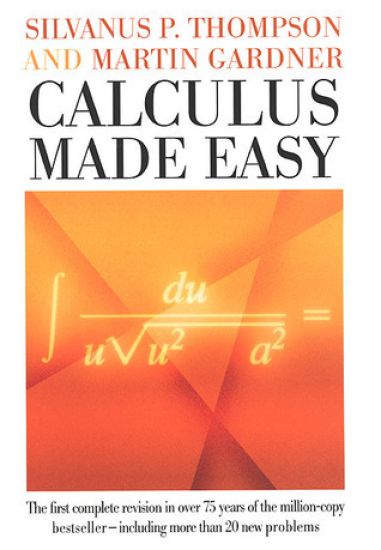
Calculus Made Easy

Calculus Made Easy

Silvanus P Thompson; Martin Gardner

Red Globe Press
1999
nidottu
Calculus Made Easy has been a classic introduction to the subject ever since it was first published by Silvanus P. Thompson in 1910. In the first major revision of the text since 1946, Martin Gardner - the 'Mathematical Games' columnist for Scientific American and author of over 50 books and innumerable articles - has thoroughly updated the text to reflect recent developments in method and terminology, written an extensive preface and three new chapters, and added more than 20 recreational problems for practice and enjoyment. He has transformed this classic primer into a modern masterpiece that explains the timeless concepts of calculus in a contemporary and user-friendly voice.
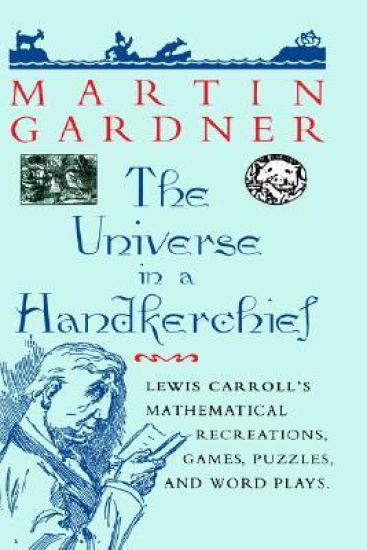
The Universe in a Handkerchief

The Universe in a Handkerchief

Martin Gardner

Copernicus Books
1998
sidottu
This book contains scores of intriguing puzzles and paradoxes from Lewis Carroll, the author of Alice in Wonderland, whose interests ranged from inventing new games like Arithmetical Croquet to important problems in symbolic logic and propositional calculus. Written by Carroll expert and well-known mathematics author Martin Gardner, this tour through Carroll's inventions is both fun and informative.
Calculus Made Easy

Calculus Made Easy

Silvanus P. Thompson; Martin Gardner

St. Martin's Press
1998
sidottu

Halvin toimitettuna 27,20 €

Calculus Made Easy by Silvanus P. Thompson and Martin Gardner has long been the most popular calculus primer. This major revision of the classic math text makes the subject at hand still more comprehensible to readers of all levels. With a new introduction, three new chapters, modernized language and methods throughout, and an appendix of challenging and enjoyable practice problems, Calculus Made Easy has been thoroughly updated for the modern reader.
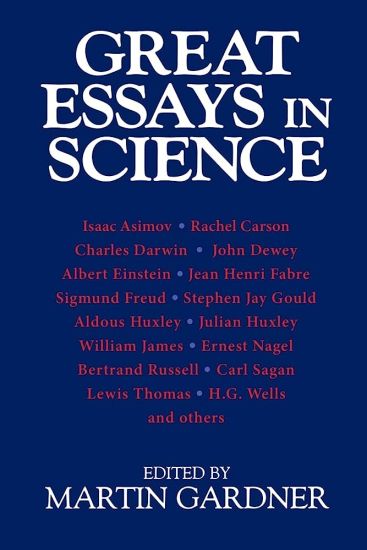
Great Essays in Science

Great Essays in Science

Martin Gardner

Prometheus Books
1994
pokkari
Martin Gardner, author of numerous books on science, mathematics, and pseudo-science, has assembled thirty-four extraordinary essays by eminent philosophers, scientists, and writers on the fundamental aspects of modern science. As Gardner makes clear in his preface to the formerly titled Sacred Beetle and Other Great Essays in Science, his intent is not to teach the reader science or to report on the latest trends and discoveries. "Rather, the purpose of this book is to spread before the reader, whether his or her interest in science be passionate or mild, a sumptuous feast of great writing - absorbing, thought-disturbing pieces that have something to say about science and say it forcibly and well." Gardner's entertaining biographical commentaries make Great Essays in Science a rich store of good reading and an informal history of the people and ideas that have shaped our culture and transformed our everyday lives. This collection includes works by Isaac Asimov, Rachel Carson, Charles Darwin, John Dewey, Albert Einstein, Jean Henri Fabre, Sigmund Freud, Stephen Jay Gould, Aldous Huxley, Julian Huxley, William James, Ernest Nagel, Bertrand Russell, Carl Sagan, Lewis Thomas, H. G. Wells, and others.
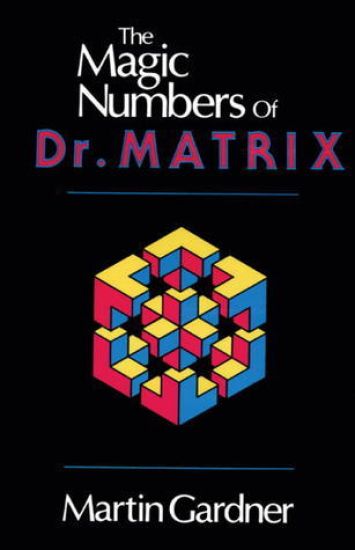
The Magic Numbers of Dr. Matrix

The Magic Numbers of Dr. Matrix

Martin Gardner

Prometheus Books
1985
pokkari
The Magic Numbers of Dr. Matrix draws us into the intriguing and fascinating world of numbers and number theory. "Numbers, you know, have a mysterious life of their own. It would be naive," claims Dr. Matrix, "to suppose that there is such a thing as a randomly arranged group of symbols." Consider, for example, the decimal expansion of pi. Long considered a random series, it is actually rich with remarkable patterns. "Correctly interpreted," says Dr. Matrix, "pi conveys the entire history of the human race." Dr. Matrix uncovers patterns and signs that will astound you. As Dr. Matrix demonstrates, we need only look to find clues all around us in number and language "coincidences" that will unlock the mysteries of the universe. In The Magic Numbers of Dr. Matrix, Martin Gardner introduces us to this extraordinary man, Dr. Irving Joshua Matrix. Believed by many to be the greatest numerologist who ever lived, Dr. Matrix claims to be a reincarnation of Pythagoras. He was, however, completely unknown to the scientific community until Gardner wrote about him in Scientific American in 1960. That first report and the subsequent ones that appeared with each new encounter are collected here in their entirety. We follow Dr. Matrix as he roams the world and assumes new identities and discovers new manifestations of the power of numbers to explain and predict and entertain. Always at his side is his beautiful Eurasian daughter, Iva, who abets and protects her father in each new adventure. As you delve into The Magic Numbers of Dr. Matrix, you will master some significant combinatorial mathematics and number theory. The many remarkable puzzles of Dr. Matrix are all clearly answered in the back of the book, together with commentary and references by Gardner to enlighten the uninitiated and entertain the inquiring reader.
Mathematische Knobeleien

Mathematische Knobeleien

Martin Gardner

Springer Vieweg
1984
nidottu
Bei dem englischen Mathematiker john Edenser Littlewood steht in der Einleitung zu Mathematician's Miscellany, einer Sammlung mathematischer Miscellen, unter anderem der Satz: "Ein guter mathematischer Scherz ist immer besser - und zwar sogar als Mathematik besser - als ein ganzes Dutzend mittelmassiger gelehrter Ab- handlungen. " Mathematische Scherze bilden den Inhalt dieses Buches - wenn man grosszugig ist und alles als Scherz gelten lasst, was ein gewisses Element des Vergnuglichen enthalt. Es gibt kaum einen Mathematiker, der nicht eine gewisse Freude an mathematischen Spielereien hatte; aber die meisten lassen sich auf solche Spielereien naturlich nur mit Massen und innerhalb vernunftiger Grenzen ein. Daneben aber gibt es auch Menschen, auf die die Faszination des mathematischen Spiels beinahe wie ein Rauschgift wirken kann. Lushin, der Held von Nabokovs grossartigem Schach- spielerroman "Lushins Verteidigung" (The Defense), ist solch ein Mensch. Er ist vom Schachspiel (das ja unleugbar ein Produkt des mathematischen Spieltriebs ist) dermassen besessen, dass er nach und nach voellig den Kontakt zur Wirklichkeit ver- liert und zuguterletzt die erbarmliche Partie seines Lebens durch einen Sprung aus dem Fenster - ein "Selbstmatt" - beenden muss.
Mathemagische Tricks

Mathemagische Tricks

Martin Gardner

Vieweg+Teubner Verlag
1981
nidottu
Wie viele andere Bereiche, die sich tiber mehrere Fachgebiete erstrecken, wird oft auch die mathematische Zauberei in zweifacher Hinsicht geringschiitzig behandelt. Mathematiker betrachten sie gerne als triviale Spielerei, die Zauberer lehnen sie als zu schwerfallig abo Wenn man ein Epigramm tiber Biophysiker auf diese Situation anwendet, so langweilen die Anhanger der mathematischen Zauberei ihre Mathe- matikerfreunde, indem sie tiber Zauberei reden, ihre Zauberfreunde durch Reden tiber Mathematik und sich gegenseitig durch Gesprache tiber Politik. In dieser Kritik steckt ein Funke Wahrheit. Mathematische Zauberei ist - man soll sich nichts vormachen - nicht die Art Zauberei, die ein mathematisch uninteressiertes Publikum langere Zeit fasziniert. Tricks dieser Art sind zu lang und dramatisch nur wenig effektvoll. Auch ist es nicht wahrscheinlich, dag man tiefgehende mathematische Einsichten gewinnt, wenn man sich iiber Tricks mathematischen Cha- rakters den Kopf zerbricht. Trotzdem iibt die mathematische Zauberei, wie auch Schach, eine eigene Anziehungskraft aus. Schach vereinigt die Schonheit mathema- tischer Struktur mit dem erholsamen Vergniigen eines Wettspiels. Die mathematische Zauberei vereinigt die Sch6nheit mathematischer Struktur mit dem Unterhaltungswert eines Tricks. Es ist deshalb nicht verwunderlich, dag die mathematische Zauberei am meisten denen Vergntigen bereitet, die sowohl gerne zaubern als auch Unterhaltungs- mathematik betreiben.
Logik unterm Galgen

Logik unterm Galgen

Martin Gardner

Vieweg+Teubner Verlag
1980
nidottu
Piet Hein, dessen Erfmdungen auf dem Gebiet der unterhaltsamen Mathe- matik mir oft Stoff fUr meine Kolumne, Mathematische Spiele" in der Zeit- schrift "Scientific American" geliefert haben, ist in seiner Heimat Danemark wohlbekannt. Er ist Autor au erordentlich popularer und anscheinend end- loser Bticherserien mit kurzen epigrammatischen Gedichten, die er "Grooks" nennt, alle in gefalligem Stil, geistreich und angefiillt mit den Kenntnissen eines Mannes, der sowohl in Wissenschaft und Mathematik als auch in Politik und Kunst zuhause ist. Der erste Band der englischen Ausgabe seiner Ge- dichte 1) enthiilt folgenden Vers: Nimmst Du Sp Nur als Sp Und Ernstes 1m Ernst, So ist kein Verl, D Du beides erkennst. Ich te nicht, wie man den Leitgedanken dieses Buches knapper und tref- fender fassen k6nnte. Es nlihert sich der Mathematik mit sehr viel Sp; in diesem Sp steckt aber das ernsthafte Bemlihen, den Leser in Gebiete der Mathematik einzufUhren, die vom Trivialen weit entfernt sind. Es sind Ge- biete, die eine wesentliche Rolle in der technischen Revolution spielen, die so explosiv die Geschichte und unser tagliches Leben verandert. Dies ist der ftinfte Band meiner Kolumnensammlung aus dem "Scientific American", bei Simon und Schuster erschienen (einsch1ie lich eines kleinen Bandes: "The Numerology of Dr. Matrix", erschienen 1967). Wie in meinen frliheren Banden erweiterte ich jede Kolumne tells mit Material, das ich seit der ersten Kolumne zufallig fand, tells mit Material, das mir treue Leser schickten.