Kirjojen hintavertailu – 12 903 725 kirjaa ja 27 kauppaa

Kirjailija

Martin Heidegger

Kirjat ja teokset yhdessä paikassa: 209 kirjaa, julkaisuja vuosilta 1956–2027, suosituimpiin kuuluu Martin Heidegger, Ontologie. Hermeneutik Der Faktizitat. Vertaile teosten hintoja ja tarkista saatavuus suomalaisista kirjakaupoista.

209 kirjaa

Kirjojen julkaisuvuodet: 1956–2027.

Pathmarks

Pathmarks

Martin Heidegger

Cambridge University Press
1998
pokkari

Halvin toimitettuna 37,00 €

This is the first time that a seminal collection of fourteen essays by Martin Heidegger (originally published in German under the title Wegmarken) has appeared in English in its complete form. It includes new or first-time translations of seven essays, and thoroughly revised, updated versions of the other seven. Amongst the new translations are such key essays as ‘On the Essence of Ground’, ‘Hegel and the Greeks’ and ‘On the Question of Being’. Spanning a period from 1919–1961, these essays have become established points of reference for all those with a serious interest in Heidegger. Now collected for the first time in translations by an experienced Heidegger translator and scholar, they will prove an essential resource for all students of Heidegger.

Till tänkandets sak

Till tänkandets sak

Martin Heidegger

Bokförlaget Thales
1998
sidottu
Denna volym innehåller tre uppsatser: Tid och vara från den allra sista fasen av Heideggers tänkande, Filosofins slut och tänkandets uppgift, med immanent kritik av frågeställningen i Varat och tiden, och den självbiografiska skissen Min väg in i fenomenologin.
Phenomenological Interpretation of Kant's Critique of Pure Reason
The text of Martin Heidegger's 1927–28 university lecture course on Emmanuel Kant's Critique of Pure Reason presents a close interpretive reading of the first two parts of this masterpiece of modern philosophy. In this course, Heidegger continues the task he enunciated in Being and Time as the problem of dismatling the history of ontology, using temporality as a clue. Within this context the relation between philosophy, ontology, and fundamental ontology is shown to be rooted in the genesis of the modern mathematical sciences. Heidegger demonstrates that objectification of beings as beings is inseparable from knowledge a priori, the central problem of Kant's Critique. He concludes that objectification rests on the productive power of imagination, a process that involves temporality, which is the basic constitution of humans as beings.
Kant and the Problem of Metaphysics, Fifth Edition, Enlarged

Kant and the Problem of Metaphysics, Fifth Edition, Enlarged

Martin Heidegger

Indiana University Press
1997
pokkari

Halvin toimitettuna 28,90 €

Since its original publication in 1929, Martin Heidegger's provocative book on Kant's Critique of Pure Reason has attracted much attention both as an important contribution to twentieth-century Kant scholarship and as a pivotal work in Heidegger's own development after Being and Time. This fifth, enlarged edition includes marginal notations made by Heidegger in his personal copy of the book and four new appendices—Heidegger's postpublication notes on the book, his review of Ernst Cassirer's Philosophy of Symbolic Forms, Heidegger's response to reviews by rudolf Odebrecht and Cassirer, and an essay "On the History of the Philosophical Chair since 1866." The work is significant not only for its illuminating assessment of Kant's thought but also for its elaboration of themes first broached in Being and Time, especially the problem of how Heidegger proposed to enact his destruction of the metaphysical tradition and the role that his reading of Kant would play therein.
Hölderlin's Hymn "the Ister"

Hölderlin's Hymn "the Ister"

Martin Heidegger

Indiana University Press
1996
sidottu
Martin Heidegger's 1942 lecture course interprets Friedrich Hölderlin's hymn "The Ister" within the context of Hölderlin's poetic and philosophical work, with particular emphasis on Hölderlin's dialogue with Greek tragedy. Delivered in summer 1942 at the University of Freiburg, this course was first published in German in 1984 as volume 53 of Heidegger's Collected Works. Revealing for Heidegger's thought of the period are his discussions of the meaning of "the political" and "the national," in which he emphasizes the difficulty and the necessity of finding "one's own" in and through a dialogue with "the foreign." In this context Heidegger reflects on the nature of translation and interpretation. A detailed reading of the famous chorus from Sophocles' Antigone, known as the "ode to man," is a key feature of the course.
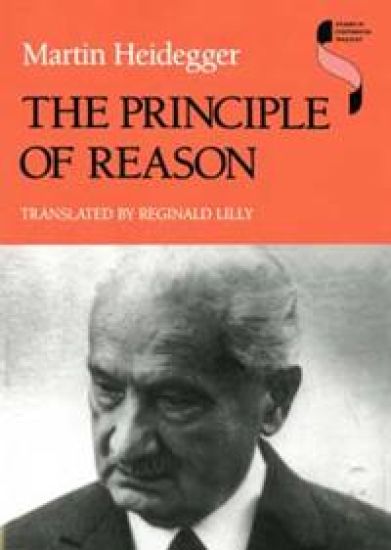
The Principle of Reason

The Principle of Reason

Martin Heidegger

Indiana University Press
1996
pokkari

Halvin toimitettuna 26,50 €

The Principle of Reason, the text of an important and influential lecture course that Martin Heidegger gave in 1955–56, takes as its focal point Leibniz's principle: nothing is without reason. Heidegger shows here that the principle of reason is in fact a principle of being. Much of his discussion is aimed at bringing his readers to the "leap of thinking," which enables them to grasp the principle of reason as a principle of being. This text presents Heidegger's most extensive reflection on the notion of history and its essence, the Geschick of being, which is considered on of the most important developments in Heidegger's later thought. One of Heidegger's most artfully composed texts, it also contains important discussions of language, translation, reason, objectivity, and technology as well as remarkable readings of Leibniz, Kant, Aristotle, and Goethe, among others.
Identitet och differens

Identitet och differens

Martin Heidegger

Bokförlaget Thales
1996
sidottu
Volymen innehåller två texter, Identitetssatsen och Metafysikens onto-teo-logiska uppbyggnad. I den förra presenteras centrala teman i Hei-deggers sena filosofi. I den senare ställer Heidegger sitt eget filosofiska program mot Hegels filosofi och försöker ge en bestämning av metafysikens väsen.
Brev om humanismen

Brev om humanismen

Martin Heidegger

Bokförlaget Thales
1996
sidottu
I denna skrift som Heidegger skrev 1946 kommenterar han sin filosofiska "vändning" på 30-talet, och utvecklar en kritik av humanismen som filosofiskt program, med särskild tonvikt på existentialismen. Humanismen hör hemma i en modern subjektsfilosofisk tradition och är grundad i en metafysisk förståelse av människan och hennes relation till det som är.
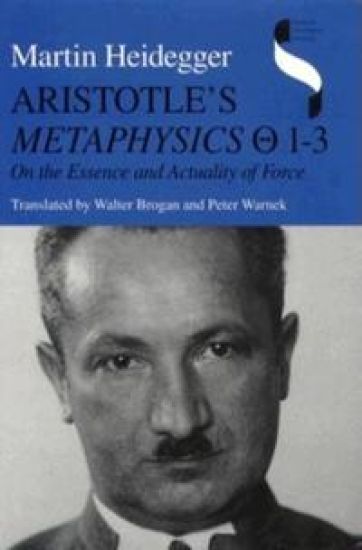
Aristotle's Metaphysics 1–3

Aristotle's Metaphysics 1–3

Martin Heidegger

Indiana University Press
1995
sidottu

Halvin toimitettuna 39,40 €

Martin Heidegger's reading of Aristotle was one of the pivotal influences in the development of his philosophy. First published in German in 1981 as volume 33 of Heidegger's Collected Works, this book translates a lecture course he presented at the University of Freiburg in 1931. Heidegger's careful translation and his probing commentary on the first three chapters of Book IX of Metaphysics show the close correlation between his phenomenological interpretation of the Greeks (especially of Aristotle) and his critique of metaphysics. Additionally, Heidegger's confrontation with Aristotle's Greek text makes a significant contribution to contemporary scholarship on Aristotle, particularly the understanding of potentiality in Aristotle's thought. Finally, the book exemplifies Heidegger's gift for teaching students how to read a philosophical text and how to question that text in a philosophical way.
Martin Heidegger, Heraklit - 1. Der Anfang Des Abendlandischen Denkens (Sommersemester 1943) 2. Logik. Heraklits Lehre Vom Logos (Sommersemester 1944)
Die beiden Vorlesungen des Sommersemesters 1943 und 1944 stellen eine breite Grundlage zu den von Martin Heidegger selbst noch veroffentlichten Schriften uber Heraklit her. In der ersten Vorlesung wird der Grund des Ursprungs der abendlandischen Metaphysik durch den Anfang erfahren, in dem das Denken sein Wesen, das anfanglich Zu-denkende, in Anspruch nimmt. Die zweite Vorlesung geht hinter die Zweideutigkeit der Logik als Logik des richtigen Denkens und als Logik der Sachen zuruck in die ursprungliche Logik: des Denkens des Logos, wie es sich bei Heraklit ereignet hat.
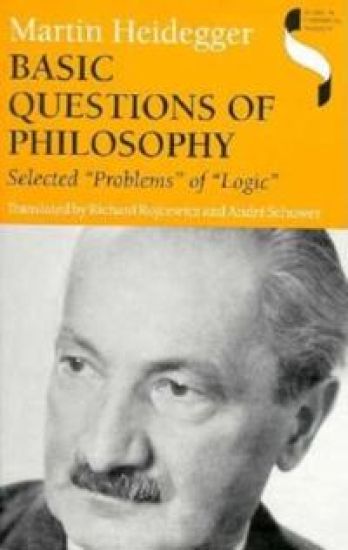
Basic Questions of Philosophy

Basic Questions of Philosophy

Martin Heidegger

Indiana University Press
1994
sidottu
First published in German in 1984 as volume 45 of Martin Heidegger's collected works, this book is the first English translation of a lecture course he presented at the University of Freiburg in 1937–1938. Heidegger's task here is to reassert the question of the essence of truth, not as a "problem" or as a matter of "logic," but precisely as a genuine philosophical question, in fact the one basic question of philosophy. Thus, this course is about the essence of truth and the essence of philosophy. On both sides Heidegger draws extensively upon the ancient Greeks, on their understanding of truth as aletheia and their determination of the beginning of philosophy as the disposition of wonder. In addition, these lectures were presented at the time that Heidegger was composing his second magnum opus, Beiträge zur Philosophie, and provide the single best introduction to that complex and crucial text.
Schellings Abhandlung Über Das Wesen Der Menschlichen Freiheit (1809)
In the course of Heidegger's philosophical development we find a recurrent engagement with Schelling's ideas, to which he devoted a number of lectures and seminars. Of central concern to him was Schelling's -Philosophical Investigations into the Nature of Human Freedom and Related Subjects- (= -Of Human Freedom-). The present edition combines the script of the 1936 lecture with an annex containing pertinent extracts from the 1941 lecture and selected seminar notes from subsequent years. For this second edition the text has been carefully emended, printing errors excised and deviations from the original manuscript corrected."
Basic Writings: Martin Heidegger

Basic Writings: Martin Heidegger

Martin Heidegger

Routledge
1993
nidottu
This revised and expanded edition of Martin Heidegger's Basic Writings includes ten key essays and the Introduction to Being and Time. Basic Writings is a concise introduction to the thought of this controversial and important twentieth-century philosopher. David Farrell Krell has expanded and improved this collection by adding `The Way to Language' and including the complete version of `The Origin of the Work of Art'. The complete selection is: Being and Time: Introduction What is Metaphysics? On the Essence of Truth The Origin of the Work of Art Letter on Humanism Modern Science, Metaphysics, and Mathematics The Question Concerning Technology Building Dwelling Thinking What Calls for Thinking? The Way to Language The End of Philosophy and the Task of Thinking
The Concept of Time

The Concept of Time

Martin Heidegger

Blackwell Publishers
1991
nidottu
The Concept of Time presents the reconstructed text of a lecture delivered by Martin Heidegger to the Marburg Theological Society in 1924. It offers a fascinating insight into the developmental years leading up to the publication, in 1927, of his magnum opus Being and Time, itself one of the most influential philosophical works this century. In The Concept of Time Heidegger introduces many of the central themes of his analyses of human existence which were subsequently incorporated into Being and Time , themes such as Dasein, Being-in-the-world, everydayness, disposition, care, authenticity, death, uncanniness, temporality and historicity. Starting out by asking: What is time?, Heidegger proceeds to radicalise the concept of time and our relation to it, ending with the question: Are we ourselves time? Am I time?
Briefwechsel 1920-1963

Briefwechsel 1920-1963

Martin Heidegger; Karl Jaspers

Verlag Vittorio Klostermann
1990
sidottu
Von 1920 bis 1963 standen Karl Jaspers und Martin Heidegger im Briefwechsel. 155 Schriftstucke sind erhalten geblieben. Von 1936 bis 1949 gab es eine Unterbrechung - aber auch in dieser Zeit kam es zu einer Zusendung der Veroffentlichungen Heideggers (bis 1943). Der Briefwechsel ist vertraulich und war ursprunglich nicht fur die Veroffentlichung bestimmt. Er enthalt scharfe Urteile uber Zeitgenossen und auch uber Schuler. Kein erwahnter Name wurde ausgelassen, kein Satz geandert. Die Unterbrechung des Briefwechsels 1936 ist so zu erklaren, dass Heidegger auf seinen Brief vom Mai 1936 mit dem Bericht uber seinen Romaufenthalt keine Antwort erhielt. Im Jaspers-Archiv ist ein Briefentwurf vorhanden, der wiedergegeben wird. Es ist unbestimmt, ob dieser Brief wirklich abgeschickt wurde. Heidegger hat ihn jedenfalls nicht erhalten. 1949 beginnt eine neue Phase des Briefwechsels, die aufschlussreich ist gerade auch fur Heideggers Stellung zum deutschen Unheil und zu seinem Verhalten zu Jaspers. Aus dem Briefwechsel erhalten wir einen Einblick in die Entwicklung der beiden grossen Philosophen. Leider sind von den zahlreichen Gesprachen Heideggers mit Jaspers bis 1933 keine Aufzeichnungen vorhanden. Aus den Briefen erfahren wir Hinweise uber die Themen. Dieser Briefwechsel gehort zu den Zeitdokumenten, die zum Verstandnis der philosophischen Freundschaft und auch zum Phanomen ihrer Entfremdung unentbehrlich sind. Im Jaspers-Nachlass befinden sich auch Briefe an Heidegger mit dem Vermerk nicht abgeschickt. Da sie aber von Jaspers chronologisch in die Korrespondenz eingeordnet waren, wurden sie hier - entsprechend gekennzeichnet - auch mitabgedruckt.
Hegel's Phenomenology of Spirit

Hegel's Phenomenology of Spirit

Martin Heidegger

Indiana University Press
1988
pokkari
The text of Martin Heidegger's 1930-1931 lecture course on Hegel's Phenomenology of Spirit contains some of Heidegger's most crucial statements about temporality, ontological difference and dialectic, and being and time in Hegel. Within the context of Heidegger's project of reinterpreting Western thought through its central figures, Heidegger takes up a fundamental concern of Being and Time, "a dismantling of the history of ontology with the problematic of temporality as a clue." He shows that temporality is centrally involved in the movement of thinking called phenomenology of spirit.