
Kirjailija
Martin Luther
Kirjat ja teokset yhdessä paikassa: 962 kirjaa, julkaisuja vuosilta 1856–2026, suosituimpiin kuuluu Isä Meidän Selitys. Vertaile teosten hintoja ja tarkista saatavuus suomalaisista kirjakaupoista.
962 kirjaa
Kirjojen julkaisuvuodet: 1856–2026.
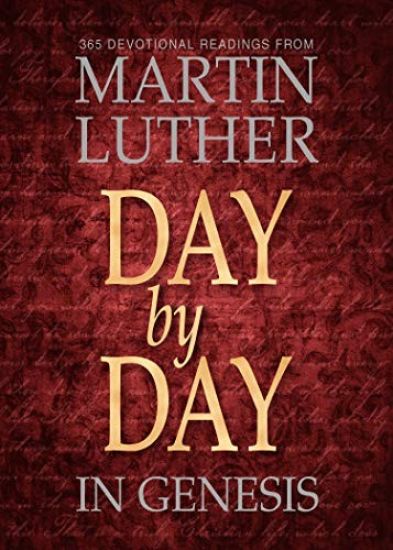
The Book of Genesis traces the very beginning of not only human history, but also God's people and His plan to redeem humanity. In this narrative, we see glimpses of Christ-a promise in Genesis that is now fulfilled. Martin Luther spent the final ten years of his academic career lecturing on the Book of Genesis. He discussed every chapter and almost every verse, bringing out themes as varied as vocation, marriage, prayer, the nature of the Trinity, the work of the Holy Spirit, Law and Gospel, and the theology of the cross. Genesis, Luther said, "is made up almost entirely of illustrations of faith and unbelief, and of the fruits that faith and unbelief bear. It is an exceedingly evangelical book." Day by Day in Genesis presents 365 short devotional readings from Martin Luther's commentary on the Book of Genesis, addressing vocation, marriage, prayer, and the promise of Christ.
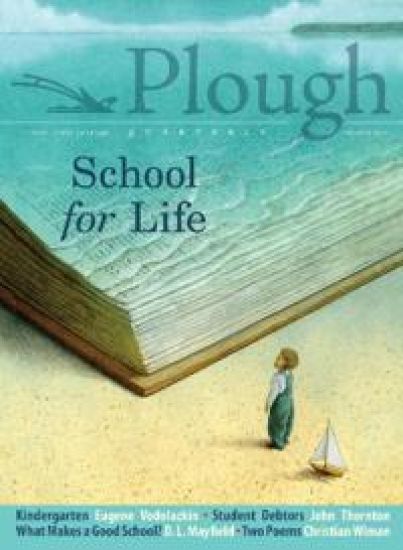
Plough Quarterly No. 19 - School for Life
Eugene Vodolazkin; Karen Swallow Prior; Christian Wiman; John Thornton; D. L. Mayfield; Andrew Balio; Julian Peters; Denise Uwimana; Alfred Delp; Martin Luther; Michael St. Thomas; Sally Thomas
Plough Publishing House
2019
pokkari
What we want for schools reveals what we value as a society. “What’s the point of school?” Parents have a stock set of responses, but the question remains unsettled, even two centuries after the Prussians invented compulsory education. The Prussian idea of what a school is for – to mold the populace to serve the state – seems unacceptable today. In vogue, instead, are slogans like “acquiring marketable skills” and “realizing your full potential.” These ideas powerfully shape our culture. Ultimately, they boil down to pursuing one supreme value: individual success in a competitive world. Schools are a mirror of our society as a whole; what we want for schools makes plain what and whom we value in our common life. In the Christian tradition, the life of discipleship is also a school. In this educational community, under the instruction of our one Teacher, we learn not to seek empowerment, but to find strength in weakness; not to out-achieve others, but to serve them; not to pursue our passion, but to obey a call. Also in this issue: poetry by Christian Wiman; reviews of new books by Robert Macfarlane, Jackie Morris, Francisco Cantú, Leif Enger, Carol Anderson, Stephanie Land, and Susan Wise Bauer; and art by Margaret McWethy, Albrecht Dürer, Raphael, Gérard David, Jackie Morris, Gustaf Tenggren, Sergey Dushkin, Anja Percival, Dmitry Samofalov, Christoph Wetzel, Sherrie York, Cathleen Rehfield, Pawel Kuczynski, and Jason Landsel. Plough Quarterly features stories, ideas, and culture for people eager to put their faith into action. Each issue brings you in-depth articles, interviews, poetry, book reviews, and art to help you put Jesus’ message into practice and find common cause with others.
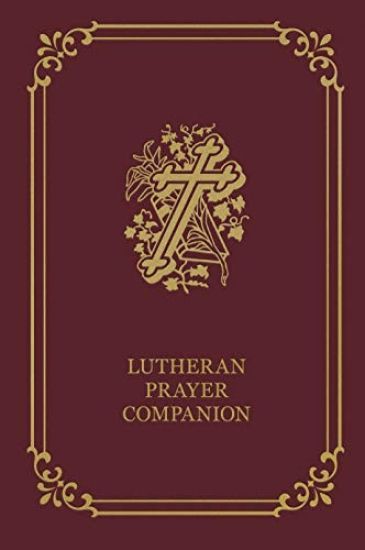
The Lutheran Prayer Companion is the first-ever English translation of the German Evangelical-Lutheran Prayer Treasury, featuring prayers written by Luther and other church fathers. Nearly 500 prayers that cover almost any situation, every Sunday in the Church Year, and each day of the weekMore than 100 hymn textsTopical prayer indexWhen you don't have the words to pray, when you feel unsure in your prayers, when you are struggling to pray-turn to these prayers rooted deeply in God's Word. These prayers will certainly enhance your prayer life, draw you closer to your Savior, and inspire your own prayers.


Sendbrief Von Dolmetschen Und Drei Andere Schriften Weltlichen Inhalts ...
Martin Luther
Wentworth Press
2018
pokkari
Erklärung Des Kleinen Katechismus Dr. Martin Luthers
Martin Luther; Johann Michael Reu
Wentworth Press
2018
pokkari
Dr. Martin Luthers' sämmtliche Werke. Dritter Band
Martin Luther; Johann Georg Plochmann; Johann Conrad Irmischer
Wentworth Press
2018
sidottu


An den christlichen Adel deutscher Nation von des christlichen Stande Besserung
Karl Benrath; Martin Luther
Auxo Verlag
2018
nidottu

A new translation of Dr. Martin Luther's Small Catechism, including his Christian Questions, with a brief introduction explaining the history of the Reformation and the Lutheran Church.
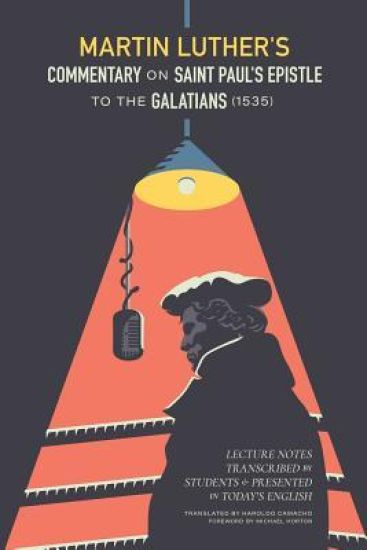
Martin Luther's Commentary On Saint Paul's Epistle To The Galatians
Martin Luther; Michael Horton
New Reformation Publications
2018
pokkari
Martin Luther's most comprehensive work on justification by faith, his commentary on St. Paul's Epistle to the Galatians is translated and edited from the Latin into a lively style, paralleling his spoken lectures. Combined with the passion and faith expressed in these lectures, the biblical foundation for the crucial doctrine of justification is underscored and expressed to a new audience. The commentary is also a historical document, a recording of a professor in a classroom in 1531 from July to December of that year, which expresses the Reformer's commitment to the good news of Jesus' death in the sinner's place, challenging the reader/hearer to compare St. Paul's theology with what he/she hears in the church today.

Commentary on the Epistle to the Galatians
Martin Luther
Createspace Independent Publishing Platform
2018
nidottu
Commentary on the Epistle to the Galatians (1535) by Martin Luther. Translated by Theodore Graebner. St. Paul wrote this epistle because, after his departure from the Galatian churches, Jewish-Christian fanatics moved in, who perverted Paul's Gospel of man's free justification by faith in Christ Jesus. The world bears the Gospel a grudge because the Gospel condemns the religious wisdom of the world. Jealous for its own religious views, the world in turn charges the Gospel with being a subversive and licentious doctrine, offensive to God and man, a doctrine to be persecuted as the worst plague on earth. As a result we have this paradoxical situation: The Gospel supplies the world with the salvation of Jesus Christ, peace of conscience, and every blessing. Just for that the world abhors the Gospel.

Luther's Little Instruction Book: The Small Catechism of Martin Luther
Martin Luther
Createspace Independent Publishing Platform
2018
nidottu
Luther's Little Instruction Book: The Small Catechism of Martin Luther. Translation by Robert E. Smith. Luther's Small Catechism (German: Der Kleine Katechismus) is a catechism written by Martin Luther and published in 1529 for the training of children. Luther's Small Catechism reviews the Ten Commandments, the Apostles' Creed, the Lord's Prayer, the Sacrament of Holy Baptism, the Office of the Keys and Confession and the Sacrament of the Eucharist. It is included in the Book of Concord as an authoritative statement of what Lutherans believe. The Small Catechism is widely used today in Lutheran churches as part of youth education and Confirmation. It was mandatory for confirmands in the Church of Sweden until the 1960s
The liturgy is not a style of worship. The liturgy is the substance of justification as it is brought through means. This book is an introduction to the liturgy and its importance. It takes the liturgy and makes it easy for the layperson to understand that the New Testament church service brings God's presence, in Jesus the Christ to the people of God who have been cleansed from their sins. This is a holy meeting made possible by the blood of Christ that cleanses the believer. This understanding of the church service helps one to understand that the church service is more than a meeting place; it is the manifestation of the New Testament church on earth as Christ calls His bride around Word and Sacraments. Heaven on Earth will deepen your understanding of the Divine Service and why it remains the Church's chief worship service.
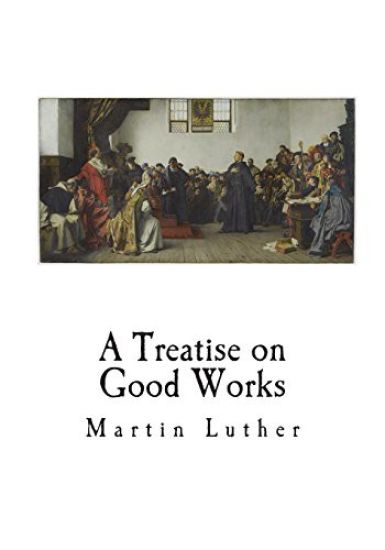
A Treatise on Good Works by Martin Luther. 1520. Martin Luther was a German professor of theology, composer, priest, monk, and a seminal figure in the Protestant Reformation. We ought first to know that there are no good works except those which God has commanded, even as there is no sin except that which God has forbidden. Therefore whoever wishes to know and to do good works needs nothing else than to know God's commandments. Thus Christ says, Matthew xix, "If thou wilt enter into life, keep the commandments." And when the young man asks Him, Matthew xix, what he shall do that he may inherit eternal life, Christ sets before him naught else but the Ten Commandments. Accordingly, we must learn how to distinguish among good works from the Commandments of God, and not from the appearance, the magnitude, or the number of the works themselves, nor from the judgment of men or of human law or custom, as we see has been done and still is done, because we are blind and despise the divine Commandments.