Kirjojen hintavertailu – 12 903 725 kirjaa ja 27 kauppaa

Kirjailija

Maurice Blanchot

Kirjat ja teokset yhdessä paikassa: 54 kirjaa, julkaisuja vuosilta 1987–2026, suosituimpiin kuuluu Vicious Circles. Vertaile teosten hintoja ja tarkista saatavuus suomalaisista kirjakaupoista.

54 kirjaa

Kirjojen julkaisuvuodet: 1987–2026.

WHEN THE TIME COMES

WHEN THE TIME COMES

Maurice Blanchot

Barrytown Limited
1995
nidottu
WHEN THE TIME COMES ostensibly chronicles the troubled relations between the narrator-a very ill man-and the two women whose lives he invades. As in all of Blanchot's intensely subjective fiction, the true subject of the work is the narrator's consciousness and the process by which his tale emerges through its telling. Powerfully affected by the slightest of events, the narrator responds with a violence that, most disturbingly, appears inevitable.
Gaze of Orpheus

Gaze of Orpheus

Maurice Blanchot

Barrytown Limited
1995
nidottu
Writing about The Gaze of Orpheus, Geoffrey Hartman suggested that When we come to write the history of criticism for the 1940 to 1980 period, it will be found that Blanchot, together with Sartre, made French 'discourse' possible, both in its relentlessness and its acuity.. This selection.is exemplary for its clearly translated and well-chosen excerpts from Blanchot's many influential books. Reading him now, and in this form, I feel once more the excitement of discovering Blanchot in the 1950s.
The One Who Was Standing Apart From Me

The One Who Was Standing Apart From Me

Maurice Blanchot

Station Hill Press
1995
pokkari
This work takes the form of a conversation, an interview. An obsessive questioning back and forth builds up Blanchot's narrative, with its sense--shared with Kafka's famous doorkeeper parable--that behind each question lies the spooky possibility of a further, more imposing, more insoluble question. Thematically, powerlessness, inertia, insufficient speech, weariness, falling, faltering--everything tied to a negative or nonexistent value in ordinary discourse--is given value here by its being articulated, moved into writing and thought. What's insignificant or worthless gathers weight through its troubling persistence, its failure to disappear. The endless conversation of Blanchot's writing turns fiction toward an experience of listening--a far cry from the storytelling most fiction (still) takes itself to be.
The Writing of the Disaster

The Writing of the Disaster

Maurice Blanchot

University of Nebraska Press
1995
pokkari

Halvin toimitettuna 33,40 €

Modern history is haunted by the disasters of the century—world wars, concentration camps, Hiroshima, and the Holocaust—grief, anger, terror, and loss beyond words, but still close, still impending. How can we write or think about disaster when by its very nature it defies speech and compels silence, burns books and shatters meaning? The Writing of the Disaster reflects upon efforts to abide in disaster's infinite threat. First published in French in 1980, it takes up the most serious tasks of writing: to describe, explain, and redeem when possible, and to admit what is not possible. Neither offers consolation. Maurice Blanchot has been praised on both sides of the Atlantic for his fiction and criticism. The philosopher Emmanuel Levinas once remarked that Blanchot's writing is a "language of pure transcendence, without correlative." Literary theorist and critic Geoffrey Hartman remarked that Blanchot's influence on contemporary writers "cannot be overestimated."
The Work of Fire

The Work of Fire

Maurice Blanchot

Stanford University Press
1995
sidottu
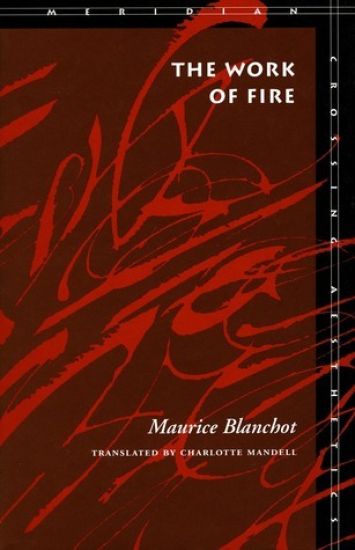
Since the middle of the twentieth century, Maurice Blanchot has been an extraordinarily influential figure on the French literary and cultural scene. He is arguably the key figure after Sartre in exploring the relation between literature and philosophy. Blanchot early developed a distinctive, limpid firm of essay writing, and, apart from his fiction, his main work has appeared as collections of essays. His essays, in form and substance, unmistakably left their imprint on the work of the most inluential of French theorists. The writings of Barthes, Foucault, and Derrida, for example, are hardly imaginable without Blanchot, and, indeed, all three have generously paid tribute to him. Published in French in 1949, The Work of Fire is a collection of 22 essays originally issued as review essays in literary journals. Certain themes return again and again: the relation of literature and language to death; the sigificance of repetition; the historical, personal, and social function of literature; and perhaps most important, simply the question, What is at stake in the fact that something such as art or literature exists? Within each essay, Blanchot raises anew these central themes in the context of a particular work or a particular author. He has read, it appears, practically everything, and an essay on a given writer or work will bristle with apposite references to other authors and works. Among the authors discussed in The Work of Fire are Kafka, Mallarme, Holderlin, Baudelaire, Rimbaud, Sartre, Gide, Pascal, Valery, Hemingway, Henry Miller, and such lesser figures as Benjamin Constant and Jean Paulhan. The essays demonstrate Blanchot's ability to pose the most lucid questions about the essence of literature while saying something new and probing about the author or work in question.

Vicious Circles

Vicious Circles

Maurice Blanchot

Barrytown Limited
1995
nidottu
These early parables of Maurice Blanchot provide a rewarding introduction to a modern master; they also illuminate with hallucinatory intensity certain consequences of the hopeless and irresistible human longing to communicate through language. The world is still haunted by the ghosts of unspoken and unspeakable words emanating from the deaths here recounted almost fifty years ago.
Thomas the Obscure

Thomas the Obscure

Maurice Blanchot

Station Hill Press
1995
nidottu
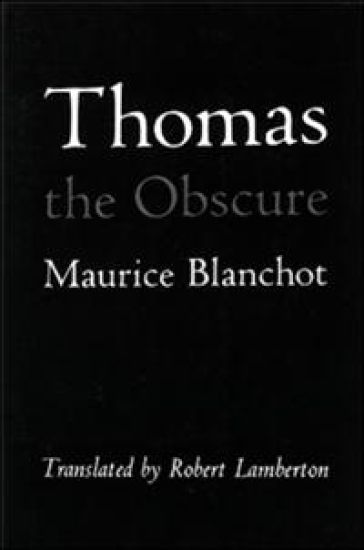
Before Sartre, before Beckett, before Robbe-Grillet, Maurice Blanchot created the new novel, the ultimate post-modern fiction. Written between 1932 and 1940, Blanchot's first novel, here brilliantly translated by Robert Lamberton, contains all the remarkable aspects of his famous and perplexing invention, the ontological narrative--a tale whose subject is the nature of being itself. This paradoxical work discovers being in the absence of being, mystery in the absence of mystery, both to be searched for limitlessly. As Blanchot launches this endless search in his own masterful way, he transforms the possibilities of the novel. First issued in English in 1973 in a limited edition, this re-issue includes an illuminating essay on translation by Lamberton.
Madness of the Day

Madness of the Day

Maurice Blanchot

Station Hill Press
1995
nidottu
Jacques Derrida writes (in Deconstruction and Criticism)of The Madness of the Day that it is a story whose title runs wild and drives the reader mad.la folie du jour, the madness of today, of the day today, which leads to the madness that comes from the day, is born of it, as well as the madness of the day itself, itself mad.. La folie du jour is a story of madness, of that madness that consists in seeing the light, vision or visibility, to see beyond what is visible, is not merely 'to have a vision' in the usual sense of the word, but to see-beyond-sight, to see-sight-beyond-sight.. The story obscures the sun.with a blinding light.
Infinite Conversation

Infinite Conversation

Maurice Blanchot

University of Minnesota Press
1992
nidottu

Halvin toimitettuna 39,00 €

In this landmark volume, Blanchot sustains a dialogue with a number of thinkers whose contributions have marked turning points in the history of Western thought and have influenced virtually all the themes that inflect the contemporary literary and philosophical debate today. “Blanchot waits for us still to come, to be read and reread. . . I would say that never as much as today have I pictured him so far ahead of us.” Jacques Derrida
The Step Not Beyond

The Step Not Beyond

Maurice Blanchot

State University of New York Press
1992
pokkari
This book is a translation of Maurice Blanchot's work that is of major importance to late 20th-century literature and philosophy studies. Using the fragmentary form, Blanchot challenges the boundaries between the literary and the philosophical. With the obsessive rigor that has always marked his writing, Blanchot returns to the themes that have haunted his work since the beginning: writing, death, transgression, the neuter, but here the figures around whom his discussion turns are Hegel and Nietzsche rather than Mallarme and Kafka. The metaphor Blanchot uses for writing in The Step Not Beyond is the game of chance. Fragmentary writing is a play of limits, a play of ever-multiplied terms in which no one term ever takes precedence. Through the randomness of the fragmentary, Blanchot explores ideas as varied as the relation of writing to luck and to the law, the displacement of the self in writing, the temporality of the Eternal Return, the responsibility of the self towards the others.
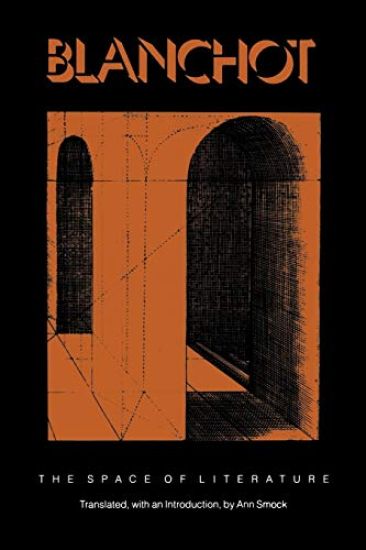
The Space of Literature

The Space of Literature

Maurice Blanchot

University of Nebraska Press
1989
pokkari

Halvin toimitettuna 38,20 €

Maurice Blanchot, the eminent literary and cultural critic, has had a vast influence on contemporary French writers—among them Jean Paul Sartre and Jacques Derrida. From the 1930s through the present day, his writings have been shaping the international literary consciousness. The Space of Literature, first published in France in 1955, is central to the development of Blanchot's thought. In it he reflects on literature and the unique demand it makes upon our attention. Thus he explores the process of reading as well as the nature of artistic creativity, all the while considering the relation of the literary work to time, to history, and to death. This book consists not so much in the application of a critical method or the demonstration of a theory of literature as in a patiently deliberate meditation upon the literary experience, informed most notably by studies of Mallarmé, Kafka, Rilke, and Hölderlin. Blanchot's discussions of those writers are among the finest in any language.