Kirjojen hintavertailu – 12 903 725 kirjaa ja 27 kauppaa
Kirjailija
Michael Brenner
Kirjat ja teokset yhdessä paikassa: 33 kirjaa, julkaisuja vuosilta 1996–2026, suosituimpiin kuuluu Jagdrecht in Baden-Württemberg. Vertaile teosten hintoja ja tarkista saatavuus suomalaisista kirjakaupoista.
Jødernes historie begrænses i dag ofte til forfølgelser, holocaustforbrydelserne og de politiske begivenheder i Mellemøsten. Denne bog ønsker at åbne for et mere facetteret og farverigere billede, hvortil især også hører den frugtbare udveksling med andre kulturer. Selv om jøderne altid har udgjort en lille minoritet, har de efterladt deres spor i talrige kulturer, har præget de store verdensreligioner og har udviklet deres egne livsverdener. Michael Brenner skildrer præcist og gennem rammende eksempler den mangefacetterede historie for en nation og en religion. Han tager læserne med på en verdensrejse fra den Nære Orient over den græske og romerske verden, det mauriske Spanien og Centraleuropa til Østeuropa, Israel og Amerika. Der opstår således et fascinerende panorama over en historie, som netop på grund af de mange brud og tvungne nye begyndelser gør indtryk gennem sin kontinuitet og troskab mod egne rødder.
This is a sweeping and powerful narrative history of the Jewish people from biblical times to today. Based on the latest scholarship and richly illustrated, it is the most authoritative and accessible chronicle of the Jewish experience available. Michael Brenner tells a dramatic story of change and migration deeply rooted in tradition, taking readers from the mythic wanderings of Moses to the unspeakable atrocities of the Holocaust; from the Babylonian exile to the founding of the modern state of Israel; and from the Sephardic communities under medieval Islam to the shtetls of eastern Europe and the Hasidic enclaves of modern-day Brooklyn. The book is full of fascinating personal stories of exodus and return, from that told about Abraham, who brought his newfound faith into Canaan, to that of Holocaust survivor Esther Barkai, who lived on a kibbutz established on a German estate seized from the Nazi Julius Streicher as she awaited resettlement in Israel. Describing the events and people that have shaped Jewish history, and highlighting the important contributions Jews have made to the arts, politics, religion, and science, "A Short History of the Jews" is a compelling blend of storytelling and scholarship that brings the Jewish past marvelously to life.
This book explores the origins of Zionism within Jewish tradition, the variety of Zionist ideologies, and the political circumstances that fostered this movement. Jewish immigration to Palestine, shifting British policies, Arab reactions to Jewish settlements, and the impact of the Holocaust are among the book's central topics. A final chapter summarises the major problems and achievements of the Jewish state, and examines possible directions for its post-Zionist future.
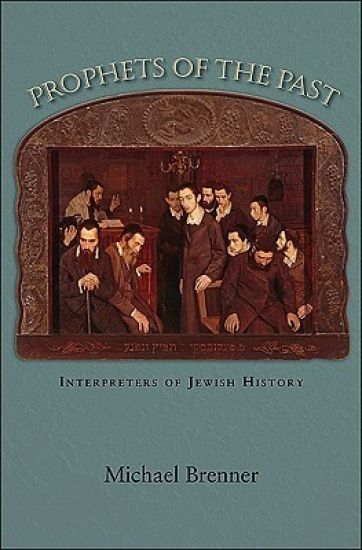
Prophets of the Past is the first book to examine in depth how modern Jewish historians have interpreted Jewish history. Michael Brenner reveals that perhaps no other national or religious group has used their shared history for so many different ideological and political purposes as the Jews. He deftly traces the master narratives of Jewish history from the beginnings of the scholarly study of Jews and Judaism in nineteenth-century Germany; to eastern European approaches by Simon Dubnow, the interwar school of Polish-Jewish historians, and the short-lived efforts of Soviet-Jewish historians; to the work of British and American scholars such as Cecil Roth and Salo Baron; and to Zionist and post-Zionist interpretations of Jewish history. He also unravels the distortions of Jewish history writing, including antisemitic Nazi research into the "Jewish question," the Soviet portrayal of Jewish history as class struggle, and Orthodox Jewish interpretations of history as divinely inspired. History proved to be a uniquely powerful weapon for modern Jewish scholars during a period when they had no nation or army to fight for their ideological and political objectives, whether the goal was Jewish emancipation, diasporic autonomy, or the creation of a Jewish state. As Brenner demonstrates in this illuminating and incisive book, these historians often found legitimacy for these struggles in the Jewish past.
A practical overview of OMA specifications and how they enable mobile multimedia services & much more …! The Open Mobile Alliance (OMA) is an industry forum, which develops open specifications to help in the creation of applications and services to be deployed over converged networks. The alliance is the leading industry forum for generating market-driven specifications for interoperable mobile service enablers that facilitate global user adoptions of mobile multimedia services. Members include traditional wireless industry segments, such as mobile operators mobile operators (e.g. AT&T, China Mobile, Orange, Sprint Nextel, T-Mobile, Telefonica, Vodafone), equipment and mobile systems manufacturers (e.g. Alcatel-Lucent, Ericsson, Motorola, Nokia, Philips, Samsung, Siemens, Sony-Ericsson), and Information Technology vendors (e.g. BEA Systems, IBM, Microsoft, Oracle Corporation, Sun Microsystems and NEC). Since its formation in 2002, the OMA has made significant progress in areas such as push-to-talk over cellular, device management, presence and group management, and messaging. The Open Mobile Alliance: Provides a comprehensive overview of the service enablers published by the OMA, tying together all the different piece parts developed by the individual working groups Offers a thorough introduction to the OMA Service Environments (OSE) and the specification process for enabling technologies. Discusses enablers for services such as gaming, IMS, Parlay, mobile broadcast and web services. Contains contributions from all stakeholders in the mobile application value chain. The Open Mobile Alliance Alliance is an invaluable resource for OMA members, product managers, network architects and planners, standards managers, standards engineers and IT professionals. Advanced Students and lecturers on mobile application development and standardization courses will also find this book of interest." The success of OMA is due to its individual members' contributions, and this book is testament to their hard work. The individual members' efforts and the authors of this book are to be congratulated on their magnificent achievements." Mark Cataldo, Senior Advisor, Orange SA, OMA Technical Plenary Chairman
"The U. S.-French relationship is unique in mixing elements of rivalry and cooperation. Historical allies and comrades in arms, the United States and France are often fractious and quarrelsome. Their promotion of competing visions for a post-Cold War Europe gives a sharp edge to disputes over security and trade issues. Yet their mutual interests as partners in multiple collective enterprises compel them to find ways to put their relations on a surer footing. Doing so is also the key to meeting the larger challenge of reconciling America's dominance as the global superpower with the aspirations of a strengthening European Union. The authors of this study examine how national identity, political culture, and diplomatic style strain ties between Washington and Paris. They prescribe a set of policy and procedural remedies and lay out a strategy for sustaining more constructive collaboration."
This landmark book is the first comprehensive account of the lives of the Jews who remained in Germany immediately following the war. Gathering never-before-published eyewitness accounts from Holocaust survivors, Michael Brenner presents a remarkable history of this period. While much has been written on the Holocaust itself, until now little has been known about the fate of those survivors who remained in Germany. Jews emerging from concentration camps would learn that most of their families had been murdered and their communities destroyed. Furthermore, all Jews in the country would face the stigma of living, as a 1948 resolution of the World Jewish Congress termed it, on "bloodsoaked German soil." Brenner brings to life the psychological, spiritual, and material obstacles they surmounted as they rebuilt their lives in Germany. At the heart of his narrative is a series of fifteen interviews Brenner conducted with some of the most important witnesses who played an active role in the reconstruction--including presidents of Jewish communities, rabbis, and journalists. Based on the Yiddish and German press and unpublished archival material, the first part of this book provides a historical introduction to this fascinating topic. Here the author analyzes such diverse aspects as liberation from concentration camps, cultural and religious life among the Jewish Displaced Persons, antisemitism and philosemitism in post-war Germany, and the complex relationship between East European and German Jews. A second part consists of the fifteen interviews, conducted by Brenner, with witnesses representing the diverse background of the postwar Jewish community. While most of them were camp survivors, others returned from exile or came to Germany as soldiers of the Jewish Brigade or with international Jewish aid organizations. A third part, which covers the development of the Jewish community in Germany from the 1950s until today, concludes the book.
Although Jewish participation in German society increased after World War I, Jews did not completely assimilate into that society. In fact, says Michael Brenner in this intriguing book, the Jewish population of Weimar Germany became more aware of its Jewishness and created new forms of German-Jewish culture in literature, music, fine arts, education, and scholarship. Brenner presents the first in-depth study of this culture, drawing a fascinating portrait of people in the midst of redefining themselves. The Weimar Jews chose neither a radical break with the past nor a return to the past but instead dressed Jewish traditions in the garb of modern forms of cultural expression. Brenner describes, for example, how modern translations made classic Jewish texts accessible, Jewish museums displayed ceremonial artifacts in a secular framework, musical arrangements transformed synagogue liturgy for concert audiences, and popular novels recalled aspects of the Jewish past. Brenner's work, while bringing this significant historical period to life, illuminates contemporary Jewish issues. The preservation and even enhancement of Jewish distinctiveness, combined with the seemingly successful participation of Jews in a secular, non-Jewish society, offer fresh insight into modern questions of Jewish existence, identity, and integration into other cultures.
Michael Brenner examines European efforts—and American responses—to reduced defense dependency in a post-Cold War world. Unresolved questions abound: institutional form, political direction, resources, and—above all—uncertainty about the place of the United States in security arrangements for and with a new Europe. As he makes clear, the culture of transatlantic security dependency casts a shadow over the ongoing project of reequilibrating the Euro-American alliance. U. S. prestige and power weigh all the heavier because of American ambivalence in coming to terms with its allies' ambitions. Agreeing on a conception of European Security and Defense Identity and measures to implement it has three requirements: clarifying a security agenda dominated by political goals; candid dialogue on the apprehensions the transatlantic partners have about each other; and dedication to perfecting multilateralism as the standard behavioral code for a more egalitarian alliance. Giving life to ESDI unavoidably will generate tensions and amplify a European voice that at times will grate on Washington's ears. However, as Brenner asserts, making multilateralism work is the best way to ensure that those negatives are outweighed by the value ESDI has for advancing U. S. as well as European interests. This is must reading for scholars, students, and policy makers involved with European security and international relations issues.
Michael Brenner examines European efforts—and American responses—to reduced defense dependency in a post-Cold War world. Unresolved questions abound: institutional form, political direction, resources, and—above all—uncertainty about the place of the United States in security arrangements for and with a new Europe. As he makes clear, the culture of transatlantic security dependency casts a shadow over the ongoing project of reequilibrating the Euro-American alliance. U. S. prestige and power weigh all the heavier because of American ambivalence in coming to terms with its allies' ambitions. Agreeing on a conception of European Security and Defense Identity and measures to implement it has three requirements: clarifying a security agenda dominated by political goals; candid dialogue on the apprehensions the transatlantic partners have about each other; and dedication to perfecting multilateralism as the standard behavioral code for a more egalitarian alliance. Giving life to ESDI unavoidably will generate tensions and amplify a European voice that at times will grate on Washington's ears. However, as Brenner asserts, making multilateralism work is the best way to ensure that those negatives are outweighed by the value ESDI has for advancing U. S. as well as European interests. This is must reading for scholars, students, and policy makers involved with European security and international relations issues.