Kirjojen hintavertailu – 12 859 828 kirjaa ja 27 kauppaa

Kirjailija

Moses Mendelssohn

Kirjat ja teokset yhdessä paikassa: 108 kirjaa, julkaisuja vuosilta 1971–2026, suosituimpiin kuuluu Les Lumières allemandes face à la Révolution. Vertaile teosten hintoja ja tarkista saatavuus suomalaisista kirjakaupoista.

108 kirjaa

Kirjojen julkaisuvuodet: 1971–2026.

Phaedon: or, The Death of Socrates

Phaedon: or, The Death of Socrates

Moses Mendelssohn

Thoemmes Continuum
2004
sidottu
Phædon: or, The Death of Socrates, originally published in German in 1767 and translated by Charles Cullen in 1789, has never been rendered into modern English. Cullen's translation is thus the only recourse for present-day scholars who cannot read German. It is long out of print and difficult to find, even in the largest academic libraries. Now that the English-speaking philosophical world is delving ever more deeply into the history of German philosophy, this facsimile of the 1789 edition - newly introduced by Curtis Bowman - will be widely welcomed.
Moses Mendelssohn: Philosophical Writings

Moses Mendelssohn: Philosophical Writings

Moses Mendelssohn

Cambridge University Press
1997
sidottu
Mendelssohn’s Philosophical Writings, published in 1761, bring the metaphysical tradition to bear on the topic of ‘sentiments’ (defined as knowledge or awareness by way of the senses). Mendelssohn offers a nuanced defence of Leibniz’s theodicy and conception of freedom, an examination of the ethics of suicide, an account of the ‘mixed sentiments’ so central to the tragic genre, a hypothesis about weakness of will, an elaboration of the main principles and types of art, a definition of sublimity and analysis of its basic forms, and, lastly, a brief tract on probability theory, aimed at rebutting Hume’s scepticism. This volume also includes the essay ‘On Evidence in Metaphysical Sciences’, selected in 1763 by the Berlin Royal Academy of Sciences over all other submitted essays, including one by Kant, as the best answer to the question of whether metaphysical sciences are capable of the same sort and degree of evidence as mathematics.
Moses Mendelssohn: Philosophical Writings

Moses Mendelssohn: Philosophical Writings

Moses Mendelssohn

Cambridge University Press
1997
pokkari
Mendelssohn’s Philosophical Writings, published in 1761, bring the metaphysical tradition to bear on the topic of ‘sentiments’ (defined as knowledge or awareness by way of the senses). Mendelssohn offers a nuanced defence of Leibniz’s theodicy and conception of freedom, an examination of the ethics of suicide, an account of the ‘mixed sentiments’ so central to the tragic genre, a hypothesis about weakness of will, an elaboration of the main principles and types of art, a definition of sublimity and analysis of its basic forms, and, lastly, a brief tract on probability theory, aimed at rebutting Hume’s scepticism. This volume also includes the essay ‘On Evidence in Metaphysical Sciences’, selected in 1763 by the Berlin Royal Academy of Sciences over all other submitted essays, including one by Kant, as the best answer to the question of whether metaphysical sciences are capable of the same sort and degree of evidence as mathematics.
Moses Mendelssohn, Dokumente I: Entlegene Zeitgenossische Texte Zu Mendelssohns Leben Und Wirken
Der erste Erganzungsband bietet 350 bisher unbekannte oder schwer zugangliche Texte. Die Inedita stammen u.a. von Alxinger, Eberhard, Hennings, Iselin, Nicolai, Elise Reimarus und Resewitz. The first supplementary volume contains 350 previously unknown or scarcely accessible texts. The Inedita were written by Alxinger, Eberhard, Hennings, Iselin, Nicolai, Elise Reimarus and Resewitz, among others.
Moses Mendelssohn, Briefwechsel (1761-1785)

Moses Mendelssohn, Briefwechsel (1761-1785)

Moses Mendelssohn

Frommann-Holzboog
1994
sidottu
Dieser Band ist die Ubertragung der in JubA 19 enthaltenen 290 Briefe in hebraischer Schrift, die zum grossten Teil in deutscher Sprache verfasst sind. Die 38 auf hebraisch verfassten Briefe vermitteln vor allem Einblick in Mendelssohns Beitrag zu rabbinischen, juristischen und biblischen Streitfragen. Seine judeo-deutschen Brautbriefe an Fromet Gugenheim liegen in moderner Orthographie und Interpunktion in Band 11 der JubA vor. Sie zeigen nun in der vorliegenden Ubertragung das Ausmass der hebraischen Floskeln und Ausdrucke, die fur Mendelssohns Briefe an Juden charakteristisch waren. - Die judeo-deutschen Briefe seiner Frau belegen Fromet Mendelssohns zartliche Liebe und die sorgsame Erziehung der Tochter. - Briefe von und an Herz Homberg, Salomo Dubno, Hartwig und Moses Wessely, Avigdor Levi - sowie dessen kunstvolles Lobgedicht. Die Anmerkungen zu den Briefen befinden sich direkt unter dem Text und erganzen sich mit denen in der Ausgabe in hebraischen Schriftzeichen (Band 19) fur den heutigen Leser. This volume is the transcription of the 290 letters contained in JubA 19 into Hebrew. Most of these letters were written in German. The 38 letters written in Hebrew provide insight primarily into Mendelssohn' contribution to rabbinical, legal and biblical issues. His Judeo-German courtship letters to Fromet Gugenheim are in Volume 11 of the JubA in modern spelling and with modern punctuation. In this transcription, they show the number of Hebrew expressions which were typical of Mendelssohn's letters to Jews. The Judeo-German letters of his wife show Fromet Mendelssohns tender love and the careful upbringing of their daughter. There are letters from and to Herz Homberg, Salomo Dubno, Hartwig and Moses Wessely, Avigdor Levi - as well as a poem of praise. The annotations of the letters are directly under the text and complement those in the edition in Hebrew characters (Volume 19) for todays readers. Correspondents of volumes 19 and 20,2: Peter Beer - Familie Bernhard - Marcus Bloch - David de Castro - Chanoch - Joseph Deiern - Wolf Dessau - Salomo Dubno - Jonathan Eibenschutz - Jacob Emden - Benjamin V. Ephraim - Sacharja V. Ephraim - Gutche Ephraim - Moses Fischer - David Friedlander - Moses Furst - Ascher Gotting - Sara Gotting - Joseph Galico - Abraham Gugenheim - Fromet Gugenheim - Joseph Gugenheim - Vogel Gugenheim - Aron Gumpertz - Samuel Halberstadt - Elkan Herz - Jochebed Herz - Naphtali Herz - Jacob Herzfeld - Mendel Heymann - Herz Homberg - Jehuda Halevi Hurwitz - Mordechai Jaffe - Jacob Jareslaw - Joseph Jareslaw - Jona Jeiteles - Pinchas Kopenhagen - Hartog Leo - Avigdor Levi - Raphael Levi - Mendel Levin - Naphtali Levin - Zebi Hirsch Levin - Robert Lowth - Salomon Maimon - Joseph Meyer - Mendel Meyer - Elias Morpurgo - Isaac Pinto - Nathanael Posner - Raphael - Simon Sommerhausen - Ulamo - Herz Ullmann - David Wagenaar - Hartwig Wessely - Moses Wessely - Moses Wiener.
Moses Mendelssohn, Schriften Zum Judentum Iii,2

Moses Mendelssohn, Schriften Zum Judentum Iii,2

Moses Mendelssohn

Frommann-Holzboog
1993
sidottu
Die vorliegenden Teilbande bieten die Ubersetzung von Mendelssohns Einleitung und die Umschrift seiner Pentateuch-Ubersetzung (siehe JubA Bande 15 bis 18) in das deutsche Alphabet. Der erste Teilband enthalt Mendelssohns Umschrift des ersten und zweiten Buches Moses; der zweite Teilband das dritte bis funfte Buch Moses sowie zwei Anhange: Druckfehler in Mendelssohns Ubersetzung; Grammatische Besonderheiten. The volumes of this set provide a translation of Mendelssohn's introduction and the transcription of his Pentateuch translation (see JubA volumes 15 to 18) into the German alphabet. The first volume contains Mendelssohns transcription of the First and Second Book of Moses, and the second volume has the Third to the Fifth Book of Moses as well as two annexes which list typographical errors in Mendelssohns translation and grammatical peculiarities.
Moses Mendelssohn, Schriften Zum Judentum Iii,1

Moses Mendelssohn, Schriften Zum Judentum Iii,1

Moses Mendelssohn

Frommann-Holzboog
1993
sidottu
Die vorliegenden Teilbande bieten die Ubersetzung von Mendelssohns Einleitung und die Umschrift seiner Pentateuch-Ubersetzung (siehe JubA Bande 15 bis 18) in das deutsche Alphabet. Der erste Teilband enthalt Mendelssohns Umschrift des ersten und zweiten Buches Moses; der zweite Teilband das dritte bis funfte Buch Moses sowie zwei Anhange: Druckfehler in Mendelssohns Ubersetzung; Grammatische Besonderheiten. The volumes of this set provide a translation of Mendelssohn's introduction and the transcription of his Pentateuch translation (see JubA volumes 15 to 18) into the German alphabet. The first volume contains Mendelssohns transcription of the First and Second Book of Moses, and the second volume has the Third to the Fifth Book of Moses as well as two annexes which list typographical errors in Mendelssohns translation and grammatical peculiarities.
Moses Mendelssohn, Rezensionsartikel in Allgemeine Deutsche Bibliothek (1765-1784). Literarische Fragmente
Der zweite Teilband bringt Mendelssohns Beitrage zu Nicolais Allgemeiner deutscher Bibliothek sowie Erstdrucke einiger literarischer Fragmente. In den langen Rezensionsartikeln der AdB kommen u.a. die Philosophie Lamberts, die Querelle des anciens et modernes (anhand einer Homerubersetzung Bitaubes), die Odentheorie Ramlers und einige bisher ubersehene Beitrage (u.a. zu Garve und Abbt) zur Sprache. Unter den literarischen Fragmenten befinden sich das verloren geglaubte Fragment von Mendelssohns Ausfuhrungen zu John Browns History of the Rise and Fall of Poetry through its Several Species, ein weiterer Teil einer Shaftesbury-Ubersetzung und Mendelssohns Notizen des Konzeptbuches von 1783/84. The second volume in the set contains Mendelssohns essays on Nicolais and his Allgemeiner deutscher Bibliothek (German General Library) as well as the first publications of several literary fragments. The long reviews of the AdB (common German reference work) mention, among others, the philosophy of Lamberts, the Querelle des anciens et moderns (based on a translation of Homer by Bitaube), Ramlers theory of odes (Odentheorie) and several essays which had been previously overlooked e.g. on Garve and Abbt). Among the literary fragments are Mendelssohns comments on John Brown's History of the Rise and Fall of Poetry through its Several Species, which were believed to have been lost, a further part of a Shaftesbury translation and Mendelssohn's notes on a book of concepts from 1783/84.
Moses Mendelssohn, Rezensionsartikel in Briefe, Die Neueste Literatur Betreffend (1759-1765)
An introductory study of the history of the origins and the impact of the Briefe, die neueste Litteratur betreffend (Letters concerning the Most Recent Literature) is followed by the text of Mendelssohn's contributions and a list of the authors dealt with and the letters. Mendelssohn wrote more than one third of these, approximately 120. In these works, which have scarcely been annotated up to now, he had a large influence on the dissemination and the improvement of contemporary knowledge. He drew attention to about 140 authors, and in some cases - such as for example Hamann, Kant and Boscovich - was one of the first to do so. As a result of the many subjects he dealt with (the history of philosophy, differential and integral calculus, metaphysics, aesthetics, evolution, microscopy, natural law and the laws of nature, political science, linguistics, biblical scholarship, European literature) he had extensive discussions with Abbt, Kant, Lessing, Michaelis, Sulzer and primarily with Hamann, who had a considerable influence on Mendelssohn. Der erste Teilband beginnt mit einer einleitenden Untersuchung der Entstehungs- und Wirkungsgeschichte der Briefe, die neueste Litteratur betreffend. Es folgen der Text der Mendelssohnschen Beitrage und Verzeichnisse zu den von Mendelssohn behandelten Autoren und zu den Briefen. Von den Literaturbriefen hat Mendelssohn etwa 120 und damit mehr als ein Drittel verfasst. Mit seinen Beitragen, die bisher kaum kommentiert wurden, hat er entscheidend auf die Verbreitung und Vertiefung zeitgenossischen Wissens gewirkt. Er lenkte die Aufmerksamkeit auf etwa 140 Verfasser, auf manche - wie Hamann, Kant und Boscovich - als einer der ersten. Aus der Vielzahl der behandelten Themen (Geschichte der Philosophie, Differential- und Integralrechnung, Metaphysik, Aesthetik, Evolution, Mikroskopie, Naturrecht und Naturgesetz, Politologie, Sprachwissenschaft, Bibelforschung, europaische Literatur) erwuchsen weitreichende Dialoge mit Abbt, Kant, Lessing, Michaelis, Sulzer und vor allem mit Hamann, den Mendelssohn wesentlich beeinflusste.

Moses Mendelssohn, Hebraische Schriften Ii,2

Moses Mendelssohn, Hebraische Schriften Ii,2

Moses Mendelssohn

Frommann-Holzboog
1990
sidottu
Die Bande 15 bis 18 bieten eine Reproduktion der Mendelssohnschen Pentateuchedition (Netivot ha schalom ('Pfade des Friedens'), Berlin: George Friedrich Starcke 1780-1783) sowie seiner Ubersetzung des Hohenliedes (Megillat schir ha-schirim, Berlin: Judische Freischule 1784/85). Die Pentateuchedition umfasst neben dem biblischen Text Mendelssohns deutsche Ubersetzung, den gemeinsam mit seinen Mitarbeitern Salomo Dubno, Naftali Herz Wessely, Aaron Jaroslaw und Herz Homberg verfassten hebraischen Kommentar (Biur) sowie die masoretischen Glossen von Salomo Dubno und Schalom Meseritz (Tikkun sofrim). Vorangestellt sind der Ausgabe Approbationen, eine Abhandlung und ein Gedicht von Naftali Herz Wessely, die fragmentarische Einleitung von Salomo Dubno, Mendelssohns eigene Einleitung sowie die Subskribentenliste. Werner Weinbergs Einleitung schildert eingehend die Entstehung und Rezeption dieses zentralen Werkes der judischen Aufklarung. Volumes 15 to 18 provide a reproduction of Mendelssohn's Pentateuch edition (Netivot ha schalom - The Paths of Peace, Berlin: George Friedrich Starcke 1780-1783), as well as a translation of the Song of Solomon (Megillat schir ha-schirim, Berlin: Judische Freischule 1784/85). In addition to the biblical text, the Pentateuch edition includes Mendelssohn's German translation, the commentary (Biur) which he wrote together with his colleagues Salomo Dubno, Naftali Herz Wessely, Aaron Jaroslaw and Herz Homberg as well as the Masoretic texts by Salomo Dubno and Schalom Meseritz (Tikkun sofrim). At the beginning of this edition there are approbations, a treatise and a poem by Wessely, the fragmentary introduction by Dubno, Mendelssohn's own introduction as well as a list of subscribers. The introduction gives a detailed description of the origins and the reception of this pivotal work of Jewish Enlightenment.
Moses Mendelssohn, Hebraische Schriften Ii,5: Der Pentateuch: Das Vierte Und Funfte Buch Moses
Die Hebraischen Schriften I wurden Ende 1938 in Breslau in Druck gegeben. Da zwei Exemplare dem Vernichtungswillen des nationalsozialistischen Regimes entgingen, war es moglich, den Band 1972 phototechnisch zu reproduzieren. Inhalt: Kohelet musar ('Prediger der Moral') - Bi'ur millot ha higgajon (Kommentar zur Logik des Maimonides) - Sefer ha nefesch ('Die Seele') - Bi'ur li megillat kohelet (Kommentar zum Buch des Predigers) - Or la netiva ('Licht auf den Pfad', Einleitung zur Pentateuchedition) - Verschiedenes: Glossen zu Maimonides' More nevuchim und zur Nikomachischen Ethik, Promemoria, Plan zur Errichtung einer Heiratsgesellschaft, Gedicht, Ratsel, Brief - Zugaben: Einleitungen und Approbationen zum Logikkommentar, zu 'Die Seele' und zum Predigerkommentar, 'Alim li terufa ('Blatter zur Heilung', Prospekt zur Pentateuchedition), Pranumerantenliste zur Pentateuchedition, Dokumente der Berliner judischen Gemeinde. Einleitungen, Lesarten und Anmerkungen. (Vgl. die JubA-Bande 9, Teil 1, und 20, Teil 1) Volumes 15 to 18 provide a reproduction of Mendelssohn's Pentateuch edition (Netivot ha schalom - The Paths of Peace, Berlin: George Friedrich Starcke 1780-1783), as well as a translation of the Song of Solomon (Megillat schir ha-schirim, Berlin: Judische Freischule 1784/85). In addition to the biblical text, the Pentateuch edition includes Mendelssohn's German translation, the commentary (Biur) which he wrote together with his colleagues Salomo Dubno, Naftali Herz Wessely, Aaron Jaroslaw and Herz Homberg as well as the Masoretic texts by Salomo Dubno and Schalom Meseritz (Tikkun sofrim). At the beginning of this edition there are approbations, a treatise and a poem by Wessely, the fragmentary introduction by Dubno, Mendelssohn's own introduction as well as a list of subscribers. The introduction gives a detailed description of the origins and the reception of this pivotal work of Jewish Enlightenment.
Moses Mendelssohn, Hebraische Schriften Ii,4: Der Pentateuch: Das Dritte Buch Moses
Die Bande 15 bis 18 bieten eine Reproduktion der Mendelssohnschen Pentateuchedition (Netivot ha schalom ('Pfade des Friedens'), Berlin: George Friedrich Starcke 1780-1783) sowie seiner Ubersetzung des Hohenliedes (Megillat schir ha-schirim, Berlin: Judische Freischule 1784/85). Die Pentateuchedition umfasst neben dem biblischen Text Mendelssohns deutsche Ubersetzung, den gemeinsam mit seinen Mitarbeitern Salomo Dubno, Naftali Herz Wessely, Aaron Jaroslaw und Herz Homberg verfassten hebraischen Kommentar (Biur) sowie die masoretischen Glossen von Salomo Dubno und Schalom Meseritz (Tikkun sofrim). Vorangestellt sind der Ausgabe Approbationen, eine Abhandlung und ein Gedicht von Naftali Herz Wessely, die fragmentarische Einleitung von Salomo Dubno, Mendelssohns eigene Einleitung sowie die Subskribentenliste. Werner Weinbergs Einleitung schildert eingehend die Entstehung und Rezeption dieses zentralen Werkes der judischen Aufklarung. Volumes 15 to 18 provide a reproduction of Mendelssohn's Pentateuch edition (Netivot ha schalom - The Paths of Peace, Berlin: George Friedrich Starcke 1780-1783), as well as a translation of the Song of Solomon (Megillat schir ha-schirim, Berlin: Judische Freischule 1784/85). In addition to the biblical text, the Pentateuch edition includes Mendelssohn's German translation, the commentary (Biur) which he wrote together with his colleagues Salomo Dubno, Naftali Herz Wessely, Aaron Jaroslaw and Herz Homberg as well as the Masoretic texts by Salomo Dubno and Schalom Meseritz (Tikkun sofrim). At the beginning of this edition there are approbations, a treatise and a poem by Wessely, the fragmentary introduction by Dubno, Mendelssohn's own introduction as well as a list of subscribers. The introduction gives a detailed description of the origins and the reception of this pivotal work of Jewish Enlightenment.
Moses Mendelssohn, Hebraische Schriften Ii,3: Der Pentateuch: Das Zweite Buch Moses
Die Bande 15 bis 18 bieten eine Reproduktion der Mendelssohnschen Pentateuchedition (Netivot ha schalom ('Pfade des Friedens'), Berlin: George Friedrich Starcke 1780-1783) sowie seiner Ubersetzung des Hohenliedes (Megillat schir ha-schirim, Berlin: Judische Freischule 1784/85). Die Pentateuchedition umfasst neben dem biblischen Text Mendelssohns deutsche Ubersetzung, den gemeinsam mit seinen Mitarbeitern Salomo Dubno, Naftali Herz Wessely, Aaron Jaroslaw und Herz Homberg verfassten hebraischen Kommentar (Biur) sowie die masoretischen Glossen von Salomo Dubno und Schalom Meseritz (Tikkun sofrim). Vorangestellt sind der Ausgabe Approbationen, eine Abhandlung und ein Gedicht von Naftali Herz Wessely, die fragmentarische Einleitung von Salomo Dubno, Mendelssohns eigene Einleitung sowie die Subskribentenliste. Werner Weinbergs Einleitung schildert eingehend die Entstehung und Rezeption dieses zentralen Werkes der judischen Aufklarung. Volumes 15 to 18 provide a reproduction of Mendelssohn's Pentateuch edition (Netivot ha schalom - The Paths of Peace, Berlin: George Friedrich Starcke 1780-1783), as well as a translation of the Song of Solomon (Megillat schir ha-schirim, Berlin: Judische Freischule 1784/85). In addition to the biblical text, the Pentateuch edition includes Mendelssohn's German translation, the commentary (Biur) which he wrote together with his colleagues Salomo Dubno, Naftali Herz Wessely, Aaron Jaroslaw and Herz Homberg as well as the Masoretic texts by Salomo Dubno and Schalom Meseritz (Tikkun sofrim). At the beginning of this edition there are approbations, a treatise and a poem by Wessely, the fragmentary introduction by Dubno, Mendelssohn's own introduction as well as a list of subscribers. The introduction gives a detailed description of the origins and the reception of this pivotal work of Jewish Enlightenment.
Moses Mendelssohn, Hebraische Schriften Ii,1

Moses Mendelssohn, Hebraische Schriften Ii,1

Moses Mendelssohn

Frommann-Holzboog
1990
sidottu
Die Bande 15 bis 18 bieten eine Reproduktion der Mendelssohnschen Pentateuchedition (Netivot ha schalom ('Pfade des Friedens'), Berlin: George Friedrich Starcke 1780-1783) sowie seiner Ubersetzung des Hohenliedes (Megillat schir ha-schirim, Berlin: Judische Freischule 1784/85). Die Pentateuchedition umfasst neben dem biblischen Text Mendelssohns deutsche Ubersetzung, den gemeinsam mit seinen Mitarbeitern Salomo Dubno, Naftali Herz Wessely, Aaron Jaroslaw und Herz Homberg verfassten hebraischen Kommentar (Biur) sowie die masoretischen Glossen von Salomo Dubno und Schalom Meseritz (Tikkun sofrim). Vorangestellt sind der Ausgabe Approbationen, eine Abhandlung und ein Gedicht von Naftali Herz Wessely, die fragmentarische Einleitung von Salomo Dubno, Mendelssohns eigene Einleitung sowie die Subskribentenliste. Werner Weinbergs Einleitung schildert eingehend die Entstehung und Rezeption dieses zentralen Werkes der judischen Aufklarung. The Pentateuch. Introduction to volumes 15-18 by Werner Weinberg. Das Hohelied. Edited by Werner WeinbergVolumes 15 to 18 provide a reproduction of Mendelssohn's Pentateuch edition (Netivot ha schalom - The Paths of Peace, Berlin: George Friedrich Starcke 1780-1783), as well as a translation of the Song of Solomon (Megillat schir ha-schirim, Berlin: Judische Freischule 1784/85). In addition to the biblical text, the Pentateuch edition includes Mendelssohn's German translation, the commentary (Biur) which he wrote together with his colleagues Salomo Dubno, Naftali Herz Wessely, Aaron Jaroslaw and Herz Homberg as well as the Masoretic texts by Salomo Dubno and Schalom Meseritz (Tikkun sofrim). At the beginning of this edition there are approbations, a treatise and a poem by Wessely, the fragmentary introduction by Dubno, Mendelssohn's own introduction as well as a list of subscribers. The introduction gives a detailed description of the origins and the reception of this pivotal work of Jewish Enlightenment.
Moses Mendelssohn, Schriften Zum Judentum IV: Unter Benutzung Von Teilweisen Vorarbeiten Aus Dem Nachlass Von Simon Rawidowicz S.A.
Band 10,1 enthalt die Einleitungen und Texte, Band 10,2 die Lesarten und Anmerkungen. Die Texte eroffnet Mendelssohns deutsche Psalmenubersetzung, die ihm personlich am Herzen lag. Weinberg vergleicht diese Ubersetzung mit der traditionellen und der zeitgenossischen Bibelexegese und er ediert auch Mendelssohns Ubersetzung des Hohenliedes, des Siegesliedes der Deborah, der Elegie an die Burg Zion (von Jehuda Halevi), eines Teils der Prufung der Welt (von Jedaja Hapenini Bederschi) und einen (von Kirnberger vertonten) Busspsalm. Unter den von Altmann betreuten Texten befinden sich Ubersetzungen hebraischer Danklieder sowie von Mendelssohn verfasste Predigten und Oden. Dazu kommen die Abhandlungen uber das umstrittene Gebet Alenu, ein philosophisches Gebet (Andachtsubung eines Weltweisen) und Ubersetzungen rabbinischer Kurzerzahlungen (Proben rabbinischer Weisheit). Die Texte zeigen Mendelssohn tief in der judischen Frommigkeit verwurzelt. Volume 10,1 contains the introductions and texts, volume 10,2 the versions and annotations. The texts start with Mendelssohn's German translation of the Psalms, a project close to his heart. Weinberg compares this translation with the traditional and with contemporary biblical exegesis and also edits Mendelssohn's translation of the Song of Solomon, the victory song of Deborah, the elegy to the fort of Zion (by Jehuda Halevi), part of the Trial of the World (by Jedaja Hapenini Bederschi) and a penitential psalm, which was set to music by Kirnberger. Among the texts whichAltmann oversaw there are translations of Hebrew hymns of thanksgiving as well as sermons and odes written by Mendelssohn. There are also essays on the controversial prayer Aleinu, a philosophical prayer (Religious Exercises of a Wise Man) and translations of rabbinical short stories (Examples of Rabbinical Wisdom). The texts show Mendelssohn's deep roots in Jewish piety.
Moses Mendelssohn, Schriften Zum Judentum II

Moses Mendelssohn, Schriften Zum Judentum II

Moses Mendelssohn

Frommann-Holzboog
1983
sidottu
Dieser Band enthalt die deutsche Ubersetzung der Schrift des beruhmten Amsterdamer Rabbiners Manasseh b. Israel Vindiciae Iudaeorum (Rettung der Juden) mit einem Vorwort sowie andere wichtige Texte Mendelssohns. In Jerusalem oder uber religiose Macht und Judentum legt er seine Auffassung vom Judentum als einer Vernunftreligion dar. Nicht von Mendelssohn stammen in diesem Band: die von August Friedrich Cranz verfasste anonyme Schrift Das Forschen nach Licht und Recht (mit der Nachschrift D. E. Morschels) - die die Veranlassung zur Enstehung des Jerusalem gab - und J. D. Michaelis' Bemerkungen, die zu einer Klarstellung (Uber die 39 Artikel der englischen Kirche und deren Beschworung) fuhrten. This volume contains the German translation of a work by the famous Amsterdam rabbi Manasseh b. Israel, Vindiciae Iudaeorum (Rescue of the Jews) with a preface as well as other important texts by Mendelssohn. In Jerusalem oder uber religiose Macht und Judentum (Jerusalem or On Religious Power and Judaism) he presents his concept of Judaism as a religion of reason. There are some works in this volume which were not written by Mendelssohn: the anonymous work Das Forschen nach Licht und Recht (The Searching for Light and Right), written by August Friedrich Cranz, which includes a postscript by D. E. Morschel - which induced Mendelssohn to write Jerusalem - and J. D. Michaelis' comments, which led to a clarification (Uber die 39 Artikel der englischen Kirche und deren Beschworung - On the Thirty-Nine Articles of the Church of England and Their Invocation).
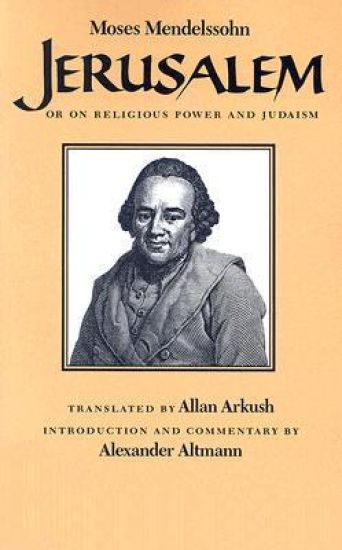
Jerusalem

Jerusalem

Moses Mendelssohn

Dartmouth College Press
1983
nidottu
A classic text of enduring significance, Moses Mendelssohn's Jerusalem (1783) stands as a powerful plea for the separation of church and state and also as the first attempt to present Judaism as a religion eminently compatible with the ideas of the Enlightenment. Allan Arkush's new translation, drawing upon the great strides made by Mendelssohn research in recent decades, does full justice to contemporary insights into the subject while authentically reflecting a distinguished eighteenth-century text. Alexander Altmann's learned introduction opens up the complex structure and background of Mendelssohn's ideas. His detailed commentary, keyed to the text, provides references to literary sources and interpretations of the philosopher's intent.
Moses Mendelssohn, Kleinere Schriften II

Moses Mendelssohn, Kleinere Schriften II

Moses Mendelssohn

Frommann-Holzboog
1981
sidottu
Die Kleineren Schriften II zeigen Mendelssohn in bisher oft unbekannten Beitragen vornehmlich als grammarien-philosophe. Seine sprachwissenschaftlichen Theorien und Studien, die Ubersetzungen (u.a. aus Platon, Shaftesbury, Rousseau), die eigenen Dichtungen und Nachdichtungen beruhen alle auf Mendelssohns Uberzeugung, dass der des Denkens fahige Mensch die Denkfahigkeit nur mittels der Sprache unter Beweis stellen kann. - Als Kritiker war sich Mendelssohn gleichzeitig bewusst, dass es um 1750 deutschsprachigen Dichtern und Literaten - im Gegensatz zu Franzosen und Englandern - an philosophischen Sprachtheorien wie an Freude uber die Ausdrucksfahigkeit der eigenen Sprache mangelte. Das von Mendelssohn bewiesene innere Gehor ist eine aufklarerische Leistung, die dem Sturm und Drang den Weg weist: vom Erkennen und Beherrschen der Sprachebenen, Sprachrhythmen, Sprachmelodie bis zu der Bedeutungsvielfalt des einzelnen gesprochenen Wortes, zur stummen Beredsamkeit des Menschen im hochsten Affekt, und bis zur Sprachalgebra abstrakter Erkenntnis. In previously relatively unknown essays, the Kleineren Schriften II (Selected Essays II) show Mendelssohn mainly as a grammarien-philosophe. His linguistic theories and studies, the translations (Plato, Shaftesbury, Rousseau among others), his own works and adaptations are all based on Mendelssohn's belief that a human being capable of thinking can only prove his reasoning skills by means of language. As a critic, Mendelssohn was also aware that German-speaking writers and literary figures around 1750 - unlike the French and the English - lacked philosophical theories of language as well as the joy in the expressiveness of their own language. The innere Gehor (inner hearing), proven by Mendelssohn, is an achievement of the Enlightenment which paved the way for the Sturm und Drang period: from recognizing and mastering the levels of language, speech rhythms, speech melodies to the various meanings of the single spoken word, to mankind's stummen Beredsamkeit (mute eloquence) and to the Sprachalgebra (linguistic algebra) of abstract knowledge.
Moses Mendelssohn, Briefwechsel III. 1781-1785

Moses Mendelssohn, Briefwechsel III. 1781-1785

Moses Mendelssohn

Frommann-Holzboog
1977
sidottu
Briefregister fur die Bande 11-13: Briefpartner: Thomas Abbt - Johann Bernhard Basedow - A. G. Baumgarten - Johann Erich Biester - Joachim Heinrich Campe - Christian Wilhelm Dohm - Johann Jacob Engel - David Friedlander - Christian Garve - Johann Wilhelm Ludwig Gleim - Fromet Gugenheim - Johann Georg Hamann - August Hennings - Johann Gottfried Herder - Marcus Herz - Herz Homberg - Isaak Iselin - Friedrich Heinrich Jacobi - Immanuel Kant - Anna Louisa Karschin - Gotthold Ephraim Lessing - Karl Gotthelf Lessing - Raphael Levi - Johann David Michaelis - Friedrich Nicolai - Karl Wilhelm Ramler - Elise Reimarus - Johann Salomo Semler - Josef von Sonnenfels - Johann Joachim Spalding - Moses Wessely - Christoph Martin Wieland - Johann Joachim Winckelmann - Johann Georg Zimmermann u.a. Correspondents volumes 11-13: Thomas Abbt - Johann Bernhard Basedow - A. G. Baumgarten - Johann Erich Biester - Joachim Heinrich Campe - Christian Wilhelm Dohm - Johann Jacob Engel - David Friedlander - Christian Garve - Johann Wilhelm Ludwig Gleim - Fromet Gugenheim - Johann Georg Hamann - August Hennings - Johann Gottfried Herder - Marcus Herz - Herz Homberg - Isaak Iselin - Friedrich Heinrich Jacobi - Immanuel Kant - Anna Louisa Karschin - Gotthold Ephraim Lessing - Karl Gotthelf Lessing - Raphael Levi - Johann David Michaelis - Friedrich Nicolai - Karl Wilhelm Ramler - Elise Reimarus - Johann Salomo Semler - Josef von Sonnenfels - Johann Joachim Spalding - Moses Wessely - Christoph Martin Wieland - Johann Joachim Winckelmann - Johann G. Zimmermann u.a