Kirjojen hintavertailu – 12 866 492 kirjaa ja 27 kauppaa

Kirjailija

Northrop Frye

Kirjat ja teokset yhdessä paikassa: 51 kirjaa, julkaisuja vuosilta 1958–2025, suosituimpiin kuuluu The Northrop Frye Quote Book. Vertaile teosten hintoja ja tarkista saatavuus suomalaisista kirjakaupoista.

51 kirjaa

Kirjojen julkaisuvuodet: 1958–2025.

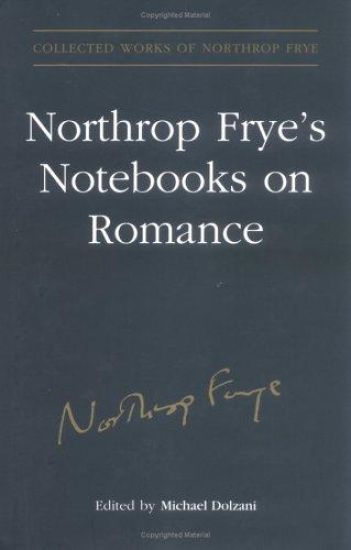
Northrop Frye's Notebooks on Romance

Northrop Frye's Notebooks on Romance

Northrop Frye

University of Toronto Press
2004
sidottu
Romance was a theme that ran through much of Northrop Frye's corpus, and his notebooks and typed notes on the subject are plentiful. This unpublished material, written between 1944 and 1989, traces a remarkable re-evaluation in his thinking over the course of time. As a young scholar, Frye insisted that romance was an expression of cultural decadence; however, in his later years, he thought of it as "the structural core of all fiction." The unpublished material Michael Dolzani has gathered for Northrop Frye's Notebooks on Romance shows how the pattern and conventions of romance inform the writing of history, anthropology, psychology, philosophy, and theology. While Frye is best known for his writing on myth and biblical scholarship, he himself eventually conceived of romance as the true and equal contrary to myth and scripture, a "secular scripture" whose message is de te fabula, "this story is about you." Given the current popular revival of romance in fiction and film, the appearance of Frye's unpublished work on romance is of profound importance.
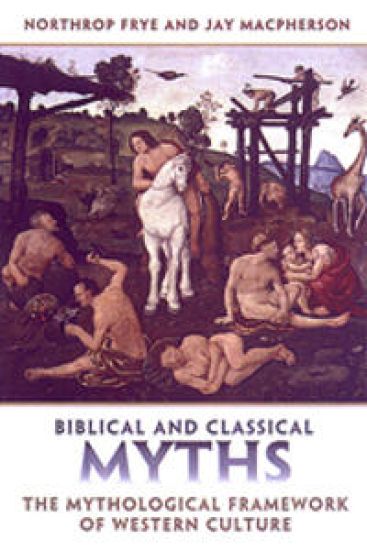
Biblical and Classical Myths

Biblical and Classical Myths

Northrop Frye; Jay Macpherson

University of Toronto Press
2004
pokkari
In the 1970s and 80s, Northrop Frye and Jay Macpherson co-taught a very influential course at the University of Toronto's Victoria College on the history of Western mythology - Frye focusing on the biblical myths; Macpherson on the classical. Biblical and Classical Myths recreates the thought behind that course, with Frye's lectures - unpublished until very recently - supplemented by Macpherson's popular 1962 textbook on classical mythology, Four Ages: The Classical Myths. Frye's lectures on the Bible make up the first half of the book. He expounds on an array of topics, including translations of the bible, sexual imagery, pastoral and agricultural imagery, and law and revolution in the bible. Four Ages makes up the second half. Macpherson narrates the major classical myths from stories of creation to the myths' survival in later European traditions. By complementing the biblical tradition with the classical, this volume imparts a comprehensive understanding of western mythology. With a preface by Alvin Lee, general editor of the Collected Works of Northrop Frye, Biblical and Classical Myths is an essential volume and represents a unique achievement in scholarship.
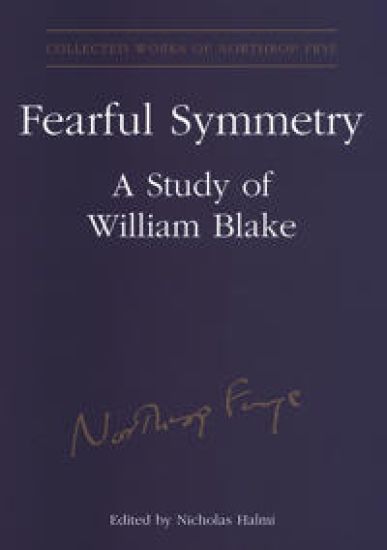
Fearful Symmetry

Fearful Symmetry

Northrop Frye

University of Toronto Press
2004
sidottu
Published in 1947, Fearful Symmetry was Northrop Frye's first book and the product of over a decade of intense labour. Drawing readers into the imaginative world of William Blake, Frye succeeded in making Blake's voice and vision intelligible to the wider public. Distinguished by its range of reference, elegance of expression, comprehensiveness of coverage, coherence of argument, and sympathy to its subject, Fearful Symmetry was immediately recognized as a landmark of Blake criticism. Fifty years later, it is still recognized as having ensured the acceptance of Blake as a canonical poet by permanently dispelling the widespread notion that he was the mad creator of an incomprehensible private symbolism. For this new edition, the text has been revised and corrected in accordance with the principles of the Collected Works of Northrop Frye series. Frye's original annotation has been supplemented with references to currently standard editions of Blake and others, and many new notes have been provided, identifying quotations, allusions, and cultural references. An introduction by Ian Singer provides biographical and critical context for the book, an overview of its contents, and an account of its reception.
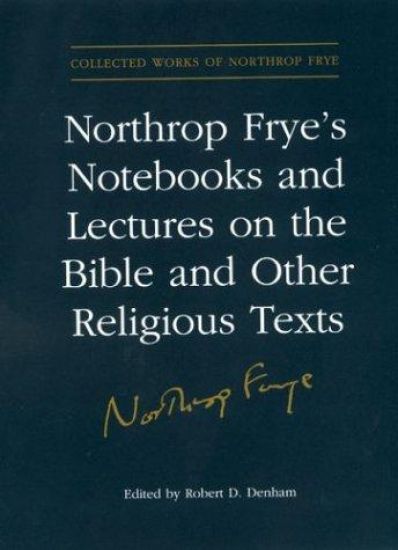
Northrop Frye's Notebooks and Lectures on the Bible and Other Religious Texts
Northrop Frye's expansive and influential lectures on the literary symbolism of the Bible given during 1981-2 are arguably among his best and most accessible works. This thirteenth volume in the Collected Works of Northrop Frye gathers together these lectures and Frye's notebooks on the Bible, Dante, and Eastern religion. The eleven holograph notebooks and the twenty-four lectures transcribed here present new insights into Frye's personality, methods, and thought, and complement the other published editions of Frye's notebooks in this series, The Late Notebooks (2000) and The 'Third Book' Notebooks (2002). The notebook material comes mostly from the 1970s, when Frye was at work on the first of his books on the Bible, The Great Code, but also includes one notebook from the 1940s, another from the 1960s, devoted to Frye's reading of Dante's Purgatorio and the first ten cantos of the Paradiso, and another from the 1980s, when Frye was at work on his second book on the Bible, Words with Power. Fully annotated, this latest volume in the Collected Works of Northrop Frye will be an invaluable addition to any literary or religious scholar's library.
Northrop Frye on Canada

Northrop Frye on Canada

Northrop Frye

University of Toronto Press
2003
sidottu
Northrop Frye is conceivably Canada's most celebrated literary theorist, but his role in the country's cultural evolution has perhaps been overlooked by later Canadian scholars in favour of his better-known literary criticism. This collection brings together all of the writings of Northrop Frye, both published and heretofore unpublished, on the subject of Canadian literature and culture. From his early book reviews of the 1930s and 1940s through his explorations of the patterns of Canadian literature in the fifties, to his cultural commentaries of the sixties, seventies, and eighties (including all his essays from The Bush Garden and Divisions on a Ground), Northrop Frye on Canada is vivid testimony to his position as an astute critic of his country's literature and a vital participant in its cultural evolution. All of Frye's writings on Canadian literature and culture - essays, articles, reviews, and speeches - are published in their entirety and are accompanied by a detailed introduction and contextual headnotes to each piece. Gathered from more than fifty years of Frye's career, the collection shows Frye as a careful and caring critic of Canada, and is demonstrative of his importance as the cultural commentator on Canada.
Northrop Frye on Modern Culture

Northrop Frye on Modern Culture

Northrop Frye

University of Toronto Press
2003
sidottu
Eradicating once and for all the unfounded notion that Frye was not a political writer, this eleventh volume in the Collected Works of Northrop Frye gathers together all of Northrop Frye's writings on politics, culture, the arts, history, literature, mass media, and music. Written between 1934 and 1986, these collected works illustrate the extent of Frye's engagement with the unfolding events of twentieth-century political life, from the Great Depression to the Reagan / Thatcher / Mulroney era. The centrepiece of the volume, Frye's learned and wide-ranging contribution to the Canadian confederation celebrations, The Modern Century (1967), is accompanied by pieces that reflect Frye's observations on such diverse political events as the Oxford 'King and Country' debate and the Vietnam war, revealing Frye the literary theorist as Frye the political entity. Jan Gorak's extensive introduction and annotations serve to historicize Frye and situate him and his work in the historical and critical context of twentieth-century Canada and North America. Frye's work is discussed in relation to that of T. S. Eliot, Edmund Wilson, Raymond Williams, Marshall McLuhan, Harold Innis, E. J. Pratt, A. J. M. Smith, F. A. Underhill, J. S. Woodsworth, George Grant, and especially Oswald Spengler. Erudite and enlightening, Frye's comments on politics are as relevant today as they were when he wrote them, and this volume will be a valuable reference for understanding the essential Frye.
Great Code: The Bible and Literature

Great Code: The Bible and Literature

Northrop Frye

Houghton Mifflin
2002
nidottu

Halvin toimitettuna 21,80 €

An examination of the influence of the Bible on Western art and literature and on the Western creative imagination in general. Frye persuasively presents the Bible as a unique text distinct from all other epics and sacred writings. "No one has set forth so clearly, so subtly, or with such cogent energy as Frye the literary aspect of our biblical heritage" (New York Times Book Review). Indices.
The 'Third Book' Notebooks of Northrop Frye, 1964-1972: the Critical Comedy
In the early 1960s, Northrop Frye began keeping notebooks with the aim of creating a critical epic that he referred to as the 'Third Book', a project intended as his third major work following Fearful Symmetry and Anatomy of Criticism. As described by Michael Dolzani, Frye's ambition for the 'Third Book' was for it to become no less than a "symbolic guide to the entire universe". The work he envisioned contemplated the ways in which myth and metaphor are the keys to all verbal structures: how they reach beyond the hypothetical realm of literature to inform, organize, and control historical, conceptual, political, and perhaps scientific thought. Although ultimately abandoned, the 'Third Book' remains both an essential component of the larger Collected Works of Northrop Frye and an intriguing text in its own right. Michael Dolzani provides an eloquent introduction that adds an essential unifying frame to the fragmented and complex critical musings which comprise this enormous volume of work. Further, he has incorporated much useful background material and cross-referencing, enhancing the value of this volume as an indispensable research tool.
Northrop Frye on Literature and Society, 1936-89

Northrop Frye on Literature and Society, 1936-89

Northrop Frye

University of Toronto Press
2002
sidottu
Drawn from previously unpublished essays, talks, reviews and papers, this volume of Northrop Frye's collected works spans some fifty years of his long writing career. The earliest item is a paper on The Canterbury Tales dating from Frye's student days at Oxford. The latest was written in 1989, on the occasion of his receiving his thirty-sixth honorary degree from the University of Bologna. The center-piece of the collection is Frye's lengthy and ambitious essay, "Rencontre." Intended as an introduction to a never-published anthology of English literature, it is unique in Frye's oeuvre, being the only example of a sustained, continuous encounter with an entire literary tradition. "Rencontre" is a masterwork in its own right. Other important essays include: "Shakespeare and the Comedy of Humours," "The Literary Meaning of 'Archetype,'" and "Blake's Jerusalem." Frye was a profound and original thinker whose stature has not yet been fully realized. The writings collected here not only exemplify his extraordinary mind and elegant prose style - they show a far-sightedness and range that has not been seen before.
The Diaries of Northrop Frye, 1942-1955

The Diaries of Northrop Frye, 1942-1955

Northrop Frye

University of Toronto Press
2001
sidottu
With the publication of Fearful Symmetry in 1947, Northrop Frye gained wide renown as a literary theorist, a reputation that continued to build throughout his lifetime. This volume in the Collected Works provides a transcription of the seven books of diaries that Frye kept intermittently from 1942 until 1955. During the period of the final six diaries, 1949 - 1955, Frye was at work on Anatomy of Criticism, and he refers frequently to many of the essays written during this period that became a part of the book that brought him international acclaim. For Frye, diary-writing was a tool for recording "everything of importance" and this ruled out very little. His entries contain a large measure of self-analysis and self-revelation, and in this respect are confessional -- we see his sanguine humour, dark moods and claustrophobia, along with the more self-congratulatory aspects of his character. But the volume also serves as a chronicle. Peering over Frye's shoulder, we watch him teach his classes, plan his career, record his dreams, register his frank reactions to the hundreds of people who cross his path, eye attractive women, reflect on books, music and movies, ponder religious and political issues, consider his various physical and psychological ailments, practise the piano, visit bookstores, frequent Toronto restaurants, and record scores of additional activities, mundane and otherwise. The volume is fully annotated and contains a directory that identifies the more than 1200 people who make an appearance. Published here for the first time, these chronicles provide an unprecedented view of the life and times of this now-legendary scholar.
Northrop Frye's Late Notebooks,1982-1990

Northrop Frye's Late Notebooks,1982-1990

Northrop Frye

University of Toronto Press
2000
sidottu
An inveterate notebook keeper, Northrop Frye continually jotted down his ideas and thoughts as he worked through the complex schemes of his criticism. Volumes 5 and 6 of the Collected Works are the notebooks that he kept while writing his two final books, "Words with Power" and "The Double Vision". They provide a record of what he was reading and thinking as he struggled with the implications of those projects. In a sense they are the workshops out of which the books were constructed. While focusing on the works-in-progress, the 3684 entries presented here range over diverse territory, never failing to surprise, delight, and provoke. In these notebooks, for instance, we find comments triggered by a detective story Frye is reading, a lecture he has to prepare, a glance at the books on his shelves, a quotation he remembers, a letter received, or the memory of a trip. In many respects, the notebooks reveal a Frye who is quite different from the critic who made his reputation with "Fearful Symmetry" and "Anatomy of Criticism", displaying aspects of his personality and thought that are not apparent in his books and essays. The notebooks show us the unbuttoned Frye, a complex man capable of both spiritual transcendence and hard-headed pragmatism. Here, for instance, his criticism of Catholicism is far more acerbic than in anything he published. Likewise, his rejection of both Marxist and feminist ideology is far more pointed than elsewhere. These two volumes include seven of Frye's handwritten notebooks and five collections of his typed notebooks - all previously unpublished. The material is the record of an extraordinary intellectual odyssey, an odyssey that is, at its base, deeply spiritual.
Northrop Frye's Late Notebooks,1982-1990

Northrop Frye's Late Notebooks,1982-1990

Northrop Frye

University of Toronto Press
2000
sidottu
An inveterate notebook keeper, Northrop Frye continually jotted down his ideas and thoughts as he worked through the complex schemes of his criticism. Volumes 5 and 6 of the Collected Works are the notebooks that he kept while writing his two final books, "Words with Power" and "The Double Vision". They provide a record of what he was reading and thinking as he struggled with the implications of those projects. In a sense they are the workshops out of which the books were constructed. While focusing on the works-in-progress, the 3684 entries presented here range over diverse territory, never failing to surprise, delight, and provoke. In these notebooks, for instance, we find comments triggered by a detective story Frye is reading, a lecture he has to prepare, a glance at the books on his shelves, a quotation he remembers, a letter received, or the memory of a trip. In many respects, the notebooks reveal a Frye who is quite different from the critic who made his reputation with "Fearful Symmetry" and "Anatomy of Criticism", displaying aspects of his personality and thought that are not apparent in his books and essays. The notebooks show us the unbuttoned Frye, a complex man capable of both spiritual transcendence and hard-headed pragmatism. Here, for instance, his criticism of Catholicism is far more acerbic than in anything he published. Likewise, his rejection of both Marxist and feminist ideology is far more pointed than elsewhere. These two volumes include seven of Frye's handwritten notebooks and five collections of his typed notebooks - all previously unpublished. The material is the record of an extraordinary intellectual odyssey, an odyssey that is, at its base, deeply spiritual.
Northrop Frye on Religion

Northrop Frye on Religion

Northrop Frye

University of Toronto Press
2000
pokkari
The late Northrop Frye is Canada's best-known literary and cultural critic, and one of the most original thinkers of the twentieth century. During his lifetime, Frye developed a profoundly religious epistemology that informed and infused much of what he wrote. In bringing together his writings on the Bible and religion, this volume offers many keys to the dynamic essence of Frye's thought. Well-organized, insightfully introduced, and carefully edited, this scholarly, annotated edition covers nearly the full range of Frye's intensive intellectual work on religion. (The Great Code and Words with Power will be published in separate volumes of the collected edition.) The writings presented here span a period of fifty-seven years and range from prayers to convocation addresses. Although remarkably diverse in form and content, they reveal the splendid coherence of Frye's vision. This is a quintessential volume in the Collected Works, indispensable to all who have been inspired by Frye's work. In it we find the brilliant and often unorthodox record of a great mind imaginatively open to the transforming power of the Bible, and open also to what William Blake called "the human form divine."
The Correspondence of Northrop Frye and Helen Kemp, 1932-1939

The Correspondence of Northrop Frye and Helen Kemp, 1932-1939

Northrop Frye

University of Toronto Press
1996
sidottu
Robert D. Denham has collected in these volumes the 266 letters, cards, and telegrams that Helen Kemp and Northrop Frye wrote to each other during the six periods when they were apart, from the winter of 1931-32 until the summer of 1939. The letters form a compelling narrative of their early relationship. They tell of a romance in which two people fall in love, want to get married, and are confronted with obstacles blocking their path, including lack of money and the education they both need to advance their careers. But the story is much more than a romance. The letters reveal Frye's early talent as a writer, illustrating that both the matter and the manner of his criticism had begun to take shape when he was only nineteen. Helen Kemp's expressiveness and intelligence come through clearly in her letters, which were only discovered in 1992. Kemp and Frye share their thoughts on literature, music, religion, politics, education, and a host of other topics. They discuss their alma mater, Victoria College; artists and musicians of Toronto; southwestern Saskatchewan, where Frye spent a summer as a pastor on a United Church circuit; Frye's hometown, Moncton, New Brunswick; and Kemp's neighbourhood on Fulton Avenue in Toronto. We travel with them around the world, from Ottawa to Rome. We see through their eyes the early years of the Co-operative Commonwealth Federation, the struggles of the United Church of Canada, the activities of the Student Christian Movement, the appeal of Communism, the rise of fascism, and the beginnings of art education in the galleries of Canada.
The Correspondence of Northrop Frye and Helen Kemp, 1932-1939

The Correspondence of Northrop Frye and Helen Kemp, 1932-1939

Northrop Frye

University of Toronto Press
1996
sidottu
Robert D. Denham has collected in these volumes the 266 letters, cards, and telegrams that Helen Kemp and Northrop Frye wrote to each other during the six periods when they were apart, from the winter of 1931-32 until the summer of 1939. The letters form a compelling narrative of their early relationship. They tell of a romance in which two people fall in love, want to get married, and are confronted with obstacles blocking their path, including lack of money and the education they both need to advance their careers. But the story is much more than a romance. The letters reveal Frye's early talent as a writer, illustrating that both the matter and the manner of his criticism had begun to take shape when he was only nineteen. Helen Kemp's expressiveness and intelligence come through clearly in her letters, which were only discovered in 1992. Kemp and Frye share their thoughts on literature, music, religion, politics, education, and a host of other topics. They discuss their alma mater, Victoria College; artists and musicians of Toronto; southwestern Saskatchewan, where Frye spent a summer as a pastor on a United Church circuit; Frye's hometown, Moncton, New Brunswick; and Kemp's neighbourhood on Fulton Avenue in Toronto. We travel with them around the world, from Ottawa to Rome. We see through their eyes the early years of the Co-operative Commonwealth Federation, the struggles of the United Church of Canada, the activities of the Student Christian Movement, the appeal of Communism, the rise of fascism, and the beginnings of art education in the galleries of Canada.
Fools of Time

Fools of Time

Northrop Frye

University of Toronto Press
1996
pokkari
In the Alexander Lectures for 1965-66 at the University of Toronto, Dr. Frye describes the basis of the tragic vision as "being in time," in which death as "the essential event that gives shape and form to life ... defines the individual, and marks him off from the continuity of life that flows indefinitely between the past and the future." In Dr. Frye's view, three general types can be distinguished in Shakespearean tragedy, the tragedy of order, the tragedy of passion, and the tragedy of isolation, in all of which a pattern of "being in time" shapes the action. In the first type, of which Julius Caesar, Macbeth, and Hamlet are examples, a strong ruler is killed, replaced by a rebel-figure, and avenged by a nemesis-figure; in the second, represented by Romeo and Juliet, Anthony and Cleopatra, and Troilus and Cressida, authority is split and the hero is destroyed by a conflict between social and personal loyalties; and in the third, Othello, King Lear, and Timon of Athens, the central figure is cut off from his world, largely as a result of his failure to comprehend the dynamics of that world. What all these plays show us, Dr. Frye maintains, is "the impact of heroic energy on the human situation" with the result that the "heroic is normally destroyed ... and the human situation goes on surviving." Fools of Time will be welcomed not only by many scholars who are familiar with Dr. Frye's keen critical insight but also by undergraduates, graduates, high-school and university teachers who have long valued his work as a means toward a firmer grasp and deeper understanding of English literature.
A Natural Perspective

A Natural Perspective

Northrop Frye; Stanley Cavell

Columbia University Press
1995
pokkari
Frye maintains that Shakespeare's comedy is widely misunderstood and underestimated, and that the four romances--Pericles, Cymbeline, The Winter's Tale, and The Tempest--are the inevitable culmination of the poet's career.
The Myth of Deliverance

The Myth of Deliverance

Northrop Frye

University of Toronto Press
1993
pokkari
In these essays Northrop Frye addresses a question which preoccupied him throughout his long and distinguished career – the conception of comedy, particularly Shakespearean comedy, and its relation to human experience. In most forms of comedy, and certainly in the New Comedy with which Shakespeare was concerned, the emphasis is on moving towards a climax in which the end incorporates the beginning. Such a climax is a vision of deliverance or expanded energy and freedom. Frye draws on the Aristotelian notion of reversal, or peripeteia, to analyse the three plays commonly known as the 'problem comedies': Measure for Measure, All's Well That Ends Well, and Troilus and Cressida, showing how they anticipate the romances of Shakespeare's final period.
Words with Power

Words with Power

Northrop Frye

HarperOne
1992
sidottu

Halvin toimitettuna 24,00 €

In Words With Power, literary critic and theorist Northrop Frye continues his exploration, begun in The Great Code, of the influence of Biblical themes and forms of expression on Western literature, with discussions of authors ranging from Chaucer and Shakespeare to Yeats and Eliot. Frye identifies four key elements found in the Bible--the mountain, the garden, the cave, and the furnace--and describes how they recur in later secular writings.
The Double Vision

The Double Vision

Northrop Frye

University of Toronto Press
1991
pokkari
The publication in 1982 of Northrop Frye's The Great Code: The Bible and Literature was a literary event of major significance. Frye took what he called 'a fresh and firsthand look' at the Bible and analysed it as a literary critic, exploring its relation to Western literature and its impact on the creative imagination. Through an examination of such key aspects of language as myth, metaphor, and rhetoric he conveyed to the reader the results of his own encounter with the Bible and his appreciation of its unified structure of narrative and imagery. Shortly before his death in January 1991, Frye characterized The Double Vision as 'something of a shorter and more accessible version' of The Great Code and its sequel, Words with Power. In simpler context and briefer compass, it elucidates and expands on the ideas and concepts introduced in those books. The 'double vision' of the title is a phrase borrowed from William Blake indicating that mere simple sense perception is not enough for reliable interpretation of the meaning of the world. In Frye's words: 'the conscious subject is not really perceiving until it recognizes itself as part of what it perceives.' In four very readable, engaging chapters, Frye contrasts the natural or physical vision of the world with the inward, spiritual one as each relates to language, space, time, history, and the concept of God. Throughout, he reiterates that the true literal sense of the Bible is metaphorical and that this conception of a metaphorical literal sense is not new, or even modern. He emphasizes the fact that the literary language of the Bible is not intended, like literature itself, simply to suspend judgement, but to convey a vision of spiritual life that contineus to transform and expand our own. Its myths become, as purely literary myths cannot, myths to live by. Its metaphors become, as purely literary metaphors cannot, metaphors to live in. The Double Vision originated in lectures delivered at Emmanuel College in the University of Toronto, the texts of which were revised and augmented. It will appeal to scholars, students, and general readers alike who enjoyed Frye's earlier works or who are interested in the Bible, literature, literary theory and criticism, and religion.