Kirjojen hintavertailu – 12 866 492 kirjaa ja 27 kauppaa

Kirjailija

Northrop Frye

Kirjat ja teokset yhdessä paikassa: 51 kirjaa, julkaisuja vuosilta 1958–2025, suosituimpiin kuuluu The Northrop Frye Quote Book. Vertaile teosten hintoja ja tarkista saatavuus suomalaisista kirjakaupoista.

51 kirjaa

Kirjojen julkaisuvuodet: 1958–2025.

Myth and Metaphor

Myth and Metaphor

Northrop Frye

University of Virginia Press
1990
sidottu
The essays in the first section of ""Myth and Metaphor"" center on those basic building blocks of literature out of which Frye believes literature is made. The second section examines generally the relationship between literature and mythology on one hand, and social concern and ideology on the other. Because one of the primary ends of education in Frye's view is to make people aware of their mythological conditioning, this section also includes two essays on education. The recurring theme through these writings is the social function of criticism. The essays in section three focus on literature itself - its critique of the purely analytic faculties, its relation to the visual arts, and two of its recurring metaphors (the stage and the journey). The subjects addressed in section four derive from Frye's long-standing preoccupation with the Bible. The book concludes with a group of essays in criticism that examine particular works by Thomas More, Castiglione, William Morris, Wagner and Joyce. Together, these essays illustrate the continuity of Frye's vision of culture.
Spiritus Mundi

Spiritus Mundi

Northrop Frye

Indiana University Press
1983
pokkari
This collection of a dozen major essays written in recent year is vintage Frye—the fine distillation of a lifetime of originative thinking about literature and its context. The essays in Spiritus Mundi—the title comes from one of Yeat's best known poems, "The Second Coming," and refers to the book that was supposedly the source of Yeat's apocalyptic vision of a "great beast, slouching toward Bethlehem"—are arranges in three groups of four essays each. The first four are about the "contexts of literature," the second are about the "mythological universe," and the last are studies of four of the great visionary or myth-making poets who have been enduring sources of interest for Frye: Milton, Blake, Yeats, and Wallace Stevens. The volume is full of agreeable surprises: a delightful piece on charms and riddles is followed by an illuminating essay on Shakespearean romance. Like most of the other essays in the book, these two are compressed and elegant expositions of ideas that in the hands of a lesser writer would have required a book. In another selection Frye rescues Spengler from neglect and argues for the inclusion of The Decline of the West among the major imaginative books produced by the Western world. Elsewhere he advances the case for placing Copernicus in a pantheon composed primarily of literary figures. OF particular interest are several essays in which Frye comments personally and reflectively on the influence he has had on the study of literature and the reactions elicited by his work. In "The Renaissance of Books" he dissents from the opinion of the McLuhanites that the written word is showing signs of obsolescence and argues that books are "the technological instrument that makes democracy possible." As the dozen essays collected here amply attest, Northrop Frye continues to be the most perceptive and most persuasive exponent of the power of mythological imagination—or as he himself calls it, "the mythological habit of mind"—written in English.
Creation and Recreation

Creation and Recreation

Northrop Frye

University of Toronto Press
1980
pokkari
Here Professor Frye analyses the way in which the structure and imagery of literature have been affected by the complex of ideas and images surrounding the word 'creation.' Traditionally, everything associated with nature, reality, settled order, the way things are, is supposed to go back to the creation, the original divine act of making the world. If the word 'creative' is applied to human activities, the humanly creative is whatever profoundly disturbs our sense of 'the' creation, a reversing or neutralizing of it. What seems to be one of the few admirable forms of human achievement, the creation of the arts, turns out to be a kind of 'decreation.' The imagery of creation lies at the heart of every mythology and every development of the arts, though Professor Frye distinguishes between the stories of creation that look up to heaven and those that look down to earth. To these he contrasts human creativity, which is projected on the future, and recorded in various forms of the arts ranging from pastoral poetry to architecture. It is this counter-movement of creation set up by man, as reflected particularly in literature, that he calls 'recreation.' Originally delivered as the 1980 Larkin-Stuart Lectures, this book provides an intriguing and provocative insight into the notion of creation and of the relationship in creativity between the human and the divine.
The Secular Scripture

The Secular Scripture

Northrop Frye

Harvard University Press
1978
nidottu
Northrop Frye’s thinking has had a pervasive impact on contemporary interpretations of our literary and cultural heritage. In his Anatomy of Criticism, a landmark in the history of modern critical theory, he demonstrated his genius for mapping out the realm of imaginative creation. In The Secular Scripture he turns again to the task of establishing a broad theoretical framework, bringing to bear his extraordinary command of the whole range of literature from antiquity to the present. Romance, a mode of literature trafficking in such plot elements as mistaken identity, shipwrecks, magic potions, the rescue of maidens in distress, has tended to be regarded as hardly deserving of serious consideration; critics praise other aspects of the Odyssey, The Faerie Queene, Shakespeare’s last plays, and Scott’s Waverley novels, for example, while forgiving the authors’ indulgence in childishly romantic plots. Frye, however, discerns in the innumerable romantic narratives of the Western tradition an imaginative universe stretching from an idyllic world to a demonic one, and a pattern of action taking the form of a cyclical descent into and ascent out of the demonic realm. Romance as a whole is thus seen as forming an integrated vision of the world, a “secular scripture” whose hero is man, paralleling the sacred scripture whose hero is God. The clarity of Northrop Frye’s perception, the scope and suggestiveness of his conceptualizing, the wit and grace of his style, have won him universal admiration.
The Critical Path

The Critical Path

Northrop Frye

Indiana University Press
1971
pokkari
This philosophic inquiry into fundamental problems of literature and society is an immensely important addition to the canon of one of America's most original and distinguished critics. What is the function of poetry? Of criticism? In what sense does the poet "know"? What is the relationship between a society and its art? Northrop Frye conducts us on an illuminating survey of these and other broad philosophic issues and offers many incidental insights into specific cultural phenomena as well. Such matters as Marxist aesthetics, Renaissance humanism, the relation of poetry to religion, the idea of progress, and the challenge of our contemporary youth culture are among the dozen interesting topics that engage his attention along the way. Mr. Frye identifies two predominating ideologies in Western culture which he designates as the "myth of concern" and the "myth of freedom." A fully developed myth of concern, he writes, "compromises everything that it most concerns a society to know." Its purpose is to hold society together, hence its deeply conservative character. The "myth of freedom," on the other hand, embodies the "liberal" attitudes of objectivity and respect for the individual. The author traces the relative importance of these two myths from Homeric Greece to the present, relating them to the types of art and government they foster, the roles of the poet and critic, and many other topics. The final thesis of the two myths: "To maintain a free and mature society we have to become aware of the tension between concern and freedom, and the necessity of preserving them both." In relating literature to this dialect, Mr. Frye ranges through the entire history of Western philosophy and literature—from Plato to Heidegger, from Sir Philip Sydney to Bob Dylan—showing us that his inquiring mind has once again gone beyond the field of literature, narrowly conceived, into the wider region of the history of ideas. He regards the artist and critic in generous terms—as persons not insulated from society but involved in it in the most profound sense and so provides a unique study informed by intelligence, broad learning, and grace and precision of style.
Fearful Symmetry

Fearful Symmetry

Northrop Frye

Princeton University Press
1969
pokkari

Halvin toimitettuna 49,40 €

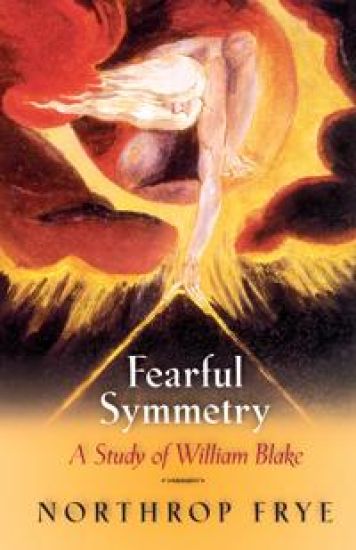
This brilliant outline of Blake's thought and commentary on his poetry comes on the crest of the current interest in Blake, and carries us further towards an understanding of his work than any previous study. Here is a dear and complete solution to the riddles of the longer poems, the so-called "Prophecies," and a demonstration of Blake's insight that will amaze the modern reader. The first section of the book shows how Blake arrived at a theory of knowledge that was also, for him, a theory of religion, of human life and of art, and how this rigorously defined system of ideas found expression in the complicated but consistent symbolism of his poetry. The second and third parts, after indicating the relation of Blake to English literature and the intellectual atmosphere of his own time, explain the meaning of Blake's poems and the significance of their characters.
The Educated Imagination

The Educated Imagination

Northrop Frye

Indiana University Press
1964
pokkari

Halvin toimitettuna 23,00 €

Addressed to educators and general readers—the "consumers of literature" from all walks of life—this important new book explores the value and uses of literature in our time. Dr. Frye offers, in addition, challenging and stimulating ideas for the teaching of literature at lower school levels, designed both to promote an early interest and to lead the student to the knowledge and kaleidoscopic experience found in the study of literature. Dr. Frye's proposals for the teaching of literature include an early emphasis on poetry, the "central and original literary form," intensive study of the Bible, as literature, and the Greek and Latin classics, as these embody all the great enduring themes of western man, and study of the great literary forms: tragedy and comedy, romance and irony.
Fables of Identity

Fables of Identity

Northrop Frye

CENGAGE LEARNING, INC
1963
pokkari
In this outstanding collection of sixteen essays, the world-renowned critic and scholar discusses various works in the central tradition of English mythopoeic poetry, paying particular attention to the centrality of Romanticism.
Myth and Symbol

Myth and Symbol

Northrop Frye

University of Nebraska Press
1963
pokkari
Thirteen of the essays in this volume were selected from sixty-one papers delivered at the 1962 joint meeting of the Midwest Modern Language Association and the Central Renaissance Conference. Two essays, "The Road of Excess" by Northrop Frye and "King Lear as Metaphor" by L. C. Knights, were originally presented as major lectures during the conference, whose central theme was criticism in relation to myth and symbol. Edited with a foreword by Bernice Slote, this book, as Miss Slote writes, is "an experiment in criticism: by repeated views from somewhat different vantage points, the essays present definitions and illustrate forms of a comparatively new way of considering literature—a concentration on myth and symbol."
Three Lectures

Three Lectures

Northrop Frye; Clyde Kluckhohn; V. B. Wigglesworth

University of Toronto Press
1958
pokkari
Hundreds were turned away from these lectures given on the day of the installation of Dr. Claude Bissell as President of the University of Toronto. Professor Frye spoke on "Humanities in a New World"; Professor Kluckhohn on "The Scientific Study of Values"; and Professor V. B. Wigglesworth on "Science: Pure and Applied".