Kirjojen hintavertailu – 12 859 828 kirjaa ja 27 kauppaa

Kirjailija

Partha Chatterjee

Kirjat ja teokset yhdessä paikassa: 32 kirjaa, julkaisuja vuosilta 1993–2026, suosituimpiin kuuluu For a Just Republic. Vertaile teosten hintoja ja tarkista saatavuus suomalaisista kirjakaupoista.

32 kirjaa

Kirjojen julkaisuvuodet: 1993–2026.

Britain in India, 1765-1905, Volume VI

Britain in India, 1765-1905, Volume VI

John Marriott; Bhaskar Mukhopadhyay; Partha Chatterjee

Routledge
2006
sidottu
Seeks to explore the nature of the relationship between Britain and India at the height of imperial expansion. This collection is of interest among academic communities exploring British and Indian history. It is useful for literary, cultural and urban historians working in this area.
Britain in India, 1765-1905, Volume VI

Britain in India, 1765-1905, Volume VI

John Marriott; Bhaskar Mukhopadhyay; Partha Chatterjee

Routledge
2006
sidottu
Seeks to explore the nature of the relationship between Britain and India at the height of imperial expansion. This collection is of interest among academic communities exploring British and Indian history. It is useful for literary, cultural and urban historians working in this area.
Britain in India, 1765-1905, Volume III

Britain in India, 1765-1905, Volume III

John Marriott; Bhaskar Mukhopadhyay; Partha Chatterjee

Routledge
2006
sidottu
Seeks to explore the nature of the relationship between Britain and India at the height of imperial expansion. This collection is of interest among academic communities exploring British and Indian history. It is useful for literary, cultural and urban historians working in this area.
Britain in India, 1765-1905, Volume II

Britain in India, 1765-1905, Volume II

John Marriott; Bhaskar Mukhopadhyay; Partha Chatterjee

Routledge
2006
sidottu
Seeks to explore the nature of the relationship between Britain and India at the height of imperial expansion. This collection is of interest among academic communities exploring British and Indian history. It is useful for literary, cultural and urban historians working in this area.
Britain in India, 1765-1905, Volume I

Britain in India, 1765-1905, Volume I

John Marriott; Bhaskar Mukhopadhyay; Partha Chatterjee

Routledge
2006
sidottu
Seeks to explore the nature of the relationship between Britain and India at the height of imperial expansion. This collection is of interest among academic communities exploring British and Indian history. It is useful for literary, cultural and urban historians working in this area.
The Politics of the Governed

The Politics of the Governed

Partha Chatterjee

Columbia University Press
2004
sidottu
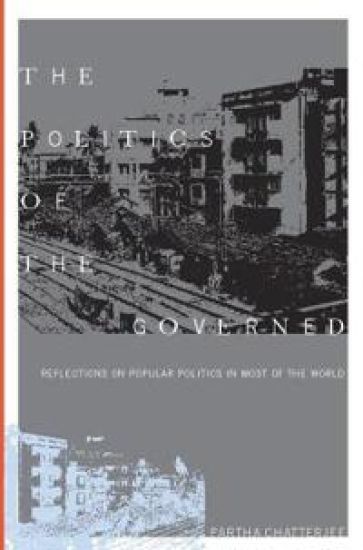
Often dismissed as the rumblings of "the street," popular politics is where political modernity is being formed today, according to Partha Chatterjee. The rise of mass politics all over the world in the twentieth century led to the development of new techniques of governing population groups. On the one hand, the idea of popular sovereignty has gained wide acceptance. On the other hand, the proliferation of security and welfare technologies has created modern governmental bodies that administer populations, but do not provide citizens with an arena for democratic deliberation. Under these conditions, democracy is no longer government of, by, and for the people. Rather, it has become a world of power whose startling dimensions and unwritten rules of engagement Chatterjee provocatively lays bare. This book argues that the rise of ethnic or identity politics-particularly in the postcolonial world-is a consequence of new techniques of governmental administration. Using contemporary examples from India, the book examines the different forms taken by the politics of the governed. Many of these operate outside of the traditionally defined arena of civil society and the formal legal institutions of the state. This book considers the global conditions within which such local forms of popular politics have appeared and shows us how both community and global society have been transformed. Chatterjee's analysis explores the strategic as well as the ethical dimensions of the new democratic politics of rights, claims, and entitlements of population groups and permits a new understanding of the dynamics of world politics both before and after the events of September 11, 2001. The Politics of the Governed consists of three essays, originally given as the Leonard Hastings Schoff Lectures at Columbia University in November 2001, and four additional essays that complement and extend the analyses presented there. By combining these essays between the covers of a single volume, Chatterjee has given us a major and urgent work that provides a full perspective on the possibilities and limits of democracy in the postcolonial world.
A Princely Impostor?

A Princely Impostor?

Partha Chatterjee

Princeton University Press
2002
pokkari
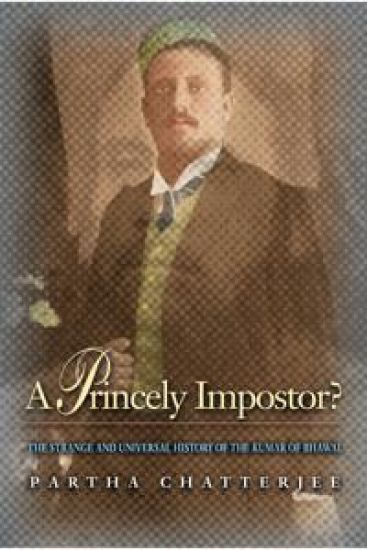
In 1921 a traveling religious man appeared in eastern British Bengal. Soon residents began to identify this half-naked and ash-smeared sannyasi as none other than the Second Kumar of Bhawal--a man believed to have died twelve years earlier, at the age of twenty-six. So began one of the most extraordinary legal cases in Indian history. The case would rivet popular attention for several decades as it unwound in courts from Dhaka and Calcutta to London. This narrative history tells an incredible story replete with courtroom drama, sexual debauchery, family intrigue, and squandered wealth. With a novelist's eye for interesting detail, Partha Chatterjee sifts through evidence found in official archives, popular songs, and backstreet Bangladeshi bookshops. He evaluates the case of the man claiming, with the support of legions of tenants and relatives, to be the long-lost Kumar. And he considers the position of the sannyasi's detractors, including the colonial government and the Kumar's young widow, who resolutely refused to meet the man she denounced as an impostor. Along the way, Chatterjee introduces us to a fascinating range of human character, gleans insights into the nature of human identity, and examines the relation between scientific evidence, legal truth, and cultural practice. The story he tells unfolds alongside decades of Indian history. Its plot is shaped by changing gender and class relations and punctuated by critical historical events, including the onset of World War II, the Bengal famine of 1943, and the Great Calcutta Killings. And by identifying the earliest erosion of colonialism and the growth of nationalist thinking within the organs of colonial power, Chatterjee also gives us a secret history of Indian nationalism.

Community, Gender and Violence

Community, Gender and Violence

Partha Chatterjee; Pradeep Jeganathan; Subaltern Studies Conference 1995 Colomb

Columbia University Press
2001
sidottu
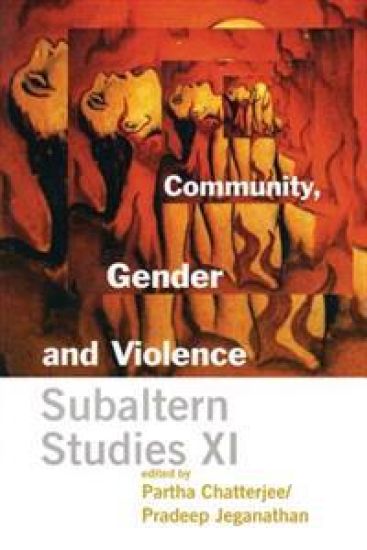
In its early phase, "Subaltern Studies" dealt extensively with the issue of community and violence in the context of peasant uprisings. Once the problems of peasant involvement in the modern politics of the nation were subjected to the same critical scrutiny, complexities in that relationship began to emerge. A new dimension was introduced when gender and national politics came to be taken seriously and in this volume the whole range of new issues raised by the relations between community, gender and violence are addressed. The question of women and the nation, especially among minorities, features strongly in this work. Qadri Ismail examines the claims of Tamil nationalism in Sri Lanka from the standpoint of the Southern Tamil woman; Aamir Mufti looks not at the familiar gendered figure of the nation as mother but, from the standpoint of the rejected minority, at the brutalized prostitute; while Tejaswini Niranjana writes on the "new woman" in contemporary Indian cinema. Further chapters look at women and minorities in the context of the law: Flavia Agnes examines the colonial and nationalist histories of the Hindu law of marriage and women's property, Nivedita Menon critically reviews the Indian debate over the universal civil code, and David Scott discusses, with an eye to Sri Lanka, the concept of minority rights within modern theories of citizenship. The issue of violence is taken up by Satish Deshpande in his study of the imagined space within which the new Hindu Right seeks to assert its dominance, and by Pradeep Jeganathan in his exploration of violence in the cultivation of masculinity. In her conclusion, Gayatri Chakravorty Spivak considers the position within a globalized economic space of the "new subaltern" - the Third World labouring woman.
Community, Gender and Violence

Community, Gender and Violence

Partha Chatterjee; Pradeep Jeganathan; Subaltern Studies Conference 1995 Colomb

Columbia University Press
2001
pokkari
In its early phase, "Subaltern Studies" dealt extensively with the issue of community and violence in the context of peasant uprisings. Once the problems of peasant involvement in the modern politics of the nation were subjected to the same critical scrutiny, complexities in that relationship began to emerge. A new dimension was introduced when gender and national politics came to be taken seriously and in this volume the whole range of new issues raised by the relations between community, gender and violence are addressed. The question of women and the nation, especially among minorities, features strongly in this work. Qadri Ismail examines the claims of Tamil nationalism in Sri Lanka from the standpoint of the Southern Tamil woman; Aamir Mufti looks not at the familiar gendered figure of the nation as mother but, from the standpoint of the rejected minority, at the brutalized prostitute; while Tejaswini Niranjana writes on the "new woman" in contemporary Indian cinema. Further chapters look at women and minorities in the context of the law: Flavia Agnes examines the colonial and nationalist histories of the Hindu law of marriage and women's property, Nivedita Menon critically reviews the Indian debate over the universal civil code, and David Scott discusses, with an eye to Sri Lanka, the concept of minority rights within modern theories of citizenship. The issue of violence is taken up by Satish Deshpande in his study of the imagined space within which the new Hindu Right seeks to assert its dominance, and by Pradeep Jeganathan in his exploration of violence in the cultivation of masculinity. In her conclusion, Gayatri Chakravorty Spivak considers the position within a globalized economic space of the "new subaltern" - the Third World labouring woman.
Texts Of Power

Texts Of Power

Partha Chatterjee

University of Minnesota Press
1995
nidottu
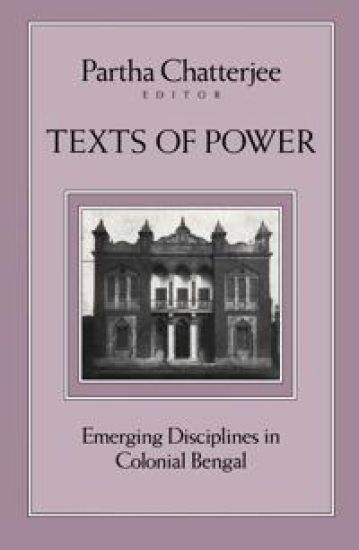
The case of Bengal illustrates the interaction of colonialism and modernity. Bengal was the first “modern” province in India-the first, that is, to undergo a forced encounter with Western modernity. Beginning with this premise, the writers in Texts of Power consider what the case of Bengal says about the workings of Western modernity in a colonial setting. A truly interdisciplinary effort, this collection probes questions of pedagogy, nationalism, and gender. Among the subjects explored are colonialist and nationalist surveillance of Bengali literature; the disposition of the nation’s art; the politics of child-rearing; the mapping of Calcutta; and the disciplining of historical memory. By applying the theoretical insights of recent historical and cultural studies to the specific circumstances of Bengal, the authors develop a new approach to Indian intellectual and cultural history. Their work makes a significant contribution to our understanding of contemporary intellectual modernity. Contributors: Pradip Kumar Bose, Keya Dasgupta, Tapati Guha-Thakurta, all at the Centre for Studies in Social Sciences, Calcutta; Tapti Roy, Maharani Kashiswari College, Calcutta; Ranabir Samaddar, Maulana Azad Institute of Asian Studies.
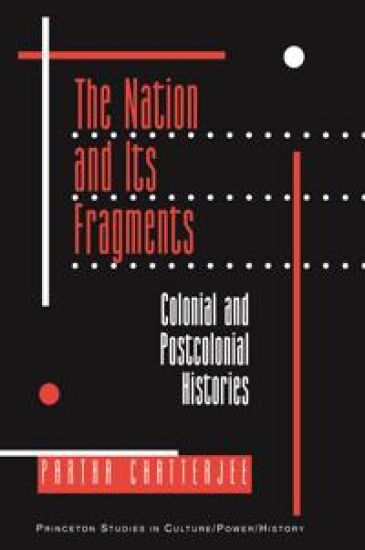
The Nation and Its Fragments

The Nation and Its Fragments

Partha Chatterjee

Princeton University Press
1993
pokkari
In this book, the prominent theorist Partha Chatterjee looks at the creative and powerful results of the nationalist imagination in Asia and Africa that are posited not on identity but on difference with the nationalism propagated by the West. Arguing that scholars have been mistaken in equating political nationalism with nationalism as such, he shows how anticolonialist nationalists produced their own domain of sovereignty within colonial society well before beginning their political battle with the imperial power. These nationalists divided their culture into material and spiritual domains, and staked an early claim to the spiritual sphere, represented by religion, caste, women and the family, and peasants. Chatterjee shows how middle-class elites first imagined the nation into being in this spiritual dimension and then readied it for political contest, all the while "normalizing" the aspirations of the various marginal groups that typify the spiritual sphere. While Chatterjee's specific examples are drawn from Indian sources, with a copious use of Bengali language materials, the book is a contribution to the general theoretical discussion on nationalism and the modern state. Examining the paradoxes involved with creating first a uniquely non-Western nation in the spiritual sphere and then a universalist nation-state in the material sphere, the author finds that the search for a postcolonial modernity is necessarily linked with past struggles against modernity.