Kirjailija
Paul Virilio
Kirjat ja teokset yhdessä paikassa: 44 kirjaa, julkaisuja vuosilta 1980–2026, suosituimpiin kuuluu Paul Virilio: Bunker Archéologie. Vertaile teosten hintoja ja tarkista saatavuus suomalaisista kirjakaupoista.
44 kirjaa
Kirjojen julkaisuvuodet: 1980–2026.
This book covers the key themes in Virilio's work: speed; society; virtuality; new technology." Negative Horizon" is Paul Virilio's most original and unified exploration of the key themes and ideas running through his thought. Provocative and forceful, it sets out Virilio's theory of dromoscopy: a means of apprehending speed and its pivotal - and potentially destructive - role in contemporary global society. Applying this theory to Western political and military history, Virilio exposes a compulsion to accelerate, and the rise of a politics of time - encapsulated in the importance accorded to speed - over territorial politics of space. Moving through human history from the cave paintings at Lascaux that depict the first hunters, to the 'stealth technologies' deployed in contemporary warfare, Virilio shows how resistance to speed and movement has consistently been eroded, and the physical world adapted, in order to satisfy the urge to move further and faster. In exposing what he believes to be the consequences of this constant acceleration for human sensory perception and, ultimately, global democracy, Virilio offers a vision of history and politics as disturbing as it is original. These books are seminal works of the finest minds in Western thought, including Adorno, Badiou, Derrida, Heidegger and Larkin. They are works of such power that they changed the cultural mind when they were written and continue to resonate today - landmark texts in the fields of philosophy, literature, popular culture, politics and theology - strikingly designed, accessibly priced.
Virilio and Lotringer revisit their prescient book on the invisible war waged by technology against humanity since World War II. In June 2007, Paul Virilio and Sylvere Lotringer met in La Rochelle, France to reconsider the premises they developed twenty-five years before in their frighteningly prescient classic, Pure War. Pure War described the invisible war waged by technology against humanity, and the lack of any real distinction since World War II between war and peace. Speaking with Lotringer in 1982, Virilio noted the "accidents" that inevitably arise with every technological development: from car crashes to nuclear spillage, to the extermination of space and the derealization of time wrought by instant communication. In this new and updated edition, Virilio and Lotringer consider how the omnipresent threat of the "accident"-both military and economic-has escalated. With the fall of the Soviet bloc, the balance of power between East and West based on nuclear deterrence has given way to a more diffuse multi-polar nuclear threat. Moreover, as the speed of communication has increased exponentially, "local" accidents-like the collapse of the Asian markets in the late 1980s-escalate, with the speed of contagion, into global events instantaneously. "Globalization," Virilio argues, is the planet's ultimate accident. Paul Virilio was born in Paris in 1932 to an immigrant Italian family. Trained as an urban planner, he became the director of the Ecole Speciale d'Architecture in the wake of the 1968 rebellion. He has published twenty-five books, including Pure War (1988) (his first in English) and The Accident of Art (2005), both with Sylvere Lotringer and published by Semiotext(e). Sylvere Lotringer, general editor of Semiotext(e), lives in New York and Baja California. He is the author of Overexposed: Perverting Perversions (Semiotext(e), 2007) and other books.
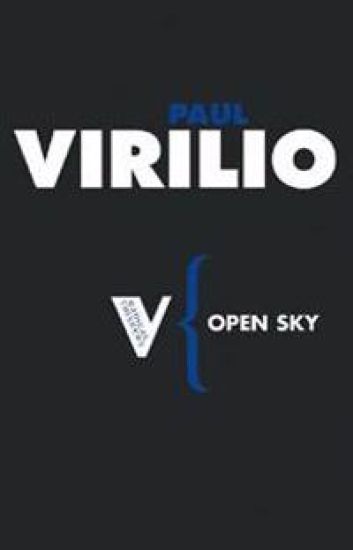
"One day the day will come when the day will not come." Bleak, but passionately political in its analysis of the social destruction wrought by modern technologies of communication and surveillance, Open Sky is Paul Virilio's most far-reaching and radical book. Deepening and extending his earlier work, he explores the growing danger of what he calls a "generalized accident," provoked by the breakdown of our collective and individual relation to time, space and movement in the context of global electronic media. But this is not merely a lucid and disturbing lament for the loss of real geographical spaces, distance, intimacy or democracy. Open Sky is also a call for revolt-against the insidious and accelerating manipulation of perception by the electronic media and repressive political power, against the tyranny of "real time," and against the infantilism of cyberhype. Virilio makes a powerful case for a new ethics of perception, and a new ecology, one which will not only strive to protect the natural world from pollution and destruction, but will also combat the devastation of urban communities by proliferating technologies of control and virtuality.
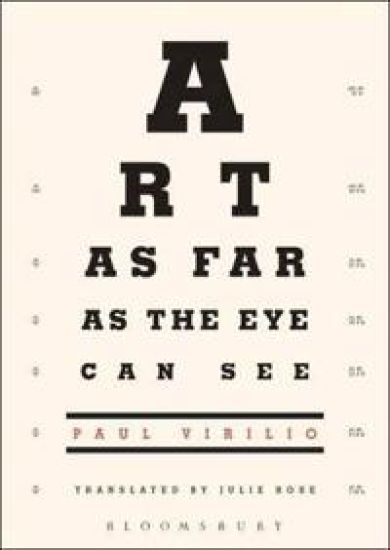
Paul Virilio puts art back where it matters - at the centre of politics. Art used to be an engagement between artist and materials. But in our new media world art has changed, its very materials have changed and have become technologized. This change reflects a broader social shift. Speed and politics - what Virilio defined as the key characteristics of the twentieth century - have been transformed in the twenty-first century to speed and mass culture. And the defining characteristic of mass culture today is panic. This induced panic relies on a new, all-seeing technology. And the first casualty of this is the human response. What we are losing is the very human 'art of seeing', one individual's engagement with another or with an event, be that political or artistic. What we are losing is our sense of the aesthetic. Where art used to talk of the aesthetics of disappearance, it must now confront the disappearance of the aesthetic.
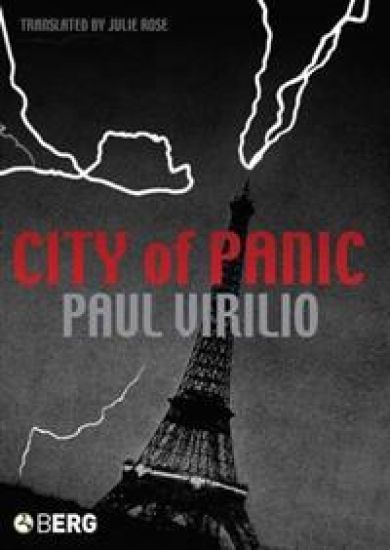
City of Panic takes the reader on a journey across the airy boulevards of Paris and into the crypt of its Metro. For Virilio, whose sense of cities was formed by earlier wars, Paris is both the City of Light and the City of Panic. Written in the shadow of war, City of Panic argues that cities everywhere have been the dedicated target of political and technological terror throughout the 20th century. The wanton erasure of the past, the construction of identikit places, the proliferation of gated-communities, the ever-widening net of surveillance, the privatisation of what was public ... Now every metropolis is a war zone and every metropolis is the same. In this globalized and militarized everywhere, all citizens are becoming one citizen - saturated, standardized and synchronized - ever-more reliant on a media fabricating a world of fear. For the panic of the 21st century is simply the final phase of the pincer movement. Place-less, media-fed, panic-struck - welcome to the desert of the real.
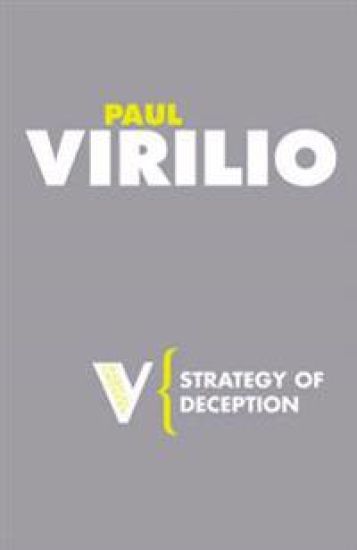
Written with his characteristic flair, Virillo's latest book is a trenchant denunciation of the Kosovo war in which he successfully unites theory with a riveting study of the conflict. Tearing aside the veil of hypocrisy in which the USA and its allies wrapped the war, Virillo demonstrates that the nature of the bombing was set by strategic rather than ethical considerations. Beneath the humanitarian rhetoric, Virillo sees a sinister innovation in the methods of waging war: territorial space is being replaced by orbital space in which a system of global telesurveillance is linked to the destructive power of bombers and missiles. Governments, the military and the media are becoming part of a seamless and self-justifying process linked by new information and arms technologies. Passionate and political, Strategy of Deception is a vital examination not only of the war in Yugoslavia but also what Virillo calls our "fin-de-siécle infantilization" in which the reality of battle is reduced to flickering images on a screen.
The future once promised the certainty of a better life for all but now it is full of uncertainty, danger and fear. Our lives are surrounded by the threats, imaginary or real, posed by terrorist outrages, natural catastrophes and disasters of all kinds. The future is overshadowed by the nightmare of an outmoded humanity overwhelmed by a catastrophe of its own making, a kind of catastrophic grand finale that would mirror the original accident - the Big Bang - that some scientists believe created the universe. A biting meditation on Progress technoscientific progress, at any cost and without any limits this book defines the ways in which postindustrial science has merged with out-and-out hyperterrorism to threaten the foundations of Greco-Roman, Judeo-Christian civilization, and the future of the planet with them, through innovation of mass catastrophes that are part and parcel of its panoply of inventions. Urging us to face up to the consequences of our brave-new-world technologies, Virilio calls for the creation of a Museum of the Accident to fight our habituation to horror and violence, and our daily overexposure to terror, in the name, not of some preventive war, but of a preventive intelligence that would help us deal with both natural and artificial disasters.
With this book Paul Virilio inaugurated the new science whose object of study is the "dromocratic" revolution. Speed and Politics (first published in France in 1977) is the matrix of Virilio's entire work. Building on the works of Morand, Marinetti, and McLuhan, Virilio presents a vision more radically political than that of any of his French contemporaries: speed as the engine of destruction. Speed and Politics presents a topological account of the entire history of humanity, honing in on the technological advances made possible through the militarization of society. Paralleling Heidegger's account of technology, Virilio's vision sees speed-not class or wealth-as the primary force shaping civilization. In this "technical vitalism," multiple projectiles-inert fortresses and bunkers, the "metabolic bodies" of soldiers, transport vessels, and now information and computer technology-are launched in a permanent assault on the world and on human nature. Written at a lightning-fast pace, Virilio's landmark book is a split-second, overwhelming look at how humanity's motivity has shaped the way we function today, and what might come of it.
Paul Virilio is one of contemporary Continental thought's most original and provocative critical voices. His vision of the impact of modern technology on the contemporary global condition is powerful and disturbing, ranging over art, science, politics and warfare. In Art and Fear, Paul Virilio traces the twin development of art and science over the twentieth century. In his provocative and challenging vision, art and science vie with each other for the destruction of the human form as we know it. He traces the connections between the way early twentieth century avant-garde artists twisted and tortured the human form before making it vanish in abstraction, and the blasting to bits of men who were no more than cannon fodder i nthe trenches of the Great War; and between the German Expressionists' hate-filled portraits of the damned, and the 'medical' experiments of the Nazi eugenicists; and between the mangled messages of global advertising, and the organisation of global terrorism. Now, at the start of the twenty-first century, science has finally left art behind, as genetic engineers prepare to turn themselves into the worst of expressionists, with the human being the raw material for new and monstrous forms of life. Art and Fear is essential reading for anyone wondering where art has gone and where science is taking us.
"Civilization or the militarization of science?" With this typically hyperbolic and provocative question as a starting point, Paul Virilio explores the dominion of techno-science, cyberwar and the new information technologies over our lives ... and deaths. After the era of the atomic bomb, Virilio posits an era of genetic and information bombs which replace the apocalyptic bang of nuclear death with the whimper of a subliminally reinforced eugenics. We are entering the age of euthanasia. These exhilarating bulletins from the information war extend the range of Virilio's work. The Information Bomb spans everything from Fukuyama to Larry Flynt, the Sensation exhibition of New British Art to space travel, all seen through the optic of Virilio's trenchant and committed theoretical position.
There is a catastrophe within contemporary art. What I call the "optically correct" is at stake. The vision machine and the motor have triggered it, but the visual arts haven't learned from it. Instead, they've masked this failure with commercial success. This "accident" is provoking a reversal of values. In my view, this is positive: the accident reveals something important we would not otherwise know how to perceive.-Paul Virilio, The Accident of ArtUrbanist and technological theorist Paul Virilio trained as a painter, studying under Henri Matisse, Georges Braque, Bazaine and de Stael. In The Accident of Art, his third extended conversation with Sylvere Lotringer, Virilio addresses the situation of art within technological society for the first time. This book completes a collaborative trilogy the two began in 1982 with Pure War and continued with Crepuscular Dawn, their 2002 work on architecture and biotechnology. In The Accident of Art, Virilio and Lotringer argue that a direct relation exists between war trauma and art. Why has art failed to reinvent itself in the face of technology, unlike performing art? Why has art simply retreated into painting, or surrendered to digital technology? Accidents, Virilio claims, can free us from speed's inertia. As technological catastrophes, accidents are inventions in their own right.
City of Panic takes the reader on a journey across the airy boulevards of Paris and into the crypt of its Metro. For Virilio, whose sense of cities was formed by earlier wars, Paris is both the City of Light and the City of Panic. Written in the shadow of war, City of Panic argues that cities everywhere have been the dedicated target of political and technological terror throughout the 20th century. The wanton erasure of the past, the construction of identikit places, the proliferation of gated-communities, the ever-widening net of surveillance, the privatisation of what was public ... Now every metropolis is a war zone and every metropolis is the same. In this globalized and militarized everywhere, all citizens are becoming one citizen - saturated, standardized and synchronized - ever-more reliant on a media fabricating a world of fear. For the panic of the 21st century is simply the final phase of the pincer movement. Place-less, media-fed, panic-struck - welcome to the desert of the real.
Desert Screen is a vision of future war, in which Paul Virilio identifies the Gulf War as a turning-point in history, the last industrial and the first information war. Virilio argues that we live in a world of global sptio-temporal collapse, a world still exhausted from the geopolitics of the Cold War, a world in which the politics of military and media technology seem to preclude the possibility of negotiation and diplomacy. Virilio's original and far-reaching analysis is vital for an understanding of the current Middle East crisis. Paul Virilio (1932-) is Director of the Ecole Speciale d'Architecture in Paris and author of over 15 books including Art and Fear, Negative Horizon, War and Cinema and Open Sky.
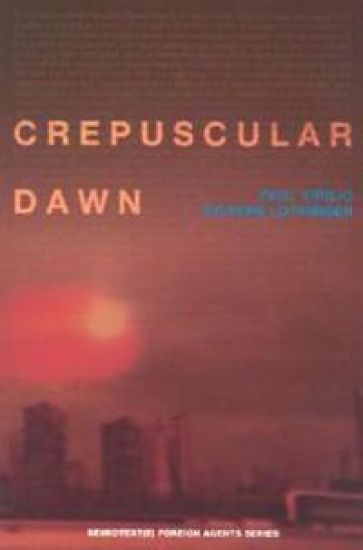
The "genetic bomb" marks a turn in the history of humanity. The accident is a new form of warfare. It is replacing revolution and war. Sarajevo triggered the First World War. New York is what Sarajevo was. September 11th opened Pandora's box. The first war of globalization will be the global accident, the total accident, including the accident of science. And it is on the way. In 1968, Virilio abandoned his work in oblique architecture, believing that time had replaced space as the most important point of reflection because of the dominance of speed. We were basically on the verge of converting space time into space speed... Speed facilitates the decoding of the human genome, and the possibility of another humanity: a humanity which is no longer extra-territorial, but extra-human. Crespuscular Dawn expands Virilio's vision of the implosion of physical time and space, onto the micro-level of bioengineering and biotechnology. In this cat-and-mouse dialogue between Sylvere Lotringer and Paul Virilio, Lotringer pushes Virilio to uncover the historical foundations of his biotech theories. Citing various medical experiments conducted during World War II, Lotringer asks whether biotechnology isn't the heir to eugenics and the "science for racial improvement" that the Nazis enthusiastically embraced. Will the endocolonizataion of the body come to replace the colonization of one's own population by the military? Both biographical and thematic, the book explores the development of Virilio's investigation of space (architecture, urbanism) and time (speed and simultanaeity) that would ultimately lay the foundation for his theories on biotechnology and his startling declaration that after the colonization of space begins the colonization of the body.
How would it be if what we take for human advance were simply a technological progress that literally leaves us out of its equations? What if progress is not humanity striking out bravely towards the future, but an ultimately destructive force? In a remarkable tour d'horizon, Paul Virilio paints a bleak picture of current scientific, cultural, social and political values. Art has succumbed to the techniques of advertising and in politics, the battle for hearts and minds has become a mere convergence of opinion. TV ratings have triumphed over universal suffrage. The events of September 11 reflect both the manipulation of a global sub-proletariat and the delusions of an elite of rich students and technicians who resemble the 'suicidal members of the Heaven's Gate cybersect'. And, in this post-humanist dystopia, we are morally rudderless before the threat of biological manipulations as yet undreamt. About the series: Appearing on the first anniversary of the attacks on the World Trade Center and the Pentagon, these series of books from Verso present analyses of the United States, the media, and the events surrounding September 11 by Europe's most stimulating and provocative philosophers. Probing beneath the level of TV commentary, political and cultural orthodoxies, and 'rent-a-quote' punditry, Baudrillard, Virilio, and Zizek offer three highly original and readable accounts that serve as fascinating introductions to the direction of their respective projects, and as insightful critiques of the unfolding events. This series seeks to comprehend the philosophical meaning of September 11 and will leave untouched none of the prevailing views currently propagated.
'If you've ever felt like we're going nowhere fast, and you'd like to know why - preferably sometime before you die - read this book' - James Der Derian, Brown University and UMASS/Amherst Examining how the 'here and now' of space, territory, the body, are being redefined by new technologies and how this undoes simplistic versions of the globalization thesis, Paul Virilio demonstrates how technology has made inertia the defining condition of modernity. An instantaneous present has replaced space and the sovereignty of territory; everything happens without the need to go anywhere.
In this series of overlapping essays on architecture and art, JohnRajchman attempts to do theory in a new way that takes off from the philosophy of the late Gilles Deleuze.foreword by Paul Virilio. In this series of overlapping essays on architecture and art, John Rajchman attempts to do theory in a new way that takes off from the philosophy of the late Gilles Deleuze. Starting from notions of folding, lightness, ground, abstraction, and future cities, he embarks on a conceptual voyage whose aim is to help "construct" a new space of connections, to "build" a new idiom, perhaps even to suggest a new architecture. Along the way, he addresses questions of the new abstraction, operative form, other geometries, new technologies, global cities, ideas of the virtual and the formless, and possibilities for critical theory after utopia and transgression.