Kirjojen hintavertailu – 12 859 818 kirjaa ja 27 kauppaa

Kirjailija

Peter Heather

Kirjat ja teokset yhdessä paikassa: 30 kirjaa, julkaisuja vuosilta 1991–2026, suosituimpiin kuuluu Geopolitikens återkomst : striden om framtidens historia. Vertaile teosten hintoja ja tarkista saatavuus suomalaisista kirjakaupoista.

30 kirjaa

Kirjojen julkaisuvuodet: 1991–2026.

Geopolitikens återkomst : striden om framtidens historia

Geopolitikens återkomst : striden om framtidens historia

Jeremy Black; Philip Bobbitt; Michael Broers; Roger Crowley; Gregory Feifer; Noah Feldman; Jonathan Fenby; David Frum; Gabriel Gorodetsky; Peter Heather; Josef Joffe; Anna-Lena Laurén; John H. Maurer; Sean McMeekin; Walter Russell Mead; Richard Miles; Fraser Nelson; Richard Overy; Lincoln Paine; Andrew Preston; Morris Rossabi; Charly Salonius-Pasternak; Norman Stone; Barry Strauss; Mikael Wigell

Bokförlaget Stolpe
2021
sidottu
Det var inte länge sedan idén om att vi nått historiens slut vann kraft och spridning: tanken att människans sociokulturella evolution nått fram till en punkt där den knappast kunde nå längre. Ett kvartssekel senare verkar denna optimism ha försvunnit. I stället bevittnar vi nu geopolitikens återkomst. Ett tjugotal experter utforskar i denna antologi hur vi hamnade där vi är idag men också vart vi kan tänkas vara på väg. Huvudredaktörer är Kurt Almqvist och Alexander Linklater.

Christendom: The Triumph of a Religion, AD 300-1300

Christendom: The Triumph of a Religion, AD 300-1300

Peter Heather

VINTAGE
2025
nidottu

Halvin toimitettuna 23,90 €

"A colossal book written by a colossus in the field" (The New York Review of Books): A major reinterpretation of the religious superstate that came to define both Europe and Christianity itself, by one of our foremost medieval historians. In the fourth century AD, a new faith grew out of Palestine, overwhelming the paganism of Rome and resoundingly defeating a host of other rival belief systems. Almost a thousand years later, all of Europe was controlled by Christian rulers, and the religion, ingrained within culture and society, exercised a monolithic hold over its population. But how did a small sect of isolated and intensely committed congregations become a mass movement centrally directed from Rome? As Peter Heather shows in this illuminating new history, there was nothing inevitable about Christendom's rise and eventual dominance. From Constantine the Great's pivotal conversion to Christianity to the crisis that followed the collapse of the Roman empire--which left the religion teetering on the edge of extinction--to the astonishing revolution of the eleventh century and beyond, out of which the Papacy emerged as the head of a vast international corporation, Heather traces Christendom's chameleonlike capacity for self-reinvention, as it not only defined a fledgling religion but transformed it into an institution that wielded effective authority across virtually all of the disparate peoples of medieval Europe. Authoritative, vivid, and filled with new insights, this is an unparalleled history of early Christianity.
Why Empires Fall: Rome, America, and the Future of the West

Why Empires Fall: Rome, America, and the Future of the West

Peter Heather; John Rapley

YALE UNIVERSITY PRESS
2024
nidottu

Halvin toimitettuna 20,70 €

A new perspective on parallels between ancient Rome and the modern world, and what comes next " A] provocative short book . . . with a novel twist."--The Economist Over the last three centuries, the West rose to dominate the planet. Then, around the start of the new millennium, history took a dramatic turn. Faced with economic stagnation and internal political division, the West has found itself in rapid decline compared to the global periphery it had previously colonized. This is not the first time we have seen such a rise and fall: the Roman Empire followed a similar arc, from dizzying power to disintegration. Historian Peter Heather and political economist John Rapley explore the uncanny parallels, and productive differences, between ancient Rome and the modern West, moving beyond the tropes of invading barbarians and civilizational decay to unearth new lessons. From 399 to 1999, they argue, through the unfolding of parallel, underlying imperial life cycles, both empires sowed the seeds of their own destruction. Has the era of Western global domination indeed reached its end? Heather and Rapley contemplate what comes next.
Why Empires Fall

Why Empires Fall

John Rapley; Peter Heather

PENGUIN BOOKS LTD
2024
pokkari

Halvin toimitettuna 17,00 €

What can the fall of Rome teach us about the decline of the West today? A historian and a political economist, both experts in their field, investigateOver the last three centuries, the West rose to dominate the planet. Then, suddenly, around the turn of the millennium, history reversed. Faced with economic stagnation and internal political division, the West has found itself in rapid decline. This is not the first time the global order has witnessed such a dramatic rise and fall. The Roman Empire followed a similar arc from dizzying power to disintegration - a fact that is more than a strange historical coincidence. In Why Empires Fall, historian Peter Heather and political economist John Rapley use this Roman past to think anew about the contemporary West, its state of crisis, and what paths we could take out of it. In this exceptional, transformative intervention, Heather and Rapley explore the uncanny parallels - and productive differences - between the two cases, moving beyond the familiar tropes of invading barbarians and civilizational decay to learn new lessons from ancient history. From 399 to 1999, the life cycles of empires, they argue, sow the seeds of their inevitable destruction. The era of western global domination has reached its end - so what comes next?
Christendom

Christendom

Peter Heather

PENGUIN BOOKS LTD
2023
pokkari

Halvin toimitettuna 23,60 €

'A fascinating story about a religion in a surprisingly precarious position' Dan Jones, Sunday Times'Superb storytelling ... captivating and profound' Literary Review'A page-turner' The SpectatorIn the fourth century AD, a new faith exploded out of Palestine. Overwhelming the paganism of Rome, and converting the Emperor Constantine in the process, it resoundingly defeated a host of other rivals. Almost a thousand years later, all of Europe was controlled by Christian rulers, and the religion, ingrained within culture and society, exercised a monolithic hold over its population. But, as Peter Heather shows in this compelling history, there was nothing inevitable about Christendom's rise to Europe-wide dominance. In exploring how the Christian religion became such a defining feature of the European landscape, and how a small sect of isolated congregations was transformed into a mass movement centrally directed from Rome, Heather shows how Christendom constantly battled against both so-called 'heresies' and other forms of belief. From the crisis that followed the collapse of the Roman Empire, which left the religion teetering on the edge of extinction, to the astonishing revolution in which the Papacy emerged as the head of a vast international corporation, Heather traces Christendom's chameleon-like capacity for self-reinvention and willingness to mobilize well-directed force. Christendom's achievement was not, or not only, to define official Christianity, but - from its scholars and its lawyers, to its provincial officials and missionaries in far-flung corners of the continent - to transform it into an institution that wielded effective religious authority across nearly all of the disparate peoples of medieval Europe. This is its extraordinary story.
Why Empires Fall: Rome, America, and the Future of the West

Why Empires Fall: Rome, America, and the Future of the West

Peter Heather; John Rapley

YALE UNIVERSITY PRESS
2023
sidottu
A new perspective on parallels between ancient Rome and the modern world, and what comes next " A] provocative short book . . . with a novel twist."--The Economist Over the last three centuries, the West rose to dominate the planet. Then, around the start of the new millennium, history took a dramatic turn. Faced with economic stagnation and internal political division, the West has found itself in rapid decline compared to the global periphery it had previously colonized. This is not the first time we have seen such a rise and fall: the Roman Empire followed a similar arc, from dizzying power to disintegration. Historian Peter Heather and political economist John Rapley explore the uncanny parallels, and productive differences, between ancient Rome and the modern West, moving beyond the tropes of invading barbarians and civilizational decay to unearth new lessons. From 399 to 1999, they argue, through the unfolding of parallel, underlying imperial life cycles, both empires sowed the seeds of their own destruction. Has the era of Western global domination indeed reached its end? Heather and Rapley contemplate what comes next.
Christendom: The Triumph of a Religion, Ad 300-1300

Christendom: The Triumph of a Religion, Ad 300-1300

Peter Heather

Knopf Publishing Group
2023
sidottu
A major reinterpretation of the religious superstate that came to define both Europe and Christianity itself, by one of our foremost medieval historians. In the fourth century AD, a new faith grew out of Palestine, overwhelming the paganism of Rome and resoundingly defeating a host of other rival belief systems. Almost a thousand years later, all of Europe was controlled by Christian rulers, and the religion, ingrained within culture and society, exercised a monolithic hold over its population. But how did a small sect of isolated and intensely committed congregations become a mass movement centrally directed from Rome? As Peter Heather shows in this illuminating new history, there was nothing inevitable about Christendom's rise and eventual dominance. From Constantine the Great's pivotal conversion to Christianity to the crisis that followed the collapse of the Roman empire--which left the religion teetering on the edge of extinction--to the astonishing revolution of the eleventh century and beyond, out of which the Papacy emerged as the head of a vast international corporation, Heather traces Christendom's chameleonlike capacity for self-reinvention, as it not only defined a fledgling religion but transformed it into an institution that wielded effective authority across virtually all of the disparate peoples of medieval Europe. Authoritative, vivid, and filled with new insights, this is an unparalleled history of early Christianity.
Rome Resurgent

Rome Resurgent

Peter Heather

Oxford University Press Inc
2020
nidottu
Between the fall of the western Roman Empire in the fifth century and the collapse of the east in the face of the Arab invasions in the seventh, the remarkable era of the Emperor Justinian (527-568) dominated the Mediterranean region. Famous for his conquests in Italy and North Africa, and for the creation of spectacular monuments such as the Hagia Sophia, his reign was also marked by global religious conflict within the Christian world and an outbreak of plague that some have compared to the Black Death. For many historians, Justinian is far more than an anomaly of Byzantine ambition between the eras of Attila and Muhammad; he is the causal link that binds together the two moments of Roman imperial collapse. Determined to reverse the losses Rome suffered in the fifth century, Justinian unleashed an aggressive campaign in the face of tremendous adversity, not least the plague. This book offers a fundamentally new interpretation of his conquest policy and its overall strategic effect, which has often been seen as imperial overreach, making the regime vulnerable to the Islamic takeover of its richest territories in the seventh century and thus transforming the great Roman Empire of Late Antiquity into its pale shadow of the Middle Ages. In Rome Resurgent, historian Peter Heather draws heavily upon contemporary sources, including the writings of Procopius, the principal historian of the time, while also recasting that author's narrative by bringing together new perspectives based on a wide array of additional source material. A huge body of archaeological evidence has become available for the sixth century, providing entirely new means of understanding the overall effects of Justinian's war policies. Building on his own distinguished work on the Vandals, Goths, and Persians, Heather also gives much fuller coverage to Rome's enemies than Procopius ever did. A briskly paced narrative by a master historian, Rome Resurgent promises to introduce readers to this captivating and unjustly overlooked chapter in ancient warfare.
Fractus Europa

Fractus Europa

Peter Heather; Daria Sapenko; Eric C Anderson

Dunn Books
2020
sidottu
TAKE A THRILL RIDE INTO THE DAY AFTER TOMORROW THROUGH A EUROPE FRACTURED BY SEISMIC CHANGE. An American journalist in Moscow uncovers a startling twist in American/Russian relations. A health care administrator struggles to keep medical services afloat amid a crumbling NHS in post-Brexit England. A Ukrainian soldier struggles to reconcile his pre- and post-war identities. This collection of short stories and beautifully rendered maps takes readers where academics and think tank philosophers dare not tread. Written by journalists and experts in regions with geopolitical unrest who have witnessed periods of great upheaval and threats both foreign and domestic, these fictionalized accounts depict the all-too-real failings of ideology and idealism in a Eurozone dystopia that has already arrived. Edited by the late Eric C. Anderson, former US Intelligence officer and author of several thrillers including the more recent "New Caliphate" trilogy--Osiris, Anubis, and Horus and the cyber thriller Byte and co-edited by Adam Dunn, author of the "More" series--Rivers of Gold, The Big Dogs, and Saint Underground--the collection features works by Conrad Zielan, Constantine Bouchagiar, Preston Smith, Peter Galuszka, David J. Doesser, Daria Sapenko, Graham Thomas, Fergal Parkinson, Nick Eaden, and Peter Heather.
Decadence and decay : from ancient Rome to the present

Decadence and decay : from ancient Rome to the present

Faramerz Dabhiowala; Melanie Grundmann; Richard Whatmore; Mattias Hessérus; Adoreé Villany; Andrew Huddleston; Saul David; Andrew Preston; Daniela Cammack; Pernille Røge; Adam Tooze; J.R. McNeill; Jonathan Rees; Robert Beuregard; William O’Reilly; Michael Nelson; Peter Heather; Robert Coates-Stephans; Neil McLynn; Richard Miles

Bokförlaget Stolpe
2019
sidottu

Halvin toimitettuna 40,40 €

The fear of living in the end times has a long history. In Decadence and Decay, a group of distinguished international scholars describe how societies over time have handled and interpreted the concept of decline. In times of unrest and transition, declinism the notion that a culture or civilisation is headed towards irreversible decline tends to capture the public imagination. The essays in this volume address how notions of decadence and decay have been used both as opprobrium and as a form of self-definition and empowerment an instrument to protect individualism against collectivistic oppression. From ancient Rome to the present, ideas and expressions of decadence and decay have played a critical role in how we perceive the world.
Rome Resurgent

Rome Resurgent

Peter Heather

Oxford University Press Inc
2018
sidottu
Between the fall of the western Roman Empire in the fifth century and the collapse of the east in the face of the Arab invasions in the seventh, the remarkable era of the Emperor Justinian (527-568) dominated the Mediterranean region. Famous for his conquests in Italy and North Africa, and for the creation of spectacular monuments such as the Hagia Sophia, his reign was also marked by global religious conflict within the Christian world and an outbreak of plague that some have compared to the Black Death. For many historians, Justinian is far more than an anomaly of Byzantine ambition between the eras of Attila and Muhammad; he is the causal link that binds together the two moments of Roman imperial collapse. Determined to reverse the losses Rome suffered in the fifth century, Justinian unleashed an aggressive campaign in the face of tremendous adversity, not least the plague. This book offers a fundamentally new interpretation of his conquest policy and its overall strategic effect, which has often been seen as imperial overreach, making the regime vulnerable to the Islamic takeover of its richest territories in the seventh century and thus transforming the great Roman Empire of Late Antiquity into its pale shadow of the Middle Ages. In Rome Resurgent, historian Peter Heather draws heavily upon contemporary sources, including the writings of Procopius, the principal historian of the time, while also recasting that author's narrative by bringing together new perspectives based on a wide array of additional source material. A huge body of archaeological evidence has become available for the sixth century, providing entirely new means of understanding the overall effects of Justinian's war policies. Building on his own distinguished work on the Vandals, Goths, and Persians, Heather also gives much fuller coverage to Rome's enemies than Procopius ever did. A briskly paced narrative by a master historian, Rome Resurgent promises to introduce readers to this captivating and unjustly overlooked chapter in ancient warfare.
Empires and Barbarians

Empires and Barbarians

Peter Heather

Pan Books
2018
pokkari

Halvin toimitettuna 29,40 €

At the start of the first millennium AD, southern and western Europe formed part of the Mediterranean-based Roman Empire, the largest state western Eurasia has ever known, and was set firmly on a trajectory towards towns, writing, mosaics, and central heating. Central, northern and eastern Europe was home to subsistence farmers, living in wooden houses with mud floors, whose largest political units weighed in at no more than a few thousand people. By the year 1000, Mediterranean domination of the European landscape had been destroyed. Instead of one huge Empire facing loosely organised subsistence farmers, Europe – from the Atlantic almost to the Urals – was home to an interacting commonwealth of Christian states, many of which are still with us today . This book tells the story of the transformations which changed western Eurasia forever: of the birth of Europe itself.
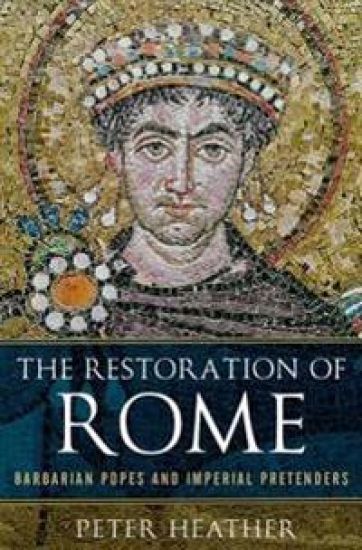
The Restoration of Rome: Barbarian Popes and Imperial Pretenders
In 476 AD, the last of Rome's emperors, known as "Augustulus," was deposed by a barbarian general, the son of one of Attila the Hun's henchmen. With the imperial vestments dispatched to Constantinople, the curtain fell on the Roman empire in Western Europe, its territories divided among successor kingdoms constructed around barbarian military manpower. But, if the Roman Empire was dead, Romans across much of the old empire still lived, holding on to their lands, their values, and their institutions. The conquering barbarians, responding to Rome's continuing psychological dominance and the practical value of many of its institutions, were ready to reignite the imperial flame and enjoy the benefits. As Peter Heather shows in dazzling biographical portraits, each of the three greatest immediate contenders for imperial power--Theoderic, Justinian, and Charlemagne--operated with a different power base but was astonishingly successful in his own way. Though each in turn managed to put back together enough of the old Roman West to stake a plausible claim to the Western imperial title, none of their empires long outlived their founders' deaths. Not until the reinvention of the papacy in the eleventh century would Europe's barbarians find the means to establish a new kind of Roman Empire, one that has lasted a thousand years. A sequel to the bestselling Fall of the Roman Empire, The Restoration of Rome offers a captivating narrative of the death of an era and the birth of the Catholic Church.