Kirjojen hintavertailu – 12 859 828 kirjaa ja 27 kauppaa

Kirjailija

Peter John

Kirjat ja teokset yhdessä paikassa: 42 kirjaa, julkaisuja vuosilta 2001–2026, suosituimpiin kuuluu Dysprosium Metal Complexes Derived from Bridging Oxygen Donor Ligands. Vertaile teosten hintoja ja tarkista saatavuus suomalaisista kirjakaupoista.

42 kirjaa

Kirjojen julkaisuvuodet: 2001–2026.

Zeenat's Journey

Zeenat's Journey

Peter John

Peter John
2025
pokkari
When recently divorced Muslim mother Zeenat books a five-day safari in South Africa's wilderness, she's seeking an escape from her carefully ordered life-not a whirlwind romance with her ruggedly handsome Afrikaner guide, Andries. But fate has other plans. Their cautious attraction explodes into desperate survival when a bull elephant in musth attacks their camp. As dawn breaks over the African bush, Zeenat must find courage she never knew she had: performing emergency medical procedures, handling a high-powered rifle, and facing down one of nature's most dangerous creatures. All while trying to ignore the growing realization that she's falling for a man who represents everything her traditional community warns against. Set against the raw beauty of the African wilderness, this cross-cultural love story challenges preconceptions about faith, family, and finding love in unexpected places. As Zeenat navigates between her religious convictions and her heart's desires, she discovers that sometimes the greatest journeys are the ones that lead us back to ourselves. Perfect for readers who loved "The No. 1 Ladies' Detective Agency" and "Out of Africa," this debut novel weaves together thrilling wildlife encounters, tender romance, and one woman's quest to define herself beyond the boundaries others have set for her.
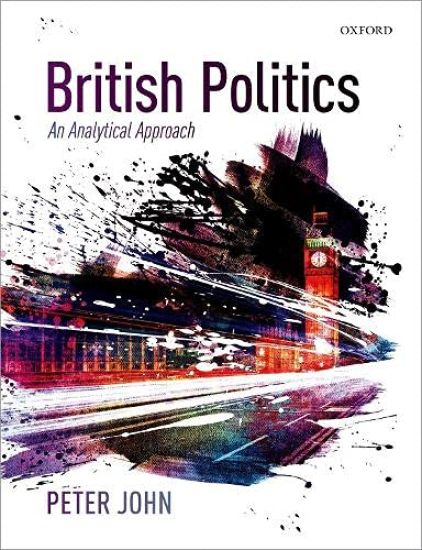
British Politics

British Politics

Peter John

Oxford University Press
2021
nidottu
- What caused the increased turbulence of British Politics in recent - How do policy blunders occur and why? - Why did Brexit happen, and what is the future of the UK-EU relationship? - How powerful are political parties in British Politics? - How is British politics shaped by variation and differentiation, especially across the nations of the UK? British Politics answers these fundamental questions, putting political science and public policy at its core to provide an analytical approach to British politics. The book's three-part structure is designed to help students make sense of the British political system. Part A covers constitutional and institutional foundations: the formal set of politics, laws, procedures, and customs which make up the distinctive features of the political system. In Part B, political behaviour and citizenship is explored, looking at politics from the view of the everyday citizen by examining political parties and the media. Finally, part C looks at how power and authority is dispersed through agencies, devolved powers, and international bodies. Overall, this gives students a thorough and rigorous introduction to the nature of British democracy in the twenty-first century. British Politics has a unique, sophisticated style, bringing together case studies, cutting-edge analysis, and comparative insights to make it essential reading for all students of British Politics. Digital formats and resources British Politics is available for students and institutions to purchase in a variety of formats, and is supported by online resources. · The e-book offers a mobile experience and convenient access along with hyperlinks to multiple-choice questions, to help you test your knowledge and understanding of British politics: www.oxfordtextbooks.co.uk/ebooks · Student resources: Multiple choice questions, web links to media sources and datasets, and biannual online updates organised by chapter are available online. Lecturer resources: Adaptable PowerPoint slides for each chapter are available online.

Abduction Chronicles GENESIS

Abduction Chronicles GENESIS

Peter John

Independently Published
2019
pokkari
A life sentence of boredom, that's what most people get out of retirement. For Colonel Petros Arkansas, it's the wildest ride he's ever been on, and as a former military man, he's been on quite a few. The aliens who abduct him try to bend him to their ways. The shadow military force he joins tries to make him a better man. The mythical trainers try to shake him to his core...but he has ideas of his own. Then, when the enemy forces try to take him out, he's had about enough. Hooyah Embark on this journey and discover the answers in the Abduction Chronicles: GENESIS
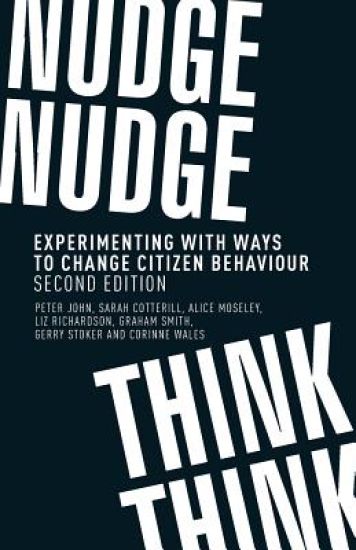
Nudge, Nudge, Think, Think

Nudge, Nudge, Think, Think

Peter John; Sarah Cotterill; Alice Moseley; Liz Richardson; Graham Smith; Gerry Stoker; Corinne Wales

Manchester University Press
2019
nidottu
How can governments persuade their citizens to act in socially beneficial ways? This ground-breaking book builds on the idea of 'light touch interventions' or 'nudges' proposed in Richard Thaler and Cass Sunstein's highly influential Nudge (2008). While recognising the power of this approach, it argues that an alternative also needs to be considered: a 'think' strategy that calls on citizens to decide their own priorities as part of a process of civic and democratic renewal. As well as setting out these divergent approaches in theory, the book provides evidence from a number of experiments to show how using 'nudge' or 'think' techniques works in practice. Updated and rewritten, this second edition features a new epilogue that reflects on recent developments in nudge theory and practice, introducing a radical version of nudge, ‘nudge plus’. There is also a substantial prologue by Cass Sunstein.
Local Governance in England and France

Local Governance in England and France

Alistair Cole; Peter John

Routledge
2018
nidottu
Local Governance in England and France addresses issues at the cutting edge of comparative politics and public policy. The book is based on extensive research and interviews, over 300 in total, with local decision makers in two pairs of cities in England and France: Lille and Leeds; Rennes and Southampton. No other Anglo-French comparative project has ever gone into such depth - based on actual case studies - making this book an invaluable resource for students and professionals alike. The book poses key questions about the changing role of the state, the difficulties of policy coordination in a fragmented institutional context, and about the relationship between governance, networks as well as political and democratic accountability. It will be of great interest to the professional research community, and practitioners in Britain, France and beyond, as well as to students of comparative politics, European public policy, British / French politics, European studies, public management and local government studies.
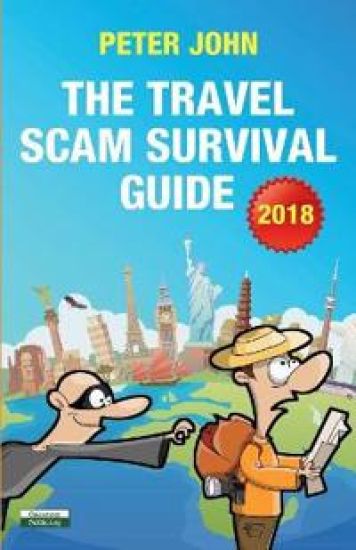
The Travel Scam Survival Guide [2018 Edition]
Travel is one of our favourite activities. From the hustle of bustle of the mega-cities to sleepy mountain towns to the tranquillity and isolation of tropical islands, we love to get out there and explore the world. But globe-trotting also comes with its pitfalls. Wherever there are travellers, there are swindlers looking to relieve individuals of their money, possessions and sometimes even more. To avoid such troubles, and to get on with enjoyable and fulfilling trips, people need to get smart. This book shows you how. The Travel Scam Survival Guide offers practical advice on avoiding the scams and hoaxes that can ruin any trip. From no-menu, rigged betting, and scenic taxi tour scams to rental damage, baksheesh, and credit card deceits - this book details scam hotspots, how the scams play out and what you can do to prevent them. The Travel Scam Survival Guide will help you develop an awareness and vigilance for high-risk people, activities, and environments. Avoiding just one of the scams listed in this book could save you money, time, hassle or much worse Forewarned is forearmed. About the Author Peter John is a lifelong traveller who dabbles in office work while planning his next trip. He has never knowingly scammed anyone, but has been scammed while he travelled more times than he cares to remember. He hopes that others can learn from his mistakes, which are spelled out in merciless detail in this book. NoteThis title is the fully-updated and revised 2018 edition of the acclaimed bestseller "Around The World in 80 Scams: An Essential Travel Guide." It is essential reading for Gap Year and Around The World travel. Table of Contents Chapter 1: Hotels and other accommodation scams Chapter 2: Transport scams Chapter 3: Cash, ATM and credit card scams Chapter 4: Travel agent and travel club scams Chapter 5: Shopping scams Chapter 6: Eating, drinking and gambling scams Chapter 7: Government scams Chapter 8: E-mail and Internet scams Chapter 9: Begging and street hustling scams Chapter 10: Extortion, blackmail and fraud scams Epilogue: How I try to avoid being scammed
How Far to Nudge?

How Far to Nudge?

Peter John

Edward Elgar Publishing Ltd
2018
nidottu
Behavioural public policies, or nudges, have become increasingly popular in recent years, with governments keen to use light-touch interventions to improve the success of their public policies. In this unique book, Peter John explores nudges, their successes and limitations, and sets out a bold manifesto for the future of behavioural public policy. This book traces the beginnings of nudge in behavioural economics and tracks the adoption of its core ideas by policy-makers, providing examples of successful applications. By considering the question ‘how far to nudge?’, John reviews why it is crucial for governments to address citizen behaviours, and reviews the criticisms of nudge and its ethical limitations. Looking to its future, this book proposes the adoption of a radical version of nudge, nudge plus, involving increased feedback and more engagement with citizens. How Far to Nudge? will be a vital text for students of behavioural public policy and policy analysis, as well as for anyone looking for an introduction to nudge policy and an explanation for its growth in popularity.
How Far to Nudge?

How Far to Nudge?

Peter John

Edward Elgar Publishing Ltd
2018
sidottu
Behavioural public policies, or nudges, have become increasingly popular in recent years, with governments keen to use light-touch interventions to improve the success of their public policies. In this unique book, Peter John explores nudges, their successes and limitations, and sets out a bold manifesto for the future of behavioural public policy. This book traces the beginnings of nudge in behavioural economics and tracks the adoption of its core ideas by policy-makers, providing examples of successful applications. By considering the question ‘how far to nudge?’, John reviews why it is crucial for governments to address citizen behaviours, and reviews the criticisms of nudge and its ethical limitations. Looking to its future, this book proposes the adoption of a radical version of nudge, nudge plus, involving increased feedback and more engagement with citizens. How Far to Nudge? will be a vital text for students of behavioural public policy and policy analysis, as well as for anyone looking for an introduction to nudge policy and an explanation for its growth in popularity.
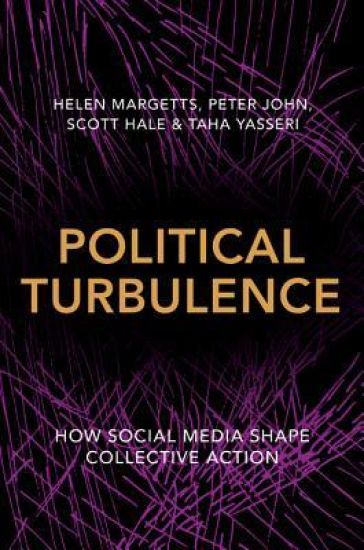
Political Turbulence

Political Turbulence

Helen Margetts; Peter John; Scott Hale; Taha Yasseri

Princeton University Press
2017
pokkari
As people spend increasing proportions of their daily lives using social media, such as Twitter and Facebook, they are being invited to support myriad political causes by sharing, liking, endorsing, or downloading. Chain reactions caused by these tiny acts of participation form a growing part of collective action today, from neighborhood campaigns to global political movements. Political Turbulence reveals that, in fact, most attempts at collective action online do not succeed, but some give rise to huge mobilizations--even revolutions. Drawing on large-scale data generated from the Internet and real-world events, this book shows how mobilizations that succeed are unpredictable, unstable, and often unsustainable. To better understand this unruly new force in the political world, the authors use experiments that test how social media influence citizens deciding whether or not to participate. They show how different personality types react to social influences and identify which types of people are willing to participate at an early stage in a mobilization when there are few supporters or signals of viability. The authors argue that pluralism is the model of democracy that is emerging in the social media age--not the ordered, organized vision of early pluralists, but a chaotic, turbulent form of politics. This book demonstrates how data science and experimentation with social data can provide a methodological toolkit for understanding, shaping, and perhaps even predicting the outcomes of this democratic turbulence.
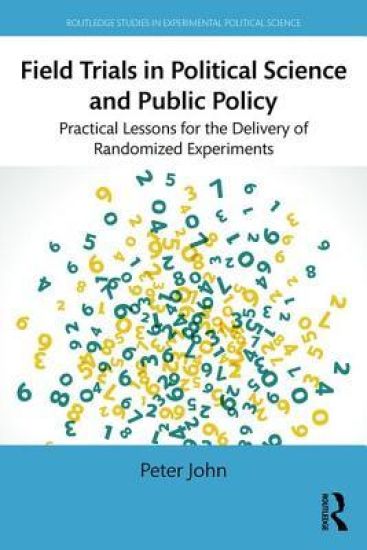
Field Experiments in Political Science and Public Policy
Field experiments -- randomized controlled trials -- have become ever more popular in political science, as well as in other disciplines, such as economics, social policy and development. Policy-makers have also increasingly used randomization to evaluate public policies, designing trials of tax reminders, welfare policies and international aid programs to name just a few of the interventions tested in this way. Field experiments have become successful because they assess causal claims in ways that other methods of evaluation find hard to emulate. Social scientists and evaluators have rediscovered how to design and analyze field experiments, but they have paid much less attention to the challenges of organizing and managing them. Field experiments pose unique challenges and opportunities for the researcher and evaluator which come from working in the field. The research experience can be challenging and at times hard to predict. This book aims to help researchers and evaluators plan and manage their field experiments so they can avoid common pitfalls. It is also intended to open up discussion about the context and backdrop to trials so that these practical aspects of field experiments are better understood. The book sets out ten steps researchers can use to plan their field experiments, then nine threats to watch out for when they implement them. There are cases studies of voting and political participation, elites, welfare and employment, nudging citizens, and developing countries.
Political Turbulence

Political Turbulence

Helen Margetts; Peter John; Scott Hale; Taha Yasseri

PRINCETON UNIVERSITY PRESS
2015
sidottu
As people spend increasing proportions of their daily lives using social media, such as Twitter and Facebook, they are being invited to support myriad political causes by sharing, liking, endorsing, or downloading. Chain reactions caused by these tiny acts of participation form a growing part of collective action today, from neighborhood campaigns to global political movements. Political Turbulence reveals that, in fact, most attempts at collective action online do not succeed, but some give rise to huge mobilizations--even revolutions. Drawing on large-scale data generated from the Internet and real-world events, this book shows how mobilizations that succeed are unpredictable, unstable, and often unsustainable. To better understand this unruly new force in the political world, the authors use experiments that test how social media influence citizens deciding whether or not to participate. They show how different personality types react to social influences and identify which types of people are willing to participate at an early stage in a mobilization when there are few supporters or signals of viability. The authors argue that pluralism is the model of democracy that is emerging in the social media age--not the ordered, organized vision of early pluralists, but a chaotic, turbulent form of politics. This book demonstrates how data science and experimentation with social data can provide a methodological toolkit for understanding, shaping, and perhaps even predicting the outcomes of this democratic turbulence.