
Kirjojen hintavertailu – 12 903 735 kirjaa ja 27 kauppaa

Kirjailija

Peter Tankov

Kirjat ja teokset yhdessä paikassa: 2 kirjaa, julkaisuja vuosilta 2003–2010, suosituimpiin kuuluu Financial Modelling with Jump Processes. Vertaile teosten hintoja ja tarkista saatavuus suomalaisista kirjakaupoista.

2 kirjaa

Kirjojen julkaisuvuodet: 2003–2010.

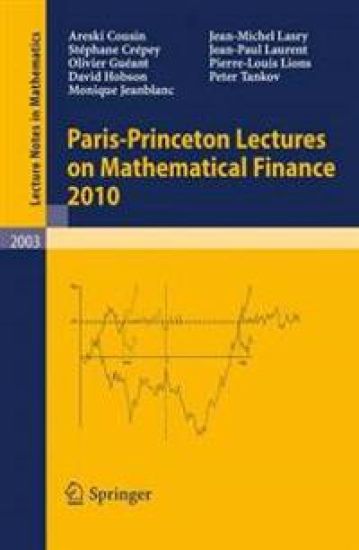
Paris-Princeton Lectures on Mathematical Finance 2010

Paris-Princeton Lectures on Mathematical Finance 2010

Areski Cousin; Stéphane Crépey; Olivier Guéant; David Hobson; Monique Jeanblanc; Jean-Michel Lasry; Jean-Paul Laurent; Pierre-Louis Lions; Peter Tankov

Springer-Verlag Berlin and Heidelberg GmbH Co. K
2010
nidottu
The Paris-Princeton Lectures in Financial Mathematics, of which this is the fourth volume, publish cutting-edge research in self-contained, expository articles from outstanding specialists - established or on the rise! The aim is to produce a series of articles that can serve as an introductory reference source for research in the field. The articles are the result of frequent exchanges between the finance and financial mathematics groups in Paris and Princeton. The present volume sets standards with five articles by: 1. Areski Cousin, Monique Jeanblanc and Jean-Paul Laurent, 2. Stéphane Crépey, 3. Olivier Guéant, Jean-Michel Lasry and Pierre-Louis Lions, 4. David Hobson and 5. Peter Tankov.
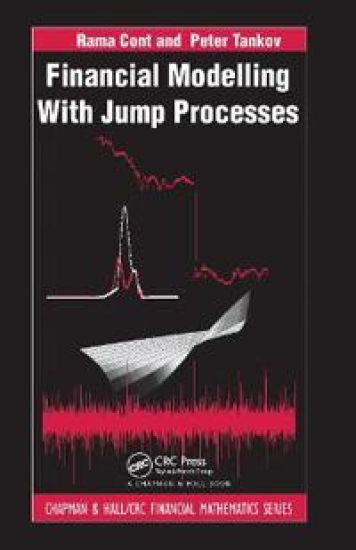
Financial Modelling with Jump Processes

Financial Modelling with Jump Processes

Rama Cont; Peter Tankov

Chapman Hall/CRC
2003
sidottu
WINNER of a Riskbook.com Best of 2004 Book Award! During the last decade, financial models based on jump processes have acquired increasing popularity in risk management and option pricing. Much has been published on the subject, but the technical nature of most papers makes them difficult for nonspecialists to understand, and the mathematical tools required for applications can be intimidating. Potential users often get the impression that jump and Lévy processes are beyond their reach. Financial Modelling with Jump Processes shows that this is not so. It provides a self-contained overview of the theoretical, numerical, and empirical aspects involved in using jump processes in financial modelling, and it does so in terms within the grasp of nonspecialists. The introduction of new mathematical tools is motivated by their use in the modelling process, and precise mathematical statements of results are accompanied by intuitive explanations. Topics covered in this book include: jump-diffusion models, Lévy processes, stochastic calculus for jump processes, pricing and hedging in incomplete markets, implied volatility smiles, time-inhomogeneous jump processes and stochastic volatility models with jumps. The authors illustrate the mathematical concepts with many numerical and empirical examples and provide the details of numerical implementation of pricing and calibration algorithms. This book demonstrates that the concepts and tools necessary for understanding and implementing models with jumps can be more intuitive that those involved in the Black Scholes and diffusion models. If you have even a basic familiarity with quantitative methods in finance, Financial Modelling with Jump Processes will give you a valuable new set of tools for modelling market fluctuations.