Kirjojen hintavertailu – 12 869 717 kirjaa ja 27 kauppaa

Kirjailija

Petr Tchaikovski

Kirjat ja teokset yhdessä paikassa: 70 kirjaa, julkaisuja vuosilta 2003–2024, suosituimpiin kuuluu Virtuoso Pieces for Oboe and Piano. Vertaile teosten hintoja ja tarkista saatavuus suomalaisista kirjakaupoista.

70 kirjaa

Kirjojen julkaisuvuodet: 2003–2024.

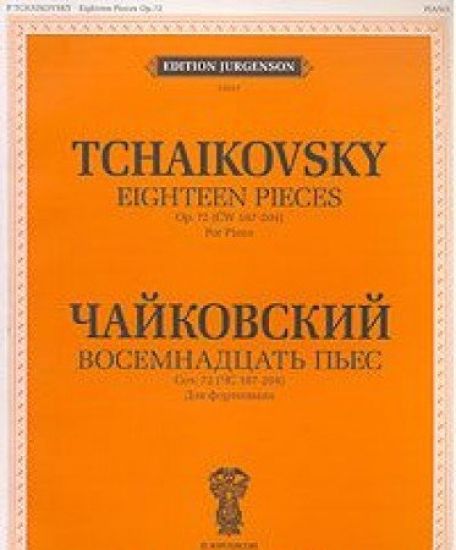
Tchaikovsky. Eighteen pieces for piano. Op. 72
CONTENTSEighteen Pieces. Op. 72 (CW 187 204)1. Impromptu2. Cradle Song3. Tender Reproaches 4. Character Dance5. Meditation6. Mazurka for Dancing 7. Concert Polonaise8. Dialogue9. A Bit of Schumann 10. Scherzo-fantasy 11. Waltz-Bagatelle12. Prankish Girl 13. Rustic Echo14. Elegiac Song 15. A Bit of Chopin16. Quintuple Wall17. Distant Past18. Dance Scene (Invitation to Trepak)
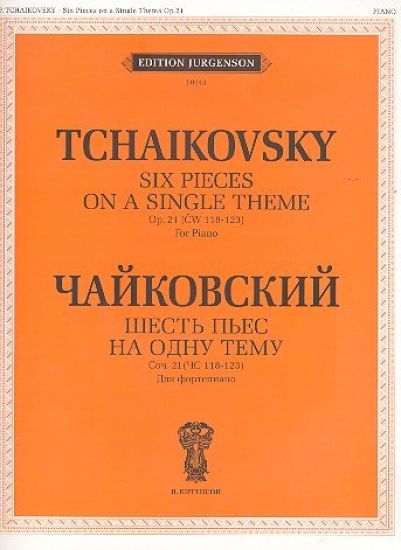
Six pieces on a single theme opus 21 for piano
Edited by Ya. MILSTEIN and K. SOROKINPublished after: P. I. Tchaikovsky. Selected Works for Piano. Book 2. - Moscow, Muzgiz, 1949. Editors' PrefaceThe present edition of Tchaikovsky's selected piano pieces is based on his Collected Works (Vols. 51a, 51b, 52 and 53). Since the composer often modified the music while preparing it for further publications, we have used also some other editions of Tchaikovsky's works, including those revised by Tchaikovsky for Jurgenson. The author's marks related to tempo, dynamics, phrasing, fingering and pedal - in short, all the marks found in the original text - are printed in large characters. All the supplementary marks, both those from Jurgenson's new edition (most probably approved by Tchaikovsky himself) and those added by the present editors, are printed in small characters.(from the preface to the first edition)One of Tchaikovsky's not numerous variation cycles for piano, with a rather complex texture. Dedicated to Tchaikovsky's teacher, the famous pianist Anton Rubinstein. For students of music colleges and conservatoires, as well as for professional performers. CONTENTSSix Pieces. Op. 21 (CW 118-123)1. Prelude2. Four-Part Fugue3. Impromptu4. Funeral March5. Mazurka6. Scherzo
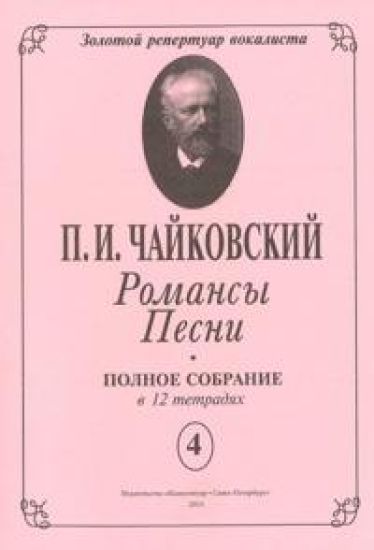
Laulukokoelma 12: ssa osassa. Osa 4. Kuusi laulua Op. 27
Laulukokoelma 12: ssa osassa. Osa 4. Kuusi laulua Op. 27TWO ROMANCES (1875)I. WOULD LIKE IN A SINGLE WORD ... Verses by L. A. Mei (from Heine)II. WE SHOULD NOT WALK FOR LONG ... Verses by N. P. GrekovSIX ROMANCES Op. 27 (1875)I. FOR THE FUTURE SLEEP. Words by N. P. OgarevII. LOOK: VON CLOUD ... Words by N. P. GrekovIII. DO NOT LEAVE ME ... Verses by A. FetIV. EVENING. Words by Ya. A. Mei (from Shevchenko)V. ALI MOTHER BORN ME ... Lyrics by L. A. Mey (from Mitskevich)Vi. MY DALER. Lyrics by L. A. Mey (from Mickiewicz)The same, 2nd edition
P. Tchaikovsky. Works. Easy arrangements  for Piano four hands.
SODERZHANIE CONTENTSSladkaja greza iz "Detskogo alboma"Sweet Dream from 'Children's Album'Grustnaja pesenkaSad SongAndante iz Sjuity No. 3Andante from Suite No. 3Ekosez iz opery "Evgenij Onegin"Ecossaise from the opera 'Eugene Onegin'Kolybelnaja pesn v burju. Lullaby in a StormNet, tolko tot, kto znal. RomansNo, Only He, who has known. RomanceVals iz "Detskogo alboma"Waltz from 'Children's Album'Barkarola iz tsikla "Vremena goda"Barcarolle from the cycle 'The Seasons'Polka iz "Detskogo alboma"Polka from 'Children's Album'Rasskaz njani iz opery "Evgenij Onegin"Nurse's Story from the opera 'Eugene Onegin'Vals iz Sjuity No. 3 Waltz from Suite No. 3Final iz Serenady dlja strunnogo orkestraFinale from Serenade for String OrchestraMazurka iz "Detskogo alboma"Mazurka from 'Children's Album'Ariozo Lizy iz opery "Pikovaja dama"Arioso of Liza from the opera 'The Queen of Spades'Stsena pisma Tatjany iz opery "Evgenij Onegin"Tatyana's Letter Scene from the opera 'Eugene Onegin'Ariozo Germana iz opery "Pikovaja dama"Arioso of Hermann from the opera 'The Queen of Spades'Marsh iz opery "Mazepa"March from the opera 'Mazepa'Ariozo iz opery "Mazepa"Arioso from the opera 'Mazepa'
Symphony No. 6. Pocket Score.

Symphony No. 6. Pocket Score.

Petr Tchaikovski

Compozitor (SPb.)
2013
muu
145 mm x 205 mmSymphony No 6 is the last symphonic composition by Pyotr Ilyich Tchaikovsky. The work at it continued from February 4 to August 12, 1893, when Tchaikovsky stayed in Klin, near Moscow. The drafts were over on March 24. Then there appeared the piano rieses or 72 and the romances to the verses by D. Rathaus. The journey via Europe preceded the completion of the Third piano concerto. Only then the time of the sixth symphony sate. The composer was making the orchestral score during the period of July 20 to August 12 already in Klin. It was on the first stages ojle creative process, when Tchaikovsky implied to the symphony to be given the program. Its name was supposed to be "The Programmatic Symphony" for the listeners to understand its purport clearly. However, the programme itself was not to be announced. Later the composer considered that intention to be not quite logical, and following his brother Modest's advice he gave it the title "Pathetic". The first public performance took place in Petersburg on October 16, 1893. The author himself conducted it. The premiere execution was accepted rather inadequately. The audience was left cold. Tchaikovsky wrote to R. Yurgenson: "It was not just simply disliked, only it seemed to have shocked the listeners. As to te, I am proud of it toge, than of any other compositions of mine". The Sixth symphony was a great success, when E. Napravnik executed it during its second premiere on November 6, 1893 - twelve days after the author's death.
Patarouva (The Queen of Spades). Ooppera. Pianopartituuri. Teksti myös translitteroituna
The Queen of Spades, Tchaikovsky's masterpiece, is one of the greatest operas of all times. For performers, teachers and music libraries. Libretto comments translated into English. Contents:IntroductionACT ONE First Tableau1. Chorus of Children, Nannies, and Others2. Scene and Arioso of Hermann3. Chorus of Holiday-Makers and Scene4. Quintet and Scene5. Scene and Ballad of Tomsky6. Final Scene. StormSecond Tableau7. Duet of Liza and Polina8. Scene, Romance of Polina and Russian Song with Chorus9. Scene and Arioso of Governess10. Final SceneACT TWO Third Tableau11. Entr'acte and Chorus12. Scene and Aria of Prince Yeletsky13. Scene14. Intermezzo 'The Sincerity of a Shepherdess'a. Chorus of Shepherds and Shepherdessesb. Dance of Shepherds and Shepherdesses (Saraband)c. Duet of Prilepa and Milovzord. Finale15. Final SceneFourth Tableau16. Scene and Chorus17. Final SceneACT THREE Fifth Tableau18. Entr'acte and Scene19. SceneSixth Tableau20. Scene and Arioso of Liza21. Scene and DuetSeventh Tableau22. Chorus and Scene23. Song of Tomsky and Chorus of the Gamblers24. Final SceneSupplement. Aria of Hermann from Seventh Tableau (in V Major)
Six French Songs (Six Melodies). Op. 65 (CW 299-304). For Voice and Piano. With transliterated text
The romances Op. 65 to texts by French poets (1888) are dedicated to the famous singer Desiree Artot, whose repertoire included a number of Tchaikovsky's works. The pieces are published in their original keys. CONTENTS1. Six French Songs (Six melodies). Op. 65 (CW 299-304). Russian translations by A. Gorchakova2. Serenade (Ou vas-tu, souffle d'aurore). Words by E. Turquety3. Deception. Words by P. Collin4. Serenade (J'aime dans le rayon). Words by P. Collin5. Qu'importe que l'hiver. Words by P. Collin6. Les larmes. Words by A.-M. Blanchecotte7. Rondel. Words by P. CollinThe publication contains original texts of romances in French and their translations, made for the first edition of 1889.
Tchaikovsky. Six Romances. Op. 63 (CW 293-298). For Voice and Piano. With transliterated text
Tchaikovsky's romances Op. 63 (1886-1887) are written to poems by Grand Duke Konstantin Romanov (K. R.), who is also their dedicatee. The best known pieces include 'I Opened the Window', 'Serenade' ('O Child, Beneath the Window'), 'The Fist Meeting'. The pieces are published in their original keys. CONTENTSSix Romances. Op. 63 (CW 293-298). Words by K. R. [K. K. Romanov]1. I Did Not Love You at First2. I Opened the Window3. I Do Not Please You4. The First Meeting5. The Fires in the Rooms Were Already Out6. Serenade
Six Romances. Op. 25 (CW 226-231). For Voice and Piano. With transliterated text
Tchaikovsky's romances Op. 25 ('Reconciliation'; 'Mignon's Song'; 'The Canary'), composed in 1873, are published here in their original keys. CONTENTSSix Romances. Op. 25 (CW 226-231)1. Reconciliation. Words byN. Shcherbina2. As Over Burning Embers. Words by F. Tyutchev3. Mignon's Song. Words by F. Tyutchev (from J. W. Goethe)4. The Canary. Words by L. Mey5. I Never Spoke to Her. Words by L. Mey6. As They Kept Saying: Fool. Words by L. Mey
Six Romances. Op. 27 (CW 232-237b). For Voice and Piano. With transliterated text
The romances op. 27 ('Look, the Cloud There'; 'My Little Favourite', etc.), composed in 1875, are published here in their original keys. CONTENTSSix Romances. Op. 27 (CW 232-237b)1. At Bedtime. Words by N. Ogaryov2. Look, the Cloud There. Words by N. Grekov3. Do Not Leave Me. Words by A. Fet4. Evening. Words by L. Mey (from T. Shevchenko)5. Did My Mother Bear Me? Words by L. Mey (from A. Mickiewicz)6. My Little Favourite (First version). Words by L. Mey (from A. Mickiewicz)7. My Little Favourite (Second version). Words by L. Mey (from A. Mickiewicz).
Tchaikovsky. Six Pieces for piano, opus 51 (CW 175-180)
Edited by Ya. MILSTEIN and K. SOROKINPublished after: P. I. Tchaikovsky. Selected Works for Piano. Book 4. - Moscow, Muzgiz, 1949. Editors' PrefaceThe present edition of Tchaikovsky's selected piano pieces is based on his Collected Works (Vols. 51a, 51b, 52 and 53). Since the composer often modified the music while preparing it for further publications, we have used also some other editions of Tchaikovsky's works, including those revised by Tchaikovsky for Jurgenson. The author's marks related to tempo, dynamics, phrasing, fingering and pedal - in short, all the marks found in the original text - are printed in large characters. All the supplementary marks, both those from Jurgenson's new edition (most probably approved by Tchaikovsky himself) and those added by the present editors, are printed in small characters.(from the preface to the first edition)This piano cycle, composed in 1882, includes such popular pieces as Natha-valse and Waltze sentimentale. For students of music colleges and conservatoires, professional performers, as well as for music lovers. CONTENTSSix Pieces. Op. 51 (CW 175-180)1. Waltze de salon2. Polka3. Minuetto scherzoso4. Natha-valse5. Romance6. Waltze sentimentale

Six Romances. Op. 28 (CW 238-243). For Voice and Piano. With transliterated text
The romances op. 28 ('Neither Response, nor Word, nor Greeting'; 'The Fearful Moment', etc.), composed in 1875, are published here in their original keys. CONTENTSSix Romances. Op. 28 (CW 238-243)1. No, I Shall Never Tell. Words by N. Grekov (from A. Musset)2. The Little Corals. Words by L. Mey (from W. Syrokomla)3. What For? Words by L. Mey4. Ne Loved Me So Much. Words by A. Apukhtin (from D. Girardin)5. Neither Response, nor Word, nor Greeting. Words by A. Apukhtin6. The Fearful Moment. Words by N. N. [P. Tchaikovsky]