Kirjojen hintavertailu – 12 859 819 kirjaa ja 27 kauppaa

Kirjailija

Philipp Melanchthon

Kirjat ja teokset yhdessä paikassa: 75 kirjaa, julkaisuja vuosilta 1977–2026, suosituimpiin kuuluu P. Rami Dialecticae Libris Duobus, Et Philippi Melan. Dialecticae Libris Quatuor Descriptae, Comparatio (1595). Vertaile teosten hintoja ja tarkista saatavuus suomalaisista kirjakaupoista.

75 kirjaa

Kirjojen julkaisuvuodet: 1977–2026.

Melanchthons Briefwechsel / Band T 5: Texte 1110-1394 (1531-1533)
English summary: 300 letters from three years document the variety of Melanchthon's activities and relationships. In the wake of longer absences in the previous years, he rededicated himself predominantly to his teaching duties and published works on rhetoric, dialectic, Aristotelian politics and mathematics. This volume contains the programmatic prefaces to these works. Moreover, Melanchthon had to publish the Augsburg Confession and its Apology. His tireless struggle to find a satisfactory formulation of the doctrine of justification finds echoes in the correspondence of the time. Shortly after the completion of the Apology, Melanchthon published the commentary on Romans (1532), which Melanchthon dedicated to the Archbishop Albert of Mainz. The university professor also continued to concern himself with political questions, chiefly in the form of official opinions. The newly created Smalcaldic League had developed interests in establishing relations with France and England. Remarkable opinions cover such matters as church property and ecclesiastical foundations, the calling of a general council, the treatment of Anabaptists, and the divorce of Henry VIII of England. After Zwingli's death and thanks to Martin Bucer's initiatives, progress was made in clarifying the question at the Lord's Supper. This important volume has been enhanced (in comparison to the digests) with fourteen newly discovered documents. With regard to text-critical matters, this volume includes thirty-five letters to Joachim Camerarius published on the basis of the original manuscripts for the first time. German description: 300 Briefe aus drei Jahren dokumentieren die Vielfalt der Tatigkeiten und Beziehungen Melanchthons. Nach langer Abwesenheit von Wittenberg in den Jahren zuvor widmete er sich nun wieder uberwiegend seinen Lehraufgaben und veroffentlichte Werke zur Rhetorik und Dialektik, zur Aristotelischen Politik und zur Mathematik. In der Edition des Briefwechsels sind die programmatischen Vorreden enthalten. Zunachst war mit der Confessio Augustana deren Apologie zu publizieren. Das muhsame Ringen um die Formulierung der Rechtfertigungslehre findet im Briefwechsel seinen Widerhall. Bald danach konnte der Kommentar zum Romerbrief vollendet werden. Mit politischen Fragen war der Professor weiterhin befasst, hauptsachlich als Gutachter. Bemerkenswerte Gutachten betreffen die Kirchenguter und Hochstifte, das Konzil, die Behandlung der Wiedertaufer und die Ehescheidung Heinrichs VIII. von England. Nach Zwinglis Tod wurde dank Bucers Initiative die Abendmahlsfrage einer Klarung nahergebracht. Dieser inhaltsreiche Band ist gegenuber den Regesten um 14 Neufunde erweitert. Textkritisch sind die 35 Briefe an Camerarius hervorzuheben, die erstmals im ursprunglichen Wortlaut geboten werden.
Melanchthons Briefwechsel / Band T 3: Texte 521-858 (1527-1529)
English summary: Focal points of this volume include Melanchthon's journeys as a ecclesiastical visitor (with many new sources), the transfer from the University of Wittenberg to Jena due to an outbreak of the plague, theological controversies among the reformers over the correct understanding of penitence and over the Lord's supper (including the Marburg Colloquy), imperial politics surrounding the Pack affair, and above all the imperial diet in Speyer at 1529, where the original texts of Melanchthon bring to light completely different points of view from what certain later editors had published. German description: Zentrale Themen des dritten Textbandes sind Melanchthons Visitationsreisen - hierzu werden viele neue Quellen geboten -, die seuchenbedingte Verlegung der Universitat Wittenberg nach Jena, der Streit der Reformatoren um das rechte Verstandnis von Busse und Abendmahl wahrend des Marburger Religionsgesprachs, die reichspolitische Affare der Packschen Handel sowie der Speyrer Reichstag von 1529, bei dem die ursprunglichen Texte Melanchthons zum Teil ganz andere Meinungen zutage bringen, als diskrete Editoren uberliefert haben.
Melanchthons Briefwechsel / Band 10: Orte A-Z Und Itinerar
English summary: The alphabetical index of the places mentioned in Melanchthons Briefwechsel (Melanchthon's Correspondence) identifies these places in accordance with their political affiliation today and at that time as an integral part of the commentary. The chronological order of Melanchthon's places of residence show his itinerary, which is completed by sources outside the correspondence and by combining other sources of information. German description: Der alphabetische Index der in Melanchthons Briefwechsel erwahnten Orte identifiziert als integraler Bestandteil des Kommentars diese Orte nach ihrer damaligen und heutigen politischen Zugehorigkeit. Die chronologische Anordnung der Aufenthaltsorte Melanchthons ergibt sein Itinerar, das aus Quellen ausserhalb des Briefwechsels und durch Kombination vervollstandigt wurde.
Melanchthons Briefwechsel / Band T 2: Texte 255-520 (1523-1526)
English summary: This second volume of texts touches upon central questions of the history of the Reformation, including the right of resistance, the Peasants' War, Luther's controversy with Erasmus, and the founding of the school in Nuremberg. As in the first volume, all the sources for each text are clearly introduced and, as necessary, briefly described. In this way one obtains a picture of the various ways in which individual pieces were disseminated. Some may be one-of-a-kind, like the original version of a letter in Greek describing Luther's marriage; others enjoyed up to thirty-five reprints, as in the case of prefaces to the edition of Terence or to the biblical book of Proverbs. The variant readings have been placed in several different sections of the apparatus, depending upon whether they concern earlier versions of the original autograph, text-critical remarks, or changes by later readers, copyists and editors. The citations and literary allusions have been carefully tracked down and placed in a fourth section of the apparatus. German description: Dieser zweite Textband betrifft zentrale Probleme der Reformationsgeschichte wie das Widerstandsrecht, den Bauernkrieg, Luthers Streit mit Erasmus und die Nurnberger Schulgrundung. Wie im ersten Textband werden alle Uberlieferungstrager ubersichtlich vorgestellt und, wenn notig, kurz charakterisiert. Dadurch wird die unterschiedliche Verbreitung der einzelnen Stucke augenfallig. Sie kann ganz esoterisch sein wie die originale Fassung des griechischen Briefes uber Luthers Heirat oder bis zu 35 Nachdrucke erreichen wie die Vorreden zur Terenzausgabe oder zu den Spruchen Salomos. Die Varianten werden in besonderen Apparaten dargeboten, je nachdem ob es sich um autographe Vorformen, um Textkritik oder um die Wirkungsgeschichte handelt. Die Zitate und literarischen Anspielungen sind sorgfaltig aufgespurt; sie werden in einem vierten Apparat nachgewiesen.
Melanchthons Briefwechsel / Band 8: Regesten 8072-9301 (1557-1560)
English summary: This last volume of regesta, which goes up to Melanchthon's death, begins with an attempt to settle the Flacians' dispute with Melanchthon and the Wittenbergians. The purpose of this was to enable a common approach by the Protestants at the second Colloquy of Worms in 1557. This was a failure on both counts. The documents and letters pertaining to this are the largest set of issues dealt with in these last years. Apart from this, the controversy concerning the Lord's Supper had broken out once again. Melanchthon advised his friend Hardenberg in Bremen, and he wrote his report for Frederick III, Elector Palatinate, which ultimately led him to Calvinism. The Counter Reformation visitation or inquisition in Bavaria inspired Melanchthon to a final reckoning with the Roman Catholic church, and for him this had the significance of a last will. German description: Dieser bis zu Melanchthons Tod reichende letzte Regestenband beginnt mit dem Versuch, den Streit der Flacianer mit Melanchthon und den Wittenbergern beizulegen. Dadurch sollte auf dem zweiten Wormser Religionsgesprach 1557 ein gemeinsames Auftreten der Protestanten ermoglicht werden. Beides scheiterte. Die Dokumente und Briefe daruber bilden den grossten Komplex dieser letzten Jahre. Daneben war auch der Streit um das Abendmahl wieder ausgebrochen. Melanchthon beriet seinen Freund Hardenberg in Bremen, und er schrieb sein Gutachten fur den Kurfursten Friedrich III. von der Pfalz, das diesen schliesslich in den Calvinismus fuhrte. Die gegenreformatorische Visitation bzw. Inquisition in Bayern inspirierte Melanchthon zu einer Schlussabrechnung mit der romischen Lehre, der er selbst testamentarisches Gewicht beilegte.
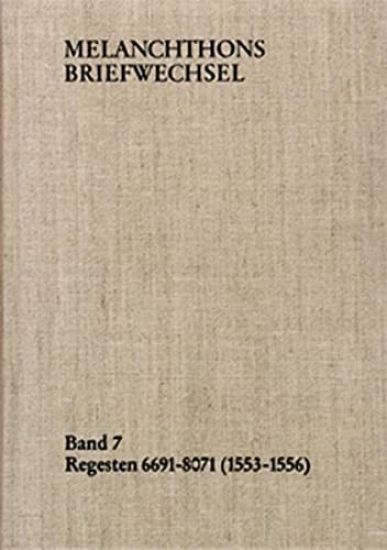
Melanchthons Briefwechsel / Band 7: Regesten 6691-8071 (1553-1556)
English summary: This volume gives a clear picture of the vast number of duties and of the mass of information with which Melanchthon was bombarded daily. Together with Camerarius, Melanchthon had to inspect the Furstenschulen and to examine the scholarship holders and also to interrogate recalcitrant predicants, since the dispute concerning the adiaphora was still not over. The controversy with Osiander concerning the correct doctrine of justification had to be assessed for Prussia, Pomerania and the imperial city of Nuremberg. Electoral Brandenburg demanded information on Christological problems, which resulted in Melanchthon's finest theological treatise, created during many months of work. The scholars of Augsburg wanted clarification of Schwenckfeld's theories, which for Melanchthon was a tedious and unresolved task. With the advent of Peter Canisius, he became aware of the first Jesuits. His friendly correspondence with the Danish king remained untroubled. His close relationship to the neighboring princes of Anhalt suffered greatly due to Georg of Anhalt's premature death. German description: Der Band vermittelt ein anschauliches Bild von der Vielzahl der Geschafte und von der Nachrichtenflut, die auf Melanchthon taglich einsturmten. Melanchthon musste zusammen mit Camerarius die Furstenschulen visitieren und Stipendiaten prufen, auch widerspenstige Pradikanten verhoren, denn der Streit um die Adiaphora war noch immer nicht zu Ende. Fur Preussen, Pommern und die Reichsstadt Nurnberg war der Osiandrische Streit uber die rechte Lehre von der Rechtfertigung zu begutachten. Kurbrandenburg verlangte Auskunft uber christologische Probleme, wodurch in monatelanger Arbeit die subtilste theologische Abhandlung Melanchthons entstand. In Augsburg wollte man Klarheit uber Schwenckfelds Lehren, fur Melanchthon eine muhsame und unbewaltigte Aufgabe. Mit Petrus Canisius traten die ersten Jesuiten in sein Blickfeld. Ungetrubt blieb die Brieffreundschaft mit dem danischen Konig. Die enge Beziehung zu den benachbarten Fursten von Anhalt erlitt durch den vorzeitigen Tod Georgs einen herben Verlust.
Melanchthons Briefwechsel / Band T 1: Texte 1-254 (1514-1522)
English summary: The first volume of texts documents Melanchthon's development from a seventeen-year-old follower of Reuchlin in Tubingen through the stormy beginnings of his Wittenberg professorship and concludes with the consolidation of the Reformation there after Luther's return from the Wartburg. The volume offers a complete tradition history of each text with appropriate evaluations and summaries. Subsequently, the older editions such as the Corpus Reformatorum are thoroughly corrected and improved upon. For example, Luther's letters from the Wartburg have been corrected on the basis of a new text-critical reading. Citations and allusions are also verified. German description: Der erste Textband dokumentiert Melanchthons Entwicklung vom siebzehnjahrigen Tubinger Reuchlinisten uber den sturmischen Beginn seiner Wittenberger Professorenzeit bis zur Konsolidierung der Reformation nach Luthers Ruckkehr von der Wartburg. Die gesamte Uberlieferung der Texte wird erfasst, bewertet und ubersichtlich dargeboten. Dabei werden die alteren Editionen wie das Corpus Reformatorum durchgehend verbessert, bei Luthers Wartburgbriefen konnten sogar bisher unbeachtete Lesungen als richtig erkannt werden. Die Zitate und Anspielungen sind verifiziert.
Melanchthons Briefwechsel / Band 6: Regesten 5708-6690 (1550-1552)
English summary: This volume deals with everyday life at the university and in the family as well as with scholarly publications and the marriage of the two children who were still alive. The consultations concerning the Council of Trent made it necessary for Melanchthon to return to high politics. The war in neighboring Magdeburg and Lower Saxony, which had never stopped, caught up with Melanchthon in Nuremberg und prevented him from continuing his journey to Trent. There were also theological issues to be clarified, in particular the problems of justification and Christology which Andreas Osiander and Francesco Stancaro had addressed. German description: Der Alltag in Universitat und Familie: wissenschaftliche Publikationen und die Heirat der beiden noch lebenden Kinder sind die Themen. Die Beratungen uber das Trienter Konzil rufen Melanchthon wieder in die hohe Politik zuruck. Der Krieg, der im benachbarten Magdeburg und Niedersachsen nie zur Ruhe gekommen war, holt Melanchthon in Nurnberg ein und verhindert seine Weiterreise nach Trient. Auch theologische Streitfragen gilt es zu klaren, insbesondere die von Andreas Osiander und Francesco Stancaro aufgeworfenen Probleme der Rechtfertigung und Christologie.
Melanchthons Briefwechsel / Band 5: Regesten 4530-5707 (1547-1549)
English summary: The vicissitudes of the Schmalkaldic War and Melanchthon's flight to Zerbst and Nordhausen, his return for the reopening of the University of Wittemberg under the new territorial ruler Moritz von Sachsen, his work as an ecclesiopolitical expert on the Augsburg Interim which resulted from this and his impact on Electoral Saxony were the most important events between 1547 and 1549. For the first time, the exact dates of numerous documents from the archives and of letters have been established. German description: Die Wechselfalle des Schmalkaldischen Krieges mit Melanchthons Flucht nach Zerbst und Nordhausen, seine Ruckkehr zwecks Wiedereroffnung der Universitat Wittenberg unter dem neuen Landesherrn Moritz von Sachsen, die daraus sich ergebende Tatigkeit als kirchenpolitischer Gutachter uber das Augsburger Interim und seine Auswirkungen auf Kursachsen sind die wichtigsten Ereignisse der Jahre 1547 bis 1549. Zahlreiche Aktenstucke und Briefe konnten erstmals exakt datiert werden.
Melanchthons Briefwechsel / Band 4: Regesten 3421-4529 (1544-1546)
English summary: The correspondence provides insights into Melanchthon's everyday life. His good relationship with Luther was able to withstand a final dramatic crisis. There was a real friendship between Melanchthon and J. Camerarius in Leipzig, V. Dietrich and H. Baumgartner in Nuremberg and also with the Protestant bishop Georg von Anhalt in Merseburg, while criticism of the territorial ruler was growing. The Diets of Speyer and Worms, the Council of Trent and the Schmalkaldic War were reflected in the developments. German description: Die Korrespondenz vermittelt Einblicke in den Alltag Melanchthons. Das gute Verhaltnis zu Luther ubersteht eine letzte dramatische Belastung. Echte Freundschaft verbindet Melanchthon mit J. Camerarius in Leipzig, V. Dietrich und H. Baumgartner in Nurnberg und auch mit dem evangelischen Bischof Georg von Anhalt in Merseburg, wogegen die Kritik am eigenen Landesherrn wachst. Die Reichstage von Speyer und Worms, das Konzil von Trient und der Schmalkaldische Krieg finden ihren Niederschlag.
Melanchthons Briefwechsel / Band 3: Regesten 2336-3420 (1540-1543)
English summary: The confessional split in Germany proved to be impossible to repair. In accordance with the Treaty of Frankfurt of 1539, an unsuccessful attempt was made to save the spiritual and religious unity of the Empire by means of discussions on religion. (Religionsgesprache) . Melanchthon was the spokesman for the Protestants, the interpreter and defender of the theology of the Reformation. German description: Die konfessionelle Spaltung Deutschlands erwies sich als unuberwindlich. Gemass dem Frankfurter Anstand 1539 wurde der vergebliche Versuch unternommen, durch Religionsgesprache die geistig-religiose Einheit des Reiches zu retten. Melanchthon war Sprecher der Evangelischen, Deuter und Verteidiger reformatorischer Theologie.
Melanchthons Briefwechsel / Regesten. Band 1: Regesten 1-1109 (1514-1530)
English summary: Noteworthy in the regesta for these years are the Wittenberg Movement 1521/22, the first church visitation in 1527/29, Otto von Pack's conspiracy in 1528, the 2nd Diet of Speyer, the Marburg Colloquy in 1529 as well as the Diet of Augsburg in 1530. Among the correspondents are Reuchlin, Erasmus, Pirckheimer, Luther, Spalatin and Camerarius. German description: In den Regesten dieser Jahre sind thematisch bemerkenswert die Wittenberger Bewegung 1521/22, die erste Kirchenvisitation 1527/29, die Pack'schen Handel 1528, der 2. Speyrer Reichstag sowie das Marburger Religionsgesprach 1529 sowie der Augsburger Reichstag 1530. Unter den Korrespondenten sind Reuchlin, Erasmus, Pirckheimer, Luther, Spalatin und Camerarius.