Kirjailija
Pierre Bourdieu
Kirjat ja teokset yhdessä paikassa: 141 kirjaa, julkaisuja vuosilta 1964–2026, suosituimpiin kuuluu Free Exchange. Vertaile teosten hintoja ja tarkista saatavuus suomalaisista kirjakaupoista.
141 kirjaa
Kirjojen julkaisuvuodet: 1964–2026.

This work presents a collection of stories from ordinary people expressing the state of society and the kinds of social exclusion, marginalization and impoverishment which are increasingly widespread.
An unremitting assault on the impact and pretensions of television that demolishes conventional arguments.' - TLS'
Acts of Resistance: Against the Tyranny of the Market
Pierre Bourdieu
New Press
1999
nidottu
Halvin toimitettuna 20,30 €
Pierre Bourdieu har i denna bok samlat ett antal föreläsningar som genom konkreta exempel redogör för grundtankarna och de centrala begreppen i hans teori. Bourdieu beskriver sin vetenskapsfilosofi som relationell, den sätter relationer före substantiella »realiteter» som till exempel individer och grupper. Denna relationella vetenskapsfilosofi bryter med det gängse sättet att studera samhället. De objektiva relationerna är inte omedelbart tillgängliga eller påtagliga utan måste erövras, konstrueras och göras giltiga genom vetenskapligt arbete. Bourdieu utvecklar vidare en handlingsfilosofi som han kallar dispositionell och som tar fasta på de möjligheter som finns inskriva i agenternas kroppar och i den struktur som präglar de situationer i vilka agenterna handlar. Denna handlingsfilosofi kan sammanfattas i några nyckelbegrepp - habitus, fält, kapital - och definieras av den dubbelriktad relationen mellan de sociala fältens objektiva strukturer och habitus förkroppsligade strukturer. I Praktiskt förnuft - bidrag till en handlingsteori ges exempel på hur dessa begrepp kan användas genom en rad konkreta analyser, från en diskussion av den moderna statens födelse till en redogörelse för familjen som centrum för den sociala reproduktionen, från en analys av de symboliska tillgångarnas ekonomi till tankar kring den politiska moralens sociala förutsättningar. Praktiskt förnuft - bidrag till en handlingsteori utgör en utmärkt introduktion till Pierre Bourdieus tänkande.
In his most explicitly political work to date, Pierre Bourdieu speaks out against the new myths of our time - especially those associated with neo-liberalism - and offers a passionate defence of the public interest. The withdrawal of the state from many areas of social life in recent years - housing, health, social services, etc. - has produced growing despair in the most deprived sections of the population; the dismantling of public welfare in the name of private enterprise, flexible markets and global competitiveness is increasing the misery of those who have suffered most. In this sharp, uncompromising attack on neo-liberalism and those who champion it - from the IMF to the President of the Bundesbank, from politicians to academic commentators - Bourdieu stands up for the interests of the powerless and helps to give a voice to those individuals, groups and social movements whose views are rarely heard in the dominant media. A powerful plea for a new internationalism which would seek to defend the public interest and the social rights of ordinary people against the new prophets of the marketplace, this important and timely book by one of Europe's most outstanding intellectuals deserves to be widely read.
Do social classes really exist? Is disinterested action really possible? What do the family, the church, and the intellectual world have in common? Can morality be founded on hypocrisy? What is the "subject" of action? In this new volume, one of France's foremost social thinkers of our time responds to these major questions and to others, thus tracing the outlines of a work that could be called "Pierre Bourdieu by himself." In these texts, the author tries to go to the essential, that is, the most elementary and fundamental, questions. He thereby explains the philosophical principles that have led to his social science research and the idea of the human that guides his choices there. With the lucidity allowed by retrospect, Bourdieu brings out the fundamental theories of his greatest books, notably Outline of a Theory of Practice and The Logic of Practice (Stanford, 1990), and, with an eye to the future, presents the first results of his most recent work on the state, the anthropological moorings of the economy, and male domination. Bourdieu's theory is both a philosophy of science dedicated to revealing the objective relations that shape and underpin social life, and a philosophy of action that takes account of agents' dispositions as well as the structured situations in which they act. This philosophy of action is condensed in a small number of key concepts-habitus, field, capital-and it is defined by the two-way relationship between the objective structures of social fields and the incorporated structures of the habitus. All in all, this book should be an indispensable introduction to Bourdieu's work, not only to students and scholars in sociology, anthropology, political science, and philosophy, but throughout the social sciences and humanities generally.
In this new volume Pierre Bourdieu - one of the foremost social thinkers of our time - clarifies and elaborates the most fundamental characteristics of his theoretical approach. Bourdieu's theory is both a relational philosophy of science dedicated to revealing the objective relations which shape and underpin social life, and a philosophy of action which takes account of agents' dispositions as well as the structured situations in which they act. This philosophy of action is condensed in a small number of key concepts - habitus, field, capital - and it is defined by the two-way relationship between the objective structures of social fields and the incorporated structures of the habitus. The key concepts and assumptions of Bourdieu's approach are exemplified in this volume through a variety of concrete analyses, from a discussion of the formation of the modern state to an account of the family as a site of social reproduction, from an analysis of the economy of symbolic goods to a reflection on the social conditions of political morality. An excellent and accessible introduction to the work of Bourdieu, Practical Reason will be of great interest to students and scholars in sociology, anthropology, politics and philosophy, and throughout the social sciences and humanities generally.
The author clarifies and elaborates on the fundamental charcteristics of his theoretical approach, covering a wide range of substantive issues, from the formation of the modern state to the social conditions of political morality. Aimed at students and researchers in sociology, anthropology, politics, and philosophy.
A corruscating attack on television - and on the 'collaboration' between intellectuals and the media which, Bourdieu argues, is leading to new and more invidious forms of dumbing down. Bourdieu examines the way in which apparently serious TV debate gives way to soundbite, as a series of talking 'experts' go through the motions of comment and consideration in increasingly self-referential circles. The result: banal and worthless drivel, shaped almost entirely by the imperatives of television ratings wars rather than any consideration of the truth. Television, Bourdieu claims, has now had a profound and largely detrimental effect not just on journalism, but on the formerly very separate worlds of art, literature, philosophy, politics, justice and even science - all of which are in danger of being forced to submit to what he describes as the 'commercial plebiscite' of audience ratings.
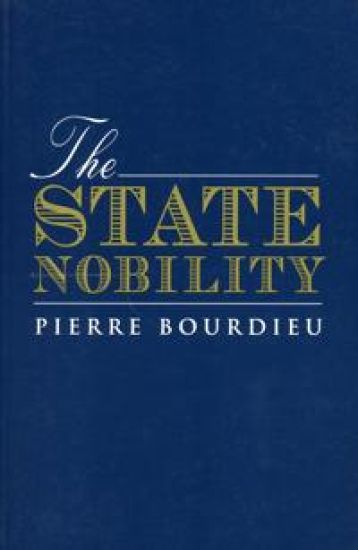
State nobility - elite schools in the field of power
Pierre Bourdieu
Blackwell publishers
1998
pokkari
This work examines the distinctive forms of power - political, intellectual, bureaucratic and economic - by means of which contemporary societies are governed. It examines in detail the work of consecration which is carried out by the educational system, especially in France by the grandes ecoles.
In this major new work, Pierre Bourdieu examines the distinctive forms of power—political, intellectual, bureaucratic, and economic—by means of which contemporary societies are governed. What kinds of competence are claimed by the bureaucrats and technocrats who govern us? And how do those who govern gain our recognition and acquiescence? Bourdieu examines in detail the work of consecration that is carried out by elite education systems—in France by the grande écoles, in the United States by the Ivy League schools, and in England by Oxford and Cambridge. Today, this "state nobility" has at its disposal an unprecedented range of powers and distinctive titles to justify its privilege. Bourdieu shows how it is the heir—structural and sometimes genealogical—of the noblesse de robe, which, in order to consolidate its position in relation to other forms of power, had to construct the modern state and the republican myths, meritocracy, and civil service that went along with it. Combining ethnographic description, historical documentation, statistical analysis, and theoretical argument, Bourdieu develops a wide-ranging and highly original account of the forms of power and governance that have come to prevail in our society today.
Pierre Bourdieu har i Kultur och kritik samlat anföranden, debattinlägg och intervjuer där han försökt ge svar på de viktigaste frågor sociologin ställer sig. Kultur och kritik innehåller reflektioner över den sociologiska metoden och över grundläggande sociologiska begrepp liksom över de kunskapsteoretiska och filosofiska frågor som samhällsvetenskapen ställs inför. Samtidigt presenterar Bourdieu nya analyser av kulturen och politiken, strejker och fackföreningsrörelser, sport och litteratur, mode och konst, språk och musik. Bordieu ger på detta sätt tillträde till det sociologiska arbetet under själva skapandet. Därigenom inbjuder han läsaren, inte till att identifiera sig med en redan färdigtänkt tanke, utan till att lära sig att behärska en tankemetod.
In this major work, Bourdieu examines the distinctive forms of power - political, intellectual, bureaucratic and economic - by means of which contemporary societies are governed. What kinds of competence are claimed by the bureaucrats and technocrats who administer our societies? And how do those who govern come to gain the recognition of those who are governed by them? Bourdieu examines in detail the work of consecration which is carried out by the educational system - and especially in France by the grandes écoles. The work of consecration can be seen in operation in different historical periods, whenever a nobility is produced. Today the socially recognized groups function according to a logic similar to that which characterized the divisions between high and low in the ancien régime. Today this state nobility is the heir - structural and sometimes even genealogical - of the noblesse de robe which, in order to consolidate its position in relation to other forms of power, had to construct the modern state and the republican myths, meritocracy and civil service which went along with it. Bourdieu examines the mechanisms which produce the kind of nobility displayed by those who govern, and the recognition granted to them by those who are governed by them.
Written with verve and intensity (and a good bit of wordplay), this is the long-awaited study of Flaubert and the modern literary field that constitutes the definitive work on the sociology of art by one of the world's leading social theorists. Drawing upon the history of literature and art from the mid-nineteenth century to the present, Bourdieu develops an original theory of art conceived as an autonomous value. He argues powerfully against those who refuse to acknowledge the interconnection between art and the structures of social relations within which it is produced and received. As Bourdieu shows, art's new autonomy is one such structure, which complicates but does not eliminate the interconnection. The literary universe as we know it today took shape in the nineteenth century as a space set apart from the approved academies of the state. No one could any longer dictate what ought to be written or decree the canons of good taste. Recognition and consecration were produced in and through the struggle in which writers, critics, and publishers confronted one another.
This is Bourdieu's long-awaited study of Flaubert and the formation of the modern literary field, it is an important contribution to the study of the social and historical conditions of literary works.
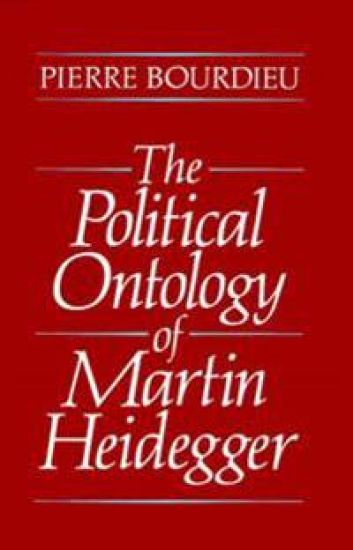
This book is an important and timely contribution to the debate concerning the relation between Heidegger's philosophy and his political affiliations to Nazism. But it is more than that: it is also a study, by the leading sociologist in France today, of some of the institutional mechanisms involved in the production of philosophical discourse. Drawing on his distinctive methods of analysis, Bourdieu argues that philosophical discourse - like all discourse - is the result of an interaction between an expressive drive and the censorship generated by the social field in which it is produced. Hence, to understand Heidegger's work, it is necessary to reconstruct the logic of the philosophical field in early twentieth-century Germany and its relation to the broader social and political fields of the Weimar Republic. In this way Bourdieu is able to shed fresh light on Heidegger's philosophical language and orientation, while steering clear of the partisan judgements adopted by those critics who charge him with an apologetics for Nazism or those who seek to redeem him at any cost. The Political Ontology of Martin Heidegger will be of interest to students and scholars in philosophy, literature, and social and political theory, as well as to anyone interested in the controversy surrounding Heidegger and his links with Nazism.
Academic Discourse
Pierre Bourdieu; Jean-Claude Passeron; Monique De Saint Martin
Stanford University Press
1996
pokkari
Education depends crucially on language: knowledge and skills are taught through a process of linguistic exchange. But how much of the language used by teachers and professors is actually understood by students? To what extent does the social background of students affect their capacity to understand the language used in the classroom or the lecture hall? Why do students and teachers overestimate the success of the educational process and underestimate the degree of misunderstanding involved? In this important work Pierre Bourdieu and his associates explore these and other questions through a careful study of the role of language and linguistic misunderstanding in the teaching contexts of higher education.
The Political Ontology of Martin Heidegger
Pierre Bourdieu
Stanford University Press
1996
nidottu
Halvin toimitettuna 30,90 €
Martin Heidegger's overt alliance with the Nazis and the specific relation between this alliance and his philosophical thought-the degree to which his concepts are linked to a thoroughly disreputable set of political beliefs-have been the topic of a storm of recent debate. Written ten years before this debate, this study by France's leading sociologist and cultural theorist is both a precursor of that debate and an analysis of the institutional mechanisms involved in the production of philosophical discourse. Though Heidegger is aware of and acknowledges the legitimacy of purely philosophical issues (in his references to canonic authors, traditional problems, and respect for academic taboos), Bourdieu points out that the complexity and abstraction of Heidegger's philosophical discourse stems from its situation in the cultural field, where two social and intellectual dimensions-political thought and academic thought-intersect. Bourdieu concludes by suggesting that Heidegger should not be considered as a Nazi ideologist, that there is no place in Heidegger's philosophical ideas for a racist conception of the human being. Rather, he sees Heidegger's thought as a structural equivalent in the field of philosophy of the "conservative revolution," of which Nazism is but one manifestation.