Kirjojen hintavertailu – 12 903 725 kirjaa ja 27 kauppaa
Kirjailija
Pliny The Younger
Kirjat ja teokset yhdessä paikassa: 37 kirjaa, julkaisuja vuosilta 1969–2025, suosituimpiin kuuluu The Letters of the Younger Pliny. Vertaile teosten hintoja ja tarkista saatavuus suomalaisista kirjakaupoista.
Nimi esiintyy myös muodoissa: Pliny (The Younger ), Pliny (the Younger)
Gaius Plinius Caecilius Secundus, born Gaius Caecilius or Gaius Caecilius Cilo (61 - c. 113), better known as Pliny the Younger, was a lawyer, author, and magistrate of Ancient Rome. Pliny's uncle, Pliny the Elder, helped raise and educate him. Pliny the Younger wrote hundreds of letters, of which 247 survive and are of great historical value. Some are addressed to reigning emperors or to notables such as the historian Tacitus. Pliny served as an imperial magistrate under Trajan (reigned 98-117), and his letters to Trajan provide one of the few surviving records of the relationship between the imperial office and provincial governors. Pliny rose through a series of civil and military offices, the cursus honorum. He was a friend of the historian Tacitus and might have employed the biographer Suetonius on his staff. Pliny also came into contact with other well-known men of the period, including the philosophers Artemidorus and Euphrates the Stoic, during his time in Syria. Pliny was by birth of equestrian rank, that is, a member of the aristocratic order of equites (knights), the lower (beneath the senatorial order) of the two Roman aristocratic orders that monopolised senior civil and military offices during the early Empire. His career began at the age of 18 and initially followed a normal equestrian route. But, unlike most equestrians, he achieved entry into the upper order by being elected Quaestor in his late twenties. Pliny was active in the Roman legal system, especially in the sphere of the Roman centumviral court, which dealt with inheritance cases. Later, he was a well-known prosecutor and defender at the trials of a series of provincial governors, including Baebius Massa, governor of Baetica; Marius Priscus, governor of Africa; Gaius Caecilius Classicus, governor of Baetica; and most ironically in light of his later appointment to this province, Gaius Julius Bassus and Varenus Rufus, both governors of Bithynia and Pontus. Pliny's career is commonly considered as a summary of the main Roman public charges and is the best-documented example from this period, offering proof for many aspects of imperial culture. Effectively, Pliny crossed all the principal fields of the organization of the early Roman Empire. It is an achievement for a man to have not only survived the reigns of several disparate emperors, especially the much-detested Domitian, but also to have risen in rank throughout. (wikipedia.org)

The only eye witness account of the Eruption of Vesuvius in AD 79, and the destruction of Pompeii and Herculaneum. Surviving the test of time, this account is unique and the events were captured by a Roman Dignitary who was also a Literary Master. Relive the horror and tragedy of this major event.
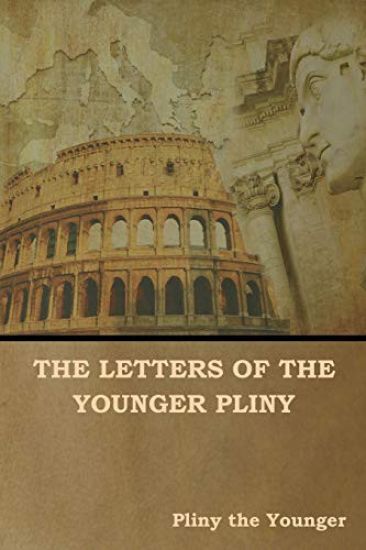
The Letters of Pliny the Younger, translated by William Melmoth and revised by F. C. T. Bosanquet. GAIUS PLINIUS CAECILIUS SECUNDUS, usually known as Pliny the Younger, was born at Como in 62 A. D. He was only eight years old when his father Caecilius died, and he was adopted by his uncle, the elder Pliny, author of the Natural History. He was carefully educated, studying rhetoric under Quintilian and other famous teachers, and he became the most eloquent pleader of his time. The letters, on which to-day his fame mainly rests, were largely written with a view to publication, and were arranged by Pliny himself. They thus lack the spontaneity of Cicero's impulsive utterances, but to most modern readers who are not special students of Roman history they are even more interesting. They deal with a great variety of subjects: the description of a Roman villa; the charms of country life; the reluctance of people to attend author's readings and to listen when they were present; a dinner party; legacy-hunting in ancient Rome; the acquisition of a piece of statuary; his love for his young wife; ghost stories; floating islands, a tame dolphin, and other marvels. But by far the best known are those describing the great eruption of Vesuvius in which his uncle perished, a martyr to scientific curiosity, and the letter to Trajan on his attempts to suppress Christianity in Bithynia, with Trajan's reply approving his policy.
This work has been selected by scholars as being culturally important, and is part of the knowledge base of civilization as we know it. This work was reproduced from the original artifact, and remains as true to the original work as possible. Therefore, you will see the original copyright references, library stamps (as most of these works have been housed in our most important libraries around the world), and other notations in the work. This work is in the public domain in the United States of America, and possibly other nations. Within the United States, you may freely copy and distribute this work, as no entity (individual or corporate) has a copyright on the body of the work. As a reproduction of a historical artifact, this work may contain missing or blurred pages, poor pictures, errant marks, etc. Scholars believe, and we concur, that this work is important enough to be preserved, reproduced, and made generally available to the public. We appreciate your support of the preservation process, and thank you for being an important part of keeping this knowledge alive and relevant.