Kirjojen hintavertailu – 12 859 818 kirjaa ja 27 kauppaa

Kirjailija

Ralph Waldo Emerson

Kirjat ja teokset yhdessä paikassa: 994 kirjaa, julkaisuja vuosilta 1836–2026, suosituimpiin kuuluu Essays by Ralph Waldo Emerson. Vertaile teosten hintoja ja tarkista saatavuus suomalaisista kirjakaupoista.

Nimi esiintyy myös muodoissa: Ralph Waldo. Emerson

994 kirjaa

Kirjojen julkaisuvuodet: 1836–2026.

Shakespeare

Shakespeare

Ralph Waldo Emerson

Cosimo Classics
1905
pokkari
"How good and sound and inviolable his innocency, that is never to seek, and never wrong, but speaks the pure sense of humanity on each occasion." -Ralph Waldo Emerson, Shakespeare Shakespeare, the Poet (1850) by Ralph Waldo Emerson is one of seven essays Emerson included in his book, Representative Men (also available from Cosimo Classics). Like the other figures in this collection, Shakespeare embodied, for Emerson, the essence of the qualities that accomplished poets possess. These were qualities Emerson felt are critical to a spiritually strong world.
Montaigne

Montaigne

Ralph Waldo Emerson

Cosimo Classics
1905
pokkari
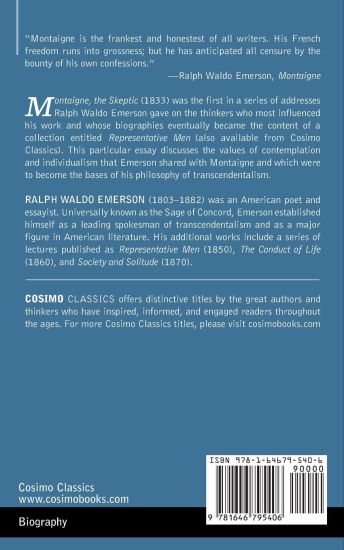
"Montaigne is the frankest and honestest of all writers. His French freedom runs into grossness; but he has anticipated all censure by the bounty of his own confessions." -Ralph Waldo Emerson, Montaigne Montaigne, the Skeptic (1833) was the first in a series of addresses Ralph Waldo Emerson gave on the thinkers who most influenced his work and whose biographies eventually became the content of a collection entitled Representative Men (also available from Cosimo Classics). This particular essay discusses the values of contemplation and individualism that Emerson shared with Montaigne and which were to become the bases of his philosophy of transcendentalism.
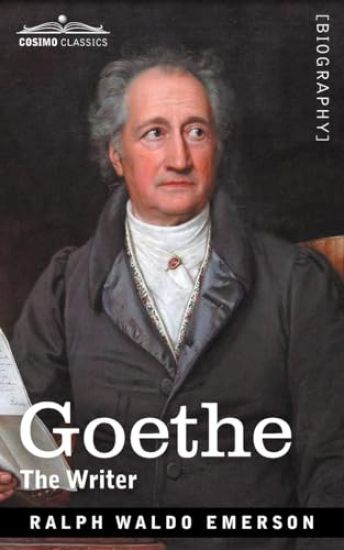
Goethe

Goethe

Ralph Waldo Emerson

Cosimo Classics
1905
pokkari
"Society has really no graver interest than the well-being of the literary class." -Ralph Waldo Emerson, Goethe; or, the Writer Goethe, the Writer (1850) by Ralph Waldo Emerson is one of seven lectures Emerson gave on the thinkers who most influenced his work and whose biographies eventually became the content of a collection entitled Representative Men (also available from Cosimo Classics). Even though there are questions about how much of Goethe's writing Emerson actually read, Emerson considered Goethe near the top of the intellectual world, and his views on science and nature, as well as several aspects of his writing style, were derived largely from those of Goethe. Of this icon, Emerson wrote, "Goethe teaches courage."
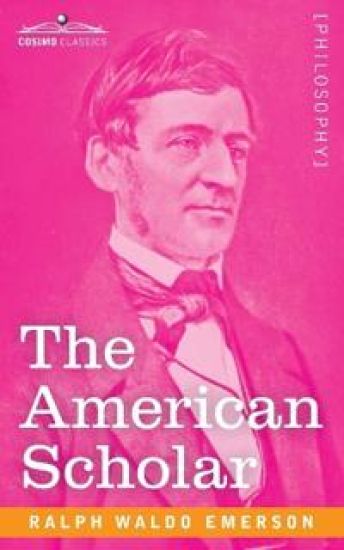
The American Scholar

The American Scholar

Ralph Waldo Emerson

Cosimo Classics
1905
pokkari
"The scholar is that man who must take up into himself all the ability of the time, all the contributions of the past, all the hopes of the future..." - Ralph Waldo Emerson, "The American Scholar" (1837) The American Scholar (1837), is an address delivered by Ralph Waldo Emerson to the Harvard Chapter of the Phi Beta Kappa Society. Emerson's writing was focused on providing a philosophical framework for escaping European culture and building a new, distinctly American identity. This essay is a declaration of independence of the United States intellectual community from Europe's. It also expresses the author's belief that the American scholar could only achieve a higher state of mind by rejecting old ideas and by thinking for himself, to become "Man Thinking" rather than "a mere thinker, or still worse, the parrot of other men's thinking," "the sluggard intellect of this continent."
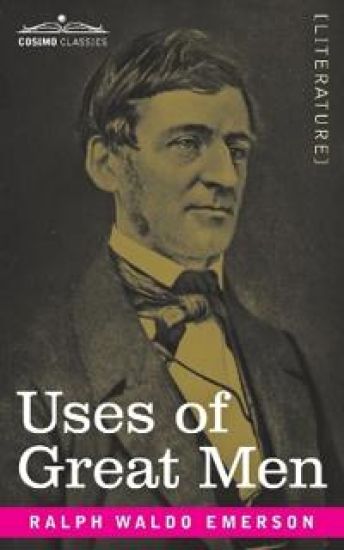
Use of Great Men

Use of Great Men

Ralph Waldo Emerson

Cosimo Classics
1850
pokkari
"...great men exist that there may be greater men. The destiny of organized nature is amelioration, and who can tell its limits."-Ralph Waldo Emerson, Use of Great Men (1850) Use of Great Men by Ralph Waldo Emerson (1850) is one of seven essays about notable scholars whom the author discusses in his collection entitled Representative Men (also available from Cosimo Classics). In most respects, it expresses the nineteenth-century belief in continuous improvement brought about the industrial revolution. With this essay as an introductory summary of the author's perspective on greatness, the essays that discuss the seven scholars in the book serve as illustrations of his point of view.
Politics

Politics

Ralph Waldo Emerson

Cosimo Classics
1844
pokkari
"The theory of politics, which has possessed the mind of men, and which they have expressed the best they could in their laws and in their revolutions, considers persons and property as the two objects for whose protection government exists."-Ralph Waldo Emerson, Politics (1844)Politics (1844), by Ralph Waldo Emerson details the author's views of the transitory nature of political institutions. Emerson's approach to politics championed democracy and individualism, Moreover, as a consequence of his transcendental beliefs, Emerson argued that the role of government would diminish as man's character evolves.
The Poet

The Poet

Ralph Waldo Emerson

Cosimo Classics
1844
pokkari
". . . for the poet is representative. He stands among partial men for the complete man, and apprises us not of his wealth, but of the common-wealth."-Ralph Waldo Emerson, The Poet The Poet, written by Ralph Waldon Emerson between 1841 and 1843, is an essay in which Emerson argues for the United States, when it was a relatively young nation, to establish a position of national poet to write about the country's virtues and vices. It reflects the way that Emerson, as a leader of the American Transcendentalist movement, championed individualism.
Manners

Manners

Ralph Waldo Emerson

Cosimo Classics
1844
pokkari
"Manners aim to facilitate life, to get rid of impediments, and bring the man pure to energize. They aid our dealing and conversation, as a railway aids travelling, by getting rid of all avoidable obstructions of the road, and leaving nothing to be conquered but pure space." -Ralph Waldo Emerson, Manners (1844)Emerson's essay on Manners (1844) is an explication of the value of manners in society. Emerson believed that the primary reason for manners was to facilitate the creation and functioning of a social order. At the same time, he sought to dispel the idea that manners reflect a basic difference among classes in society, noting that lower classes sometimes emulate the mannerisms of their superiors without really understanding the purpose of social graces or manners.
Experience

Experience

Ralph Waldo Emerson

Cosimo Classics
1844
pokkari
"Nature and books belong to the eyes that see them. It depends on the mood of the man, whether he shall see the sunset or the fine poem." -Ralph Waldo Emerson, Experience (1844)Experience (1844), by Ralph Waldo Emerson, was first published in Essays: Second Series. It is one of many of the author's commentaries on the importance of the individual. In this essay, Emerson contends that the life experience of each individual depends on their focus-that different people will experience the same physical reality differently depending on their interests and priorities.
Nature

Nature

Ralph Waldo Emerson

Cosimo Classics
1844
pokkari
"Nature is always consistent, though she feigns to contravene her own laws. She keeps her laws, and seems to transcend them. She arms and equips an animal to find its place and living in the earth, and, at the same time, she arms and equips another animal to destroy it." -Ralph Waldo Emerson, NatureNature (1844), by Ralph Waldo Emerson, is the second of two essays with the same title, the first authored in 1936. In this later commentary, two ideas fundamental to his transcendental philosophy are discussed: first, that a purely scientific understanding of our physical being does not preclude a spiritual existence; and second, that nature embodies a divine intelligence.
Character

Character

Ralph Waldo Emerson

Cosimo Classics
1844
pokkari
"The purpose of life is not to be happy. It is to be useful, to be honorable, to be compassionate, to have it make some difference that you have lived and lived well." -Ralph Waldo Emerson, Character (1844)Character (1844), by Ralph Waldo Emerson, is connected to the author's other writings in which he attempted to define the values that are central to the philosophical system he was creating. Character, according to Emerson, is a form of greatness which can be perceived by its effects more than by any direct manifestation. Evidence of character is a cheerful self-sufficiency, as well as by a person's "incessant growth" of the soul.
Essays

Essays

Ralph Waldo Emerson

Cosimo Classics
1844
pokkari
"Every violation of truth is not only a sort of suicide in the liar, but is a stab at the health of human society."-Ralph Waldo Emerson, Essays: Second SeriesIn Essays: Second Series (1844) by Ralph Waldo Emerson, the author brought together a series of writings that laid out many of the fundamental concepts of the philosophical system that has come to be known as Transcendentalism. This book contains, "The Poet," "Experience," "Character," "Manners," "Gifts, "Nature," "Politics," "Nominalist and Realist," and "New England Reformers." These are also available from Cosimo Classics individually.
New England Reformers

New England Reformers

Ralph Waldo Emerson

Cosimo Classics
1844
pokkari
"Every project in the history of reform, no matter how violent and surprising, is good, when it is the dictate of a man's genius and constitution, but very dull and suspicious when adopted from another."-Ralph Waldo Emerson, New England ReformersNew England Reformers (1844), by Ralph Waldo Emerson, is a lecture the author delivered to the American Anti-Slavery Society, led by William Lloyd Garrison. In it, Emerson offered an explanation of his refusal to join utopian movements, arguing that he could not support any organization unequivocally if it elevated the well-being of society at the expense of the development and perfection of the individual.
Nominalist and Realist

Nominalist and Realist

Ralph Waldo Emerson

Cosimo Classics
1844
pokkari
"All persons exist to society by some shining trait of beauty or utility, which they have."-Ralph Waldo Emerson, Nominalist and RealistNominalist and Realist (1844), by Ralph Waldo Emerson, is an essay Emerson wrote specifically as part of Essays: Second Series and in order to explore the ideas that contributed to his formulation of the philosophy of transcendentalism. It contains the author's reflections on the platonic school of philosophy and its tendency toward excessive abstraction and overgeneralization.
Self-Reliance

Self-Reliance

Ralph Waldo Emerson

Cosimo Classics
1841
pokkari
"A foolish consistency is the hobgoblin of little minds, adored by little statesmen and philosophers and divines."-Ralph Waldo Emerson, Self-Reliance Self-Reliance (1841) is an essay that articulates Emerson's belief in the importance of individualism and the need for each individual to rely on their own ideas and instincts. It offers an analysis of what the author describes as the "aboriginal self on which a universal reliance may be grounded" and maintains that everyone can achieve happiness by changing their mindset.
Spiritual Laws

Spiritual Laws

Ralph Waldo Emerson

Cosimo Classics
1841
pokkari
"Place yourself in the middle of the stream of power and wisdom which animates all whom it floats, and you are without effort impelled to truth, to right and a perfect contentment."-Ralph Waldo Emerson In Spiritual Laws (1841), Emerson makes a case for simplicity as the path to serenity and success. According to the author, our intellects are clouded by material interests, and he argues that it is only by emptying our minds and turning to spiritual solutions that great men are able to use their natural intuition and talents effectively.
The Over-Soul

The Over-Soul

Ralph Waldo Emerson

Cosimo Classics
1841
pokkari
"Nothing is at last sacred but the integrity of your own mind."-Ralph Waldo Emerson, The Over-Soul The Over-Soul (1841) is a treatise on transcendentalism. Emerson was one of the original authors of this philosophical system, and in his essay, he argues the basic principles of individualism and free thought. He also elaborates on his belief that God lives in each of us, that we can communicate with the spiritual world without any formal religious affiliation, and that our souls are limitless, free to rise above the petty circumstances of daily life and to merge with the universal spirit.
Prudence

Prudence

Ralph Waldo Emerson

Cosimo Classics
1841
pokkari
"Prudence is the virtue of the senses. It is the science of appearances. It is the outmost action of the inward life."-Ralph Waldo Emerson, PrudenceThis essay on Prudence (1841) was originally delivered by Emerson as a lecture in a course on human culture in the winter of 1837-8. In it, he sought to balance his lofty positions on love and friendship with practical experience, lauding the contribution of prudence to improving human relations and its value in influencing the surface of life rather than its interior.