Kirjojen hintavertailu – 12 859 818 kirjaa ja 27 kauppaa

Kirjailija

Ralph Waldo Emerson

Kirjat ja teokset yhdessä paikassa: 994 kirjaa, julkaisuja vuosilta 1836–2026, suosituimpiin kuuluu Essays by Ralph Waldo Emerson. Vertaile teosten hintoja ja tarkista saatavuus suomalaisista kirjakaupoista.

Nimi esiintyy myös muodoissa: Ralph Waldo. Emerson

994 kirjaa

Kirjojen julkaisuvuodet: 1836–2026.

Circles

Circles

Ralph Waldo Emerson

Cosimo Classics
1841
pokkari
"What I write, whilst I write it, seems the most natural thing in the world: but yesterday I saw a dreary vacuity in this direction in which now I see so much; and a month hence, I doubt not, I shall wonder who he was that wrote so many continuous pages."-Ralph Waldo Emerson, CirclesIn his essay Circles (1841), Emerson writes about how fluid the universe is and the circular patterns that can be seen in it. He maintains that there are no perceptions that are so important they might not seem meaningless in the light of new ideas. That's why, he argues, people gain most when they learn to live with change.
Art

Art

Ralph Waldo Emerson

Cosimo Classics
1841
pokkari
"Art is a jealous mistress, and, if a man have a genius for painting, poetry, music, architecture or philosophy, he makes a bad husband and an ill provider."-Ralph Waldo Emerson, ArtIn Art (1841) Emerson discusses the dual role of art in the human experience, providing opportunities for every individual to express themselves and giving all who choose it a medium to speak to everyone. In his essay, he also expresses an admiration for the universal nature of the experiences art offers.
Essays

Essays

Ralph Waldo Emerson

Cosimo Classics
1841
pokkari
"Within man is the soul of the whole; The wise silence; The universal beauty."-Ralph Waldo Emerson, EssaysEssays: First Series (1841) is a collection of essays drafted early in Emerson's career as a writer. In them, he elaborates on the ideas that emerged following approximately fifteen years spent studying philosophy, religion, and literature and formulating a set of beliefs that laid the foundation for the American transcendental movement. This collection contains the following twelve essays: "Art," "Circles," "Compensation," "Friendship," "Heroism," "History," "Intellect," "Love," "Prudence," "Self-Reliance," "Spiritual Laws," and "The Over-Soul." These are also available as individual publications from Cosimo Classics.
Friendship

Friendship

Ralph Waldo Emerson

Cosimo Classics
1841
nidottu
"The only reward of virtue is virtue; the only way to have a friend is to be one." -Ralph Waldo Emerson, FriendshipEmerson's essay on Friendship (1841) is essentially a tribute to the ways friendship enhances human lives. In it, he stresses the happiness that two people who meet on common ground can experience. As friendships grow, both parties learn to appreciate and admire the assets and accomplishments of the other and experience joy by observing their successes, according to Emerson. In the presence of a friend, "there is no winter and no night; all tragedies, all ennuis vanish."
Heroism

Heroism

Ralph Waldo Emerson

Cosimo Classics
1841
pokkari
"The characteristic of genuine heroism is its persistency. All men have wandering impulses, fits and starts of generosity. But when you have resolved to be great, abide by yourself, and do not weakly try to reconcile yourself with the world. The heroic cannot be the common, nor the common, the heroic." -Ralph Waldo Emerson, HeroismIn his essay on Heroism (1841), Emerson maintains that true heroism is the product of balanced minds, a condition that he believed has not been present since the days of the Roman Empire. It consists, the author believed, of self-confidence and persistence and a willingness to stand up to popular opinion. For Emerson, it requires the courage to "stand up to the mob by the absolute truth of his speech and the rectitude of his behavior."
History

History

Ralph Waldo Emerson

Cosimo Classics
1841
pokkari
The enlightened individual] . . . "should see that he can live all history in his own person."-Ralph Waldo Emerson, History In History (1841), Emerson explores the philosophical principle that an enlightened individual "should see that he can live all history in his own person." In his view, individual minds contain principles of the universal mind, and so we can learn from those principles by studying biography. Through reading about others, we can learn about our own natures and consequently about the human experience.
Intellect

Intellect

Ralph Waldo Emerson

Cosimo Classics
1841
pokkari
"Nature shows all things formed and bound. The intellect pierces the form, overleaps the wall, detects intrinsic likeness between remote things, and reduces all things into a few principles."-Ralph Waldo Emerson, IntellectIn his essay on Intellect (1841), Emerson addresses his perception that human intellect is nothing more than an interpretation of a universal mind. Here, Emerson asserts that all men have an intuitive, instinctive consciousness that reflects the ideas generated by a universal mind and that, to tap into that mind, men only need to allow events to flow unimpeded while also maintaining aware, rational minds able to understand the meaning of "experience." His ideas laid the groundwork for the development of the belief system known as "transcendentalism," as well as the school of philosophy known as "phenemonology."
Love

Love

Ralph Waldo Emerson

Cosimo Classics
1841
nidottu
"Thus are we put in training for a love which knows not sex, nor person, nor partiality, but which seeks virtue and wisdom everywhere, to the end of increasing virtue and wisdom."-Ralph Waldo Emerson, LoveLove (1841) is an essay in which Emerson attempts to explain the love between two people and how it evolves with time and age. According to Emerson, youthful lovers feel a passionate longing and devotion to their beloved, but, as they give themselves totally to each other, he writes, both are changed, "with new perceptions, new and keener purposes and a religious solemnity." Ultimately, he argued, that experience leads to an appreciation of, and desire for, divine love.
Compensation

Compensation

Ralph Waldo Emerson

Cosimo Classics
1840
nidottu
"The law of nature is: Do the thing, and you shall have the power, but they who do not the thing have not the power."-Ralph Waldo Emerson, CompensationEmerson's essay on Compensation (1841) affirms the author's belief that there are natural laws governing the universe which everyone must follow or risk failure. The laws Emerson is concerned with ensure balance in the universe. Thus, every condition has its opposite; for every action there is a reaction, day is offset by night, up by down, even by odd, spirit by matter, and so on. According to Emerson, any excesses practiced by man, such as greed, need to be moderated, or they will create imbalance and eventually lead to destruction.
Nature

Nature

Ralph Waldo Emerson

Cosimo Classics
1836
pokkari
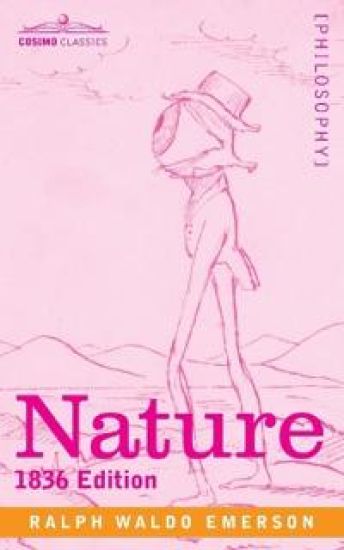
"Nature, in the common sense, refers to essences unchanged by man: space, the air, the river, the leaf."-Ralph Waldo EmersonNature (1836) was originally written by Ralph Waldo Emerson as a long essay in which he began to break away from traditional religious and social thinking and formulated the ideas and beliefs that were basic to the philosophy of Transcendentalism. In this essay, Emerson outlined his thinking about the fundamental relationship of man with nature. To many other intellectuals at the time his ideas were revolutionary because he abandoned the popular belief that humanity is separate from and above the rest of the natural world. In 1844, Emerson wrote and published two more series of essays entitled "Nature" in which the implications of this shift are discussed in greater detail.
Nature

Nature

Ralph Waldo Emerson

Binker North
1836
pokkari
Nature, by Ralph Waldo Emerson, is a superb nature essay and a philosophical interpretation of nature and how it influences man physically and spiritually. Emerson's writing is redolent with the wonder of the true romantic, but never sinks to the level of maudlin fluff. In the essay Emerson put forth the foundation of transcendentalism, a belief system that espouses a non-traditional appreciation of nature. Transcendentalism suggests that the divine, or God, suffuses nature, and suggests that reality can be understood by studying nature. Emerson's visit to the Mus um National d'Histoire Naturelle in Paris inspired a set of lectures he later delivered in Boston which were then published. Within the essay, Emerson divides nature into four usages: Commodity, Beauty, Language and Discipline. These distinctions define the ways by which humans use nature for their basic needs, their desire for delight, their communication with one another and their understanding of the world. Emerson followed the success of "Nature" with a speech, "The American Scholar", which together with his previous lectures laid the foundation for transcendentalism and his literary career. Ralph Waldo Emerson (May 25, 1803 - April 27, 1882) 5] was an American essayist, lecturer, philosopher, and poet who led the transcendentalist movement of the mid-19th century. He was seen as a champion of individualism and a prescient critic of the countervailing pressures of society, and he disseminated his thoughts through dozens of published essays and more than 1,500 public lectures across the United States. Emerson gradually moved away from the religious and social beliefs of his contemporaries, formulating and expressing the philosophy of transcendentalism in his 1836 essay "Nature". Following this work, he gave a speech entitled "The American Scholar" in 1837, which Oliver Wendell Holmes Sr. considered to be America's "intellectual Declaration of Independence."