Kirjojen hintavertailu – 12 859 828 kirjaa ja 27 kauppaa

Kirjailija

Ramjee Prasad

Kirjat ja teokset yhdessä paikassa: 47 kirjaa, julkaisuja vuosilta 1996–2025, suosituimpiin kuuluu Cognitive Radio Networks. Vertaile teosten hintoja ja tarkista saatavuus suomalaisista kirjakaupoista.

47 kirjaa

Kirjojen julkaisuvuodet: 1996–2025.

Cognitive Radio Networks

Cognitive Radio Networks

Kwang-Cheng Chen; Ramjee Prasad

John Wiley Sons Inc
2009
sidottu
Giving a basic overview of the technologies supporting cognitive radio this introductory-level text follows a logical approach, starting with the physical layer and concluding with applications and general issues. It provides a background to advances in the field of cognitive radios and a new exploration of how these radios can work together as a network. Cognitive Radio Networks starts with an introduction to the fundamentals of wireless communications, introducing technologies such as OFDM & MIMO. It moves onto cover software defined radio and explores and contrasts wireless, cooperative and cognitive networks and communications. Spectrum sensing, medium access control and network layer design are examined before the book concludes by covering the topics of trusted cognitive radio networks and spectrum management. Unique in providing a brief but clear tutorial and reference to cognitive radio networks this book is a single reference, written at the appropriate level for newcomers as well as providing an encompassing text for those with more knowledge of the subject. One of the first books to provide a systematic description of cognitive radio networksProvides pervasive background knowledge including both wireless communications and wireless networksWritten by leading experts in the fieldFull network stack investigation

Safeguarding 6G: Security and Privacy for the Next Generation

Safeguarding 6G: Security and Privacy for the Next Generation

Ramjee Prasad; Ana Koren

River Publishers
2025
sidottu
This book provides a comprehensive overview of security and privacy challenges in 6G networks, addressing the urgent need for advanced security frameworks as the next generation of wireless technology emerges. The rapid advancements in quantum computing, AI, and IoT are transforming the digital landscape, introducing both unprecedented opportunities and significant security threats. From AI-driven cyberattacks to the vulnerabilities of IoT devices, this book explores cutting-edge technologies such as quantum key distribution (QKD), post-quantum cryptography, and AI-enabled security systems. Designed for professionals and researchers, this resource outlines real-world applications of 6G security techniques, offering practical insights into protecting critical infrastructures, autonomous vehicles, smart cities, and more. By emphasizing a proactive approach to cybersecurity and fostering collaboration across industries, academia, and policymakers, the book lays out a roadmap for ensuring the resilience and trustworthiness of 6G networks in the future.
5G: 2020 and Beyond

5G: 2020 and Beyond

Ramjee Prasad

River Publishers
2024
nidottu
The future society would be ushered in a new communication era with the emergence of 5G. 5G would be significantly different, especially, in terms of architecture and operation in comparison with the previous communication generations (4G, 3G...). This book discusses the various aspects of the architecture, operation, possible challenges, and mechanisms to overcome them. Further, it supports users? interac- tion through communication devices relying on Human Bond Communication and COmmunication-NAvigation- SENsing- SErvices (CONASENSE). Topics broadly covered in this book are; • Wireless Innovative System for Dynamically Operating Mega Communications (WISDOM)• Millimeter Waves and Spectrum Management• Cyber Security• Device to Device Communication
Single- And Multi-Carrier Mimo Transmission for Broadband Wireless Systems

Single- And Multi-Carrier Mimo Transmission for Broadband Wireless Systems

Ramjee Prasad; Muhammad Imadur Rahman; Sekhar Suvra Das

River Publishers
2024
nidottu
The main focus of Single- and Multi-Carrier MIMO Transmission for Broadband Wireless Systems is to provide the basic understanding of the underlying techniques related to PHY-MAC design of future wireless systems. It includes basic concepts related to single- and multi-carrier transmissions together with MIMO techniques. Discussions related to different recent standards that use single- and multi-carrier transmissions are also explained. Single- and Multi-Carrier MIMO Transmission for Broadband Wireless Systems provides a comprehensive and holistic approach to the variety of technical solutions. Future system design would require these different technologies to work together, and not independently. Therefore, it is very important to analyze the effects and gains when they are put together in a unified platform. This is the prime focus of this book. Moreover, the authors include recent research results which are not yet published in another form. The book is intended to be used for lectures in graduate level courses at universities. PhD level students should also find it useful as this book will outline the fundamental concepts and design methods for PHY and MAC layers of future wireless systems. This book can also be used as a reference by engineers and developers in the industry as well as by researchers in academia. For professionals, system architects and managers who play a key role in the selection of a baseline system concept for future wireless standards, such as IMT-Advanced type architecture, the authors will include discussions, analysis and guidelines to highlight overall system level perspective.
6G: The Road to the Future Wireless Technologies 2030

6G: The Road to the Future Wireless Technologies 2030

Paulo Sergio Rufino Henrique; Ramjee Prasad

River Publishers
2024
nidottu
Since the launch of Second-Generation Networks (2G), planning for each future mobile service was initiated many years before its commercial launch. In 2019, 5G Networks begun to be deployed commercially after almost ten years of planning. Similarly, the race for the 6G wireless networks that will be operational in 2030 has already started. To fulfill its potential in the upcoming decade, 6G will undoubtedly require an architectural orchestration based on the amalgamation of existing solutions and innovative technologies. The book will begin by evaluating the state of the art of all current mobile generations' while looking into their core building blocks. 6G implementation will require fundamental support from Artificial Intelligence (AI) and Machine Learning on the network's edge and core, including a new Radio Frequency (RF) spectrum. The 6G use cases will require advanced techniques for enabling the future wireless network to be human-centric, ensuring enhanced quality of experience (QoE) for most of its applications. The concept of Human Bond Communication Beyond 2050 (Knowledge Home) and Communication, Navigation, Sensing, and Services (CONASENSE) will also profit from future wireless communication. Terahertz domains will exploit the ultra-Massive Multiple Input Multiple Output Antennas (UM-MIMO) technologies to support Terabits' data throughputs. Moreover, optical wireless communications (OWC) will also come into play to support indoor and outdoor high-data rates. Further expansion of 6G core entities will support the novel concept of Society 5.0. Quantum computing processing and communications is also likely to be added into the 6G ecosystem with security managed by blockchain orchestration for a robust network.
Ofdm Based Relay Systems for Future Wireless Communications

Ofdm Based Relay Systems for Future Wireless Communications

Milica Pejanovic-Djurisic; Enis Kocan; Ramjee Prasad

River Publishers
2024
nidottu
Relay systems have become a subject of intensive research interest over the recent years, as it is recognized that they can improve performances and extend the coverage area of wireless communication systems. Special attention has been dedicated to them since the proposal appeared for their implementation in mobile cellular systems. Numerous researches conducted after that proposal have enabled incorporation of OFDM based relay systems in both accepted standards for IMT-Advanced systems. Nowadays, researches are ongoing with the aim to define new solutions for performance improvement of the standardized OFDM relay systems for cellular networks and one of the interesting solutions is implementation of subcarrier permutation (SCP) at the relay (R) station. The book OFDM based relay systems for future wireless communications presents a comprehensive research results in analyzing behavior and performance of the OFDM based relay systems with SCP. Dual-hop relay scenario with three communication terminals, and no direct link between the source (S) and the destination (D) has been analyzed, as it is compliant with the accepted solutions for IMT-Advanced systems. The book includes performance analysis and performance comparison of OFDM based:• amplify-and-forward (AF) relay systems with fixed gain (FG),• amplify-and-forward (AF) relay systems with variable gain (VG),• decode-and-forward (DF) relay systems,each including two SCP schemes, known to maximize the system capacity and/or improve the bit error rate (BER) performances. Performance comparisons have enabled definition of optimal solutions for the future wireless communication systems in a given conditions, and for the given optimality criteria. OFDM based relay systems for future wireless communications contains recent research results in this area and is ideal for the academic staff and master/research students in area of mobile communication systems, as well as for the personnel in communication industry.
Adaptive PHY-MAC Design for Broadband Wireless Systems

Adaptive PHY-MAC Design for Broadband Wireless Systems

Ramjee Prasad; Suvra Sekhar Das; Muhammad Imadur Rahman

River Publishers
2024
nidottu
The next generation mobile communication networks (4G) have the challenging target of The next generation mobile communication networks (4G) have the challenging target of providing a peak data rate of 1 Gigabit per second local area and 100 Megabit per second wide area. The ability to offer such high data rates in 100MHz bandwidth requires overall a very high spectral efficiency, and hence the need for multi-antenna techniques (MIMO) with spatial multiplexing, fast dynamic link adaptation and packet scheduling, wideband access techniques, and most likely non-contention based spectrum sharing among multiple operators. Many of these required technology components and techniques are well researched and established. Adaptive PHY-MAC Design for Broadband Wireless Systems explains how one can integrate and optimise their use in providing the target cell data rates with high availability. The authors address the ability to cope with interference and enhanced physical layer processing, and simultaneously, the multifaceted system level design. Focus is also on the selection of technology components and techniques, which leads to the highest spectral efficiency and peak data rate availability with reasonable Quality of Service (QoS) support, such as improved outage scenario, reduced delay, guaranteed bit rate, etc. In short, this book will answer questions such as, how individual techniques relate to each other, how can we benefit the gains by suitable combinations of different technologies and how to choose different technological solutions in different scenarios, etc. The next generation mobile communication networks (4G) have the challenging target of The next generation mobile communication networks (4G) have the challenging target of providing a peak data rate of 1 Gigabit per second local area and 100 Megabit per second wide area.
Orthogonal Time Frequency Space Modulation

Orthogonal Time Frequency Space Modulation

Suvra Sekhar Das; Ramjee Prasad

River Publishers
2024
nidottu
Over the last few decades wireless communications, especially Mobile Communication Technology, has evolved by leaps and bounds. The mobile communication industry has named the different major changes as generations namely 1G, 2G,..5G. We are presently looking at deployment of 5G technologies. The work for 6G has already started. This book is focused on the waveform design of 6G. It presents a discourse on a potential waveform for 6G namely Orthogonal Time Frequency Space (OTFS) modulation. OTFS has a distinct feature when compared to earlier generation waveforms such that information bearing signal is placed in the delay Doppler domain as opposed to the usual placement of such signals in the time-frequency domain. This unique feature of OTFS enables it to overcome several disadvantages of a very popular and highly successful waveform namely Orthogonal Frequency Division Multiplexing (OFDM). OTFS is known to be more resilient to frequency offset and Doppler which is one of the key drawbacks of OFDM. With this feature, OTFS, can support higher mobility as well as higher frequency bands of operation which is also one of the key requirements of the next generation wireless communication technologies. The implementation complexity of OTFS remains comparable to that of OFDM. It is found that OTFS provides significant SNR advantage, higher resilience, lower PAPR, lower out of band signal leakage and higher multi-user spectral efficiency than that of OFDM. This book addresses• Fundamental signal model of OTFS. • Receiver design for OTFS• Channel estimation in OTFS• Multiple Access through non-orthogonal multiple access (NOMA-OTFS)The contents of the books are primarily outcome of the research work done at the G. S. Sanyal School of Telecommunications, Indian Institute of Technology Kharagpur, Kharagpur, India. Orthogonal Time Frequency Space Modulation : A waveform for 6G is ideal for personnel the wireless communication industry as well as academic staff and master/research students in electrical engineering with a specialization in wireless communications.
Orthogonal Time Frequency Space Modulation

Orthogonal Time Frequency Space Modulation

Suvra Sekhar Das; Ramjee Prasad

River Publishers
2021
sidottu
Over the last few decades wireless communications, especially Mobile Communication Technology, has evolved by leaps and bounds. The mobile communication industry has named the different major changes as generations namely 1G, 2G,..5G. We are presently looking at deployment of 5G technologies. The work for 6G has already started. This book is focused on the waveform design of 6G. It presents a discourse on a potential waveform for 6G namely Orthogonal Time Frequency Space (OTFS) modulation. OTFS has a distinct feature when compared to earlier generation waveforms such that information bearing signal is placed in the delay Doppler domain as opposed to the usual placement of such signals in the time-frequency domain. This unique feature of OTFS enables it to overcome several disadvantages of a very popular and highly successful waveform namely Orthogonal Frequency Division Multiplexing (OFDM). OTFS is known to be more resilient to frequency offset and Doppler which is one of the key drawbacks of OFDM. With this feature, OTFS, can support higher mobility as well as higher frequency bands of operation which is also one of the key requirements of the next generation wireless communication technologies. The implementation complexity of OTFS remains comparable to that of OFDM. It is found that OTFS provides significant SNR advantage, higher resilience, lower PAPR, lower out of band signal leakage and higher multi-user spectral efficiency than that of OFDM. This book addresses • Fundamental signal model of OTFS. • Receiver design for OTFS • Channel estimation in OTFS • Multiple Access through non-orthogonal multiple access (NOMA-OTFS) The contents of the books are primarily outcome of the research work done at the G. S. Sanyal School of Telecommunications, Indian Institute of Technology Kharagpur, Kharagpur, India. Orthogonal Time Frequency Space Modulation : A waveform for 6G is ideal for personnel the wireless communication industry as well as academic staff and master/research students in electrical engineering with a specialization in wireless communications.
6G: The Road to the Future Wireless Technologies 2030

6G: The Road to the Future Wireless Technologies 2030

Paulo Sergio Rufino Henrique; Ramjee Prasad

River Publishers
2021
sidottu
Since the launch of Second-Generation Networks (2G), planning for each future mobile service was initiated many years before its commercial launch. In 2019, 5G Networks begun to be deployed commercially after almost ten years of planning. Similarly, the race for the 6G wireless networks that will be operational in 2030 has already started. To fulfill its potential in the upcoming decade, 6G will undoubtedly require an architectural orchestration based on the amalgamation of existing solutions and innovative technologies. The book will begin by evaluating the state of the art of all current mobile generations' while looking into their core building blocks. 6G implementation will require fundamental support from Artificial Intelligence (AI) and Machine Learning on the network's edge and core, including a new Radio Frequency (RF) spectrum. The 6G use cases will require advanced techniques for enabling the future wireless network to be human-centric, ensuring enhanced quality of experience (QoE) for most of its applications. The concept of Human Bond Communication Beyond 2050 (Knowledge Home) and Communication, Navigation, Sensing, and Services (CONASENSE) will also profit from future wireless communication. Terahertz domains will exploit the ultra-Massive Multiple Input Multiple Output Antennas (UM-MIMO) technologies to support Terabits' data throughputs. Moreover, optical wireless communications (OWC) will also come into play to support indoor and outdoor high-data rates. Further expansion of 6G core entities will support the novel concept of Society 5.0. Quantum computing processing and communications is also likely to be added into the 6G ecosystem with security managed by blockchain orchestration for a robust network.
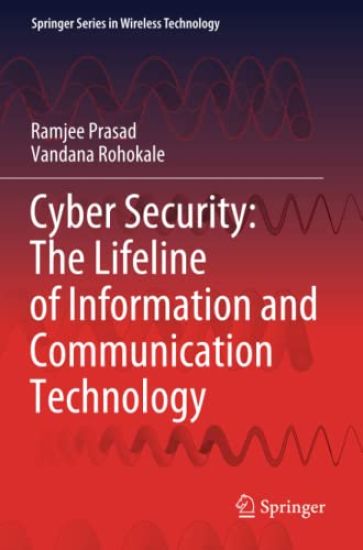
Cyber Security: The Lifeline of Information and Communication Technology

Cyber Security: The Lifeline of Information and Communication Technology

Ramjee Prasad; Vandana Rohokale

Springer Nature Switzerland AG
2020
nidottu
This book discusses a broad range of cyber security issues, addressing global concerns regarding cyber security in the modern era. The growth of Information and Communication Technology (ICT) and the prevalence of mobile devices make cyber security a highly topical and relevant issue. The transition from 4G to 5G mobile communication, while bringing convenience, also means cyber threats are growing exponentially. This book discusses a variety of problems and solutions including: • Internet of things and Machine to Machine Communication; • Infected networks such as Botnets; • Social media and networking; • Cyber Security for Smart Devices and Smart Grid • Blockchain Technology and • Artificial Intelligence for Cyber Security Given its scope, the book offers a valuable asset for cyber security researchers, as well as industry professionals, academics, and students.
Cyber Security: The Lifeline of Information and Communication Technology

Cyber Security: The Lifeline of Information and Communication Technology

Ramjee Prasad; Vandana Rohokale

Springer Nature Switzerland AG
2019
sidottu
This book discusses a broad range of cyber security issues, addressing global concerns regarding cyber security in the modern era. The growth of Information and Communication Technology (ICT) and the prevalence of mobile devices make cyber security a highly topical and relevant issue. The transition from 4G to 5G mobile communication, while bringing convenience, also means cyber threats are growing exponentially. This book discusses a variety of problems and solutions including: • Internet of things and Machine to Machine Communication; • Infected networks such as Botnets; • Social media and networking; • Cyber Security for Smart Devices and Smart Grid • Blockchain Technology and • Artificial Intelligence for Cyber Security Given its scope, the book offers a valuable asset for cyber security researchers, as well as industry professionals, academics, and students.
VoIP Technology: Applications and Challenges

VoIP Technology: Applications and Challenges

Tamal Chakraborty; Iti Saha Misra; Ramjee Prasad

Springer Nature Switzerland AG
2018
nidottu
This book offers an accessible introduction and practical guide to Voice over Internet Protocol (VoIP) technology, providing readers with the know-how to solve the problems encountered in applying VoIP technology across all types of network. It incorporates the latest research findings and brings readers up to date with the challenges that are faced by researchers developing novel applications of VoIP. The authors discuss the general architecture of VoIP technology, along with its application and relevance in conventional and emerging wireless communication networks, including Wireless Local Area Networks (WLANs), Worldwide Interoperability for Microwave Access (WiMAX), Long Term Evolution (LTE) and Cognitive Radio Networks. The book also includes Quality of service (QoS) studies under dynamic and unpredictable network conditions, which examine the reliability of both legacy systems And the upcoming pervasive computing systems. Further, it explains how the heuristic-based learning algorithms that are used in VoIP communications may help develop today’s technology in the area of autonomous systems. This book is a valuable source of information for academics and researchers, as it provides state-of-theart research in VoIP technology. It is also of interest to network designers, application architects, and service providers looking for a coherent understanding of VoIP across a wide range of devices, network applications and user categories.
VoIP Technology: Applications and Challenges

VoIP Technology: Applications and Challenges

Tamal Chakraborty; Iti Saha Misra; Ramjee Prasad

Springer International Publishing AG
2018
sidottu
This book offers an accessible introduction and practical guide to Voice over Internet Protocol (VoIP) technology, providing readers with the know-how to solve the problems encountered in applying VoIP technology across all types of network. It incorporates the latest research findings and brings readers up to date with the challenges that are faced by researchers developing novel applications of VoIP. The authors discuss the general architecture of VoIP technology, along with its application and relevance in conventional and emerging wireless communication networks, including Wireless Local Area Networks (WLANs), Worldwide Interoperability for Microwave Access (WiMAX), Long Term Evolution (LTE) and Cognitive Radio Networks. The book also includes Quality of service (QoS) studies under dynamic and unpredictable network conditions, which examine the reliability of both legacy systems And the upcoming pervasive computing systems. Further, it explains how the heuristic-based learning algorithms that are used in VoIP communications may help develop today’s technology in the area of autonomous systems. This book is a valuable source of information for academics and researchers, as it provides state-of-theart research in VoIP technology. It is also of interest to network designers, application architects, and service providers looking for a coherent understanding of VoIP across a wide range of devices, network applications and user categories.
Context-Aware Communication and Computing: Applications for Smart Environment

Context-Aware Communication and Computing: Applications for Smart Environment

Punnarumol Temdee; Ramjee Prasad

Springer International Publishing AG
2018
nidottu
This book introduces context-aware computing, providing definitions, categories, characteristics, and context awareness itself and discussing its applications with a particular focus on smart learning environments. It also examines the elements of a context-aware system, including acquisition, modelling, reasoning, and distribution of context. It also reviews applications of context-aware computing – both past and present – to offer readers the knowledge needed to critically analyse how context awareness can be put to use. It is particularly to those new to the subject area who are interested in learning how to develop context-aware computing-oriented applications, as well as postgraduates and researchers in computer engineering, communications engineering related areas of information technology (IT). Further it provides practical know-how for professionals working in IT support and technology, consultants and business decision-makers and those working in the medical, human, and social sciences.
Context-Aware Communication and Computing: Applications for Smart Environment

Context-Aware Communication and Computing: Applications for Smart Environment

Punnarumol Temdee; Ramjee Prasad

Springer International Publishing AG
2017
sidottu
This book introduces context-aware computing, providing definitions, categories, characteristics, and context awareness itself and discussing its applications with a particular focus on smart learning environments. It also examines the elements of a context-aware system, including acquisition, modelling, reasoning, and distribution of context. It also reviews applications of context-aware computing – both past and present – to offer readers the knowledge needed to critically analyse how context awareness can be put to use. It is particularly to those new to the subject area who are interested in learning how to develop context-aware computing-oriented applications, as well as postgraduates and researchers in computer engineering, communications engineering related areas of information technology (IT). Further it provides practical know-how for professionals working in IT support and technology, consultants and business decision-makers and those working in the medical, human, and social sciences.
Human Bond Communication

Human Bond Communication

Sudhir Dixit; Ramjee Prasad

Wiley-Blackwell
2017
sidottu
This book approaches the topic area of the Internet of Things (IoT) from the perspective of the five types of human communication. Through this perspective on the human communication types, the book aims to specifically address how IoT technologies can support humans and their endeavors. The book explores the fields of sensors, wireless, physiology, biology, wearables, and the Internet. This book is organized with five sections, each covering a central theme; Section 1: The basics of human bond communication Section 2: Relevance IoT, BAN and PAN Section 3: Applications of HBC Section 4: Security, Privacy and Regulatory Challenges Section 5: The Big Picture (Where do we go from here?)
WiMAX Networks

WiMAX Networks

Ramjee Prasad; Fernando J. Velez

Springer
2014
nidottu
Ignited by the mobile phone's huge success at the end of last century, the demand for wireless services is constantly growing. To face this demand, wireless systems have been and are deployed at a large scale. These include mobility-oriented technologies such as GPRS, CDMA or UMTS, and Local Area Network-oriented technologies such as WiFi. WiMAX Networks covers aspects of WiMAX quality of service (QoS), security, mobility, radio resource management, multiple input multiple output antenna, planning, cost/revenue optimization, physical layer, medium access control (MAC) layer, network layer, and so on.
5G: 2020 and Beyond

5G: 2020 and Beyond

Ramjee Prasad

River Publishers
2014
sidottu
The future society would be ushered in a new communication era with the emergence of 5G. 5G would be significantly different, especially, in terms of architecture and operation in comparison with the previous communication generations (4G, 3G...). This book discusses the various aspects of the architecture, operation, possible challenges, and mechanisms to overcome them. Further, it supports users? interac- tion through communication devices relying on Human Bond Communication and COmmunication-NAvigation- SENsing- SErvices (CONASENSE). Topics broadly covered in this book are; • Wireless Innovative System for Dynamically Operating Mega Communications (WISDOM)• Millimeter Waves and Spectrum Management• Cyber Security• Device to Device Communication
Ofdm Based Relay Systems for Future Wireless Communications

Ofdm Based Relay Systems for Future Wireless Communications

Milica Pejanovic-Djurisic; Enis Kocan; Ramjee Prasad

River Publishers
2012
sidottu
Relay systems have become a subject of intensive research interest over the recent years, as it is recognized that they can improve performances and extend the coverage area of wireless communication systems. Special attention has been dedicated to them since the proposal appeared for their implementation in mobile cellular systems. Numerous researches conducted after that proposal have enabled incorporation of OFDM based relay systems in both accepted standards for IMT-Advanced systems. Nowadays, researches are ongoing with the aim to define new solutions for performance improvement of the standardized OFDM relay systems for cellular networks and one of the interesting solutions is implementation of subcarrier permutation (SCP) at the relay (R) station. The book "OFDM based relay systems for future wireless communications" presents a comprehensive research results in analyzing behavior and performance of the OFDM based relay systems with SCP. Dual-hop relay scenario with three communication terminals, and no direct link between the source (S) and the destination (D) has been analyzed, as it is compliant with the accepted solutions for IMT-Advanced systems. The book includes performance analysis and performance comparison of OFDM based: • amplify-and-forward (AF) relay systems with fixed gain (FG), • amplify-and-forward (AF) relay systems with variable gain (VG), • decode-and-forward (DF) relay systems, each including two SCP schemes, known to maximize the system capacity and/or improve the bit error rate (BER) performances. Performance comparisons have enabled definition of optimal solutions for the future wireless communication systems in a given conditions, and for the given optimality criteria. OFDM based relay systems for future wireless communications contains recent research results in this area and is ideal for the academic staff and master/research students in area of mobile communication systems, as well as for the personnel in communication industry.