Kirjojen hintavertailu – 12 903 725 kirjaa ja 27 kauppaa

Kirjailija

Robert J Elliott

Kirjat ja teokset yhdessä paikassa: 10 kirjaa, julkaisuja vuosilta 1994–2018, suosituimpiin kuuluu Binomial Models in Finance. Vertaile teosten hintoja ja tarkista saatavuus suomalaisista kirjakaupoista.

Nimi esiintyy myös muodoissa: Robert J. Elliott

10 kirjaa

Kirjojen julkaisuvuodet: 1994–2018.

Introduction to Hidden Semi-Markov Models

Introduction to Hidden Semi-Markov Models

John van der Hoek; Robert J. Elliott

Cambridge University Press
2018
pokkari
Markov chains and hidden Markov chains have applications in many areas of engineering and genomics. This book provides a basic introduction to the subject by first developing the theory of Markov processes in an elementary discrete time, finite state framework suitable for senior undergraduates and graduates. The authors then introduce semi-Markov chains and hidden semi-Markov chains, before developing related estimation and filtering results. Genomics applications are modelled by discrete observations of these hidden semi-Markov chains. This book contains new results and previously unpublished material not available elsewhere. The approach is rigorous and focused on applications.
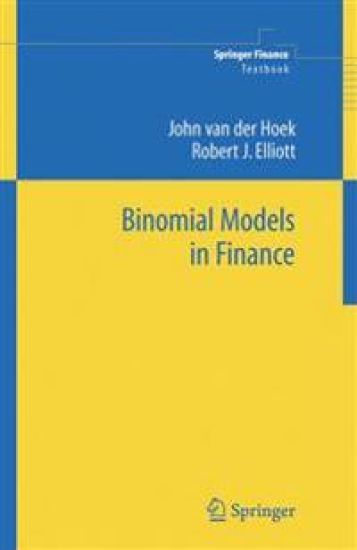
Binomial Models in Finance

Binomial Models in Finance

John van der Hoek; Robert J Elliott

Springer-Verlag New York Inc.
2010
nidottu
This book describes the modelling of prices of ?nancial assets in a simple d- crete time, discrete state, binomial framework. By avoiding the mathematical technicalitiesofcontinuoustime?nancewehopewehavemadethematerial accessible to a wide audience. Some of the developments and formulae appear here for the ?rst time in book form. We hope our book will appeal to various audiences. These include MBA s- dents,upperlevelundergraduatestudents,beginningdoctoralstudents,qu- titative analysts at a basic level and senior executives who seek material on new developments in ?nance at an accessible level. The basic building block in our book is the one-step binomial model where a known price today can take one of two possible values at a future time, which might, for example, be tomorrow, or next month, or next year. In this simple situation “risk neutral pricing” can be de?ned and the model can be applied to price forward contracts, exchange rate contracts and interest rate derivatives. In a few places we discuss multinomial models to explain the notions of incomplete markets and how pricing can be viewed in such a context, where unique prices are no longer available. The simple one-period framework can then be extended to multi-period m- els. TheCox-Ross-RubinsteinapproximationtotheBlackScholesoptionpr- ing formula is an immediate consequence. American, barrier and exotic - tions can all be discussed and priced using binomial models. More precise modelling issues such as implied volatility trees and implied binomial trees are treated, as well as interest rate models like those due to Ho and Lee; and Black, Derman and Toy.
Binomial Models in Finance

Binomial Models in Finance

John van der Hoek; Robert J Elliott

Springer-Verlag New York Inc.
2005
sidottu
This book describes the modelling of prices of ?nancial assets in a simple d- crete time, discrete state, binomial framework. By avoiding the mathematical technicalitiesofcontinuoustime?nancewehopewehavemadethematerial accessible to a wide audience. Some of the developments and formulae appear here for the ?rst time in book form. We hope our book will appeal to various audiences. These include MBA s- dents,upperlevelundergraduatestudents,beginningdoctoralstudents,qu- titative analysts at a basic level and senior executives who seek material on new developments in ?nance at an accessible level. The basic building block in our book is the one-step binomial model where a known price today can take one of two possible values at a future time, which might, for example, be tomorrow, or next month, or next year. In this simple situation “risk neutral pricing” can be de?ned and the model can be applied to price forward contracts, exchange rate contracts and interest rate derivatives. In a few places we discuss multinomial models to explain the notions of incomplete markets and how pricing can be viewed in such a context, where unique prices are no longer available. The simple one-period framework can then be extended to multi-period m- els. TheCox-Ross-RubinsteinapproximationtotheBlackScholesoptionpr- ing formula is an immediate consequence. American, barrier and exotic - tions can all be discussed and priced using binomial models. More precise modelling issues such as implied volatility trees and implied binomial trees are treated, as well as interest rate models like those due to Ho and Lee; and Black, Derman and Toy.
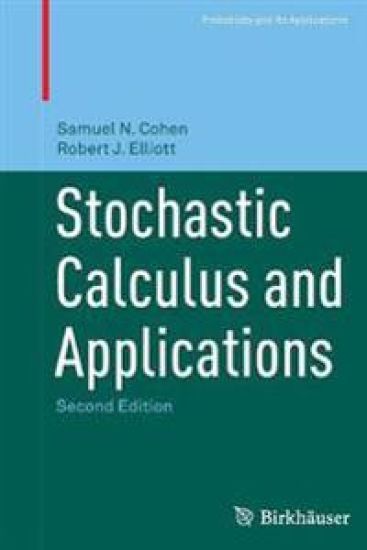
Stochastic Calculus and Applications

Stochastic Calculus and Applications

Samuel N. Cohen; Robert J. Elliott

Springer-Verlag New York Inc.
2015
nidottu
Completely revised and greatly expanded, the new edition of this text takes readers who have been exposed to only basic courses in analysis through the modern general theory of random processes and stochastic integrals as used by systems theorists, electronic engineers and, more recently, those working in quantitative and mathematical finance. Building upon the original release of this title, this text will be of great interest to research mathematicians and graduate students working in those fields, as well as quants in the finance industry. New features of this edition include:End of chapter exercises; New chapters on basic measure theory and Backward SDEs; Reworked proofs, examples and explanatory material; Increased focus on motivating the mathematics; Extensive topical index." Such a self-contained and complete exposition of stochastic calculus and applications fills an existing gap in the literature. The book can be recommended for first-year graduate studies. It will be useful for all who intend to work with stochastic calculus as well as with its applications."–Zentralblatt (from review of the First Edition)
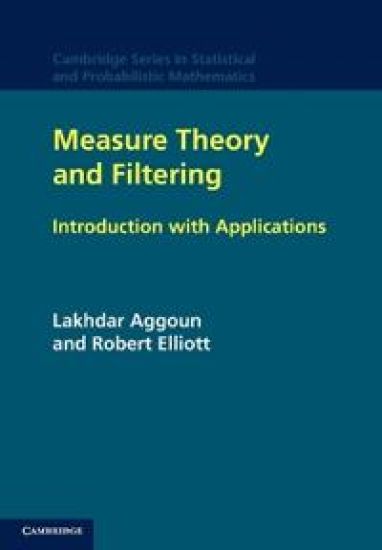
Measure Theory and Filtering

Measure Theory and Filtering

Lakhdar Aggoun; Robert J. Elliott

Cambridge University Press
2012
pokkari
The estimation of noisily observed states from a sequence of data has traditionally incorporated ideas from Hilbert spaces and calculus-based probability theory. As conditional expectation is the key concept, the correct setting for filtering theory is that of a probability space. Graduate engineers, mathematicians and those working in quantitative finance wishing to use filtering techniques will find in the first half of this book an accessible introduction to measure theory, stochastic calculus, and stochastic processes, with particular emphasis on martingales and Brownian motion. Exercises are included. The book then provides an excellent users' guide to filtering: basic theory is followed by a thorough treatment of Kalman filtering, including recent results which extend the Kalman filter to provide parameter estimates. These ideas are then applied to problems arising in finance, genetics and population modelling in three separate chapters, making this a comprehensive resource for both practitioners and researchers.
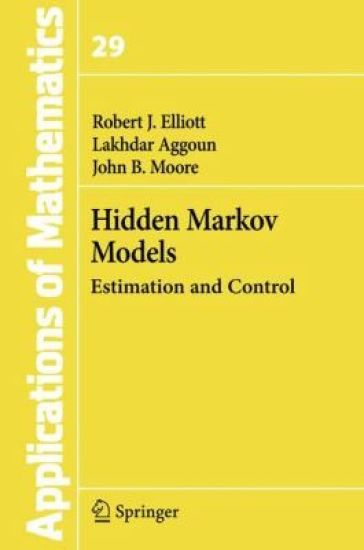
Hidden Markov Models

Hidden Markov Models

Robert J Elliott; Lakhdar Aggoun; John B. Moore

Springer-Verlag New York Inc.
2010
nidottu
As more applications are found, interest in Hidden Markov Models continues to grow. Following comments and feedback from colleagues, students and other working with Hidden Markov Models the corrected 3rd printing of this volume contains clarifications, improvements and some new material, including results on smoothing for linear Gaussian dynamics. In Chapter 2 the derivation of the basic filters related to the Markov chain are each presented explicitly, rather than as special cases of one general filter. Furthermore, equations for smoothed estimates are given. The dynamics for the Kalman filter are derived as special cases of the authors’ general results and new expressions for a Kalman smoother are given. The Chapters on the control of Hidden Markov Chains are expanded and clarified. The revised Chapter 4 includes state estimation for discrete time Markov processes and Chapter 12 has a new section on robust control.
Mathematics of Financial Markets

Mathematics of Financial Markets

Robert J Elliott; P. Ekkehard Kopp

Springer-Verlag New York Inc.
2010
nidottu
This work is aimed at an audience with a sound mathematical background wishing to learn about the rapidly expanding ?eld of mathematical ?nance. Its content is suitable particularly for graduate students in mathematics who have a background in measure theory and probability. The emphasis throughout is on developing the mathematical concepts required for the theory within the context of their application. No attempt is made to cover the bewildering variety of novel (or ‘exotic’) ?nancial - struments that now appear on the derivatives markets; the focus throu- out remains on a rigorous development of the more basic options that lie at the heart of the remarkable range of current applications of martingale theory to ?nancial markets. The ?rst ?ve chapters present the theory in a discrete-time framework. Stochastic calculus is not required, and this material should be accessible to anyone familiar with elementary probability theory and linear algebra. The basic idea of pricing by arbitrage (or, rather, by non-arbitrage) is presented in Chapter 1. The unique price for a European option in a single-period binomial model is given and then extended to multi-period binomial models. Chapter 2 introduces the idea of a martingale measure for price processes. Following a discussion of the use of self-?nancing tr- ing strategies to hedge against trading risk, it is shown how options can be priced using an equivalent measure for which the discounted price p- cess is a martingale.
Mathematics of Financial Markets

Mathematics of Financial Markets

Robert J Elliott; P. Ekkehard Kopp

Springer-Verlag New York Inc.
2004
sidottu
This work is aimed at an audience with a sound mathematical background wishing to learn about the rapidly expanding ?eld of mathematical ?nance. Its content is suitable particularly for graduate students in mathematics who have a background in measure theory and probability. The emphasis throughout is on developing the mathematical concepts required for the theory within the context of their application. No attempt is made to cover the bewildering variety of novel (or ‘exotic’) ?nancial - struments that now appear on the derivatives markets; the focus throu- out remains on a rigorous development of the more basic options that lie at the heart of the remarkable range of current applications of martingale theory to ?nancial markets. The ?rst ?ve chapters present the theory in a discrete-time framework. Stochastic calculus is not required, and this material should be accessible to anyone familiar with elementary probability theory and linear algebra. The basic idea of pricing by arbitrage (or, rather, by non-arbitrage) is presented in Chapter 1. The unique price for a European option in a single-period binomial model is given and then extended to multi-period binomial models. Chapter 2 introduces the idea of a martingale measure for price processes. Following a discussion of the use of self-?nancing tr- ing strategies to hedge against trading risk, it is shown how options can be priced using an equivalent measure for which the discounted price p- cess is a martingale.
Measure Theory and Filtering

Measure Theory and Filtering

Lakhdar Aggoun; Robert J. Elliott

Cambridge University Press
2004
sidottu
The estimation of noisily observed states from a sequence of data has traditionally incorporated ideas from Hilbert spaces and calculus-based probability theory. As conditional expectation is the key concept, the correct setting for filtering theory is that of a probability space. Graduate engineers, mathematicians and those working in quantitative finance wishing to use filtering techniques will find in the first half of this book an accessible introduction to measure theory, stochastic calculus, and stochastic processes, with particular emphasis on martingales and Brownian motion. Exercises are included. The book then provides an excellent users' guide to filtering: basic theory is followed by a thorough treatment of Kalman filtering, including recent results which extend the Kalman filter to provide parameter estimates. These ideas are then applied to problems arising in finance, genetics and population modelling in three separate chapters, making this a comprehensive resource for both practitioners and researchers.
Hidden Markov Models

Hidden Markov Models

Robert J Elliott; Lakhdar Aggoun; John B. Moore

Springer-Verlag New York Inc.
1994
sidottu
As more applications are found, interest in Hidden Markov Models continues to grow. Following comments and feedback from colleagues, students and other working with Hidden Markov Models the corrected 3rd printing of this volume contains clarifications, improvements and some new material, including results on smoothing for linear Gaussian dynamics. In Chapter 2 the derivation of the basic filters related to the Markov chain are each presented explicitly, rather than as special cases of one general filter. Furthermore, equations for smoothed estimates are given. The dynamics for the Kalman filter are derived as special cases of the authors’ general results and new expressions for a Kalman smoother are given. The Chapters on the control of Hidden Markov Chains are expanded and clarified. The revised Chapter 4 includes state estimation for discrete time Markov processes and Chapter 12 has a new section on robust control.