Kirjojen hintavertailu – 12 859 829 kirjaa ja 27 kauppaa

Kirjailija

Robert J. Sternberg

Kirjat ja teokset yhdessä paikassa: 52 kirjaa, julkaisuja vuosilta 1982–2026, suosituimpiin kuuluu The Nature of Intellectual Styles. Vertaile teosten hintoja ja tarkista saatavuus suomalaisista kirjakaupoista.

Nimi esiintyy myös muodoissa: Robert J Sternberg

52 kirjaa

Kirjojen julkaisuvuodet: 1982–2026.

Starting Your Career in Academic Psychology

Starting Your Career in Academic Psychology

Robert J. Sternberg

American Psychological Association
2016
pokkari
This book provides a systematic guide for jump-starting a career in academic psychology—from applying and interviewing for academic positions, to settling in at a new job, to maximizing success during the pre-tenure years. The chapters cover all key skills in which new faculty must become proficient: teaching, conducting and funding faculty-level research, serving the department and field, and "softer" activities such as networking and navigating university politics. Given the demands and competition in the field, this guide is an essential roadmap for new faculty.
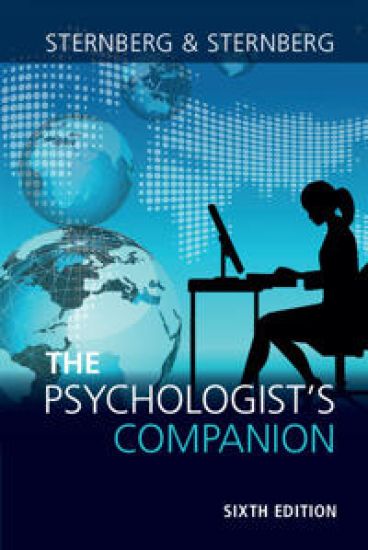
The Psychologist's Companion

The Psychologist's Companion

Robert J. Sternberg; Karin Sternberg

Cambridge University Press
2016
pokkari
The Psychologist's Companion, 6th edition is written for students, young professionals, and even mid-career scholars. It is the most comprehensive guide available to both written and oral communication processes for academic psychologists. It covers the topics necessary for career success, including planning papers, writing papers, presenting data, evaluating one's papers, writing grant proposals, giving talks, finding a book publisher, doing job interviews, and doing media interviews. Because the book is in its sixth edition, it is market tested for success in reaching and engaging its readers. Two special (new) pedagogical features are 'Experience is the Best Teacher', which draws on the authors' personal experiences to help make the book more personalized and exciting to readers, and 'What's Wrong Here', which gives readers an opportunity for active learning while they read the book. The authors have written the book in a personable and often humorous style that will keep readers engaged.
The Psychologist's Companion

The Psychologist's Companion

Robert J. Sternberg; Karin Sternberg

Cambridge University Press
2016
sidottu
The Psychologist's Companion, 6th edition is written for students, young professionals, and even mid-career scholars. It is the most comprehensive guide available to both written and oral communication processes for academic psychologists. It covers the topics necessary for career success, including planning papers, writing papers, presenting data, evaluating one's papers, writing grant proposals, giving talks, finding a book publisher, doing job interviews, and doing media interviews. Because the book is in its sixth edition, it is market tested for success in reaching and engaging its readers. Two special (new) pedagogical features are 'Experience is the Best Teacher', which draws on the authors' personal experiences to help make the book more personalized and exciting to readers, and 'What's Wrong Here', which gives readers an opportunity for active learning while they read the book. The authors have written the book in a personable and often humorous style that will keep readers engaged.
Psychology 101½

Psychology 101½

Robert J. Sternberg

American Psychological Association
2016
pokkari
In this second edition of his popular Psychology amp frac 2 , eminent psychologist Robert J. Sternberg updates and extends a trove of wisdom gleaned from decades of experience in various academic settings and leadership positions. In his signature straightforward, intellectually honest, and pragmatic style, he imparts life lessons for building a successful and gratifying career. This revision features lessons in five basic categories: identity and integrity, interpersonal relationships, institutions and academia, problems and tasks, and job and career. Recent developments in the field are covered, and new questions at the end of each lesson prompt reader self-reflection. Valuable to academic psychologists at any level, this book will be especially prized by graduate students, post-doctorates, and early-career professors.
What Universities Can Be

What Universities Can Be

Robert J. Sternberg

Cornell University Press
2016
sidottu
In What Universities Can Be, the high-profile educator Robert J. Sternberg writes thoughtfully about the direction of higher education in this country and its potential to achieve future excellence. Sternberg presents, for the first time, his concept of the ACCEL model, in which institutions of higher education are places where students learn to become Active Concerned Citizens and Ethical Leaders. One of the greatest problems in our society is a lack of leaders who understand the importance of behaving in ethical ways for the common good of all. At a time when new models of education are sorely needed, universities have the opportunity to claim the education of future leaders as their mission. In the course of laying out the ACCEL concept and how such a model might be achieved, Sternberg offers many insights into the realities of higher education as it is practiced today and suggests ways that we could move in a better direction, one that would produce graduates who make the world a better place in which to live. Sternberg's compelling narrative and convincing argument address all aspects of universities, such as admissions, financial aid, instruction and assessment, retention and graduation, student life, diversity, finances, athletics, governance, and marketing. This book is essential reading for educators and laypeople who are interested in learning how our universities work and how they could work better.
Teaching for Successful Intelligence

Teaching for Successful Intelligence

Elena L Grigorenko; Robert J. Sternberg

Skyhorse Publishing
2016
pokkari
Strengthen critical thinking skills with strategies that dramatically improve student performance! Coauthored by two internationally renowned educators and researchers, this resource helps teachers strengthen their classroom practice with lessons that promote successful intelligence—a set of abilities that allow students to adapt and succeed within their environment, make the most of their strengths, and learn to compensate for their weaknesses. The authors demonstrate how to design instructional units that help students apply successful intelligence to solve problems and make decisions. This research-based text also includes: Sample unit plans and 40 ready-to-use lessons illustrated with classroom examples Proven assessment techniques to promote the development of creative, analytical, and practical thinking skills Approaches to encourage both passive and active learning With teacher reflection activities and suggested homework for students, this resource is ideal for strengthening students' higher-order thinking abilities and raising overall academic performance!
The Creativity Conundrum

The Creativity Conundrum

Robert J. Sternberg; James C. Kaufman; Jean E. Pretz

Psychology Press Ltd
2012
nidottu
This book challenges traditional notions of creativity as a trait, and brings forward ideas of multiple types of creativity, along with the possibility of development of creativity.
College Admissions for the 21st Century

College Admissions for the 21st Century

Robert J. Sternberg

Harvard University Press
2010
sidottu
SATs, ACTs, GPAs. Everyone knows that these scores can’t tell a college everything that’s important about an applicant. But what else should admissions officers look for, and how can they know it when they see it? In College Admissions for the 21st Century a leading researcher on intelligence and creativity offers a bold and practical approach to college admissions testing. Standardized tests are measures of memory and analytical skills. But the ever-changing global society beyond a college campus needs more than just those qualities, argues Robert Sternberg. Tomorrow’s leaders and citizens also need creativity, practicality, and wisdom. How can the potential for those complex qualities be measured? One answer is “Kaleidoscope,” a new initiative in undergraduate admissions, first used at Tufts University. Its open-ended questions for applicants, and the means used to score the answers, gives applicants and admissions officers the chance to go beyond standardized tests. Does it work? As Sternberg describes in detail, Kaleidoscope measures predicted first-year academic success, over and above SATs and high school GPAs, and predicted first-year extracurricular activities, leadership, and active citizenship as well. And every year that Kaleidoscope measures were used, the entering class’s average SATs and high school GPAs went up too. What worked at Tufts can work elsewhere. New kinds of assessments, like Kaleidoscope, can liberate many colleges and students from the narrowness of standardized tests and inspire new approaches to teaching for new kinds of talented, motivated citizens of the world.
Explorations in Giftedness

Explorations in Giftedness

Robert J. Sternberg; Linda Jarvin; Elena L. Grigorenko

Cambridge University Press
2010
sidottu
This book is a scholarly overview of the modern concepts, definitions, and theories of intellectual giftedness, and of past and current developments in the field of gifted education. The authors consider, in some detail, the roles of intelligence, creativity, and wisdom in giftedness and the interaction between culture and giftedness, as well as how giftedness can be understood in terms of a construct of developing expertise. The authors also review and discuss a set of key studies that address the issues of identification and education of children with intellectual gifts. This volume may be used as a summary overview of the field for educators, psychologists, social workers, and other professionals who serve intellectually gifted children and their families.
The Nature of Hate

The Nature of Hate

Robert J. Sternberg; Karin Sternberg

Cambridge University Press
2008
sidottu
What is hate and why is there so much of it? How does it originate, and what can we do about it? This book opens with a discussion of how hate makes its presence felt in the real world, discussing various definitions and theories of hate. Next it describes a duplex - two-part - theory of hate. According to the first part of the theory, hate has three components: negation of intimacy, passion, and commitment. According to the second part of the theory, this structure of hate originates from stories people create about the target - that, say, a group comprises enemies of God, or monsters, or vermin, or power-crazy tyrants, or any of a number of other stories. The authors discuss hate in the context of interpersonal relationships, survey the role of propaganda in inciting hate and analyze the role of hate in instigating terrorism, massacres, and genocides.
Applied Intelligence

Applied Intelligence

Robert J. Sternberg; James C. Kaufman; Elena L. Grigorenko

Cambridge University Press
2008
sidottu
Typical texts develop students' knowledge while only minimally developing the general skills they will need for success in school and in life. The goal of our text is to assist students in acquiring the most important skills for facing the diverse challenges life presents. The book contains an overview of theories of intelligence, but itself is based in large part on a theory according to which individuals need creative skills to generate new ideas and a vision for the future, analytical skills to make sure that the vision is a good one, and practical skills to execute the ideas and to persuade other people of their value. The book considers key skills in problem solving, logical reasoning, analysis of arguments, knowledge acquisition, creative and practical thinking, automatizing information processing, and avoiding life traps that derail even the most intelligent among us.
Wisdom, Intelligence, and Creativity Synthesized

Wisdom, Intelligence, and Creativity Synthesized

Robert J. Sternberg

Cambridge University Press
2007
pokkari

Halvin toimitettuna 42,00 €

In Wisdom, Intelligence, and Creativity Synthesized, Sternberg reviews and summarizes the best research available on human intelligence. He argues that any serious understanding of intelligence must go beyond the standard paper and pencil tests currently in use. In addition to analytical and quantitative abilities, a theory of intelligence must take account of peoples' creative abilities - their ability to go beyond given information and imagine new and exciting ways of reformulating old problems. It must also take into account peoples' ability to weigh options carefully and act prudently. Understanding one's own intellectual shortcomings, and learning how to overcome, is as important as developing one's strengths. Sternberg develops a vision of human intelligence that is far more nuanced and accurate than anything previously offered. Wisdom, Intelligence and Creativity Synthesized will be essential reading for psychologists, cognitive scientists, educators, and organizational researchers.
Intelligence

Intelligence

Anna T. Cianciolo; Robert J. Sternberg

Wiley-Blackwell (an imprint of John Wiley Sons Ltd)
2004
nidottu

Halvin toimitettuna 40,70 €

Intelligence: A Brief History is a lively and accessible look at the origins of the field of intelligence. The book explores the nature and measurement of intelligence, examines approaches to teaching intelligence, and discusses individual and group differences in intelligence. Readers will receive an historical overview of the field as well as a good understanding of its major ideas.
Intelligence

Intelligence

Anna T. Cianciolo; Robert J. Sternberg

Wiley-Blackwell (an imprint of John Wiley Sons Ltd)
2004
sidottu
Intelligence: A Brief History is a lively and accessible look at the origins of the field of intelligence. The book explores the nature and measurement of intelligence, examines approaches to teaching intelligence, and discusses individual and group differences in intelligence. Readers will receive an historical overview of the field as well as a good understanding of its major ideas.
Culture and Competence

Culture and Competence

Robert J. Sternberg; Elena L. Grigorenko

American Psychological Association
2004
sidottu
This volume will be an valuable resource for graduate students new to the fields of intelligence and of cultural psychology while also appealing to cognitive, developmental, cultural, and educational psychologists as well as anthropologists and educators at all levels.
Wisdom, Intelligence, and Creativity Synthesized

Wisdom, Intelligence, and Creativity Synthesized

Robert J. Sternberg

Cambridge University Press
2003
sidottu
In Wisdom, Intelligence, and Creativity Synthesized Sternberg reviews and summarizes the best research available on human intelligence. He argues that any serious understanding of intelligence must go beyond the standard paper and pencil tests currently in use. In addition to analytical and quantitative abilities, a theory of intelligence must take account of peoples' creative abilities - their ability to go beyond given information and imagine new and exciting ways of reformulating old problems. It must also take into account peoples' ability to weigh options carefully and act prudently. Understanding one's own intellectual shortcomings, and learning how to overcome, is as important as developing one's strengths. Sternberg develops a vision of human intelligence that is far more nuanced and accurate than anything previously offered. Wisdom Intelligence and Creativity Synthesized will be essential reading for psychologists, cognitive scientists, educators, and organizational researchers.
Creativity and Development

Creativity and Development

R. Keith Sawyer; Vera John-Steiner; Seana Moran; Robert J Sternberg; David Henry Feldman; Jeanne Nakamura; Mihaly Csikszentmihalyi

Oxford University Press Inc
2003
nidottu
What is creativity, and where does it come from? Creativity and Development explores the fascinating connections and tensions between creativity research and developmental psychology, two fields that have largely progressed independently of each other-until now. In this book, scholars influential in both fields explore the emergence of new ideas, and the development of the people and situations that bring them to fruition. The uniquely collaborative nature of Oxford's Counterpoints series allows them to engage in a dialogue, addressing the key issues and potential benefits of exploring the connections between creativity and development. Creativity and Development is based on the observation that both creativity and development are processes that occur in complex systems, in which later stages or changes emerge from the prior state of the system. In the 1970s and 1980s, creativity researchers shifted their focus from personality traits to cognitive and social processes, and the co-authors of this volume are some of the most influential figures in this shift. The central focus on system processes results in three related volume themes: how the outcomes of creativity and development emerge from dynamical processes, the interrelation between individual processes and social processes, and the role of mediating artefacts and domains in developmental and creative processes. The chapters touch on a wide range of important topics, with the authors drawing on their decades of research into creativity and development. Readers will learn about the creativity of children's play, the creative aspects of children's thinking, the creative processes of scientists, the role of education and teaching in creative development, and the role of multiple intelligences in both creativity and development. The final chapter is an important dialogue between the authors, who engage in a roundtable discussion and explore key questions facing contemporary researchers, such as: Does society suppress children's creativity? Are creativity and development specific to an intelligence or a domain? What role do social and cultural contexts play in creativity and development? Creativity and Development presents a powerful argument that both creativity scholars and developmental psychologists will benefit by becoming more familiar with each other's work.
The Creativity Conundrum

The Creativity Conundrum

Robert J. Sternberg; James C. Kaufman; Jean E. Pretz

Psychology Press Ltd
2002
sidottu
This book challenges traditional notions of creativity as a trait, and brings forward ideas of multiple types of creativity, along with the possibility of development of creativity.
Defying the Crowd

Defying the Crowd

Robert J. Sternberg; Todd I. Lubart

The Free Press
2002
pokkari
World renowned psychologist Robert Sternberg presents a fresh and compelling picture of the creative process from the inception of an idea to its ultimate success. With illuminating examples, Sternberg reveals the paths we all can take to become more creative and shows how institutions can learn to foster creativity.“What is creative is new and often brings about positive change. But what is new is also strange, and what is strange can be scary, even threatening—which is why ‘they’ don’t want to hear it. But they are unwise not to listen, for the creative person with original ideas is the one who, with support, will advance and improve the milieu to the benefit of all.” —from Defying the Crowd
Dynamic Testing

Dynamic Testing

Robert J. Sternberg; Elena L. Grigorenko

Cambridge University Press
2001
sidottu
The goal of this book is to present and evaluate the concept of dynamic testing. Unlike 'static' tests such as the SAT or IQ tests, dynamic testing emphasizes learning potential rather than past learning accomplishments. The book opens with a theoretical framework of abilities as forms of developing expertise. It then continues with an introduction to dynamic testing and then a capsule history of dynamic testing. The book also reviews the approaches of Feuerstein and Budoff and other diverse approaches to dynamic testing. The Drs Sternberg and Grigorenko present their own three-prong approach to dynamic testing along with two case studies using dynamic testing in their own research. The authors conclude that dynamic testing has enormous potential which has not yet been tapped.