Kirjojen hintavertailu – 12 903 725 kirjaa ja 27 kauppaa

Kirjailija

Roscoe Pound

Kirjat ja teokset yhdessä paikassa: 85 kirjaa, julkaisuja vuosilta 1917–2026, suosituimpiin kuuluu New Paths of the Law: First Lectures in the Roscoe Pound Lectureship Series. Vertaile teosten hintoja ja tarkista saatavuus suomalaisista kirjakaupoista.

85 kirjaa

Kirjojen julkaisuvuodet: 1917–2026.

New Paths of the Law: First Lectures in the Roscoe Pound Lectureship Series
""New Paths of the Law"" is a collection of lectures delivered by Roscoe Pound, a renowned legal scholar and former dean of Harvard Law School, as part of the inaugural Roscoe Pound Lectureship Series. In this book, Pound explores the evolution of the legal system and its role in society, arguing that the law must adapt to changing social and economic conditions in order to remain relevant and effective. He also discusses the importance of legal education and the need for lawyers to have a broader understanding of the social and economic factors that underpin legal disputes. With its insightful analysis and thought-provoking ideas, ""New Paths of the Law"" is essential reading for anyone interested in the future of the legal profession and the role of the law in shaping society. This scarce antiquarian book is a facsimile reprint of the old original and may contain some imperfections such as library marks and notations. Because we believe this work is culturally important, we have made it available as part of our commitment for protecting, preserving, and promoting the world's literature in affordable, high quality, modern editions, that are true to their original work.
An Introduction to the Philosophy of Law [1922]
The published version of Pound's Storrs Lectures delivered at Yale University during the academic year 1921-1922, this book outlines the philosophy of law from antiquity to the twentieth century. "Dean Pound has given us a clear, concise introduction to the philosophy of the law. It is so concise that it is impossible to summarize it so as to give any idea of its wealth of learning. It is as popular in its method of presentation as an introduction to philosophy can be. (...) An excellent, impartial and concise presentation of the subject, it leaves us with the uneasy feeling that neither philosophy nor law, nor any combination thereof, has led the way as often as it should to any creative or constructive juristic system." William Herbert PageHarvard Law Review 36 (1922):115-117Roscoe Pound 1870-1964] was a pre-eminent legal educator, a prolific and influential writer and a leading figure in the development of sociological jurisprudence. A professor at Harvard Law School for most of his career, and its dean from 1916-1936, he taught throughout the world in his later years.307 pp.
The Spirit of the Common Law

The Spirit of the Common Law

Roscoe Pound

Routledge
2018
sidottu
The Spirit of the Common Law is one of Roscoe Pound's most notable works. It contains the brilliant lectures he delivered at Dartmouth College in the summer of 1921. It is a seminal book embodying the spiritual essence of sociological jurisprudence by its leading prophet. This work is both a celebration of the common law and a warning for common law judges and lawyers to return to and embrace the pragmatism and judicial empiricism that define and energize the common law. The two fundamental doctrines of the common law, Pound writes, are the doctrine of precedents and the doctrine of supremacy of law. In an earlier preface, Justice Arthur J. Goldberg writes that The Spirit of the Common Law will always be treasured by judges and lawyers for its philosophy and history, but more importantly for Roscoe Pound's optimism and faith in the capacity of law to keep up with the times without sacrificing fundamental values. It is a faith built upon the conviction that the present is not to be divorced from the past, but rather that the past and the present are to be built upon to make a better future. Neil Hamilton and Mathias Alfred Jaren provide a biographical introduction to the book. They discuss the various influences upon Pound's scholarly pursuits and they analyze many of his writings that led up to The Spirit of the Common Law. This volume is a necessary addition to the libraries of legal scholars and professionals, sociologists, and philosophers.
Criminal Justice in America

Criminal Justice in America

Roscoe Pound

Routledge
2018
sidottu
Roscoe Pound believed that unless the criminal justice system maintains stability while adapting to change, it will either fossilize or be subject to the whims of public opinion. In Criminal Justice in America, Pound recognizes the dangers law faces when it does not keep pace with societal change. When the home, neighborhood, and religion are no longer capable of social control, increased conflicts arise, laws proliferate, and new menaces wrought by technology, drugs, and juvenile delinquency flourish. Where Pound saw the influence of the motion pictures as part of the "multiplication of the agencies of menace," today we might cite television and the Internet. His point still holds true: The "old machinery" cannot meet the evolving needs of society. In Criminal Justice in America,Pound points out that one aspect of the criminal justice problem is a rigid mechanical approach that resists change. The other dimension of the problem is that change, when it comes, will result from the pressure of public opinion. Justice suffers when the public is moved by the oldest of public feelings, vengeance. This can result in citizens taking the law into their own hands--from tax evasion to mob lynchings--as well as in altering the judicial system--from sensationalizing trials to producing wrongful convictions. Ron Christenson, in his new introduction, discusses the evolution of Roscoe Pound's career and thought. Pound's theories on jurisprudence were remarkably prescient. They continue to gain resonance as crimes become more and more sensationalized by the media. Criminal Justice in America is a fascinating study that should be read by legal scholars and professionals, sociologists, political theorists, and philosophers.
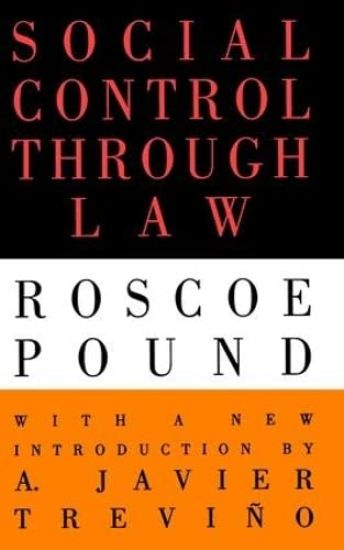
Social Control Through Law

Social Control Through Law

Roscoe Pound

Routledge
2017
sidottu
Social Control Through Law is remarkable in manner and style. Roscoe Pound shows himself to be a jurist, philosopher, and scientist. For Pound, the subject matter of law involves examining manifestations of human nature which require social control to assert or realize individual expectations. Pound formulates a list of social-ethical principles, with a three-fold purpose. First, they are meant to identify and explain human claims, demands, or interests of a given social order. Second, they express what the majority of individuals in a given society want the law to do. Third, they are meant to guide the courts in applying the law. Pound distinguishes between individual interests, public interests, and social interests. He warns that these three types of interests are overlapping and interdependent and that most claims, demands, and desires can be placed in all three categories. Pound's theory of social interests is crucial to his thinking about law and lies at the conceptual core of sociological jurisprudence. Pound explains that rights unlike interests, are plagued with a multiplicity of meanings. He rejects the idea of rights as being natural or inalienable, and argues that to the contrary, interests are natural. The contemporary significance of the book is aptly demonstrated by the skyrocketing rate of litigation in our postmodern society. As the influence of familial and religious institutions declines, the courts exert an unprecedented degree of control over the public and private lives of most Americans. Law is now the paramount agency of social control. In the new introduction, A. Javier Treviño outlines the principal aspects of Roscoe Pound's legal philosophy as it is conveyed in several of his books, articles, and addresses, and shows their relationship to Social Control Through Law. This book is an insightful, concise summary of Pound's ideas that, after more than half a century, remains surprisingly fresh and relevant. It will doubtlessly continue to engage jurists, legal theorists, and sociologists for many years to come.