
Kirjailija
Rudolf Steiner
Kirjat ja teokset yhdessä paikassa: 1 477 kirjaa, julkaisuja vuosilta 1910–2026, suosituimpiin kuuluu The Cosmic New Year: A Course of Lectures by Rudolf Steiner. Vertaile teosten hintoja ja tarkista saatavuus suomalaisista kirjakaupoista.
1 477 kirjaa
Kirjojen julkaisuvuodet: 1910–2026.
The Doorway of Initiation – The Trial of the Soul – The Guardian of the Threshold – The Souls Awaken Rudolf Steiner’s four modern mystery dramas are powerful portrayals of the complex laws of reincarnation and karma, transporting us to landscapes of soul and spirit where supra-sensory beings are visible, active and influential. Through perception of these hidden worlds, we are given tools to comprehend the background to the struggles we face in everyday life – both in human relationships and in our attempts to practise spiritual development. Written between the years 1910 and 1913, during periods of intense inner and outer work, the dramas are powerful testimonies to Steiner’s artistic creativity. By manifesting soul and spirit forms on stage, they foreshadow a dramatic art of the future. Rudolf Steiner planned for all four mystery dramas to be performed in August 1923, but this was no longer possible because of the burning of the first Goetheanum on New Year’s Eve, 1922. They were eventually performed together for the first time in 1930 and since then have been staged regularly, in many languages, throughout the world. This fresh rendering into English by Richard Ramsbotham also features an extensive introduction by him.


Die Pforte der Einweihung & Die Prüfung der Seele: Zwei Mysteriendramen von Rudolf Steiner
Rudolf Steiner
e-artnow
2023
nidottu

Die Kernpunkte der sozialen Frage in den Lebensnotwendigkeiten der Gegenwart und Zukunft
Rudolf Steiner
e-artnow
2023
nidottu
Barely four months after the end of the First World War, with Europe in chaos and exhausted from years of conflict, Rudolf Steiner offered these lectures of hope and renewal. Despite continuing social troubles around the world, he knew that human beings had an opportunity to organize society in a new way. Steiner responded to this prospect by giving suggestions for creating innovative social structures that are in harmony with people’s inner needs. Humanity as a whole is now facing a great challenge in that it is ‘crossing the threshold’ to the spiritual world, says Steiner. This means that an evolutionary separation is taking place within the human soul between thinking, feeling and will. For this to happen in a healthy way, the outer make-up of society should mirror and support our internal evolution. Steiner points to the urgent need for ‘threefolding’ – a separation between the workings of culture, economics and politics. This is a subconscious demand, he asserts – not for thinking up cranky ideas within a sect, but for shedding light on what is needed universally! These important lectures cover numerous themes, including the overcoming of class distinctions, the administration of money, technology and capitalism, the antisocial tendency of nationalism, and the future management of international relations.
‘As soon as you start thinking about the living sphere, you have to make the thought itself mobile. The thought must begin to gain inner mobility through your own power.’ – Rudolf Steiner Rudolf Steiner divides these absorbing, previously-untranslated lectures into three sections, opening with ‘The Value of Thinking’. Here, he discusses the quality of thinking itself, contrasting ‘dead physical cognition’, ‘living imaginative cognition’, ‘inspired cognition’, and the latter’s connection with previous periods of human and planetary development. He clarifies how ‘visionary clairvoyance’ can relate to individual intelligence, and also speaks of the submergence of ideas – the effects of sad or joyful experiences and feelings – into the unconscious. These can be ‘life-promoting’ or ‘life-inhibiting’. In the second section he speaks about ‘The Relationship between Spiritual Science and Natural Science’, using a contemporary publication as a case study for how texts can be fruitfully analysed. He characterizes the spiritual-scientific method as allowing facts or personalities to speak for themselves, rather than making personal judgements. Finally, he deliberates on ‘Episodic Observations about Space, Time, Movement’ – kinetic formula and concepts such as the speed of light – introducing, directly from his spiritual observations, notions such as ‘light ether’. The lectures are supplemented with an introduction, comprehensive notes, line drawings and an index.
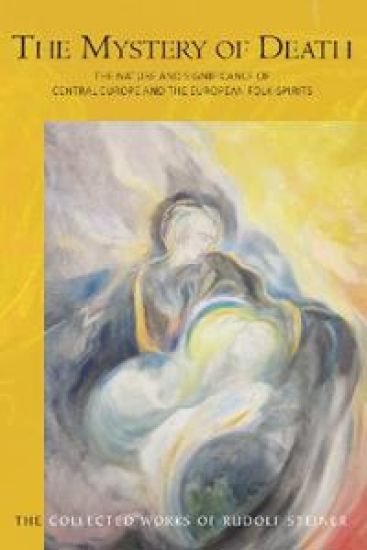
Speaking during the early stages of the First World War – with the Western Front just miles away and thousands of young men dying – Rudolf Steiner focuses on the subject of death. In particular, he addresses the difficult question of why some people die prematurely, particularly in youth. Steiner also speaks of the deaths of three of his acquaintances, having made contact with their living souls in the afterlife. He voices their own words and describes the first stages of their journeys after death. Rudolf Steiner strikes a second chord with the description of the task of Central Europe in the context of the various ‘Folk-souls’. The influences of these spiritual entities are reflected in the culture and life of various peoples, but do not promote nationalism. In fact, nationalism can only be transcended when we understand and recognize our differences. This approach is based on phenomenology rather than value-judgements. The third main theme running through these lectures relates to understanding the impulses and connections active in history. Reaching beyond simple notions of ‘fate’, are we able to allow for the workings of the impulse of Christ? These extraordinary lectures, previously unpublished in English, are presented here with an introduction, notes and an index.
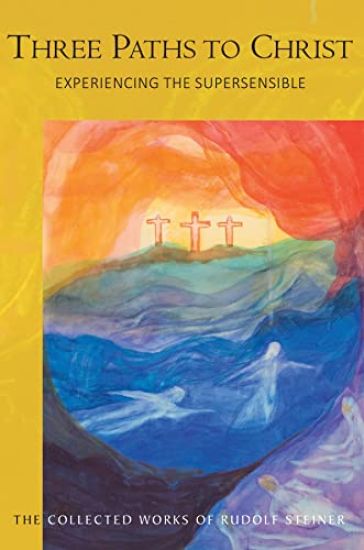
Replete with fresh immediacy, rich spiritual content, innovation and occasional humour, these talks were given at a time when Rudolf Steiner was preparing for independence from the Theosophical Society. Alongside the much-loved lectures ‘Nervousness and Ego Development’ – in which Steiner shares practical exercises for coping with contemporary life’s challenges – and ‘Love and Its Significance in the World’, the collection finds a focal point in descriptions of the ‘Three Soul Paths to Christ’. The first of these is via the Gospels, the second through ‘Inner Experience’ and the third ‘Initiation’, which Steiner characterizes as a path transcending religion. He further elaborates these themes in a lecture entitled, ‘Mysteries of the Kingdoms of Heaven in Parables and in Real Form’. Elijah, John the Baptist, Raphael and Novalis form a golden thread throughout, appearing as a fourfold herald of a true Christianity of the future. A moving yet astringent tribute to the founder of Theosophy, H. P. Blavatsky, on the tenth anniversary of her death, adds the Christian verities not embraced by Blavatsky during her lifetime, and two stirring talks that set the mood for Christmastide – via St Matthew, Eudocia and St Luke – round off the volume with paeans to Novalis. The lectures are complemented with an introduction by Margaret Jonas, detailed notes and an index.
Vuodenkulun myötäeläminen neljässä kosmisessa imaginaatiossa
Rudolf Steiner
SUOMEN ANTROPOSOFINEN LIITTO
2023
sidottu
Vuodenaikaimaginaatiot, Rudolf Steinerin lokakuussa 1923 jäsenille pitämät esitelmät, ovat nyt saatavissa suomeksi kirjana. Esitelmissä valottuvat Maan ja sen ihmisten elämän yhteydet kosmoksen elämään vuodenkulun aikana sekä myös se, miten nämä yhteydet ovat aikojen kuluessa muuttuneet. Esitelmät lähtevät ulkoisista havainnoista ja syventävät niitä tutkien ihmisen suhdetta niin Maahan elävänä olentona kuin kosmoksen reaalisiin vaikutuksiin Maan ja ihmisen yhteiselämään. Nämä imaginaatiot voidaan siirtää myös henkisestä noudetuksi tulevaisuuden taiteeksi. Rudolf Steiner kuvaa vuodenkiertoa valtavana kosmisena hengitystapahtumana, joka vastaa ihmisen hengitystä: sisäänhengitys vastaa syksyä ja talvea, uloshengitys taas kevättä ja kesää. Teoksessa kuvataan yksittäisten aisti-ilmiöiden ja moninaisten prosessien — kuihtumisen, itämisen, versomisen, kukkimisen ja kypsymisen — taustalla vaikuttavien henkisten olentojen, neljän arkkienkelin, Mikaelin, Gabrielin, Rafaelin ja Urielin toimintaa. He säteilevät kosmokseen ja antavat virikkeitä vuodenkierron täyteydelle Maan päällä. Ihminen elää ruumiillisesti ja sielullis-henkisesti noissa prosesseissa, jotka vaikuttavat ihmisessä myös aina ravitsemukseen ja ajatustoimintaan saakka.
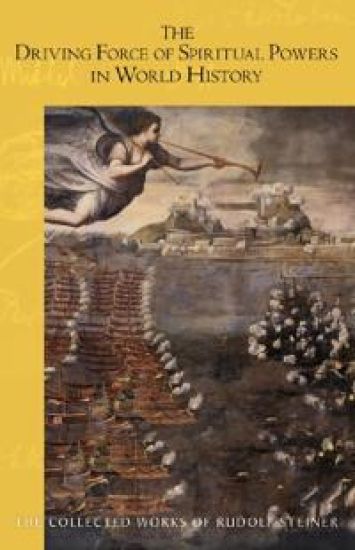
The Driving Force of Spiritual Powers in World History
Rudolf Steiner
STEINERBOOKS, INC
2023
pokkari
Halvin toimitettuna 28,70 €
7 lectures in Dornach, Switzerland, March 11-23, 1923 (CW 222)"Historical happenings on Earth can be understood in their reality only when we see them as reflections of what is being enacted in the supersensible, spiritual world between the beings of the higher hierarchies." -- Rudolf Steiner (March 17, 1923)What is the qualitative difference between the utterance of true and untrue words? Is there one? How about between living and dead thoughts? What is the origin of war and strife among peoples on Earth? How can humanity find a right relationship to the beings of the spiritual world? These are among the compelling questions addressed by Rudolf Steiner in this concise yet powerful series of lectures given in March 1923, comprising this volume of "The Collected Works of Rudolf Steiner." In these lectures, Steiner portrays, among other things, the work of various hierarchical beings--both in collaboration and sometimes in opposition to one another--whose activity and strife in the spiritual world is mirrored in the migrations of and wars among peoples on Earth. The clashes between East and West, for example, are thus seen in an entirely new light, heralding a sea change in the approach to history. No longer should events on Earth be viewed as isolated within themselves, but rather as interwoven in a grand, vibrant tapestry formed from the threads that connect humanity on Earth with the activity and aims of exalted spiritual beings. Humanity has profound potential--for both good and evil. The question is whether we will be able to rise to a renewed form of cognition through which we can once again grasp living spiritual reality, or we will persist in the dead, intellectualized thinking so common today, thinking that (as Steiner points out in the final lecture of this volume), if not transformed, will lead to the gradual destruction of Earth itself. These lectures are a tour de force that should not be neglected by any serious student of history or the future of humanity and human life more broadly. Includes 10 color platesThis volume is a translation from German of Die Impulsierung des weltgeschichtlichen Geschehens durch geistige M chte, Rudolf Steiner Verlag, 1989 (GA 222). Cover Image: Naval Battle of Le Panto (1571), by Luca Cambiasi (1521-1585); at the Royal Monastery of San Lorenzo de El Escorial, Spain.

Die Rätsel der Philosophie in ihrer Geschichte als Umriss dargestellt
Rudolf Steiner
Steiner Verlag, Dornach
2023
sidottu

Die geistige Führung des Menschen und der Menschheit
Rudolf Steiner
Steiner Verlag, Dornach
2023
sidottu
The Liberation of the Human Being as the Basis for Social Reorganisation
Rudolf Steiner
Anthroposophical Publications
2023
pokkari
These lectures, held in Switzerland, were addressed to a mostly middle-class audience that had been spared from the First World War. Thus Rudolf Steiner presented the threefoldness here quite differently than in Germany and showed new perspectives of this topic. Nine public lectures, held between March 11th and November 10th 1919 in Basel, Bern and Winterthur.

Das esoterische Christentum und die geistige Führung der Menschheit
Rudolf Steiner
Steiner Verlag, Dornach
2023
sidottu
Knowledge of the Higher Worlds and Its Attainment
Rudolf Steiner
SANAGE PUBLISHING HOUSE LLP
2023
nidottu
Halvin toimitettuna 27,80 €

Knowledge of the Higher Worlds and Its Attainment
Rudolf Steiner
SANAGE PUBLISHING HOUSE LLP
2023
sidottu
"Meissä on tavallaan näkymätön ihminen, joka sisältyy kasvuvoimiimme sekä myös niihin kätkettyihin voimiin, jotka toteutuvat ravitsemuksessa. Näkymätön ihminen sisältyy kaikkeen mihin ihmisen tietoinen toiminta ei oikeastaan ulotu. Tämä vaikutus ulottuu kuitenkin myös tiedostamattomaan toimintaan aina kasvamisesta päivittäiseen ravinnon aikaansaamaan voimien palautumiseen saakka." Rudolf Steinerin elämäntoiminnassa ensimmäisen maailmansodan jälkeiset vuodet sisälsivät lukuisia esitelmiä, joita lääkärit ja terapeutit pyysivät häneltä ymmärtääkseen paremmin ihmisessä vaikuttavia sairastumiseen ja parantumiseen johtavia voimia. Näkymätön ihminen meissä; Patologian ymmärtäminen terapian lähtökohtana - esitelmästä on tullut kulmakivi, joka laajentaa antroposofista ihmiskuvaa niille, jotka ovat jo tutustuneet peruskäsitteisiin. Toisaalta nyt 100 vuotta esitelmän pitämisen jälkeen myös antroposofiaan uutena asiana tutustuva lukija voi löytää välittömän vastauksen omille pohdinnoilleen.
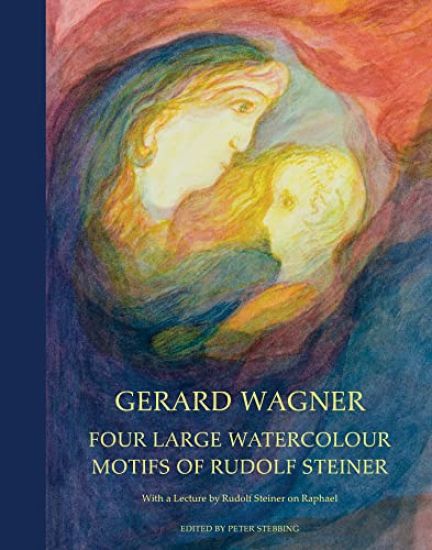
Four Large Watercolour Motifs of Rudolf Steiner
Rudolf Steiner; Virginia Sease
STEINERBOOKS, INC
2023
sidottu
"The art of the future will be an art of inner maturity. What leads to artistic activity will be sensed only at a relatively advanced age in life. It will no longer be assumed that one cannot have the necessary youth forces for artistic creation in later years--as is still often asserted today. It will be found that only by way of inner deepening augmented by spiritual scientific insight are the forces released that lead to artistic creation." --Rudolf Steiner, Dornach, February 7, 1915The painter Henni Geck convinced Rudolf Steiner to paint five watercolors featured in this book: - The Moon Rider (The Dream Song of Olaf steson), January 1924- New Life (Mother and Child), February 1924- Easter (Three Crosses), April 1924- The Archetypal Plant, May 1924- Archetypal Human Being (or Archetypal Animal) July/August 1924The paintings reproduced in this book--also including a small selection from the work of the painter Gerard Wagner--are images that arise from direct color experience and "imagination" as Rudolf Steiner's describes this inner capacity. The purpose of this volume is to focus on the unique possibilities that can open up for the future of art in the world and become a means and path for spiritual-scientific inquiry." We are at a point in the fifth post-Atlantean age when current views must be directed to spiritual forms in art." --Rudolf Steiner, Dornach, August 31, 1918