

Kirjailija
Rudolf Steiner
Kirjat ja teokset yhdessä paikassa: 1 477 kirjaa, julkaisuja vuosilta 1910–2026, suosituimpiin kuuluu The Cosmic New Year: A Course of Lectures by Rudolf Steiner. Vertaile teosten hintoja ja tarkista saatavuus suomalaisista kirjakaupoista.
1 477 kirjaa
Kirjojen julkaisuvuodet: 1910–2026.

Den mest omfattende beskrivelse av den antroposofiske skolerings- og utviklingsvei fra Rudolf Steiners hånd.

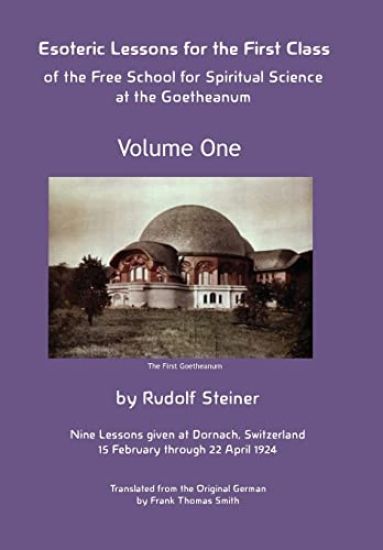
Esoteric Lessons for the First Class of the Free School for Spiritual Science at the Goetheanum
Rudolf Steiner
Anthroposophical Publications
2021
sidottu
During the re-founding of the Anthroposophical Society at Christmas1923, Rudolf Steiner also reconstituted the "Esoteric School" which had originally functioned in Germany from 1904 until 1914, when the outset of the First World War made it's continuance impossible. However, the original school was only for a relatively few selected individuals, whereas the new school was incorporated into the Free School for Spiritual Science at the Goetheanum in Dornach, Switzerland. Rudolf Steiner was only able to give nineteen lessons - plus seven "recapitulation" lessons - for the First Class before his illness and death. His intention had been to develop three classes. The lessons were recorded by a stenographer, then typed in clear text without having been reviewed by Rudolf Steiner. They had not been publicly accessible until recently.

Weihnachtspiele aus altem Volkstum. Die Oberuferer Spiele
Rudolf Steiner
Steiner Verlag, Dornach
2021
nidottu

Das Prinzip der spirituellen Ökonomie im Zusammenhang mit Wiederverkörperungsfragen
Rudolf Steiner
Steiner Verlag, Dornach
2021
sidottu


This book is a call to examine the very nature of technology and to develop practices for meeting its many challenges. Illuminating, compelling, challenging, at times staggering in its breadth, A Road to Sacred Creation is above all the definitive text for gaining a hold on Rudolf Steiner's nuanced perspectives on technology. Charting both an inner and outer course--part pilgrimage toward greater perception and knowledge, part dramatic, unfolding plot line of the future of humans and machines, the metaphoric "road" of the title is exactly where humanity finds itself today, though the exact route and destination are still to be determined. The map is not yet drawn, but here is a beginning. Taken together, the relevant concepts, ideas, and insights of Rudolf Steiner, deftly brought into sequence and dialogue as Gary Lamb has done in this book, reveal how the work to arrive at a more spiritually imbued technological future not only involves all domains and fields of spiritual science and anthroposophical work, but has its origins in the very core of our being, fundamentally entwined with our moral progress toward freedom and selfless love. C O N T E N T S Preface: How I Came to Edit this Compendium Editor's Note: Intention Introduction 1: The Evolution of Science: From Natural Science to Spiritual Science by Way of Goethe2: Atoms and Atomic Theories3: Electricity and the Challenge of Evil4: Early Twentieth-Century Technology5: Keely, Strader, and the Development of Etheric Technology6: Transcending Private Capitalism and Socialism: The Necessity for a Threefold Social Organism7: Child Development: Waldorf Education and Cultural Freedom in Relation to Technology8: Ahriman's Pervasive Influence in the Age of Modern Technology: How to Meet Its Challenge9: Thinking as a Spiritual Activity Appendix A: Earth Evolution IllustrationsAppendix B: Publishers Referenced in this Volume Bibliography

Voraussetzung für die Ernährung des Menschen sind die Substanzen, die der Mensch dem Lebensbereich der Erde entnimmt und zubereitet. Wie die Substanzen der Erde für die Nahrung des Menschen verwandelt werden, und welche Prozesse bei der Nahrungsverarbeitung stattfinden, schildert Rudolf Steiner in neun ausgewählten Vorträgen.

TABLE OF CONTENTSTRANSLATOR'S NOTEBeing deeply interested in Dr. Steiner's work and teachings, and desirous of sharing with my English-speaking friends the many invaluable glimpses of Truth which are to be found therein, I decided upon the translation of the present volume. It is due to the kind co-operation of several friends who prefer to be anonymous that this task has been accomplished, and I wish to express my hearty thanks for the literary assistance rendered by them-also to thank Dr. Peipers of Munich for permission to reproduce his excellent photograph of the author. The special value of this volume consists, I think, in the fact that no advice is given and no statement made which is not based on the personal experience of the author, who is, in the truest sense, both a mystic and an occultist. If the present volume should meet with a reception justifying a further venture, we propose translating and issuing during the coming year a further series of articles by Dr. Steiner in continuation of the same subject, and a third volume will consist of the articles now appearing in the pages of The Theosophist, entitled "The Education of Children."- MAX GYSI.

The Education Of Children From The Standpoint Of Theosophy
Rudolf Steiner
Alpha Edition
2021
pokkari
An Outline of Occult Science (4th Edition). By Rudolf Steiner, Ph. D. Originally Published 1922.---Much complementary and additional matter has been inserted in this edition in the part dealing with "Perception of the Higher Worlds." The endeavour has been made to represent in a graphic way the kind of inner soul-processes by which the power of cognition liberates itself from the limits which confine it in the world of sense and thereby becomes qualified for experiencing the supersensible world. The attempt has been made to show that these experiences, even though gained by entirely inner ways and methods, still do not have a merely subjective significance for the particular individual who gains them. The description attempts to show that within the soul stripped of its individuality and personal peculiarities, an experience takes place which every human being may have in the same way, if he will only work at his development from out his subjective experiences. It is only when "knowledge of supersensible worlds" is thought of as bearing this character that it may be differentiated from old experiences of merely subjective mysticism. Of this mysticism it may be said that it is after all more or less a subjective concern of the mystic. The scientific spiritual training of the soul, however, as it is described here, strives for objective experiences, the truth of which, although recognized in an entirely inner way, may yet, for that very reason, be found to be universally valid.---Rudolf Steiner
Rudolf Steiner shows how deeply and intimately human beings, the microcosm, are related to the macrocosm. But for Steiner the macrocosm is more than just the physical universe. It includes many hidden realms – like the world of Elements and the world of Archetypes – which lie behind outer manifestations such as our physical body. The macrocosm works within us continuously – in the daily alternation between sleeping and waking and in the great cyclical interchange between incarnation on earth and our time between death and rebirth. Steiner discusses the various paths of self-development that lead across the threshold to spiritual dimensions, transforming human soul-forces into organs of higher perception. In future we will even have the capacity to evolve a form of thinking that is higher than the intellect – the thinking of the heart. In this classic series of lectures, now retranslated and featuring a previously-unavailable public address, Rudolf Steiner also discusses: the planets and their connection with our sleeping and waking life; the inner path of the mystic; the ‘greater’ and ‘lesser’ guardians of the threshold; the Egyptian mysteries of Osiris and Isis; initiation in the Northern mysteries; The four spheres of the higher worlds; mirror-images of the macrocosm in man; the strengthening powers of sleep; the symbol of the Rose Cross; reading the Akashic Record; four-dimensional space; the development of future human capacities, and much more. The volume includes an introduction, notes and index.
In this landmark series of lectures, Rudolf Steiner challenges the notion that human consciousness has in essence remained the same throughout history. On the contrary, we can only see the past in its true light when we study the differences in human souls during the various historical eras. Consciousness, he says, evolves constantly and we can only comprehend the present by understanding its origin in the past. Delivered in the evenings during the course of the ‘mystery act’ of the Christmas Foundation Meeting – when Rudolf Steiner not only re-founded the Anthroposophical Society but for the first time took a formal role within it – these lectures study world history in parallel with the ancient mysteries of initiation, showing how they are intimately linked. Steiner describes consciousness in the ancient East and follows the initiation principle from Babylonia to Greece, up to its influences in present-day spiritual life. He also discusses Gilgamesh and Eabani, the mysteries of Ephesus and Hibernia, and the occult relationship between the destruction by fire of the Temple of Artemis and the burning of the first Goetheanum in Dornach, Switzerland. Published for the first time with colour plates of Steiner’s blackboard drawings, the freshly-revised text is complemented with an introduction, notes and appendices by Professor Frederick Amrine and an index.

Notes from 16 lectures, Munich and Oslo, Apr. 22, 1907-May 21, 1909 (CW 104a); 1 lecture in Paris, June 14, 1906 (CW 94) "In the New Testament it says that the second coming of Christ will occur in the realm of the clouds. What Steiner's lectures make clear is that some of these clouds will be very dark, bringing thunder and lightning." -- James H. Hindes We can be overwhelmed by the fearsome pictures of our current world situation, which reflect powerful spiritual events taking place today. This book is based on notes written down at 16 lectures given in 1907 and 1909, presenting Rudolf Steiner's masterful account of the meaning of the most esoteric book in the Bible. They instruct a practice and inner training in reading the signs of the times, so that we can prepare responsibly and in full consciousness to meet the challenges that humanity is facing now and in the future. In aphoristic, intense sections, Steiner surveys the sweep of world history on a cosmic scale. His penetrating interpretation of the Apocalypse shows how the human soul will evolve and change through the present and coming great conflagrations. Themes include - the nature of the third millennium; - Sorat and the significance of the number 666; - the War of All against All; - the Second Coming of Christ; - the true nature of the "I"; - how future possiblities will depend on our present actions. "The Apocalypse of Saint John, when properly understood, expands our conception of Christianity to cosmic proportions again. It reveals in images―in a kind of picture language―the deepest secrets of earthly and human evolution. These images contain the power of the Word, the Logos. Taken into the soul, they transform; over time, they can initiate. This is the connection between the Apocalypse and the work of Rudolf Steiner, who said that simply hearing and reading the results of anthroposophical research can gradually transform the human soul and awaken in us the ability to perceive the spirit." (from the introduction) This volume is a translation from German of Aus der Bilderschrift der Apokalypse des Johannes (GA 104a); the added lecture in Paris is from Kosmogonie. Popul re Okkultismus. Das Johannes-Evangelium. Die Theosophie an Hand des Johannes-Evangelium (GA 94).
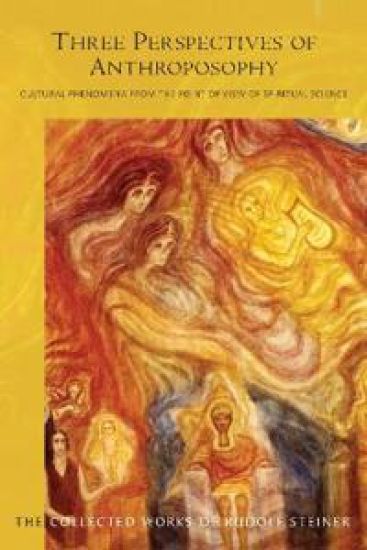
What is truly real? Rudolf Steiner sheds light on everyday reality through spiritual knowledge, repeatedly urging us to bring anthroposophy into daily human existence. We might consciously experience the difference between consuming a potato as compared to cereals such as rye, for example - or we could grasp ordinary phenomena, such as sleepwalking, through an understanding of the threefold human being. Likewise, we might strive to comprehend how our head is the transformed organism of our previous life. Throughout, Steiner emphasizes that we can achieve spirituality on earth if only we make anthroposophy real. The twelve lectures here were delivered during the portentous year of 1923, in the context of increasing attacks from Steiner's opponents. His architectural masterpiece, the first Goetheanum, had already been destroyed by fire, but he was yet to refound the Anthroposophical Society at the Christmas Conference. In these uncertain times, Steiner speaks of the decline of European culture and the development of materialism as a philosophy, leaving anthroposophy with no exoteric foundation on which to build. But Rudolf Steiner strikes a positive note with an exciting and constructive way forward, providing us with the tools to see the world through three key perspectives of anthroposophy: the physical, the soul and the spiritual dimensions of reality. This previously-unpublished volume is translated by Elizabeth Marshall and includes an introduction, notes and index.