Kirjojen hintavertailu – 12 903 725 kirjaa ja 27 kauppaa

Kirjailija

Rudolf Steiner

Kirjat ja teokset yhdessä paikassa: 1 477 kirjaa, julkaisuja vuosilta 1910–2026, suosituimpiin kuuluu The Cosmic New Year: A Course of Lectures by Rudolf Steiner. Vertaile teosten hintoja ja tarkista saatavuus suomalaisista kirjakaupoista.

1 477 kirjaa

Kirjojen julkaisuvuodet: 1910–2026.

Frihedens filosofi KKK

Frihedens filosofi KKK

Rudolf Steiner

Forlaget Klim
2011
nidottu
Rudolf Steiner udgav FRIHEDENS FILOSOFI første gang i 1894. Værket, som indtager en central plads i Steiners forfatterskab, har siden opnået status som et væsentligt etisk værk. Den gamle pligtetik har mistet sin overbevisende kraft, de utilitaristiske teorier har vist sig utilstrækkelige, og om det meste af det, der forstås som postmodernisme, må det siges, at det savner en videnskabelig acceptabel karakter. Rudolf Steiner vil vise, at den etiske tænkning må have en erkendelsesteori som forudsætning. Han giver en idealistisk-empirisk erkendelsesteori som begrundelse for sin etiske individualisme i værkets første halvdel. I den anden halvdel af værket viser han, hvorledes frihed kan forstås som grundlaget for en almenmenneskelig etik, som ikke vil kræve overensstemmelse mellem menneskene som etisk fordring, men som vil vise frem til, hvordan overensstemmelse og samdrægtighed kan opstå. Bogen er forsynet med et efterskrift af Oskar Borgman Hansen, som også har oversat.
Our Dead

Our Dead

Rudolf Steiner

SteinerBooks, Inc
2011
nidottu
This book collects Rudolf Steiner's memorial, funeral, and cremation addresses, as well as a sampling of prayers and meditations for the dead. The context, intimate and sober with grief, means that his intent is quite other than if he had been speaking in a lecture hall. His primary concerns--while based on spiritual-scientific research and, in some cases, the actual living expression of it in real time--are ethical and existential and, at the same time, ceremonial and communal. He stands as speaker before and for the living--relations, friends, and community members--and for the one who has died, even, in a way, for the greater "cloud" of all the dead. With his feet planted firmly on the Earth, Steiner moves seamlessly between the sensory-physical, embodied world and the invisible, suprasensory, discarnate one. Speaking in an intimate, personal manner to both worlds, he unites the living and the dead with words that are both practical and healing.
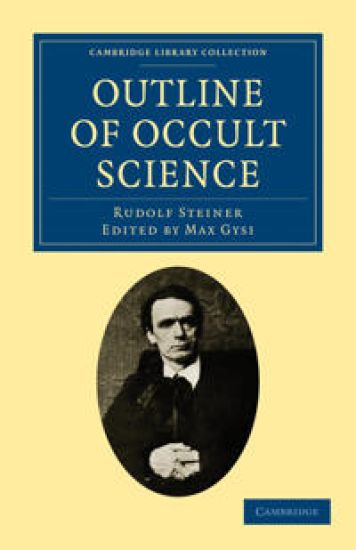
Outline of Occult Science

Outline of Occult Science

Rudolf Steiner

Cambridge University Press
2011
pokkari
Austrian philosopher, playwright, and artist Rudolf Steiner (1861–1925) is perhaps best known as an educational philosopher and reformer, the founder of Steiner (or Waldorf) schools located around the world. Steiner was an active member and leader of the German branch of Madame Blavatsky's Theosophical Society before forming his own Anthroposophical Society. His engagement with the occult stems from his work in theosophy and anthroposophy, philosophies invested in reaching and understanding the 'supersensible' world that relies on a cultivation of body, spirit, and soul. This anonymous translation of the fourth German edition was published by the Theosophical Publishing Society in 1914; the first edition was published in Germany in 1909. Steiner asserts in this work the necessary and intrinsic connection between what is possible through cognition with the power of the soul and the spirit. It will be of interest to scholars of spiritual philosophy, spiritual movements, and social psychology.
Occult Science

Occult Science

Rudolf Steiner

Rudolf Steiner Press
2011
sidottu
LIMITED EDITION HARDBACKS TO COMMEMORATE THE 150TH ANNIVERSARY OF RUDOLF STEINER'S BIRTH Rudolf Steiner Press is proud to publish a new series of re-edited, re-typeset and re-designed editions of the classic, authorised translations of Rudolf Steiner's four fundamental works. Each volume of this series is printed in a limited edition of 1,000 copies and sewn-bound in high-quality cloth, finished with coloured end-papers and a marker ribbon. Given his energetic involvement in practical initiatives and extensive lecturing, Rudolf Steiner had little time to write books. Of those he did write - belonging almost entirely to the earlier years of his work - four titles form an indispensable introduction to his later teaching: Knowledge of the Higher Worlds, Theosophy, The Philosophy of Freedom and Occult Science. The anthroposophy of Rudolf Steiner is not a theoretical system, but the results of research based on direct observation. As Steiner's research was so vast and conducted over such a long period of time, no single book can be said to contain the whole of his spiritual teaching. However, of all his books Occult Science comes closest. Steiner even referred to it as 'an epitome of anthroposophical spiritual science'. The book sets out, in systematic order, the fundamental facts concerning the nature and constitution of the human being and, in chronological order, the history of the universe and man. Whereas the findings of natural science are derived from observations made through the senses, the findings of spiritual science, or anthroposophy, are 'occult' inasmuch as they derive from direct observation of realities which are hidden to everyday perception. And yet these elements of humanity and the universe form the foundation of the sense world. A substantial part of Occult Science is taken up with a description of the preliminary training which is necessary to make such spiritual observations. Although Occult Science is not all-inclusive, it is indispensable to serious students who seek to master Rudolf Steiner's extraordinary philosophy.
The Philosophy of Freedom

The Philosophy of Freedom

Rudolf Steiner

Rudolf Steiner Press
2011
sidottu

Halvin toimitettuna 33,80 €

LIMITED EDITION HARDBACKS TO COMMEMORATE THE 150TH ANNIVERSARY OF RUDOLF STEINER'S BIRTH Rudolf Steiner Press is proud to publish a new series of re-edited, re-typeset and re-designed editions of the classic, authorised translations of Rudolf Steiner's four fundamental works. Each volume of this series is printed in a limited edition of 1,000 copies and sewn-bound in high-quality cloth, finished with coloured end-papers and a marker ribbon. Given his energetic involvement in practical initiatives and extensive lecturing, Rudolf Steiner had little time to write books. Of those he did write - belonging almost entirely to the earlier years of his work - four titles form an indispensable introduction to his later teaching: Knowledge of the Higher Worlds, Occult Science, The Philosophy of Freedom and Theosophy. Are we free, whether we know it or not? Or is our sense of freedom merely an illusion? Rudolf Steiner tackles this age-old problem in a new way. He shows that by taking account of our own activity of thinking, we can know the reasons for our actions. And if these reasons are taken from our world of ideals, then our actions are free, because we alone determine them. But this freedom cannot be settled for us by philosophical argument. It is not simply granted to us. If we want to become free, we have to strive through inner activity to overcome our unconscious urges and habits of thought. In order to do this we must reach a point of view that recognises no limits to knowledge, sees through all illusions, and opens the door to an experience of the reality of the spiritual world. Then we can achieve the highest level of evolution, and recognise ourselves as free spirits.
Knowledge of the Higher Worlds

Knowledge of the Higher Worlds

Rudolf Steiner

Rudolf Steiner Press
2011
sidottu
LIMITED EDITION HARDBACKS TO COMMEMORATE THE 150TH ANNIVERSARY OF RUDOLF STEINER'S BIRTH Rudolf Steiner Press is proud to publish a new series of re-edited, re-typeset and re-designed editions of the classic, authorised translations of Rudolf Steiner's four fundamental works. Each volume of this series is printed in a limited edition of 1,000 copies and sewn-bound in high-quality cloth, finished with coloured end-papers and a marker ribbon. Given his energetic involvement in practical initiatives and extensive lecturing, Rudolf Steiner had little time to write books. Of those he did write - belonging almost entirely to the earlier years of his work - four titles form an indispensable introduction to his later teaching: Knowledge of the Higher Worlds, Occult Science, The Philosophy of Freedom and Theosophy. Rudolf Steiner's fundamental handbook for spiritual and personal development has grown more modern as time has passed, although his methods remain clearly distinguishable from the many others now in circulation. For one thing, Steiner's path of spiritual growth is based on the clarity of thought normally associated with scientific research. Rather than denying clear thinking, his aim is to extend it beyond its present limitations. Secondly, Steiner recognizes - as in all genuine disciplines - that the path to spiritual experience is an arduous and dangerous one, calling for self-control in thought, word and deed. Human beings comprise a unity, and we cannot develop knowledge without a corresponding development in feeling and will. Rudolf Steiner foretold that humanity would begin to experience a longing for forms of experience that transcend intellectual, materialistic thinking. More than 100 years after the first publication of this book in 1904, there are countless means to achieve such experience, such as eastern meditation, channelling, remote viewing and astral projection. In addition, there has been a huge growth in people reporting extrasensory perceptions of various kinds, such as near-death experiences and meetings with angels. In this context, Steiner's key spiritual workbook - reproduced here in the classic Osmond/Davy translation - is needed more than ever, given its unique, precise instructions for inner training, its protective exercises, and its indications for grounding and centring. Knowledge of the Higher Worlds begins with the conditions required for personal development, and guides us through the stages of initiation, its practical aspects and its effects.

The Influence of Spiritual Beings Upon Man

The Influence of Spiritual Beings Upon Man

Rudolf Steiner

Literary Licensing, LLC
2011
sidottu
The Influence of Spiritual Beings Upon Man is a philosophical and spiritual book written by Rudolf Steiner. The book explores Steiner's belief that spiritual beings play a significant role in shaping human experiences and consciousness. Steiner argues that these beings, which he refers to as angels, archangels, and other spiritual entities, are actively involved in the development of human consciousness and have a profound impact on human life. Steiner delves into the relationship between these spiritual beings and the physical world, outlining how they interact with and influence humans. He explores the idea that spiritual beings are responsible for the creation of the physical world and that they continue to play a role in its ongoing development. The book also discusses the role of human beings in this relationship, with Steiner arguing that humans have the ability to connect with these spiritual beings and work with them to shape their own consciousness and experiences. He outlines various spiritual practices and exercises that can be used to develop this connection and enhance one's spiritual development. Overall, The Influence of Spiritual Beings Upon Man is a thought-provoking and insightful exploration of the relationship between spiritual beings and human consciousness. It offers a unique perspective on spirituality and provides practical guidance for those seeking to deepen their connection with the spiritual world. Eleven Lectures Delivered In Berlin Between January 6 And June 11, 1908. This scarce antiquarian book is a facsimile reprint of the old original and may contain some imperfections such as library marks and notations. Because we believe this work is culturally important, we have made it available as part of our commitment for protecting, preserving, and promoting the world's literature in affordable, high quality, modern editions, that are true to their original work.
Supersensible Physiology and Balance in Teaching: Two Lectures, Stuttgart, September 21-22, 1920
Supersensible Physiology And Balance In Teaching: Two Lectures, Stuttgart, September 21-22, 1920 is a book written by Rudolf Steiner. The book comprises two lectures that were delivered in Stuttgart in September 1920. The lectures focus on the concept of supersensible physiology, which is the study of the spiritual aspects of the human body. Steiner explores the idea that the human body is not just a physical entity, but also has a spiritual dimension that can be studied and understood through supersensible physiology. The book also discusses the importance of balance in teaching, both in terms of the balance between the physical and spiritual aspects of the body, and in terms of the balance between different teaching methods and approaches. Steiner argues that a balanced approach to teaching is essential for the healthy development of the child, and that teachers need to be aware of the spiritual dimensions of their students in order to provide effective education. Overall, Supersensible Physiology And Balance In Teaching is a thought-provoking book that explores the spiritual dimensions of the human body and provides valuable insights into the role of balance in teaching. Published From A Stenographic Report Not Edited By The Lecturer. This scarce antiquarian book is a facsimile reprint of the old original and may contain some imperfections such as library marks and notations. Because we believe this work is culturally important, we have made it available as part of our commitment for protecting, preserving, and promoting the world's literature in affordable, high quality, modern editions, that are true to their original work.
The Mission of the Archangel Michael

The Mission of the Archangel Michael

Rudolf Steiner

Literary Licensing, LLC
2011
sidottu
The Mission of the Archangel Michael is a spiritual book written by Rudolf Steiner. The book explores the role of the Archangel Michael in human history and the spiritual evolution of humanity. Steiner presents Michael as a powerful spiritual being who is responsible for guiding and protecting humanity through its evolution. The book delves into the various manifestations of Michael throughout history, including his appearances in the Bible, in ancient mythology, and in modern times. Steiner also discusses the significance of Michael's mission in relation to the challenges facing humanity today, including the rise of materialism and the decline of spirituality. The book is a fascinating exploration of spiritual themes and offers insights into the nature of the human spirit and its relationship to the divine. It is a must-read for anyone interested in spirituality, mythology, and the evolution of human consciousness. This scarce antiquarian book is a facsimile reprint of the old original and may contain some imperfections such as library marks and notations. Because we believe this work is culturally important, we have made it available as part of our commitment for protecting, preserving, and promoting the world's literature in affordable, high quality, modern editions, that are true to their original work.
Development of Thought from the Fourth to the Nineteenth Centuries: Lecture, Dornach, May 15, 1921
""Development of Thought from the Fourth to the Nineteenth Centuries"" is a lecture delivered by Rudolf Steiner on May 15, 1921 in Dornach. In this lecture, Steiner explores the evolution of human thought from the fourth century to the nineteenth century. He discusses the development of Christianity, the rise of Islam, the Renaissance, the Enlightenment, and the emergence of modern science and technology. Steiner also examines the impact of these historical developments on human consciousness and spiritual evolution. This book provides a fascinating insight into the evolution of human thought and the role of spirituality in shaping our understanding of the world. It is a must-read for anyone interested in philosophy, history, and spirituality. In Anthroposophy, V8, No. 2, Midsummer, 1933. This scarce antiquarian book is a facsimile reprint of the old original and may contain some imperfections such as library marks and notations. Because we believe this work is culturally important, we have made it available as part of our commitment for protecting, preserving, and promoting the world's literature in affordable, high quality, modern editions, that are true to their original work.
Cosmic Forces in Man: Three Lectures Given in Christiania, November 24, 27, and December 4, 1921
Cosmic Forces In Man is a book written by Rudolf Steiner, consisting of three lectures given in Christiania (now Oslo) in November and December of 1921. The lectures explore the concept of cosmic forces and their impact on human beings. Steiner delves into the spiritual nature of the universe and how it interacts with human consciousness, discussing the role of cosmic forces in shaping human destiny and evolution. He also examines the relationship between the physical and spiritual worlds, and how the two are interconnected. Throughout the book, Steiner draws on his extensive knowledge of esoteric philosophy and spiritual science to provide a unique perspective on the nature of existence and the human experience. Cosmic Forces In Man is a thought-provoking and insightful read for anyone interested in spirituality, philosophy, or the mysteries of the universe. This scarce antiquarian book is a facsimile reprint of the old original and may contain some imperfections such as library marks and notations. Because we believe this work is culturally important, we have made it available as part of our commitment for protecting, preserving, and promoting the world's literature in affordable, high quality, modern editions, that are true to their original work.
Some Deeper Secrets of Human Development in the Light of the Gospel of St. Matthew
""Some Deeper Secrets Of Human Development In The Light Of The Gospel Of St. Matthew"" is a book written by Rudolf Steiner, an Austrian philosopher and esotericist. The book explores the spiritual aspects of human development and how they relate to the teachings of the Gospel of St. Matthew. Steiner delves into the concept of karma and reincarnation, and how they shape the human experience. He also discusses the role of Christ in human development and how individuals can cultivate a deeper connection to the divine. Steiner's insights are based on his own spiritual experiences and his extensive knowledge of esoteric traditions. This book is a fascinating exploration of the spiritual dimensions of human existence and provides a unique perspective on the teachings of Christianity. A Course Of Three Lectures Given On November 1, 9, 23, 1909, In Berlin. This scarce antiquarian book is a facsimile reprint of the old original and may contain some imperfections such as library marks and notations. Because we believe this work is culturally important, we have made it available as part of our commitment for protecting, preserving, and promoting the world's literature in affordable, high quality, modern editions, that are true to their original work.