Kirjailija
Rudolf Steiner
Kirjat ja teokset yhdessä paikassa: 1 477 kirjaa, julkaisuja vuosilta 1910–2026, suosituimpiin kuuluu The Cosmic New Year: A Course of Lectures by Rudolf Steiner. Vertaile teosten hintoja ja tarkista saatavuus suomalaisista kirjakaupoista.
1 477 kirjaa
Kirjojen julkaisuvuodet: 1910–2026.
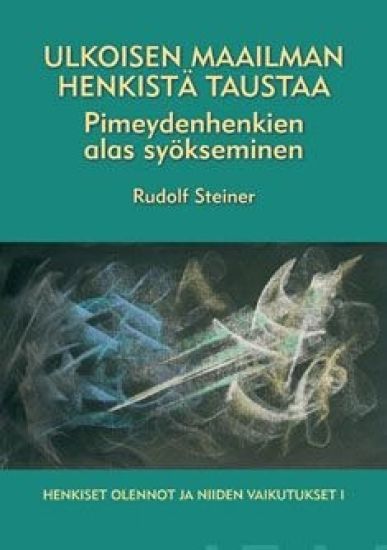
Monipuolisen kulttuurivaikuttajan, kasvattajan, filosofin ja henkisen opettajan Rudolf Steinerin esitelmät dramaattisena syksynä 1917, jolloin Venäjä oli vallankumouksen kourissa ja I maailmansota riehui täydessä käynnissä, ovat aivan erityisen voimakkaita, vakavia ja syvällisiä. Näissä neljässätoista esitelmässä Rudolf Steiner tarkastelee ulkoisen maailman verhon takana juuri silloin vahvana vaikuttavia voimia ja niiden erästä lähtökohtaa, henkisessä maailmassa 1800-luvulla käytyä valon ja pimeyden valtojen taistelua. Tässä tapahtumassa henkisessä maailmassa alkoi valoisa aikakausi ja ns. pimeydenhenget syöstiin vaikuttamaan maan päällä. Tämän vaikutus on nähtävissä ihmiskunnan historiallisessa kehityksessä ja se on otettava huomioon. Steiner puhuu tähän liittyvistä vaaratekijöistä ja siitä, miten on toimittava, jotta ihmiskunnan kehitys kääntyisi nousuun. Ihmisen vastuu elämästä maan päällä on kasvanut ratkaisevasti. Kokonaisuutena neliosaisen sarjan Henkiset olennot ja niiden vaikutukset 47 esitelmää luovat näkymän siihen dynaamiseen vuorovaikutukseen, joka vallitsee Maan maailman ja henkisen maailman välillä. Esitelmien myötä käy ilmi, miten henkistä ja fyysistä maailmaa erottava raja tulee yhä läpäisevämmäksi. Siksi tarvitaan henkistä tietoa, jotta ihminen voi orientoitua moniulotteisessa maailmassa ja elää ihmisarvoista elämää.
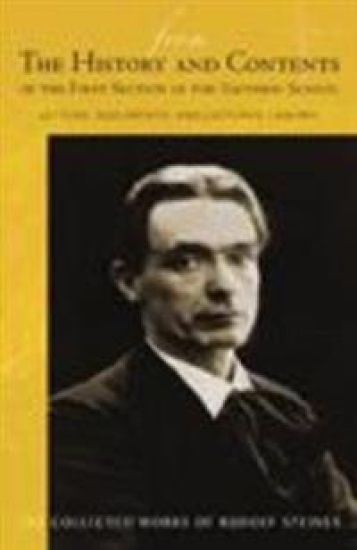
From the History and Contents of the First Section of the Esoteric School 1904-1914
Rudolf Steiner
SteinerBooks, Inc
2010
nidottu
This is an important text for anyone interested in the development of Rudolf Steiner's teaching and for those wishing to explore the advice and admonitions Steiner provided for his early esoteric students. This collection of letters, circulars, and lectures offer a glimpse of the birth of the anthroposophic movement from the German section of the Theosophical Society of the late nineteenth century. One gains a clear picture of why Steiner could no longer work within the theosophic framework, as well as the events that led to the split between the Theosophical Society under the leadership of Annie Besant and the Esoteric School under Steiner's guidance and leadership. Primarily in the form of letters are the specific exercises and advice that Steiner gave to pupils who wished to further their spiritual capacities. Also included are his early lectures and teachings concerning the "Masters" and their relationship to human evolution. From the History and Contents of the First Section of the Esoteric School 1904-1914 includes introductory and concluding remarks by the book's original editor, Hella Wiesberger. German source: Zur Geschichte und aus den Inhalten der ersten Abteilung der Esoterischen Schule, 1904-1914 (GA 264).

Christianity as Mystical Fact and the Mysteries of Antiquity
Rudolf Steiner; Harry Collison
Lulu.com
2010
Nidottu
6 lectures and 2 discussions in Stuttgart, June 12-16, 1921 (CW 342)The lectures and discussions presented in First Steps in Christian Religious Renewal make up the first of the five "Priest Courses." They record the first steps of the remarkable journey taken in 1921 by a small group of dedicated souls who, out of their own inner needs and guided by Rudolf Steiner, sought a path to Christian religious renewal. Addressing the group with warm intimacy, Steiner frames their task not primarily in theological terms, but as a need for a renewing "the religious," or "the working of the religious element as such." For this, the sermon (or how we speak) is central, for today we must use language in new ways. We cannot reopen the spiritual worlds by starting from "old conditions." Traditional religious life has become too corrupted, while modern culture has radically changed and become divorced from tradition. In earlier times, people could understand concepts such as "Christ," "grace," and "salvation," but now we need a new starting point, one that begins with the reality that we cannot teach anything we do not believe and have not experienced. When we speak, images and symbols must be experienced as real; we can no longer hold the split view that accepts both modern science as it is and spiritual reality as it is. Next, Steiner turns to the group's stated concerns: ritual, the sermon, community building, and the relationship between these and individual efforts to awaken to the "I." Here, a question arises about the extent to which such matters should become conscious. The question arises: How do we avoid conscious religious content from becoming abstract, intellectual, and cut off from feeling? All too often, intellect is confused with consciousness. Yet Goethe, for one, was certainly conscious and was able to think pictorially and live in images without falling into intellectuality. We, too, must learn to do so. In a sense, however, even this is secondary. Community building, which requires finding "what lives and weaves between human beings," is the key. To bring the community to birth, Steiner advises the group to abandon teaching or exercising power through words and concepts. Instead of focusing on "knowledge of God" (theology), they must find a way to communicate actual "life in God"--experience of the divine within the soul. This means that they must learn to live in a content that is greater and beyond what they can speak. Thus, the importance of ritual, which must remain simple while expressing inner transformation of the human being, or the "en-Christing," imbuing the human being with Christ. Steiner explains, "Human beings are not born imbued with Christ beforehand by way of inheritance; they must find the Christ in themselves." Such transformation, "en-Christing," can be expressed symbolically in many ways through simple, effective, ritual. First Steps in Christian Religious Renewal is a translation from German of Vortrage und Kurse uber christlich-religioses Wirken, Bd.1, Anthroposophische Grundlagen fur ein erneuertes christlich-religioses Wirken (GA 342).
Introducing Anthroposophical Medicine
Rudolf Steiner
SteinerBooks, Inc
2010
nidottu
Halvin toimitettuna 29,50 €
Written works by Rudolf SteinerCONTENTS: Foreword From Wahrspruchworte, Truth-Wrought-Words Verses for Children Verses for the Dead The Foundation Stone (two renderings) From the Mystery Dramas: Verse Passages from "The Portal of Initiation"; The Soul's Probation"; and "The Guardian of the Threshold" Prose Passages: Concerning and Including "The Dream Song of Olaf sterson" (From the Ancient Norwegian) and concerning Beauty, Truth, Goodness, Love, and Freedom References Index
8 lectures, Oslo, Nov-Dec, 1921 (CW 79)The lectures in this book were delivered by Steiner in 1921. Today, their content remains valid and the world situation even more desperate and in need of change in keeping with spiritual-scientific knowledge. The need for developing "consciousness of the self as the spiritual essence of the free, individualistic, single-personality human being" is one of Steiner's unique contributions to the evolving history of humankind. This book marks another milestone on that path. This book is a translation of Die Wirklichkeit der hohren Welten ("The Reality of the Higher Worlds").
The review exercises bring the experiences of our daily lives to full awareness. By directing our attentive gaze to what has happened - whether in a single day or in whole phases of life - we kindle light in our will. Undertaking such a review backwards, in reverse sequence, or from an 'external perspective', requires a huge inner effort as we establish distance between ourselves and our daily experiences. In this essential handbook the editor has drawn together virtually all Rudolf Steiner's statements on the review exercises, supporting them with commentary and notes. Described from different perspectives and approaches, there are a surprising range of suggestions for carrying them out. Individual chapters focus on reviewing the day (transforming the power of memory); reviewing events in your life (awakening the higher self); reviewing the other's perspective (awakening social impulses); exercises in thinking backwards (illuminating the will); and more.
The so-called 'supplementary exercises' - to be carried out alongside the 'review exercises' and meditation - are integral to the path of personal development presented by Rudolf Steiner. Together they form a means of experiencing the spiritual realm in full consciousness. Meditation enlivens thinking, the review exercises cultivate the will, whilst the supplementary exercises educate and balance feeling. Conscientiously practised, this path of self-knowledge and development has the effect of opening a source of inner strength and psychological health that soon make themselves felt in daily life. In six stages these exercises enable the practise of qualities that can be summarized as: control of thoughts, initiative of will, equanimity, positivity, open-mindedness and equilibrium of soul. When carried out regularly, they balance possible harmful effects of meditative practice and bring inner certainty and security to the soul. They are also of inestimable value in their own right due to their beneficial and wholesome effect on daily life. In this invaluable small book, the editor has drawn together virtually all Rudolf Steiner's statements on the supplementary exercises, supporting them with commentary and notes. With a chapter devoted to each exercise, they are described in detail and from different perspectives.




18 lectures in Dornach, January 9 - February 22, 1920 (CW 196) In the vast range of Rudolf Steiner's lectures, jewels of all kinds lie hidden in plain sight, awaiting only our discovery of them. Such lectures contain a kind of wisdom not found anywhere else. And sometimes, as in What Is Necessary in These Urgent Times, they also have a translucency and conviction that makes them transformational. In early 1920, political, economic, social, and spiritual chaos was everywhere. The old world had fallen apart and would need to be rebuilt. Anthroposophy, too, had to be remade. Recognizing this, Rudolf Steiner tirelessly working for the "threefold social order," establishing the first Waldorf school, helping to create businesses, and addressing the talented, educated, and idealistic young people who were beginning to turn toward Anthroposophy for answers. In these lectures, Steiner speaks in the new, direct "Michaelic" way, seeking the path to a new way of doing Anthroposophy. Throughout the critical situation of the time, he never lost his sense of humor or his compassion and equilibrium. His tone is warm, relaxed, and intimate. Rather than following a strictly predetermined path, he speaks directly from the heart about what concerned him. He stresses that the task of spiritual science is to awaken us to reality and to a true understanding of life that sees through illusions and understands the ever-present potential of evil. Speaking both esoterically and exoterically, he returns repeatedly to the importance of community, of meeting one another face-to-face, heart-to-heart, as individuals. Thus, rather than seeking power and control, we are called to cultivate trust and receptivity. This takes a spiritual transformation. We must learn to live this present life in the context of our greater spiritual life, which extends from before birth through earthly life and into the life after death that precedes our next birth. At the same time, we must come to know the Christ, who is to be met only in community. Selfishness, egotism, has no part in the new way: "When someone is alone Christ is not there. You cannot find Christ without first feeling a connection to humanity as a whole. You must seek Christ on the path that connects you with all humankind.... To be connected only with your own inner experiences leads you away from Christ." Steiner deals with many other important themes, as well, including "imperialism," the initiate behind Shakespeare, Bacon, and James I--makers of our modern age--and well as fascinating, initiatory remarks on reincarnation, esoteric physiology, and psychology. Running throughout the talks is the earnest admonition to be true to the spirit and the call to come to our senses and not fall prey to self-pity. Now, as it was then, the world needs us to be awake spiritually, and we need the world to be awake spiritually. There is nowhere to hide. CONTENTS: Introduction by Christopher Bamford 1. The Science of Initiation and the Realities of Life2. Illusion and Evil3. Knowledge of the Human Being through Knowledge of the World4. The Necessity for the Development of New Social Forms5. Initiation Science in the Light of Modern Thinking6. Conditions for Understanding Supersensible Experiences7. Thinking, Feeling, and Willing in Social Life8. The Nature of the Threefold Social Organism9. Historical Backgrounds and Personalities10. The Foundations of a New Social Form11. Spiritual Realities in Practical Life12. Transforming Social Life through a New Understanding of Christianity13. Memory, Intelligence, and the Senses in Relation to the Spiritual World14. The Metamorphosis of Feeling, Desiring, and Wanting15. A Spiritual Contemplation of Threefolding16. The Development of Imperialism: I17. The Development of Imperialism: II18. The Development of Imperialism: III What Is Necessary in These Urgent Times is a translation from German of Geisitige und soziale Wandlungen in der Menschheitsentwikelung (GA 196).
Boka inneholder de fem foredragene om "Det femte evangelium" holdt i Oslo i 1913, sammen med to foredrag holdt i Bergen: "Om samværet med de døde" og "Om utviklingen av høyere erkjennelseskrefter". Boka inneholder også et bidrag av Peter Selg.