
Kirjailija
Rudolf Steiner
Kirjat ja teokset yhdessä paikassa: 1 477 kirjaa, julkaisuja vuosilta 1910–2026, suosituimpiin kuuluu The Cosmic New Year: A Course of Lectures by Rudolf Steiner. Vertaile teosten hintoja ja tarkista saatavuus suomalaisista kirjakaupoista.
1 477 kirjaa
Kirjojen julkaisuvuodet: 1910–2026.
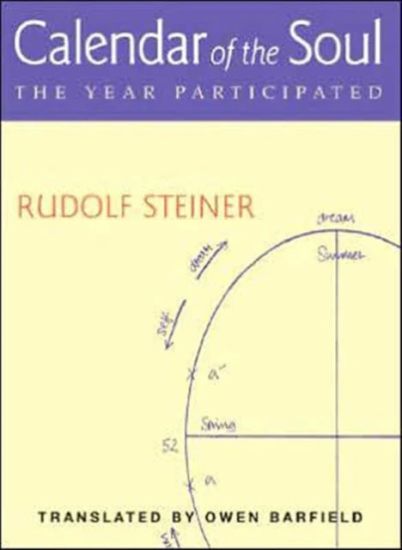
In listening to the changing language of the year, said Rudolf Steiner, we can rediscover our individual nature. These meditative verses, one for each week of the year, help to awaken a feeling of unity with nature while simultaneously stimulating a discovery of the self. Through intensive work, Steiner's unique meditations can lead to a feeling of oneness with the world. This budget-priced pocket version features Owen Barfield's pioneering translation - 'paraphrased for an English ear' - based on more than 50 years studying the text. As Barfield argues, no simple translation can convey the 'thrust' of the verses. In his words: 'It is this quality which the version that follows especially aims to suggest - at the expense, where necessary, of close reproduction.'
'A great deal is happening all the time in world evolution; and it falls to human beings, particularly those of our own time, to acquire real understanding of the world events in which they are involved.' In this popular lecture, Rudolf Steiner reveals that the angels - the spirits closest to human beings - are seeking to create images in human astral bodies. These images are given with the intention of bringing about 'definite conditions in the social life of the future' related to brotherhood, religious freedom, and conscious spirituality. Other spiritual beings, however, are working against the angels. If, as a consequence of their disruption, humanity sleeps though the angels' spiritual revelation, the consequences will be dire, and aberrations connected to sexuality, the misuse of medicine, and the misapplication of mechanical forces will begin to manifest.
'All historical life, all social life, all ethical life, proceed by virtue of the co-operation between the so-called living and the so-called dead. Our whole being can be infinitely strengthened when we are conscious not only of our firm stand here in the physical world, but are filled with the inner realization of being able to say of the dead whom we have loved: they are with us, they are in our midst.' In this valuable lecture Rudolf Steiner speaks with clarity about life after death, and explains how those on the earth can keep a connection with loved ones who have passed on. He describes the conditions in the environment of the dead, the advantages as well as the dangers of connecting with the dead, the importance of the moments of waking and going to sleep, the significance of dying in childhood and old age, and the appropriateness of different types of funeral services.
'Once one has passed through powerlessness and refinds oneself, one also finds Christ. Before we can gain access to the Christ Impulse, we must plumb the depths of our own feelings of insignificance, and this can only happen when we view our strengths and capacities without any pride.' How does one find the Christ today? Rudolf Steiner emphasizes the importance of striving for self-knowledge, the significance of experiencing powerlessness, and the eventual resurrection from powerlessness. In this important lecture, he also speaks about the ancient Academy of Gondishapur, the significance of the year 666, the mission of Islam, as well as the crucial consequences of the Ecumenical Council of 869.

13 lectures, various cities, 1907-1923 (CW 284) Unnoticed by most people at the time, a significant moment in spiritual history took place at Whitsun (Pentecost) in Munich in 1907. Known as "the Congress of the Federation of European Sections of the Theosophical Society," this event witnessed Rudolf Steiner's emergence onto the public stage as an independent esoteric Christian spiritual teacher with a world mission to transform planetary culture through what would come to be called "Anthroposophy." The event (and hence Anthroposophy itself) was placed under the sign of Christian Rosenkreutz and the cultural impulse of Rosicrucianism, which, since its initial appearance in the early seventeenth century, had gone underground to be transmitted through the centuries by small, more-or-less hidden esoteric groups. In the Congress, however, the original aim of the movement--a "general reform" of human society through the unity of art, science, and religion--was proclaimed anew and with the firm intent to put it into practice. This volume thus marks not only the birth of Anthroposophy as a spiritual movement of cultural renewal--from which would flow new initiatives in art, science, religion, education, agriculture, medicine, architecture, and drama--but also the articulation of this activity as the evolutionary tip of human consciousness reaching back to the primordial mystery centers. Collected here, with Steiner's lectures and descriptions, are essays and reports on the Theosophical Congress of Whitsun 1907, as well as documents relating to some of the direct consequences of the Congress, especially those leading to the design and construction of the first Goetheanum. An extensive color section of facsimiles, photographs, and plates includes the esoteric and symbolic artistic work (the seals and columns) created for the congress hall. This "Collected Works" edition contains an introduction, illustrations, a chronology of Rudolf Steiner's life, editorial notes, and an index. TOPICS: Art and Its Future TaskThe Munich Congress of Witsun 1907Rosicrucian InitiationPlanetary and Human EvolutionExplanations of the Seals and ColumnsReport on the CongressVarious reports and commentariesThe Apocalyptic SealsSymbols and Sings as Effects of ChaosHistory of the Anthroposophical SocietyEffects of the Munich CongressSpeech at the Laying of the Malsch Foundation StoneSixty-four pages of color images This volume is a translation of Bilder okkulter Siegel und S ulen. Der M nchner Kongress Pfingsten 1907 und seine Auswirkungen (GA 284).


Dieses Buch eignet sich für Menschen, die die geisteswissenschaftlichen Grundlagen der wichtigsten Naturphänomene suchen: Das Wesen des Lichtes, wie ? Materie? entsteht und was sie überhaupt ist, wie das Blut aus den kosmischen Kräften heraus den Körper des Menschen zustande bringt. "Ich habe Sie ja im Verlauf der Vorträge darauf aufmerksam gemacht, dass, wenn man sein Erkenntnisvermögen, seinen Erkenntnistrieb so erzieht, dass die menschliche Seele, während sie die Erkenntnis anstrebt, die Zustände aufnimmt, die wir bezeichnen können als ? Staunen, ? Verehrung, ? weisheitsvollen Einklang mit den Weltereignissen und ? Ergebenheit gegenüber allem Weltgeschehen. Dass wenn also die Seele diese Zustände annimmt, dann die Erkenntnis sich allmählich dazu aufschwingen kann, in dem, was uns umgibt, überall zu unterscheiden: Hier habe ich es mit einem Werdenden zu tun, mit einem, das erst in der Zukunft seine Vollkommenheit erlangen wird, und auf der anderen Seite habe ich es mit einem allmählich Ersterbenden, Hinschwindenden zu tun." Rudolf Steiner (im letzten Vortrag)

Das Miterleben des Jahreslaufes in vier kosmischen Imaginationen
Rudolf Steiner
Steiner Verlag, Dornach
2006
pokkari
The Sun Mystery and the Mystery of Death and Resurrection
Rudolf Steiner
SteinerBooks, Inc
2006
nidottu
12 lectures in various cities, 1922 (CW 211)"We must understand that if we relate only to dead matter, we ourselves become dead and ahrimanic, but if we have sufficient courage and love for all the beings around us to relate to them directly (not to our dead ideas about them), we discover the Christ in everything and victorious spirit everywhere. When this happens, we may need to speak in ways that seem paradoxical to our contemporaries. We may need to speak about the individual spiritual beings that live in the solid and fluid elements and so forth. As long as we avoid talking about these beings, we are talking about a dead science that is not imbued with the Christ. To speak about them is to speak in a truly Christian sense. We must imbue all of our scientific activity with the Christ. More than that, we must also bring the Christ into all of our social efforts, all of our knowledge--in short, into all aspects of our life. The Mystery of Golgotha will truly bear fruit only through human strength, human efforts, and human love for each other. In this sense, Anthroposophy in all its details strives to imbue the world with the Christ." --Rudolf SteinerThese lectures were given midway between World War I and Steiner's death in 1925. They will be of particular interest to anyone wanting to comprehend Rudolf Steiner's mature understanding of his mission: "enchristing" the world. The first two lectures constitute a call to arms or return to basics. Steiner speaks existentially and phenomenologically, building upon recognizable descriptions of actual experiences. His theme is the three states of consciousness (waking, dreaming, and dreamless sleep), and he shows how these ordinary human functions have initiatory possibilities. The next four lectures deal with the evolution of consciousness in relation to the universal significance of the Christ event. Through the resurrection, Christ's being entered earthly evolution. As a result, we see the world differently. Where ancient humanity experienced, "Not I but the divine spirit around me," we can experience, "Not I, but the Christ in me." With this insight, we reach the heart of this volume--esoteric Christianity. For Steiner, our most important task as human beings is to learn to overcome death by uniting with the Christ, who overcame death. Humanity's survival depends upon the "enchristing" of the world. It is the purpose of Anthroposophy to bring this reality into world evolution, to enable all religions and all human beings to experience the new reality. LECTURES: The Life of the Human Soul in Sleeping, Waking, and Dreaming The Three States of Night Consciousness The Transformation of Worldviews Historical Changes in the Experience of Breathing The Human Being as Portrayed in Greek Art Investigating and Formulating the Cosmic Word in Inhalation and Exhalation Exoteric and Esoteric Christianity The Teachings of the Risen Christ Spiritual Insight and Initiation Perceiving the Christ through Anthroposophy The Threefold Sun and the Risen Christ Anthroposophy as an Attempt to Enchristen the World Cover image Burial by Ninetta Sombart. The Sun Mystery and the Mystery of Death and Resurrection is the first complete English translation of Das Sonnenmysterium und das Mysterium von Tod und Auferstehung. Exoterisches und esoterisches Christentum (GA 211). Eight lectures were published in an earlier English translation as part of Festivals and their Meaning II: Easter (1956).

Kuusiosaisen Kohtalon yhteyksiä -sarjan yli 80 esitelmää luovat ainutlaatuisen näkymän jälleensyntymisen ja kohtalon todellisuuteen. Sarjan kolmannessa osassa Rudolf Steiner tuo esiin välttämättömyyden alkaa nähdä ihmiselämä toisiinsa liittyvien elämien ketjuna jälleensyntymisen ja kohtalon näkökulmasta. Ihmiskunnan historiaa oppii ymmärtämään syventävästi, kun tietää että ihmiset valmistelevat tärkeitä tapahtumia kuoleman ja uuden syntymän välisenä aikana henkisessä maailmassa. Steiner antaa konkreettisia esimerkkejä historiallisten persoonallisuuksien eri inkarnaatioista havainnollistaakseen näitä asioita. Eräänä aiheena on kristillisyyden kehitys 300-luvulta nykyaikaan. Varhaisempina aikoina Kristuksessa nähtiin kosminen aurinko-olento, joka inkarnoitui ihmiseksi. Myöhemmin tämä näkemys hämärtyi. Niin sanotussa Chartresin koulussa keskiajalla se vielä eli vahvana. Nykyään se voidaan löytää uudestaan.
Abnormal Paths into the Spiritual World and Their Transmutation
Rudolf Steiner
Kessinger Pub
2005
pokkari