Kirjojen hintavertailu – 12 903 725 kirjaa ja 27 kauppaa

Kirjailija

Rudolf Steiner

Kirjat ja teokset yhdessä paikassa: 1 477 kirjaa, julkaisuja vuosilta 1910–2026, suosituimpiin kuuluu The Cosmic New Year: A Course of Lectures by Rudolf Steiner. Vertaile teosten hintoja ja tarkista saatavuus suomalaisista kirjakaupoista.

1 477 kirjaa

Kirjojen julkaisuvuodet: 1910–2026.

The Arts and Their Mission

The Arts and Their Mission

Rudolf Steiner

SteinerBooks, Inc
1986
nidottu
8 lectures, Oslo, May 18 & 20, 1923 - Dornach, May 27-9, 1923 (CW 276) "Art, always a daughter of the Divine, has become estranged from her parent.... We should not mock scientific materialism and naturalistic art. These have their place in human culture. But the starting point for a new life of art can come only through direct stimulation from the spiritual realm. We must become artists, not by developing symbolism or allegory, but by rising, through spiritual knowledge, more and more nto the spiritual world." --Rudolf Steiner In these lectures, Steiner offers insights into architecture, sculpture, painting, drama, costuming, music, poetry, and eurythmy. The Arts and Their Mission is a translation from German of Das K nstlerische in seiner Weltmission. Der Genius der Sprache. Die Welt des sich offenbarenden strahlenden Scheins - Anthroposophie und Kunst. Anthroposophie und Dichtung (GA 276).
The Apocalypse of St John

The Apocalypse of St John

Rudolf Steiner

SteinerBooks, Inc
1985
sidottu
Initiation enables a person to see, understand, and communicate what may be observed with spiritual eyes. St. John's text arises from such an initiation. It addresses the fundamental questions of existence that every human being asks: Where are we? Where have we come from? Where are we going? And because it arises from esoteric Christian vision, it emphasizes the task of the individual: What am I, and what is my purpose now in this era of cosmic and human evolution? These talks by Rudolf Steiner unveil the mysteries of John's vision and show it to be a profound description of Christian initiation. As he says, "The deepest truths of Christianity may be considered quite naturally in connection with this document, for it contains a great part of the mysteries of Christianity--that is, the profoundest part of what may be described as esoteric Christianity." Steiner shows that the messages to the seven churches and the unsealing of the seven seals must be understood as an initiation text. Based on his initiation and on spiritual science, Steiner interprets John's insights into cosmic and human history. In this way, the spiritual images of John's writing--the twenty-four elders, the sea of glass, the woman clothed with the sun, the vials of wrath, the lamb and the dragon, the new heaven and the new earth, and the number of the beast --all take on new meaning. Since the previous painful century has closed, these important words have even greater meaning and significance; readers interested in contributing their moral will to future generations cannot afford to pass them by. Read Bobby Matherne's review of this book
The Michael Mystery

The Michael Mystery

Rudolf Steiner

SteinerBooks, Inc
1984
pokkari
From the time of the Foundation Meeting of the Anthroposophical Society (Dornach, Christmas to the New Year, 1923-24) until his death shortly before Easter 1925, Rudolf Steiner wrote a weekly letter addressed to the members of the Anthroposophical Society. The letters were printed in the members' supplement to the Goetheanum Weekly and in its English edition, Anthroposophical Movement. This book represents the second of two volumes. The earlier letters speak of the character and aims of the Anthroposophical Society and the social tasks arising in the anthroposophic movement. They deal with the problems encountered in the common study of Spiritual Science (Anthroposophy) and in its presentation to the world at large, relating it to the prevailing science and civilization of the time. With the exception of the first two (issued in August 1924, while he was in England) the letters in this volume were written by Rudolf Steiner from his sickbed during his final illness. During these last six months of his life, the letters--always written in the very early hours of the morning--came with unfailing regularity. The last of the letters was printed two weeks after his death. These letters form a continuous series and were given the appropriate collective title The Michael Mystery. As such, they constitute an invaluable addition to the great teacher's fundamental works on Spiritual Science. The present volume is a revised edition of the translation originally made by the late Mrs. E. Bowen-Wedgwood, first published as a book in 1930 and again in 1933.
The Gospel of St.John

The Gospel of St.John

Rudolf Steiner

SteinerBooks, Inc
1984
nidottu
During Pentecost 1908--seven years after he had given the world his book Christianity As Mystical Fact and the first intimation of the consequences of his Christ experience--Rudolf Steiner began his great work of renewing humanity's understanding of the Mystery of Golgotha and its meaning for human and earthly evolution. Accordingly, he turned to the deepest, most spiritual of the Gospels--that of the initiate St. John. In this lecture course, readers will find that the incarnation, death, and resurrection of the Divine Word, or Logos, reveals the mission of the Earth: Love. We learn of the mysteries behind Lazarus' resurrection, the "I AM" sayings, and the seven degrees of initiation. We come to understand that the Gospel of St. John is a continuing spiritual presence--to be recalled, meditated, and permeated with one's own life. In doing so, we realized that our purpose--and that of all humankind--is to become the Virgin Sophia, a receptical for the Holy Spirit. All of Steiner's work, as Marie Steiner writes in her introduction, was "to pave the way to Christ." Indeed, at the conclusion of these lectures, Rudolf Steiner said: It will come to be understood that Christianity is only beginning its influence and will fulfill its real mission only when it is understood in its true, spiritual form.... The more these lectures are understood in this sense, the better they will be understood as they were intended. This volume is essential if one is to truly understand Rudolf Steiner's understanding of esoteric Christianity and its place in the world today and in the future. Contents: The Doctrine of the Logos Esoteric Christianity The Mission of the Earth The Raising of Lazarus The Seven Degrees of Initiation The "I AM" The Mystery of Golgotha Human Evolution in Its Relation to the Christ Principle The Prophetical Documents of the Origin of Christianity The Effect of the Christ Principle Christian Initiation The Nature of the Virgin Sophia and of the Holy Spirit This volume is a translation of Das Johannes-Evangelium (GA 103).

How Can Mankind Find the Christ Again?

How Can Mankind Find the Christ Again?

Rudolf Steiner

SteinerBooks, Inc
1984
pokkari
8 lectures, Basel and Dornach, Dec. 22, 1918 - Jan. 1, 1919 (CW 187)"This is the goal toward which mankind strives through the new wisdom, in the new spirit: To find in the spirit itself the power to overcome egotism and the falseness of life, to overcome self-seeking through love, the sham of life through truth, illness through health-giving thoughts that put us into immediate accord with the harmonies of the universe, because they flow from the harmonies of the harmonies of the universe." --Rudolf SteinerSteiner examines the inner history of Christianity, explaining its relationship to ancient Judaism, Hellenism, Romanism, Gnosticism, and Egypto-Chaldean initiation. He describes the hidden spiritual battle raging today and the need for a renewal of the mysteries in a modern form. Today's road to Christ must involve a new, formative thinking whose Christian character is shown in the advent of selflessness, health, and a sense for truth. George O'Neil describes the nature of these lectures in his foreword: "As always, Rudolf Steiner spoke freely without using notes. Most of his audience had studied--or were at least familiar with--his written works and the published lecture cycles on the Gospels and related themes. A similar background will be needed for reading How Can Mankind Find the Christ Again? Such a background will prepare the reader for challenges and vistas not encountered elsewhere. Steiner's message of the new Christ Light midst the shadow existence of our age speaks to the modern soul in search of a cognitive reach" How Can Mankind Find the Christ Again? is a translation of Wie kan die Menschheit den Christus wiederfinden? Das dreifache Schattendasein unserer Zeit und das neue Christus-Licht (GA 187).
The Cycle of the Year as Breathing-Process of the Earth
5 lectures, Dornach, March 31 - April 8, 1923 (GA 223) Rudolf Steiner Human beings must attain an esoteric maturity in order to think not merely abstractly, but to be able to think so concretely that they can again become festival-creating. Then it will be possible again to unite something spiritual with the cycle of sense phenomena. These five lectures were given at Easter, 1923. Rudolf Steiner, in a fully conscious way, laid a foundation for celebrating the Christian festivals --Christmas, Easter, St. John's, and Michaelmas. This is begun with a description of how the festival year evolved over long ages from the Earth's cycle of inbreathing and outbreathing. These forces are the Earth's soul activities in relation to the cosmos. Steiner reveals the deep relationship between humanity and the seasons of the Earth, the solstices, and the equinoxes. And through the festivals of the seasons, he reveals humanity's relationship to the Christ Being The esoteric realities behind the festivals are also discussed in relation to sub-earthly and supra-earthly forces, the ancient Mysteries, the activity of the Archangel Michael, morality, and the arts.
The Inner Nature of Music and the Experience of Tone
Selected Lectures"A tone is at the foundation of everything in the physical world." This is one of many astonishing statements made by Rudolf Steiner in this collection of seven lectures on the inner realities of music. These lectures are an unusual treasure, since they are the only two groups of lectures that Steiner gave primarily on music, other than the lecture cycle for the tone eurythmy course, Eurythmy as Visible Music. In the first group of three lectures, given in 1906, Steiner explains why music affects the human soul so powerfully. Music has always held a special position among the arts because it is the only art form whose archetype, or source, lies not in the physical world, as with architecture, sculpture, and painting, but purely in the spiritual world-the soul's true home. Music thus directly expresses through tones the innermost essence of the cosmos, and our sense of well-being when we hear music comes from a recognition of our soul's experience in the spiritual world. In the remaining lectures, given in 1922 and 1923, Steiner discusses our experience of musical intervals and shows how it has undergone profound changes during the course of evolution. The religious effects of music in ancient times and the union of music with speech are considered, as well as the origin of musical instruments out of imaginations that accompanied singing. New insights are offered on the nature of the major and minor modes and on future directions of musical development.
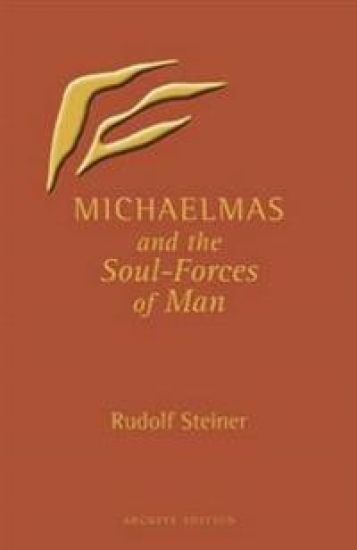
Michaelmas and the Soul-Forces of Man

Michaelmas and the Soul-Forces of Man

Rudolf Steiner

SteinerBooks, Inc
1982
nidottu
4 lectures, Vienna, September 27-October 1, 1923 (from CW 223)Steiner shows the need to "expand the horizon of life into the breadth of the world" in order to overcome today's hermit-like existence. He shows that the path to becoming true citizens of the cosmos is through the forces of the Archangel Michael, who is always present and prepared to help us. Synopses: September 27 -- How shall man, the earth citizen, once more become a citizen of the cosmos? The expansion of life's horizon into cosmic reaches. Philosophic aspects and impulses determining the human being in the picture of Michael's Conflict with the Dragon. September 28 -- Present-day man as a world hermit. The way back to spirit through the Michael force. Enchantment and liberation of the elemental beings. Man's responsibility to the cosmos. What is demanded of us is a profound faith in the spirit that will make us into instruments of the divine-spiritual forces. Experiencing spirit through pure thought leads to inspiration. September 30 -- Prerequisites of the inauguration of an autumn festival: penetrating extra-terrestrial, cosmic contexts; experiencing the course of the seasons. The Druidic and the Mithras Mysteries; the sun circles and cromlechs. Observation of the sun yielded knowledge of the connection between heaven and earth. The language of the heavens was deciphered and the cult gave directions regulating practical and social life, thereby becoming a sort of divine service -- the image of the Bull in the Mithras cult, and the schooling of the neophyte's capacity for sensitive perception: the heart as a sense organ was raised to a certain degree of consciousness. Through the heart organization the course of nature was perceived within man, and through the heart science the spirit of the sun's annual passage through the zodiac was studied. In this way men read in the heavens what was to be done on earth -- Concerning the cosmic-historical evolution of the planetary system. October 1 -- We need realistic thinking in place of mere methods of calculation. The far-reaching social significance of a Michael Festival. Earth spirit and human spirit. The cosmic breathing process. Nature-consciousness, self-consciousness, and spirit-consciousness. This volume is a translation of the final four of the nine lectures in Der Jahreskreislauf als Atmungsvorgang der Erde und die vief grossen Festeszeiten.