Kirjojen hintavertailu – 12 859 824 kirjaa ja 27 kauppaa
Kirjailija
Rudyard Kipling
Kirjat ja teokset yhdessä paikassa: 2 583 kirjaa, julkaisuja vuosilta 1890–2026, suosituimpiin kuuluu Oxford Reading Tree TreeTops Classics: Level 15: Pack of 6. Vertaile teosten hintoja ja tarkista saatavuus suomalaisista kirjakaupoista.
"The Man Who Would Be King" (1888) is a novella by Rudyard Kipling. It is about two British adventurers in British India who become kings of Ka ristan, a remote part of Afghanistan. It has been adapted for other media a number of times. In 1975, the story was adapted by director John Huston into a feature lm of the same name, starring Sean Connery and Michael Caine as the adventurers and Christopher Plummer as Kipling. Joseph Rudyard Kipling (1865 - 1936) was an English journalist, short-story writer, poet, and novelist. Kipling's works of fiction include The Jungle Book (1894), Kim (1901), and many short stories, including "The Man Who Would Be King" (1888). His poems include"Mandalay" (1890), "Gunga Din" (1890), "The Gods of the Copybook Headings" (1919), "The White Man's Burden" (1899), and "If-" (1910). He is regarded as a major innovator in the art of the short story; his children's books are classics of children's literature; and one critic described his work as exhibiting "a versatile and luminous narrative gift". Kipling was one of the most popular writers in the United Kingdom, in both prose and verse, in the late 19th and early 20th centuries. In 1907, at the age of 42, he was awarded the Nobel Prize in Literature, making him the first English-language writer to receive the prize, and its youngest recipient to date. This classic title has been published by RADLEY BOOKS. Each RADLEY CLASSIC is a meticulously restored, luxurious and faithful reproduction of a classic book; produced with elegant text layout, clarity of presentation, and stylistic features that make reading a true pleasure. Special attention is given to legible fonts and adequate letter sizing, correct line length for readability, generous margins and triple lead (lavish line separation); plus we do not allow any mistakes/changes/additions to creep into the author's words. Visit RADLEY BOOKS at www.radleybooks.com (or search RADLEY CLASSIC on Amazon) to see more classic book titles in this series.
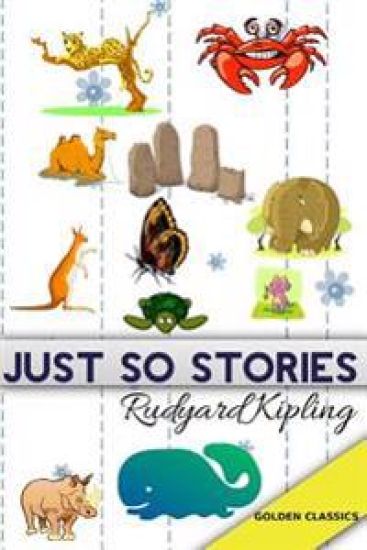
Classics for Your Collection: goo.gl/U80LCr --------- Just So Stories for Little Children is a 1902 collection of origin stories by the British author Rudyard Kipling. Considered a classic of children's literature, the book is among Kipling's best-known works. Kipling began working on the book by telling the first three chapters as bedtime stories to his daughter Josephine. These had to be told "just so" (exactly in the words she was used to) or she would complain. The stories describe how one animal or another acquired its most distinctive features, such as how the Leopard got his spots. The stories have appeared in a variety of adaptations including a musical, and animated films. Evolutionary biologists have noted that what Kipling did in fiction, they have done in reality, providing explanations for the evolutionary development of animal features. The Just So Stories each tell how a particular animal was modified from an original form to its current form by the acts of man, or some magical being. For example, the Whale has a tiny throat because he swallowed a mariner, who tied a raft inside to block the whale from swallowing other men. The Camel has a hump given to him by a djinn as punishment for the camel's refusing to work (the hump allows the camel to work longer between times of eating). The Leopard's spots were painted by an Ethiopian (after the Ethiopian painted himself black). The Kangaroo gets its powerful hind legs, long tail, and hopping gait after being chased all day by a dingo, sent by a minor god responding to the Kangaroo's request to be made different from all other animals. The Just So Stories began as bedtime stories told to his daughter "Effie" Josephine, Kipling's firstborn]; when the first three were published in a children's magazine, a year before her death, Kipling explained: "in the evening there were stories meant to put Effie to sleep, and you were not allowed to alter those by one single little word. They had to be told just so; or Effie would wake up and put back the missing sentence. So, at last they came to be like charms, all three of them, -the whale tale, the camel tale, and the rhinoceros tale." Contents: How the Whale Got His Throat - why the larger whales eat only small prey. How the Camel Got His Hump - how the idle camel was punished and given a hump. How the Rhinoceros Got His Skin - why rhinos have folds in their skin and bad tempers. How the Leopard Got His Spots - why leopards have spots. The Elephant's Child - how the elephant's trunk became long. The Sing-Song of Old Man Kangaroo - how the kangaroo assumed long legs and tail. The Beginning of the Armadillos - how a hedgehog and tortoise transformed into the first armadillos. How the First Letter Was Written - introduces the only characters who appear in more than one story: a family of cave-people, called Tegumai Bopsulai (the father), Teshumai Tewindrow (the mother), and Taffimai Metallumai, (the daughter). Explains how Taffimai delivered a picture message to her mother. How the Alphabet Was Made - Taffimai and her father invent an alphabet. The Crab That Played with the Sea - explains the ebb and flow of the tides, as well as how the crab changed from a huge animal into a small one. The Cat That Walked by Himself - the longest story, explains how man domesticated all the wild animals except the cat, which insisted on greater independence. The Butterfly That Stamped - how Solomon saved the pride of a butterfly, and the Queen of Sheba used this to prevent his wives scolding him. Scroll Up and Grab Your Copy
Joseph Rudyard Kipling 30 December 1865 - 18 January 1936) was an English journalist, short-story writer, poet, and novelist. Kipling's works of fiction include The Jungle Book (1894), Kim (1901), and many short stories, including "The Man Who Would Be King" (1888). His poems include "Mandalay" (1890), "Gunga Din" (1890), "The Gods of the Copybook Headings" (1919), "The White Man's Burden" (1899), and "If-" (1910). He is regarded as a major innovator in the art of the short story; his children's books are classics of children's literature; and one critic described his work as exhibiting "a versatile and luminous narrative gift".
Soldiers Three is a collection of short stories by Rudyard Kipling. The three soldiers of the title are Learoyd, Mulvaney and Ortheris, who had also appeared previously in the collection Plain Tales from the Hills. The current version, dating from 1899 and more fully titled Soldiers Three and other stories, consists of three sections which each had previously received separate publication in 1888; Learoyd, Mulvaney and Ortheris appear only in the first section, which is also titled Soldiers Three. The books reveal a side of the British Tommy in Afghanistan rarely seen in the Twilight of the British Empire. The soldiers comment on their betters, act the fool, but cut straight to the rawness of war in the mid-east as the British began to loosen their Imperial hold.. The Story of the Gadsbys is a story by Rudyard Kipling. 1] It was originally published as no. 2 of the Indian Railway Library in 1888. The Story of the Gadsbys is written in dramatic form, consisting of eight short scenes (listed below). This short pamphlet, of 100 pages, was later collected in book form as the second part of Soldiers Three. "Poor Dear Mamma" "The World Without" "The Tents of Kedar" "With any Amazement" "The Garden of Eden" "Fatima" "The Valley of the Shadow" "The Swelling of Jordan" "L'Envoi" (a poem)... In Black and White is a collection of eight short stories by Rudyard Kipling which was first published in a booklet of 108 pages as no. 3 of A H Wheeler & Co.'s Indian Railway Library in 1888. It was subsequently published in a book along with nos 1 and 2, Soldiers Three (1888) and The Story of the Gadsbys, as Soldiers Three (1899). The characters about whom the stories are concerned are native Indians, rather than the British for writing about whom Kipling may be better known; four of the stories are narrated by the Indians, and four by an observant wise English journalist (the persona that Kipling likes to adopt). The stories are: "Dray Wara Yow Dee" - told by an Afghan (Pathan) narrator "The Judgement of Dungara" - told by an English narrator "At Howli Thana" - told by an Indian narrator "Gemini" - told by an Indian narrator "At Twenty-Two" - told by an English narrator "In Flood Time" - told by an Indian narrator "The Sending of Dana Dee" - told by an English narrator "On the City Wall" - told by an English narrator... Joseph Rudyard Kipling ( 30 December 1865 - 18 January 1936) was an English journalist, short-story writer, poet, and novelist. Kipling's works of fiction include The Jungle Book (1894), Kim (1901), and many short stories, including "The Man Who Would Be King" (1888). His poems include "Mandalay" (1890), "Gunga Din" (1890), "The Gods of the Copybook Headings" (1919), "The White Man's Burden" (1899), and "If-" (1910). He is regarded as a major innovator in the art of the short story; his children's books are classics of children's literature; and one critic described his work as exhibiting "a versatile and luminous narrative gift". Kipling was one of the most popular writers in the United Kingdom, in both prose and verse, in the late 19th and early 20th centuries. Henry James said: "Kipling strikes me personally as the most complete man of genius, as distinct from fine intelligence, that I have ever known." In 1907, at the age of 42, he was awarded the Nobel Prize in Literature, making him the first English-language writer to receive the prize, and its youngest recipient to date. He was also sounded out for the British Poet Laureateship and on several occasions for a knighthood, both of which he declined....
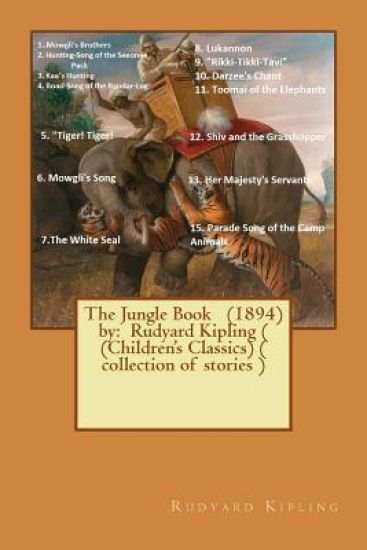
The Jungle Book (1894) is a collection of stories by English author Rudyard Kipling. The stories are fables, using animals in an anthropomorphic manner to give moral lessons. A principal character is the boy or "man-cub" Mowgli, who is raised in the jungle by wolves. Other characters include Shere Khan the tiger and Baloo the bear. The book has been adapted many times for film and other media. The stories were first published in magazines in 1893-94. The original publications contain illustrations, some by the author's father, John Lockwood Kipling. Rudyard Kipling was born in India and spent the first six years of his childhood there. After about ten years in England, he went back to India and worked there for about six-and-a-half years. These stories were written when Kipling lived in Naulakha, the home he built in Dummerston, Vermont, in the United States. 1] There is evidence that Kipling wrote the collection of stories for his daughter Josephine, who died from pneumonia in 1899, aged 6; a rare first edition of the book with a handwritten note by the author to his young daughter was discovered at the National Trust's Wimpole Hall in Cambridgeshire, England, in 2010
The Barrack-Room Ballads is the collective name given to a series of songs and poems by Rudyard Kipling, dealing with the late-Victorian British Army and mostly written in a vernacular dialect. The series contains some of Kipling's most well-known work, including the poems "Gunga Din", "Tommy" and "Danny Deever", and helped consolidate his early fame as a poet. The first poems were published in the Scots Observer in the first half of 1890, and collected in Barrack-Room Ballads and Other Verses in 1892. Kipling later returned to the theme in a group of poems collected in The Seven Seas under the same title. A third group of vernacular Army poems from the Boer War, titled "Service Songs" and published in The Five Nations (1903), can be considered part of the Ballads, as can a number of other uncollected pieces. While two volumes of Kipling's poems are clearly labelled as "Barrack-Room Ballads", identifying which poems should be grouped in this way can be complex. The main collection of the Ballads was published in the 1890s, in two volumes: Barrack-Room Ballads and Other Verses (1892, the first major publishing success for Methuen) and The Seven Seas (1896), sometimes published as The Seven Seas and Further Barrack-Room Ballads. In both books, they were collected into a specific section set aside from the other poems, and can be easily identified. (Barrack-Room Ballads and Other Verses has an introductory poem ("To T. A.") in Kipling's own voice, which is strictly not part of the set but is often collected with them.) A third group of poems, published in 1903 in The Five Nations, continued the theme of military vernacular ballads; while they were titled "Service Songs", they fit well with the themes of the earlier ballads and are clearly connected. Charles Carrington produced the first comprehensive volume of the Ballads in 1973, mainly drawn from these three collections but including five additional pieces not previously collected under the title. Three of these date from the same period: an untitled vernacular poem ("My girl she gave me the go onst") taken from a short story, The Courting of Dinah Shadd, in Life's Handicap (1891); Bobs (1892 or 1898), citation needed] a poem praising Lord Roberts; and The Absent-Minded Beggar (1899), a poem written to raise funds for the families of soldiers called up for the Boer War. The remaining two date from the First World War; Carrington considered Epitaphs of the War, written in a first-person style, and Gethsemane, also in a soldier's voice, to meet his definition. Both were published in The Years Between (1919). Kipling wrote profusely on military themes during the war, but often from a more detached perspective than the first-person vernacular he had previously adopted. Finally, there are some confusingly captioned pieces. Many of Kipling's short stories were introduced with a short fragment of poetry, sometimes from an existing poem and sometimes an incidental new piece. These were often identified "A Barrack-Room Ballad", though not all the poems they were taken from would otherwise be collected or classed this way. This includes pieces such as the introductory poem to My Lord the Elephant (from Many Inventions, 1899), later collected in Songs from Books but not identified as a Ballad. It is not clear if these were deliberately omitted by Carrington or if he explicitly chose not to include them.... Wolcott Balestier (December 13, 1861 - December 6, 1891, in Rochester, New York) was an American writer and editor notable primarily through his connection to Rudyard Kipling.... Joseph Rudyard Kipling ( 30 December 1865 - 18 January 1936) was an English journalist, short-story writer, poet, and novelist.
Captains Courageous is an 1897 novel, by Rudyard Kipling, that follows the adventures of fifteen-year-old Harvey Cheyne Jr., the spoiled son of a railroad tycoon, after he is saved from drowning by a Portuguese fisherman in the north Atlantic. The novel originally appeared as a serialisation in McClure's, beginning with the November 1896 edition. In 1900, in his essay "What We Can Expect of the American Boy," Teddy Roosevelt extolled the book and praised Kipling for describing "in the liveliest way just what a boy should be and do." The book's title comes from the ballad "Mary Ambree", which starts, "When captains courageous, whom death could not daunt". Kipling had previously used the same title for an article on businessmen as the new adventurers, published in The Times of 23 November 1892. Plot: Protagonist Harvey Cheyne, Jr., is the son of a wealthy railroad magnate and his wife, in San Diego, California. Washed overboard from a transatlantic steamship and rescued by fishermen off the Grand Banks of Newfoundland, Harvey can neither persuade them to take him quickly to port, nor convince them of his wealth. Disko Troop, captain of the schooner We're Here, offers him temporary membership in the crew until they return to port, and Harvey later accepts. Through a series of trials and adventures, Harvey, with the help of the captain's son Dan Troop, becomes acclimated to the fishing lifestyle, and even skillful. Eventually, the schooner returns to port and Harvey wires his parents, who immediately hasten to Boston, Massachusetts, and thence to the fishing town of Gloucester to recover him. There, Harvey's mother rewards the seaman Manuel, who initially rescued her son; Harvey's father hires Dan to work on his prestigious tea clipper fleet; and Harvey goes to Stanford to prepare for taking over his father's shipping lines.... Joseph Rudyard Kipling ( 30 December 1865 - 18 January 1936) was an English journalist, short-story writer, poet, and novelist. Kipling's works of fiction include The Jungle Book (1894), Kim (1901), and many short stories, including "The Man Who Would Be King" (1888). His poems include "Mandalay" (1890), "Gunga Din" (1890), "The Gods of the Copybook Headings" (1919), "The White Man's Burden" (1899), and "If-" (1910). He is regarded as a major innovator in the art of the short story; his children's books are classics of children's literature; and one critic described his work as exhibiting "a versatile and luminous narrative gift". Kipling was one of the most popular writers in the United Kingdom, in both prose and verse, in the late 19th and early 20th centuries. Henry James said: "Kipling strikes me personally as the most complete man of genius, as distinct from fine intelligence, that I have ever known." In 1907, at the age of 42, he was awarded the Nobel Prize in Literature, making him the first English-language writer to receive the prize, and its youngest recipient to date. He was also sounded out for the British Poet Laureateship and on several occasions for a knighthood, both of which he declined. Kipling's subsequent reputation has changed according to the political and social climate of the age and the resulting contrasting views about him continued for much of the 20th century. George Orwell called him a "prophet of British imperialism". Literary critic Douglas Kerr wrote: " Kipling] is still an author who can inspire passionate disagreement and his place in literary and cultural history is far from settled. But as the age of the European empires recedes, he is recognised as an incomparable, if controversial, interpreter of how empire was experienced. That, and an increasing recognition of his extraordinary narrative gifts, make him a force to be reckoned with."
Viidakkokirja (engl. The Jungle Book) on Rudyard Kiplingin tunnetuimpia teoksia. Se on tarinakokoelma Intian viidakoista. Keskeiset kolme tarinaa kertovat viidakossa susien kanssa kasvaneesta Mowgli-pojasta. Kokoelman tarinat ilmestyiv t ensi kerran aikakauslehdiss 1893-1894, kirjamuodossa 1894. Osa tarinoista oli Kiplingin is n John Lockwood Kiplingin kuvittamia. Kipling syntyi Intiassa ja vietti kuusi ensimm ist elinvuottaan siell . Vietetty n noin vuosikymmenen Englannissa h n muutti takaisin Intiaan ja ty skenteli siell kuusi vuotta. Kipling kirjoitti tarinakokoelman Vermontissa asuessaan.
Stalky & Co. is a novel by Rudyard Kipling, about adolescent boys at a British boarding school. It was first published in 1899 (following serialisation in the Windsor Magazine). Reflecting its origins, the novel is episodic in nature, with self-contained chapters. It is set at an unnamed school referred to as the College or the Coll., which is based on the United Services College in Devon, which Kipling attended. The character Beetle, one of the main trio, is partly based on Kipling himself, while the charismatic character Stalky is based on Lionel Dunsterville, M'Turk is based on George Charles Beresford and Mr King is based on William Carr Crofts. The stories have elements of revenge, the macabre, bullying and violence, and hints about sex, making them far from childish or idealised. For example, Beetle pokes fun at an earlier, more earnest, boys' book, Eric, or, Little by Little, thus flaunting his more worldly outlook. There is also some information about Stalky in later life. In his essay entitled "What We Can Expect of the American Boy," Teddy Roosevelt disdained this novel, calling it "a story which ought never to have been written, for there is hardly a single form of meanness which it does not seem to extol, or of school mismanagement which it does not seem to applaud."........ Joseph Rudyard Kipling ( 30 December 1865 - 18 January 1936) was an English journalist, short-story writer, poet, and novelist. Kipling's works of fiction include The Jungle Book (1894), Kim (1901), and many short stories, including "The Man Who Would Be King" (1888). His poems include "Mandalay" (1890), "Gunga Din" (1890), "The Gods of the Copybook Headings" (1919), "The White Man's Burden" (1899), and "If-" (1910). He is regarded as a major innovator in the art of the short story; his children's books are classics of children's literature; and one critic described his work as exhibiting "a versatile and luminous narrative gift". Kipling was one of the most popular writers in the United Kingdom, in both prose and verse, in the late 19th and early 20th centuries. Henry James said: "Kipling strikes me personally as the most complete man of genius, as distinct from fine intelligence, that I have ever known." In 1907, at the age of 42, he was awarded the Nobel Prize in Literature, making him the first English-language writer to receive the prize, and its youngest recipient to date. He was also sounded out for the British Poet Laureateship and on several occasions for a knighthood, both of which he declined. Kipling's subsequent reputation has changed according to the political and social climate of the age and the resulting contrasting views about him continued for much of the 20th century. George Orwell called him a "prophet of British imperialism". Literary critic Douglas Kerr wrote: " Kipling] is still an author who can inspire passionate disagreement and his place in literary and cultural history is far from settled. But as the age of the European empires recedes, he is recognised as an incomparable, if controversial, interpreter of how empire was experienced. That, and an increasing recognition of his extraordinary narrative gifts, make him a force to be reckoned with."