Kirjailija
Salman Akhtar
Kirjat ja teokset yhdessä paikassa: 58 kirjaa, julkaisuja vuosilta 1992–2026, suosituimpiin kuuluu Chimeric Vaccine Design Against Melioidosis via Subtractive Proteomics. Vertaile teosten hintoja ja tarkista saatavuus suomalaisista kirjakaupoista.
58 kirjaa
Kirjojen julkaisuvuodet: 1992–2026.
One hundred (and one) tales to mark Salman Akhtar’s one hundredth book! Divided into eight informative parts – Dr Akhtar’s journey to psychoanalysis; the lessons he learned from his teachers, supervisors, and mentors; the teachings from his peers and colleagues; the benefits of clinical work; the impact of cultural difference; insights gained from students, supervisees, and audiences; his experiences of writing, editing, and publishing; and advice for those about to take their first steps – each section is packed full of incredible advice lightly given in a series of engaging anecdotes. Tales of Transformation: A Life in Psychotherapy and Psychoanalysis is the perfect book for trainees, practising clinicians, those considering psychoanalysis as a career path, anyone with an interest in the subject, and all who enjoy reading the recollections of a witty raconteur.

This book seeks to underscore the multifaceted ways in which we encounter suffering in clinical and social settings. The fear, greed, and guilt cause an individual to suffer privately, while the deception, betrayal, and revenge lead others to suffer.
This book is a collection of "stories", and just as the Stories of the Dreaming act as a container of experiences for the indigenous people, it attempts to be a container for experiences that had not had enough exposure in psychoanalytic literature.
This book addresses five areas of difficulty in psychotherapy: initial assessment, boundaries, money, disruptions, and suicidal crises. It outlines the conceptual issues and the technical details of each of the concept in detail.
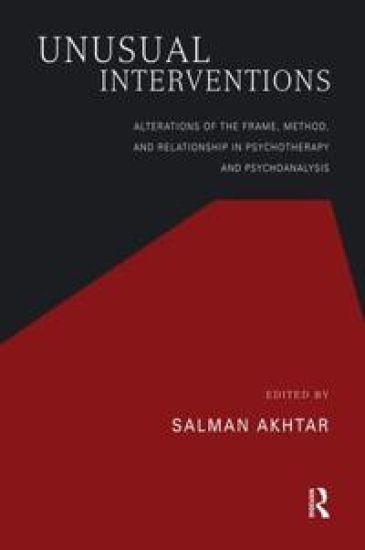
Radical departures from the set and familiar rules of technique often become necessary in the course of psychotherapy and psychoanalysis. These can include conducting a session outside the office, giving advice, not charging fees, talking about oneself, giving a gift to the patient, and so on. Such interventions have so far remained imbued with mystery or, worse, have been the staple of cocktail party conversations. Unusual Interventions brings a variety of exceptional measures together to highlight their indications, risks, and their potential anchors in psychoanalytic theory of human relatedness. In accomplishing this, the book itself becomes an unusual addition to the literature on the technique of psychotherapy and psychoanalysis.
This book focuses on the intrapsychic vicissitudes of what it means to be truly alive and how death accompanies us at each step of our life's journey. It shows that, psychologically-speaking, death is always present in life and life in death.
Bringing together the experiences of mistrust, jealousy, lack of love, shamelessness, regret, and despair, this far-reaching book elucidates human sorrow in striking sociocultural and clinical details.
Joseph Breuer's celebrated patient, Anna O., designated psychoanalysis to be a "talking cure". She was correct insofar as psychoanalysis does place verbal exchange at the center stage. However, the focus upon the patient's and therapist's speaking activities diverted attention from how the two parties listen to each other. Psychoanalysis is a listening and talking cure. Both elements are integral to clinical work. Listening with no talking can only go so far. Talking without listening can mislead and harm. And yet, the listening end of the equation has received short shrift in analytic literature. This book aims to rectify this problem by focusing upon analytic listening. Taking Freud's early description of how an analyst ought to listen as its starting point, the book traverses considerable historical, theoretical, and clinical territory. The ground covered ranges from diverse methods of listening through the informative potential of the countertransference to the outer limits of our customary attitude where psychoanalytic listening no longer helps and might even be contraindicated.'- Salmon Akhtar, from his Introduction
Silent Virtues addresses six areas of mental functioning namely patience, curiosity, privacy, intimacy, humility, and dignity. Each of the areas is elucidated with the help of clinical, literary, and cultural material. The book introduces a series of novel ideas, including: (i) the distinction between patience as a component of the therapeutic attitude and the exercise of patience as a specific technical intervention; (ii) the description of the five psychopathological syndromes involving curiosity: excessive, deficient, uneven, anachronistic, instinctualized, and false curiosity; (iii) the description of four psychopathological syndromes (failed, florid, fluctuating, and false) involving intimacy; (iv) the discourse on the importance of humility in selecting patients and in deciding upon the longevity of our professional careers; and (v) the description of three forms of dignity (metaphysical, existential, and characterological) and the various ways in which they affect psychoanalytic technique.
In this compact and pithy book, the distinguished and prolific psychoanalyst Salman Akhtar steps out of his consulting room to address certain matters of urgent global concern. These include migration across national borders, the current refugee crisis, ethno-racial prejudice, subjective distress of minorities, and, above all, the forever-present ominous shadow of terrorism. Akhtar evolves and advocates a uniquely 'anthropological psychoanalysis' which is a blend of depth psychology and humanities, including sociology, economics, political science, history, and , of course, anthropology. He deconstructs what seems self-evident and confronts his readers with some socio-politically unpleasant realities, both within psychoanalysis and in the prevalent perspectives on the on-going turmoil and bloodshed in today's world. His book is not all doom and gloom, however. It also delineates ameliorative strategies for dealing with the pain of the disenfranchised and the misguided violence of the radicalized. This is applied psychoanalysis at its best.
Bringing together the experiences of mistrust, jealousy, lack of love, shamelessness, regret, and despair, this far-reaching book elucidates human sorrow in striking sociocultural and clinical details.
Good Stuff is divided into two main parts; Part I addresses Positive Attributes and Part II, Positive Actions. The former contains chapters on Courage, Resilience, and Gratitude. The latter contains chapters on Generosity, Forgiveness, and Sacrifice. Together, the six chapters constitute a harmonious gestalt of the relational scenarios that assure enrichment of human experience. This book offers socioclinical meditations to temper Freud’s view that human beings are essentially ‘bad’ and whatever goodness they can muster is largely defensive. By elucidating the origins, dynamics, social pleasures, and clinical benefits of courage, resilience, gratitude, generosity, forgiveness, and sacrifice, this book sheds light on a corner of human experience that has remained inadequately understood by psychoanalysts and other mental health professionals.
This book seeks to underscore the multifaceted ways in which we encounter suffering in clinical and social settings. The fear, greed, and guilt cause an individual to suffer privately, while the deception, betrayal, and revenge lead others to suffer.
Moving from one country to another causes a radical alteration of one's cultural and geophysical surround. Separation from friends and family, loss of valued possessions, and encountering new ways of living result in mental pain and disorienting anxieties. In Immigration and Acculturation, Salman Akhtar examines the traumatic impact of immigration and the acculturation process and the psychological defenses that are mobilized in the immigrant, including nostalgia and fantasies of return. Akhtar explores each aspect of an immigrant's life, shedding light on the complexities of work, friendship, sex, marriage, aging, religion, and politics, as well as showing how unresolved conflicts are passed on to the next generation. Akhtar provides first-hand accounts from immigrants from a variety of backgrounds and countries of origin, and he provides clinical strategies for working with immigrant and ethnically diverse patients and their offspring. Deftly synthesizing observations from psychoanalysis, anthropology, literature, history, and related disciplines in the humanities, Salman Akhtar elegantly elucidates postmigration identity change.
Good Stuff is divided into two main parts; Part I addresses Positive Attributes and Part II, Positive Actions. The former contains chapters on Courage, Resilience, and Gratitude. The latter contains chapters on Generosity, Forgiveness, and Sacrifice. Together, the six chapters constitute a harmonious gestalt of the relational scenarios that assure enrichment of human experience. This book offers socioclinical meditations to temper Freud’s view that human beings are essentially ‘bad’ and whatever goodness they can muster is largely defensive. By elucidating the origins, dynamics, social pleasures, and clinical benefits of courage, resilience, gratitude, generosity, forgiveness, and sacrifice, this book sheds light on a corner of human experience that has remained inadequately understood by psychoanalysts and other mental health professionals.
'Joseph Breuer's celebrated patient, Anna O., designated psychoanalysis to be a "talking cure". She was correct insofar as psychoanalysis does place verbal exchange at the center stage. However, the focus upon the patient's and therapist's speaking activities diverted attention from how the two parties listen to each other. Psychoanalysis is a listening and talking cure. Both elements are integral to clinical work. Listening with no talking can only go so far. Talking without listening can mislead and harm. And yet, the listening end of the equation has received short shrift in analytic literature. This book aims to rectify this problem by focusing upon analytic listening. Taking Freud's early description of how an analyst ought to listen as its starting point, the book traverses considerable historical, theoretical, and clinical territory. The ground covered ranges from diverse methods of listening through the informative potential of the countertransference to the outer limits of our customary attitude where psychoanalytic listening no longer helps and might even be contraindicated.'- Salmon Akhtar, from his Introduction
Radical departures from the set and familiar rules of technique often become necessary in the course of psychotherapy and psychoanalysis. These can include conducting a session outside the office, giving advice, not charging fees, talking about oneself, giving a gift to the patient, and so on. Such interventions have so far remained imbued with mystery or, worse, have been the staple of cocktail party conversations. Unusual Interventions brings a variety of exceptional measures together to highlight their indications, risks, and their potential anchors in psychoanalytic theory of human relatedness. In accomplishing this, the book itself becomes an unusual addition to the literature on the technique of psychotherapy and psychoanalysis.