
Kirjailija
Sigmund Freud
Kirjat ja teokset yhdessä paikassa: 1 311 kirjaa, julkaisuja vuosilta 1920–2027, suosituimpiin kuuluu The Freud/Jung Letters. Vertaile teosten hintoja ja tarkista saatavuus suomalaisista kirjakaupoista.
1 311 kirjaa
Kirjojen julkaisuvuodet: 1920–2027.

In fall 1909, Dr. Sigmund Freud gave a series of five lectures at the 20th anniversary celebration of the opening of Clark University in Worcester, Massachusetts. Joined by other speakers, including Carl Jung, this lecture series helped to disseminate the ideas of psychoanalysis on an international stage. Dr. Freud (b. 1856, d. 1939) was the founder of psychoanalysis, the clinical procedure of evaluating and treating mental disorders through revealing unconscious desires and repressed memories. While his work is not as popular today as it once was, it was revolutionary in its approach and has permeated nearly all of Western culture. Dr. Freud was a prolific writer and lecturer. In 1909, he made his only visit to the United States, where he presented this series of five lectures. Dr. Freud originally presented them in German, without notes. Freud later wrote them down, and translations were first published in The American Journal of Psychology in April 1910. The five lectures describe the origins and development of his theory of psychoanalysis, as far as it had reached in September 1909. In the first lecture, Dr. Freud explains how his colleague, Dr. Breuer, developed the foundations of psychoanalysis when Freud himself was a student. Dr. Breuer had a patient who was suffering from a long list of ailments, including paralysis on her right side, impaired vision, nausea, and the inability to speak. Attributing these symptoms to that vague malady "hysteria," Dr. Breuer attempted a "talking cure" with the patient and worked to discover her "psychic trauma" through hypnosis. The patient improved, and Drs. Breuer and Freud determined that unprocessed memories of traumatic experiences were causing her illness. In the second lecture, Dr. Freud shares the next evolution of psychoanalysis, in which he abandoned hypnotism. As he learned that not all patients could be hypnotized, he instead worked with them in their normal state. Through conversation and suggestion, Dr. Freud drew out the repressed memories that the patient couldn't normally recall, resolving the conflict between the patient's conscious and unconscious. In the third lecture, Dr. Freud moves on to the interpretation of dreams. He believed that dreams could reveal repressed wishes, if the true meaning could be ascertained. Through techniques like free association, Dr. Freud believed he and the patient could unlock the symbolism of dreams to reveal repressed desires. Freud's fourth lecture explores a topic that he knew to be controversial-how often he found that symptoms of disease root back to "impressions from the sexual life...and necessitate the assumption that to disturbances of the erotic sphere must be ascribed the greatest significance among the etiological factors of the disease." He acknowledged that this was not a popular view among his peers. But he found that when patients realized they could "disregard conventional restraints" in a doctor/patient relationship, they revealed truths that very often pointed to sexual causes. Finally, Dr. Freud discusses "transference," that phenomenon by which a neurotic "applies to the person of the physician a great amount of tender emotion." This process is crucial, he believed, in helping the patient to gain insight into their relationship patterns. It was his belief that bringing repressed desires into consciousness would help people to master them or sublimate them, for the good of both individuals and society. While Dr. Freud's trip to America was not perfect-he found Americans far too informal-he was delighted to find that the faculty at Clark University was familiar with his work. As Freud said himself in his autobiography, the trip was "the realization of some incredible daydream: psychoanalysis was no longer a product of delusion, it had become a valuable part of reality."
In fall 1909, Dr. Sigmund Freud gave a series of five lectures at the 20th anniversary celebration of the opening of Clark University in Worcester, Massachusetts. Joined by other speakers, including Carl Jung, this lecture series helped to disseminate the ideas of psychoanalysis on an international stage. Dr. Freud (b. 1856, d. 1939) was the founder of psychoanalysis, the clinical procedure of evaluating and treating mental disorders through revealing unconscious desires and repressed memories. While his work is not as popular today as it once was, it was revolutionary in its approach and has permeated nearly all of Western culture. Dr. Freud was a prolific writer and lecturer. In 1909, he made his only visit to the United States, where he presented this series of five lectures. Dr. Freud originally presented them in German, without notes. Freud later wrote them down, and translations were first published in The American Journal of Psychology in April 1910. The five lectures describe the origins and development of his theory of psychoanalysis, as far as it had reached in September 1909. In the first lecture, Dr. Freud explains how his colleague, Dr. Breuer, developed the foundations of psychoanalysis when Freud himself was a student. Dr. Breuer had a patient who was suffering from a long list of ailments, including paralysis on her right side, impaired vision, nausea, and the inability to speak. Attributing these symptoms to that vague malady "hysteria," Dr. Breuer attempted a "talking cure" with the patient and worked to discover her "psychic trauma" through hypnosis. The patient improved, and Drs. Breuer and Freud determined that unprocessed memories of traumatic experiences were causing her illness. In the second lecture, Dr. Freud shares the next evolution of psychoanalysis, in which he abandoned hypnotism. As he learned that not all patients could be hypnotized, he instead worked with them in their normal state. Through conversation and suggestion, Dr. Freud drew out the repressed memories that the patient couldn't normally recall, resolving the conflict between the patient's conscious and unconscious. In the third lecture, Dr. Freud moves on to the interpretation of dreams. He believed that dreams could reveal repressed wishes, if the true meaning could be ascertained. Through techniques like free association, Dr. Freud believed he and the patient could unlock the symbolism of dreams to reveal repressed desires. Freud's fourth lecture explores a topic that he knew to be controversial-how often he found that symptoms of disease root back to "impressions from the sexual life...and necessitate the assumption that to disturbances of the erotic sphere must be ascribed the greatest significance among the etiological factors of the disease." He acknowledged that this was not a popular view among his peers. But he found that when patients realized they could "disregard conventional restraints" in a doctor/patient relationship, they revealed truths that very often pointed to sexual causes. Finally, Dr. Freud discusses "transference," that phenomenon by which a neurotic "applies to the person of the physician a great amount of tender emotion." This process is crucial, he believed, in helping the patient to gain insight into their relationship patterns. It was his belief that bringing repressed desires into consciousness would help people to master them or sublimate them, for the good of both individuals and society. While Dr. Freud's trip to America was not perfect-he found Americans far too informal-he was delighted to find that the faculty at Clark University was familiar with his work. As Freud said himself in his autobiography, the trip was "the realization of some incredible daydream: psychoanalysis was no longer a product of delusion, it had become a valuable part of reality."

Proizvedenija, napisannye bolee sta let nazad izvestnymi uchenymi i vkljuchennye v etu knigu, obedineny temoj vojny i ee posledstvij. Posle nachala Pervoj mirovoj vojny, kotoraja porodila massu nervnykh boleznej, trebovavshikh objasnenija i lechenija, spory predstavitelej raznykh psikhologicheskikh shkol o tom, chto zhe takoe "travmaticheskij nevroz", razgorelis s novoj siloj. Psikhoanalitiki vo glave s Z. Frejdom vyskazali svoju tochku zrenija v sbornike "K psikhoanalizu voennykh nevrozov" (sostavlen po materialam diskussii na V Mezhdunarodnom psikhoanaliticheskom kongresse 1918 g.), kotoryj segodnja predstavljaet interes ne tolko kak istoricheskij dokument, no i kak obrazets psikhoanaliticheskoj mysli, kasajuschijsja psikhoanaliticheskogo ponimanija spetsifiki voennykh nevrozov. Frejda volnovali i bolee globalnye voprosy, svjazannye s vojnoj: kakovo nashe otnoshenie k smerti? Kak otnositsja k smerti nashe bessoznatelnoe? Vozmozhno li osvobodit ljudej ot fatuma vojny? Kak problema predotvraschenija vojn vygljadit s psikhologicheskoj tochki zrenija?

S razvitiem psikhoanaliza znamenityj avstrijskij psikholog i psikhiatr Zigmund Frejd vse chasche obraschaetsja k kulturologii, primenjaja psikhoanaliticheskij podkhod k problemam kultury i chelovecheskoj psikhologii v ee kontekste. V nastojaschij sbornik voshli osnovnye raboty Frejda po psikhologii kultury: pomimo prochego, trud "Buduschee odnoj illjuzii", posvjaschennyj sudbe religii v sovremennom mire; programmnyj traktat "Neprijatie kultury", gde Frejd rassuzhdaet o neizbyvnom konflikte cheloveka s tsivilizatsiej, kotoraja prinuzhdaet ljubogo chlena obschestva k trudu i podavleniju estestvennykh vlechenij - seksualnykh i destruktivnykh; "Chelovek po imeni Moisej i monoteizm" - plod mnogoletnego interesa Frejda k lichnosti i mifu proroka Moiseja kak tsentralnoj figury evrejskoj i khristianskoj mifologii; otkrytoe pismo Albertu Ejnshtejnu o prirode vojny i drugie raboty, posvjaschennye dinamicheskim otnoshenijam kultury i ee nositelej. Otdelnye raboty v etom sbornike publikujutsja v novom perevode.

"Kakoe svoeobraznoe ocharovanie vnosit ostroumie v nashe obschestvo! Novaja shutka srodni sobytiju, k kotoromu projavljajut shirokij interes: ona peredaetsja iz ust v usta, slovno vest o tolko chto oderzhannoj pobede", - pisal Frejd, krajne zainteresovannyj fenomenom ostroumija i ego rolju v zhizni otdelnykh ljudej i obschestva v tselom. On byl uveren, chto populjarnost ostroumija nelzja objasnit odnim lish udovolstviem ot khoroshej shutki, i zadalsja tselju raskryt mekhanizm i tajnye pruzhiny etogo unikalnogo v svoem rode javlenija. Obobschiv opyt kolleg i rezultaty sobstvennykh issledovanij, Frejd napisal odnu iz samykh neobychnykh i interesnykh svoikh rabot, dostupnykh ponimaniju shirokogo chitatelja.
?????? ???? ???? ??? ??????? ????? ?? ????
Sigmund Freud
Kidsocado Publishing House
2024
pokkari
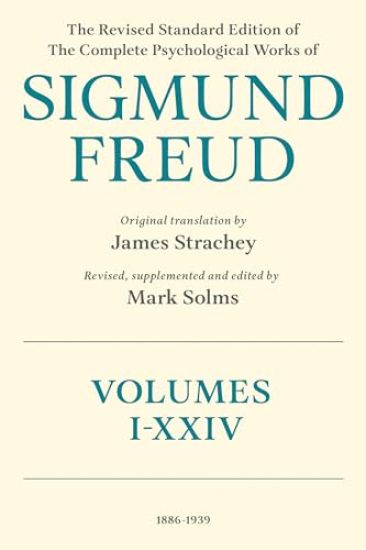
The Revised Standard Edition of the Complete Psychological Works of Sigmund Freud
Sigmund Freud; James (TRN) Strachey; Mark (TRN) Solms
Rowman Littlefield Pub Inc
2024
sidottu
R ussissez votre bac de philosophie 2024 gr ce notre tude du psychanalyse Sigmund Freud R dig e de mani re claire et pr cise, cette analyse philosophique est con ue pour aider l'ensemble des lyc ens. Gr ce notre travail ditorial, les points suivants n'auront plus aucun secret pour vous: la biographie du psychanalyse, l' tude de sa pens e, l'analyse de ses th mes principaux et le courant philosophique auquel il appartient.

Un comportamiento del ser humano en materia sexual es a menudo un prototipo del conjunto de sus otros modos de reacci n en la vida." Tres Ensayos para una Teor a Sexual" es una obra magistral de Sigmund Freud, el padre del psicoan lisis, cuyo legado contin a resonando en la psicolog a moderna y m s all . En este texto revolucionario, Freud aborda con profundidad y perspicacia las complejidades m s ntimas y fundamentales de la sexualidad humana desde una perspectiva psicoanal tica. Con una mezcla nica de erudici n cient fica y visi n cl nica, explora las profundidades del inconsciente para arrojar luz sobre las ra ces m s profundas de nuestros deseos y conflictos sexuales. Desde las perversiones sexuales m s inusuales hasta la sexualidad infantil y el complicado proceso de la pubertad, Freud examina cada aspecto con detalle y meticulosidad, desafiando las convenciones sociales y culturales de su tiempo y ofreciendo una visi n nica y reveladora del desarrollo sexual humano. A trav s de su trabajo pionero, Freud no solo revoluciona nuestra comprensi n de la sexualidad, sino que tambi n allana el camino para una comprensi n m s profunda de la psique humana y su influencia en el comportamiento y la experiencia individual. Este libro sigue siendo una lectura fundamental para aquellos interesados en explorar las complejidades de la mente y el comportamiento humanos, una obra que desaf a, provoca y enriquece nuestra comprensi n de nosotros mismos y de la naturaleza humana en su totalidad. Extracto: PARA explicar las necesidades sexuales del hombre y del animal supone la Biolog a la existencia de un instinto sexual, del mismo modo que supone para explicar el hambre de un instinto de nutrici n. Pero el lenguaje popular carece de un t rmino que corresponda al de hambre en lo relativo a lo sexual. La ciencia usa en este sentido la palabra libido. La opini n popular posee una bien definida idea de la naturaleza y caracteres de este instinto sexual. Se cree firmemente que falta en absoluto en la infancia; que se constituye en el proceso de maduraci n de la pubertad, y en relaci n con l, que se exterioriza en los fen menos de irresistible atracci n que un sexo ejerce sobre el otro, y que su fin est constituido por la c pula sexual o a lo menos por aquellos actos que a ella conducen. Existen, sin embargo, poderosas razones para no ver en estos juicios m s que un reflejo harto infiel de la realidad. Analiz ndolos detenidamente, descubrimos en ellos multitud de errores, inexactitudes e inadvertencias.

Un comportamiento del ser humano en materia sexual es a menudo un prototipo del conjunto de sus otros modos de reacci n en la vida." Tres Ensayos para una Teor a Sexual" es una obra magistral de Sigmund Freud, el padre del psicoan lisis, cuyo legado contin a resonando en la psicolog a moderna y m s all . En este texto revolucionario, Freud aborda con profundidad y perspicacia las complejidades m s ntimas y fundamentales de la sexualidad humana desde una perspectiva psicoanal tica. Con una mezcla nica de erudici n cient fica y visi n cl nica, explora las profundidades del inconsciente para arrojar luz sobre las ra ces m s profundas de nuestros deseos y conflictos sexuales. Desde las perversiones sexuales m s inusuales hasta la sexualidad infantil y el complicado proceso de la pubertad, Freud examina cada aspecto con detalle y meticulosidad, desafiando las convenciones sociales y culturales de su tiempo y ofreciendo una visi n nica y reveladora del desarrollo sexual humano. A trav s de su trabajo pionero, Freud no solo revoluciona nuestra comprensi n de la sexualidad, sino que tambi n allana el camino para una comprensi n m s profunda de la psique humana y su influencia en el comportamiento y la experiencia individual. Este libro sigue siendo una lectura fundamental para aquellos interesados en explorar las complejidades de la mente y el comportamiento humanos, una obra que desaf a, provoca y enriquece nuestra comprensi n de nosotros mismos y de la naturaleza humana en su totalidad. Extracto: PARA explicar las necesidades sexuales del hombre y del animal supone la Biolog a la existencia de un instinto sexual, del mismo modo que supone para explicar el hambre de un instinto de nutrici n. Pero el lenguaje popular carece de un t rmino que corresponda al de hambre en lo relativo a lo sexual. La ciencia usa en este sentido la palabra libido. La opini n popular posee una bien definida idea de la naturaleza y caracteres de este instinto sexual. Se cree firmemente que falta en absoluto en la infancia; que se constituye en el proceso de maduraci n de la pubertad, y en relaci n con l, que se exterioriza en los fen menos de irresistible atracci n que un sexo ejerce sobre el otro, y que su fin est constituido por la c pula sexual o a lo menos por aquellos actos que a ella conducen. Existen, sin embargo, poderosas razones para no ver en estos juicios m s que un reflejo harto infiel de la realidad. Analiz ndolos detenidamente, descubrimos en ellos multitud de errores, inexactitudes e inadvertencias.


"Slova vyzyvajut affekty i javljajutsja obschepriznannym sredstvom vozdejstvija ljudej drug na druga". Zigmund Frejd (1856-1939) - znakovaja figura v mire psikhologii, vsemirno izvesten kak osnovatel teorii psikhoanaliza. V knige "Vvedenie v psikhoanaliz" sobrany lektsii avtora, kotorye posvjascheny oshibochnym dejstvijam, snovidenijam i obschej teorii nevrozov." Psikhoanaliz predlagaet psikhiatrii nedostajuschuju ej psikhologicheskuju osnovu, blagodarja kotoroj stanovitsja ponjatnym sochetanie somaticheskogo narushenija s psikhicheskim".